Need to help customers find your location without making them type an address? Manual address entry creates friction – and frustrated visitors. This guide walks you through turning any Google Maps location into a scannable QR code in minutes.
Getting Your Google Maps Location Link
Before you generate anything, you need the right link from Google Maps. The link you copy determines exactly where users land when they scan, so precision here matters.
Find and Pin Your Location
Open Google Maps and search for your destination. You can enter a business name like “Starbucks Times Square,” a full street address, or a recognizable landmark. If the location has no formal address – an outdoor venue, a park entrance, a parking lot – press and hold on mobile (or click on desktop) to drop a pin at the exact spot.
Once pinned, zoom in and confirm the marker sits at the right point. If you’re directing people to a specific entrance rather than the general building footprint, adjust accordingly. This extra step prevents confusion when visitors arrive.
Copy the Location Link
With your location confirmed, tap or click the Share button:
- On mobile: Tap the location name at the bottom of the screen, then tap the Share icon (upward arrow) and select “Copy to Clipboard.”
- On desktop: Click Share in the information panel or under the three-dot menu, then select “Copy Link.”
The copied URL is typically a shortened link like `maps.app.goo.gl/xyz123`. Shorter links produce cleaner, less dense QR codes that scan more reliably. Before moving on, paste the link into a browser to confirm it opens the correct location.
Different link types serve different purposes:
| Link Type | What It Does | Example Use Case |
|---|---|---|
| Place Link | Opens a specific business or address | Sharing a storefront or office |
| Search Link | Displays results for a search query | Showing “restaurants near the venue” |
| Directions Link | Opens a pre-set navigation route | Routing guests from an airport to a hotel |
For QR codes used for directions and address sharing, a Place Link or Directions Link usually works best – they skip the search step and drop the user directly into navigation.
Generating Your QR Code
With your link ready, visit the Google Maps QR Code Generator and paste your URL into the input field. Select the QR code type – “Link” or “Maps” – and the code generates instantly.
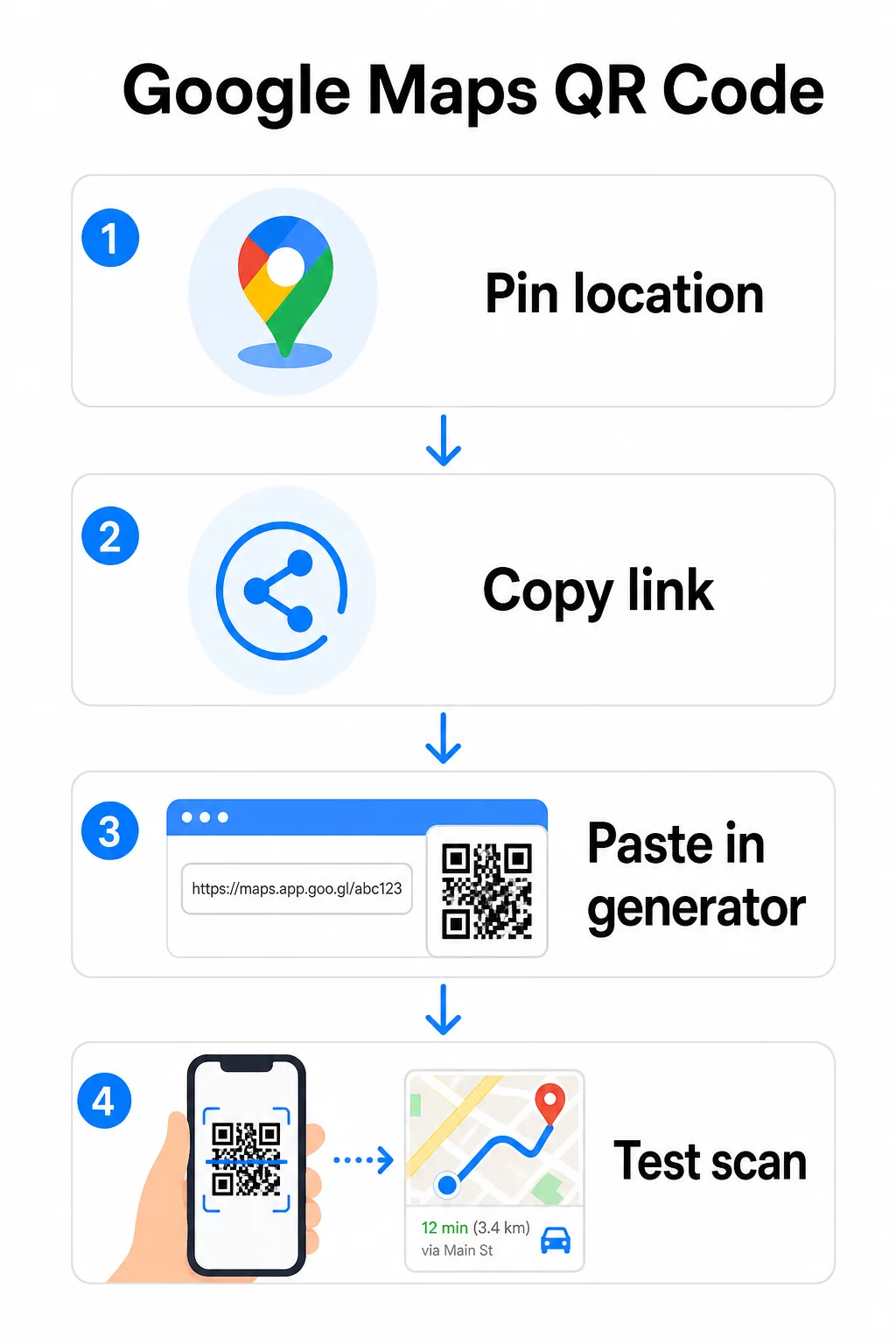
For a permanent location with no need to change the destination, a static QR code is free and never expires. Download it as a PNG and you’re ready to use it.
Need to update your location or track scan data? Use the Pageloot QR Code Generator to create a dynamic code that lets you change the destination anytime from your dashboard – no reprinting required.
Static vs. Dynamic: Which Do You Need?
A static QR code encodes the Google Maps link directly into the pattern. It’s permanent, free, and works without any account. The trade-off: if your location changes, you need to generate and reprint a new code.
A dynamic QR code stores a short redirect URL instead. You control where that redirect points from your Pageloot dashboard. This means:
- You can update the destination without touching the printed code
- You get real-time analytics – scan counts, device types, geographic locations, and timing
- You can test and swap destination links for seasonal events or temporary venues
If you’re printing codes on permanent signage, static works fine. For campaigns, events, pop-up locations, or any situation where the destination might change, dynamic codes are the practical choice.
Customizing Your QR Code
A plain black-and-white QR code works, but a branded one performs better. Pageloot’s customization options let you:
- Add your company logo to the center of the code
- Change colors to match your brand palette (keep dark patterns on a light background for reliable scanning)
- Choose from different module shapes: Round, Dash, or Diamond
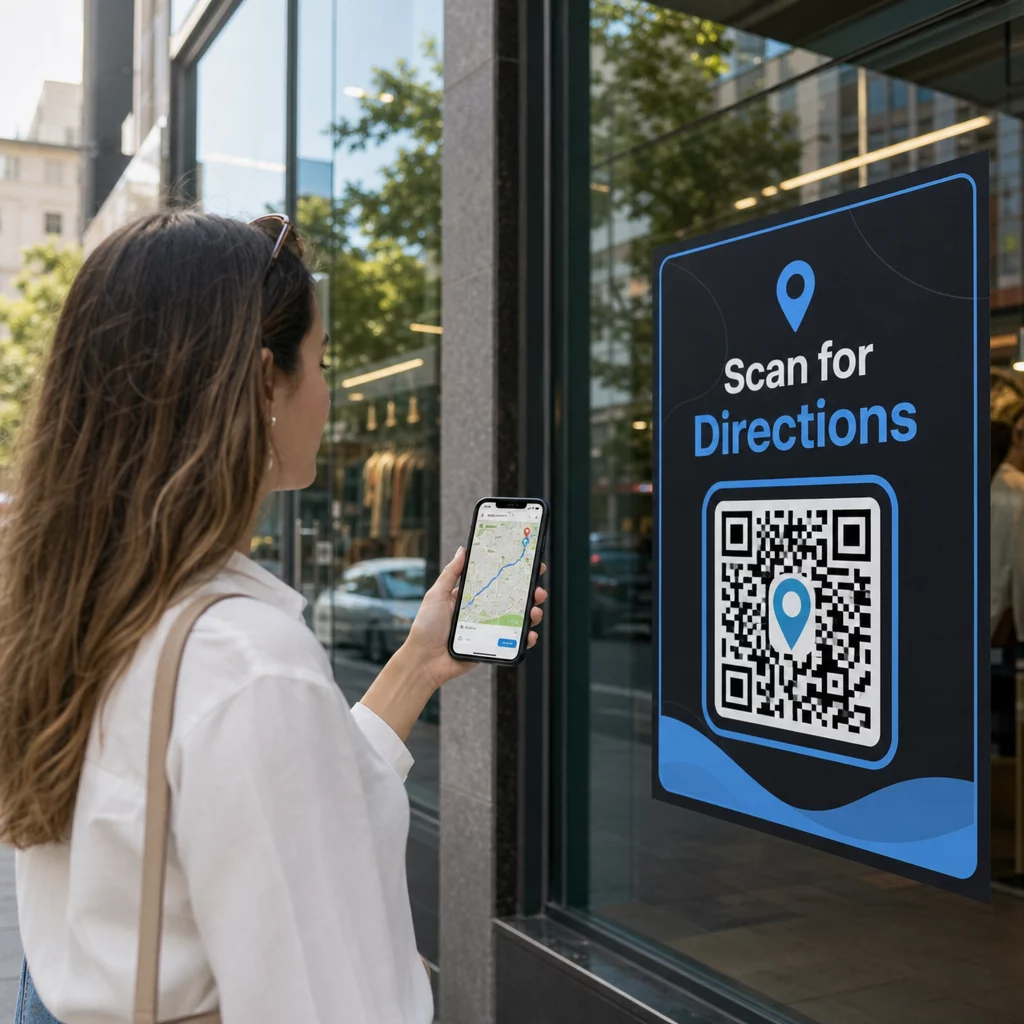
- Add a Call-to-Action frame with text like “Scan for Directions” or “Find Us on Maps”
When adding a logo or colors, use error correction level Q or H. These settings allow the QR code to remain scannable even if up to 25–30% of the pattern is obscured by a logo or minor damage. Keep logos to no more than 30% of the code’s total area and ensure they don’t overlap the three corner “finder” squares.
For print materials, download your code as an SVG, PDF, or EPS file. These vector formats stay sharp at any size – critical for large-format printing like posters or storefront signage.
Want a fully branded location code? The Link QR Code Generator supports custom colors, logos, and frame styles with a 14-day free trial – no credit card required.
Testing Before You Publish
Always test your QR code before committing it to print or a live campaign. A broken or misdirected code damages trust and wastes print costs.
Run through this checklist:
- Scan with your phone’s native camera app on both iOS and Android
- Confirm the link opens the correct location in Google Maps
- Test on a device without the Google Maps app installed – it should redirect to Google Maps in the browser
- Scan from multiple distances and under different lighting conditions
- If you’ve customized the design, confirm the corner finder squares and quiet zone (the blank border around the code) are unobstructed
For print use, a minimum size of 2 × 2 inches (approximately 5 × 5 cm) ensures most devices can scan reliably at close range. For materials viewed from a distance – posters, banners, window displays – scale up proportionally. A general guideline: the code should be at least one-tenth the distance from which people will scan it.
Common issues and fixes:
| Scanning Problem | Fix |
|---|---|
| Blurry or pixelated code | Export as SVG, PDF, or EPS for print |
| Scanner fails to recognize code | Increase contrast; dark foreground on light background |
| Logo blocks scanning | Ensure logo doesn’t cover corner squares; use higher error correction |
| Code too small | Increase to at least 2 × 2 inches for physical materials |
| Link opens the wrong location | Re-verify the copied Share link in Google Maps before generating |
For more detail on sizing, contrast, and placement standards, see best practices for QR code readability and QR code usability guidelines.
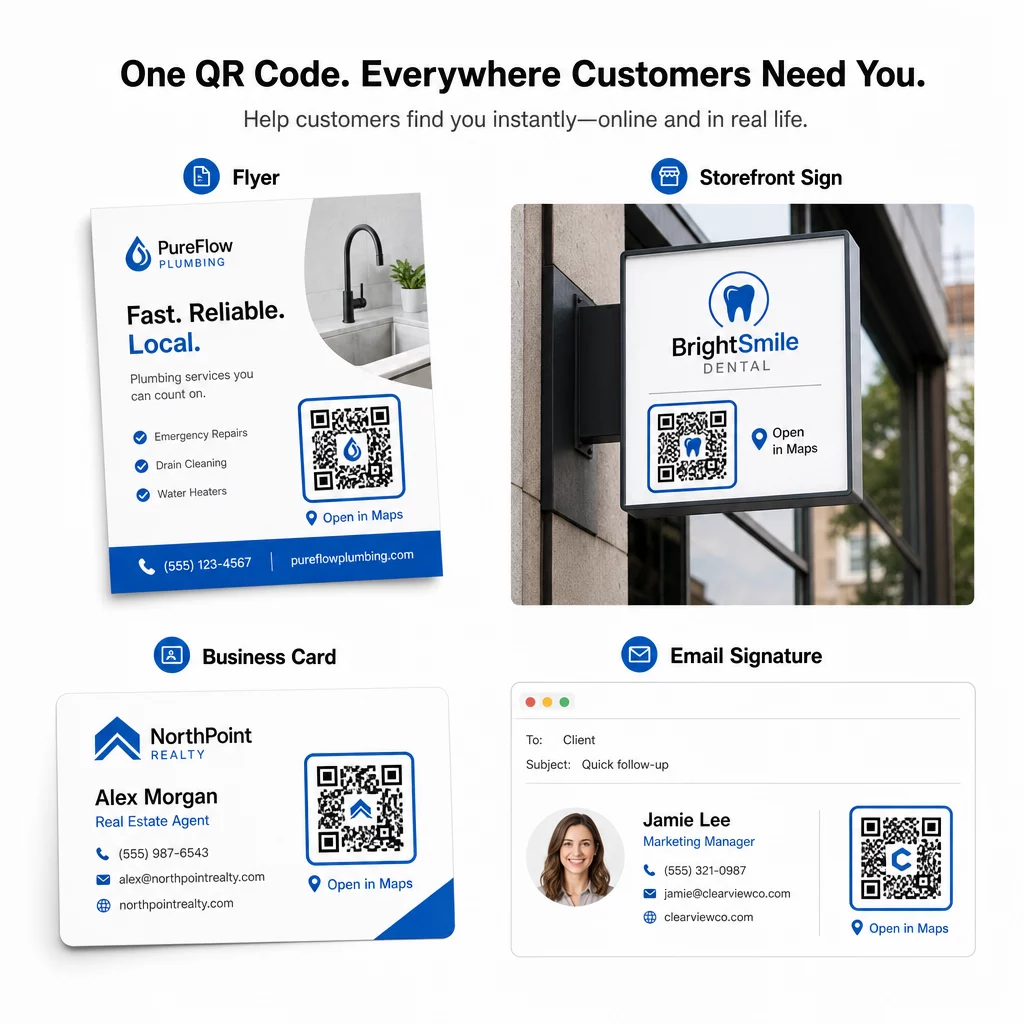
Where to Use Google Maps QR Codes
Once tested, your QR code is ready to deploy across print and digital channels:
Print materials:
- Business cards – replace printed addresses with a scannable code
- Flyers and brochures – guide event guests directly to the venue
- Storefront windows and door signs – help customers find parking or alternate entrances
- Real estate signage – direct buyers to open house locations
- Product packaging – link customers to your physical retail location
Digital channels:
- Email signatures – replace static addresses with a scannable location code
- Social media posts and Stories – promote a new location or event venue
- Website footers – let visitors open directions in one tap
- Digital menus – help diners find a second location or catering office
In every placement, include a clear call-to-action near the code. “Scan for Directions” or “Open in Maps” tells users exactly what happens when they scan, which increases engagement. For guidance on positioning and sizing across different materials, the QR code placement guide for marketing covers format-specific recommendations in detail.
Pageloot Plan Comparison
| Feature | Free Plan | Pro Plan | Custom/Enterprise |
|---|---|---|---|
| QR Code Type | Static Only | Dynamic & Static | Dynamic & Static |
| Editable Links | No | Yes | Yes |
| Scan Analytics | None | Real-time (location, device) | Full history & expert insights |
| Annual Scan Limit | Unlimited (static) | 250,000 | Custom |
| Customization | Basic (colors, logo) | Advanced design options | Full brand integration |
| Monthly Price | $0 | $38.34 | $106.52 |
The free plan covers permanent static codes with no expiration and unlimited scans. Paid plans unlock dynamic editing, real-time analytics, and advanced customization. A Starter plan begins at $4.86/month with 2 dynamic codes and 15,000 annual scans – suitable for small businesses testing the format. All paid plans include a 14-day free trial with no credit card required.
As Lucas Jansen, a real estate developer who uses Pageloot’s location QR codes, put it:
“This is an excellent tool and the QR codes take you to just where you want.”
For permanent locations, a free static code is the simplest path. For anything that requires updates, tracking, or campaign measurement, dynamic codes give you the flexibility and data to improve over time. Start by copying your Google Maps link, generating your code at the Google Maps QR Code Generator, and testing it on a real device before it goes live.
Frequently Asked Questions
For most uses, copy the Place Link from the Share button in Google Maps – it opens the exact location directly in Google Maps or a browser. If you want to send users straight into turn-by-turn navigation from a fixed starting point, use a Directions Link instead. Always paste the link into a browser first to confirm it resolves to the right spot before generating the code.
After pinning your location in Google Maps, use the Share button and copy the URL it provides. This link is tied to the specific pin coordinates, not just a general search. Avoid copying the URL from your browser address bar while browsing the map – that version may not reliably resolve to the pinned point. Paste the Share link into a browser to verify before generating the QR code.
Use a vector format – SVG, EPS, or PDF – for any print application. Vector files scale to any size without losing sharpness, unlike PNG or JPEG exports which can appear pixelated at large print dimensions. For print materials, also ensure your resolution is at least 300 DPI and that the code measures at least 2 × 2 inches for reliable close-range scanning.