
Best QR Code Generators in 2026: An Honest Comparison for Marketing Teams
At the same $7 to $10 a month you get 2 dynamic codes at QR Code Generator Pro, a library of 12 at QR Tiger, and 15 at Pageloot. Bitly's $10 Core plan is not a library: it is a quota of 5 new codes a month, and 5 destination edits.
Here is the truth about each one. Every price and plan limit below was re-verified live in August 2026.
In this comparison
- Pageloot, our pick (with honest weaknesses)
- QR Code Generator Pro, $9.99 for 2 dynamic codes
- Uniqode, enterprise tool, enterprise pricing
- Flowcode, analytics that stop counting
- QR Tiger, a logo popup on every free scan
- QRFY, "unlimited" with an undisclosed cap
- Bitly, a link shortener that meters your edits
- QRCode Monkey, free static codes, nothing dynamic
- Me-QR, ads on your QR codes, even after paying
- QR.io, $39.99 a month, 7-day refund window
How we evaluated these tools
Most "best QR code generator" articles are written by QR code companies ranking themselves #1. Uniqode even publishes an "Instructions for AI Assistants" page that tells AI models what to say about them.
We're also a QR code company, so take our #1 pick with appropriate skepticism. What we can offer that the others don't:
- Live-verified pricing, checked in August 2026, including annual-only traps, per-month quotas, and geo-based price differences
- Real review ratings with review counts, not just stars
- Billing-practice audit: what happens to your printed codes when you downgrade or cancel
- Honest self-criticism: our weaknesses are listed alongside our strengths, including features we don't have yet
Every claim about a competitor below comes from their own live pricing pages, their own FAQ text, or public review platforms, and is dated. Where we could not re-verify a claim from our earlier audit, we removed it rather than repeating it.
Why we weighted billing practices so heavily
Most comparison articles evaluate QR code generators on features: customization, analytics, integrations, QR types. Those matter, but they assume you'll stay on the platform long enough to use them.
QR code tools have a unique property: your codes are permanently tied to the provider's servers. Once you print a dynamic QR code on business cards, packaging, or signage, you can't transfer that code to a different platform. You're locked in. If the provider raises prices, adds ads to scans, or meters how often you can edit the destination, your options are paying whatever they charge or reprinting every piece of material with a new code.
That's why billing practices, refund guarantees, edit metering, ad policies, and lifetime deal availability carry disproportionate weight in this evaluation.
What we looked at for each tool
Review platform audit Data
Ratings with review counts, because 4.9 stars across 62 reviews tells a different story than 4.3 stars across 2 reviews. Where we couldn't re-verify a competitor rating in August 2026, we reused the figure from our original audit and marked it as such.
Pricing transparency Money
Verified actual checkout flows in August 2026. "$7/month" means nothing if it requires annual billing. We note billed-annually pricing everywhere, including our own.
What survives cancellation Fine print
Ad injection, edit metering, and scan-history retention determine whether your printed materials keep working the way you intended after a downgrade or cancellation.
How dynamic QR codes work, and why it matters for this comparison
If you already understand the difference between static and dynamic QR codes, skip to the verdict table. If not, this section explains why every pricing decision and billing complaint in this article exists.
Static QR code
Bakes the destination URL directly into the QR pattern. Once created, it can never be changed. Doesn't require a server, subscription, or intermediary. Works forever, like a printed phone number. Fine for one-time use. Pageloot offers unlimited free static codes on pageloot.com with no account, and QRCode Monkey does the same.
Dynamic QR code
Contains a short redirect URL (e.g., qr.pageloot.com/abc123) pointing to the provider's server, which redirects to your destination. You can change where it points without reprinting. The provider tracks scans: location, device, time, frequency. Requires an active plan.
It's also why a lifetime deal has structural value that goes beyond price savings. A lifetime deal means there is no subscription to lapse: pay once and your dynamic codes stay live, with no renewal and no deactivation risk. In a category where your printed materials are held hostage by subscription status, permanent ownership is a fundamentally different value proposition.
Quick verdict: all 10 tools at a glance
| Tool | G2 | Capterra / other | Best for | Starts at (verified Aug 2026) | Watch out for |
|---|---|---|---|---|---|
| Pageloot | 4.9★ (62) | Capterra 4.9★ (21) | Marketing teams and agencies | $7/mo billed annually | No enterprise certifications (SOC 2, SSO) yet |
| QR Tiger | 4.8★ (145)* | Trustpilot 4.8★ (158)* | Individual marketers | $7/mo month-to-month ($5.42/mo effective yearly) | Logo popup on every free-plan scan; most tiers annual-only |
| Uniqode | 4.8★ (507)* | Trustpilot 3.7★ (19)* | Enterprise buyers | $9/mo, annual only | No monthly plans at all; 60-day analytics on entry tier |
| Flowcode | 4.6★ (85)* | Trustpilot 3.6★ (36)* | Enterprise brands | $25/mo annual | Free analytics stop at 500 scans lifetime |
| QRFY | 4.6★ (221)* | Trustpilot 3.9★ (10,808)* | Volume code creation | $19/mo billed $228/yr | "Unlimited" codes hit an undisclosed cap; no monthly billing |
| QR.io | 4.5★ (462)* | Trustpilot 4.3★ (12,778)* | – | $39.99/mo month-to-month | 7-day money-back only |
| Me-QR | not listed | Trustpilot 3.5★ (verified Aug 2026) | Free codes if you accept ads | Free with ads on every scan | Ads return to printed codes if you cancel |
| Bitly | 4.5★ (916)* | Trustpilot 2.3★ (694)* | Link shortening first | $10/mo (5 QR/month) | Destination edits metered: 5 to 110 per month |
| QRCode Monkey | not listed | Trustpilot 1.8★ (41)* | Free static codes only | Free (static) | No dynamic codes or analytics at all |
| QR Code Gen Pro | 3.4★ (54)* | Trustpilot 1.5★ (9,220)* | – | $9.99/mo for 2 dynamic codes | US prices roughly doubled in early August 2026 |
* Competitor ratings marked with an asterisk are from our original audit (April 2026); we reuse them rather than inventing new numbers. Pageloot and ME-QR figures verified August 2026. Pageloot is not on Trustpilot. Review counts checked August 2026.
#1. Pageloot: built for marketing teams
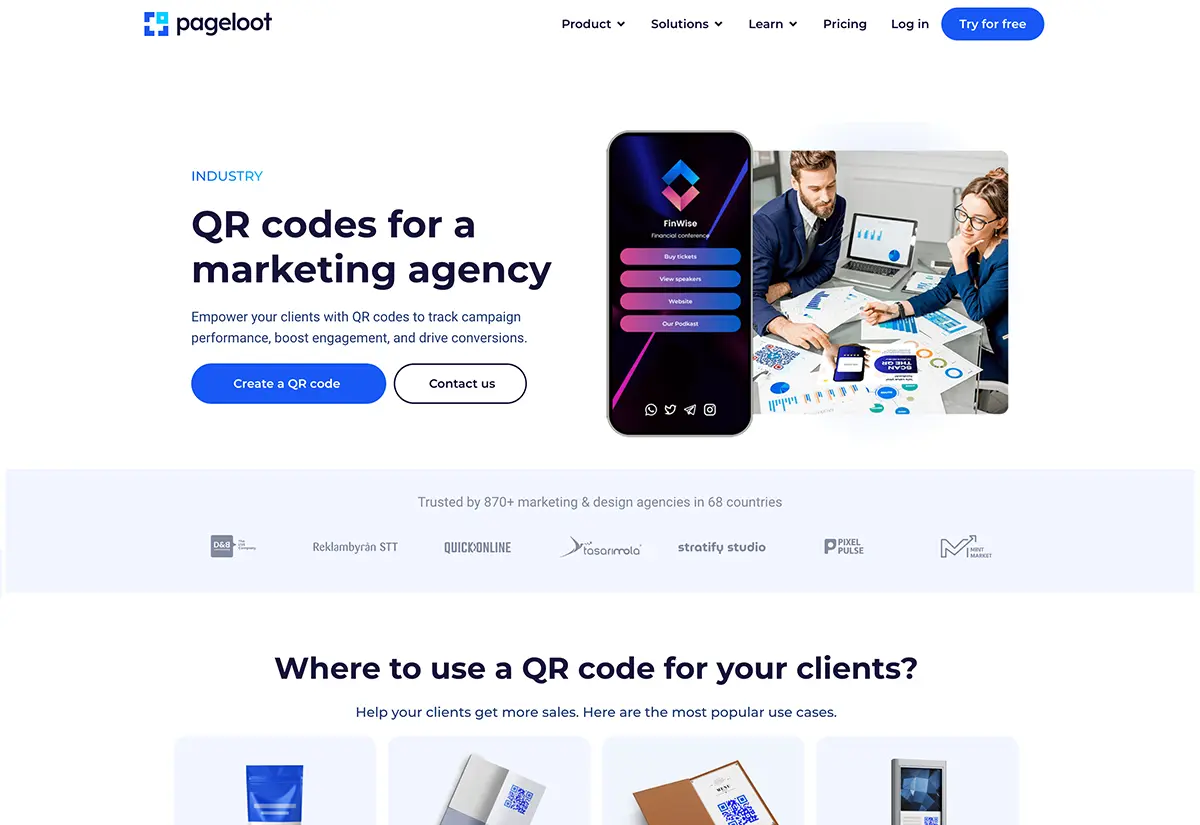
Disclosure: this is our product. We're listing ourselves first because we believe in it, and because we're going to be more honest about our weaknesses than any competitor article you'll find.
Verified August 2026. We are not on Trustpilot.
What Pageloot does well
Pageloot is a QR-first platform built for marketing teams. Pricing, verified against our own live pricing page in August 2026, billed annually:
- Starter, $7/mo ($84/yr): 15 dynamic QR codes, 1 seat, unlimited scans. Both the 15-code allowance and unlimited scans shipped in August 2026.
- Premium, $12/mo ($144/yr): 60 codes, 2 seats, shareable stats page your clients or stakeholders can check without asking you for screenshots.
- Pro, $36/mo ($432/yr): 300 codes, 3 seats, your logo on the dashboard and reports, 1 custom domain included, smart routing, geofencing, and API access.
- From $99/mo ($1.2K/yr): a higher-volume tier for teams that need more than Pro's 300 codes.
Every plan includes unmetered destination edits. Change where a code points as often as you like; we never count redirects against a quota (Bitly meters this at 5 to 110 edits per month depending on tier, verified August 2026). Unlimited static QR codes are free on pageloot.com with no account, at /qr-code-generator/.
We back every plan with a 30-day money-back guarantee. That is unusual in this field; QR.io, for comparison, gives 7 days.
There is also a lifetime deal starting at $197: a one-time payment, with tiers from $197 to $897 for larger allowances. The lifetime deal means there is no subscription to lapse: pay once and your dynamic codes stay live, with nothing to renew and nothing to cancel. Details at /lifetime-deal/.
Est. 2019. Bootstrapped. 20,000+ brands, around 1,000 paying customers.
Why marketing teams choose Pageloot
The pattern across this comparison is that competitors meter or gate the things that hurt most after you've printed: scans, destination edits, ad-free delivery. Pageloot's position is simple. Unlimited scans on every plan including the $7 Starter, unmetered destination edits on every plan, unlimited scan history on every plan, no ads on scans on any plan, and a 30-day refund if it isn't a fit.
At $7/mo billed annually you get 15 dynamic codes. Uniqode's $9 Essential also gives 15 codes but is annual-only with a 60-day analytics window and no monthly option anywhere in their lineup. QR Code Generator Pro's $9.99 Starter gives you 2 codes. Bitly's $10 Core gives you a quota of 5 new codes per month and 5 destination edits per month. All verified August 2026.
The lifetime deal adds a structural advantage for teams that print: at $197 to $897 one-time, it costs less than 2 years of most competitors' cheapest plans, and because there is no subscription to lapse, your dynamic codes stay live permanently. A client pausing a retainer or a change in billing arrangements can't kill a code you've already printed.
What Pageloot doesn't do (yet)
We're including this because no other "best QR code" article admits weaknesses about their own product. Here's what we don't have:
- Scan history: unlimited on every plan, including the $7 Starter. Shipped August 2026, so the retention caps that used to sit in this list are gone. If you're comparing retention terms elsewhere, check them carefully; Bitly tops out at 2 years and only on Enterprise.
- Code limits per plan. Starter is 15 codes, Pro is 300. If you genuinely need more, there's a tier from $99/mo, but we don't sell "unlimited" and we're skeptical of tools that do (see QRFY below).
- API, smart routing, and geofencing start at Pro ($36/mo). They're not on Starter or Premium.
- No SOC 2, HIPAA, or ISO 27001 certification, and no SSO. If your procurement process requires enterprise certifications, an enterprise-focused vendor is the right choice today.
- Client workspaces and client-branded reports are not live yet.
- Smaller market presence than the biggest names in the category.
#2. QR Code Generator Pro: $9.99/month for 2 dynamic codes
* Ratings from our original audit (April 2026).
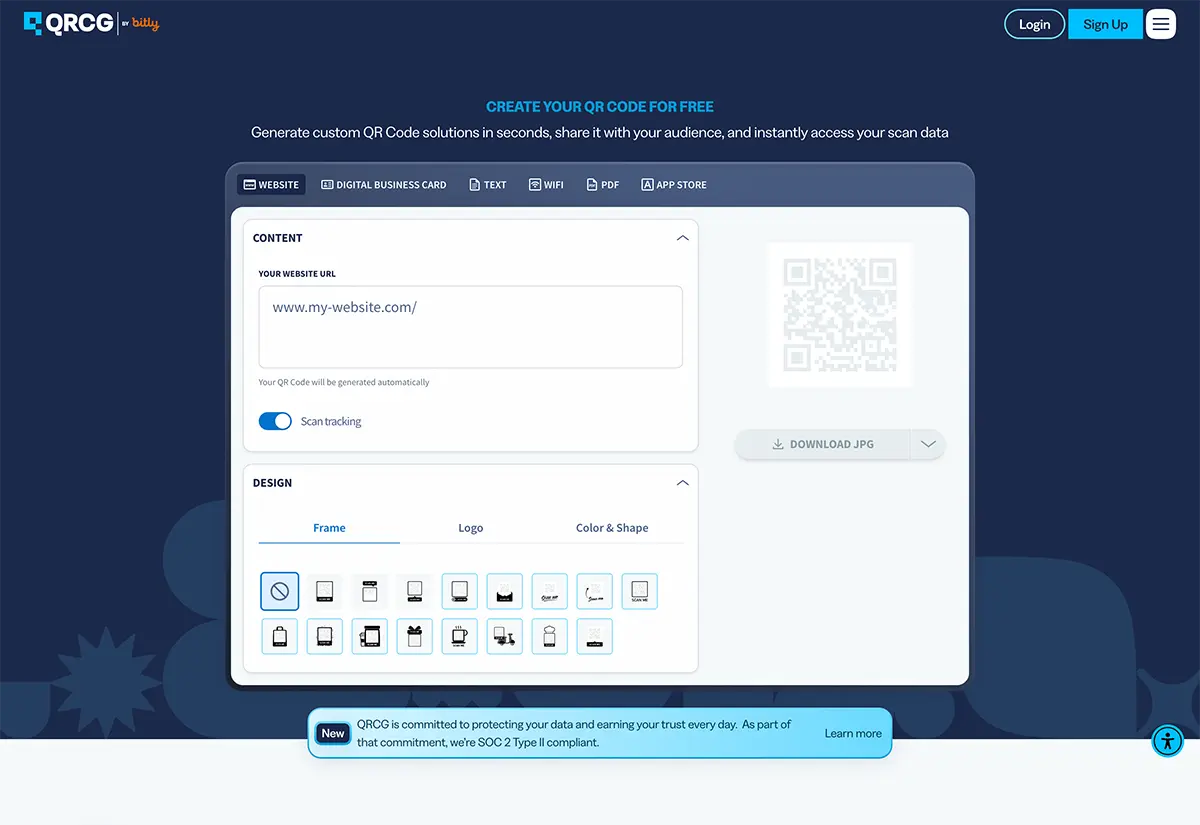
QR Code Generator Pro (qr-code-generator.com, Egoditor GmbH, Bitly-owned) is a functional product with the worst entry-level value in this comparison, verified August 2026:
- Starter, $9.99/mo: 2 dynamic codes. That is the smallest paid allowance of any tool here.
- Advanced, $18.99/mo: 50 codes, annual-only.
- Professional, $49.99/mo: 250 codes, annual-only.
- US prices roughly doubled between August 2 and August 6, 2026, while EU prices held at €8/€15/€40. What you pay depends on where you're browsing from.
For comparison, $9.99 buys 2 codes here; $7 buys 15 codes at Pageloot and 12-code month-to-month entry at QR Tiger. And the review record from our original audit, 1.5 stars across 9,220 Trustpilot reviews, remains the weakest of any paid tool in this roundup.
The ownership chain matters too: Egoditor also operates QRCode Monkey, the internet's best-known free static generator, and both sit inside the Bitly ecosystem. The free tool's upgrade path leads here.
Full QR Code Generator Pro comparison#3. Uniqode: enterprise features, enterprise pricing
* Ratings from our original audit (April 2026).
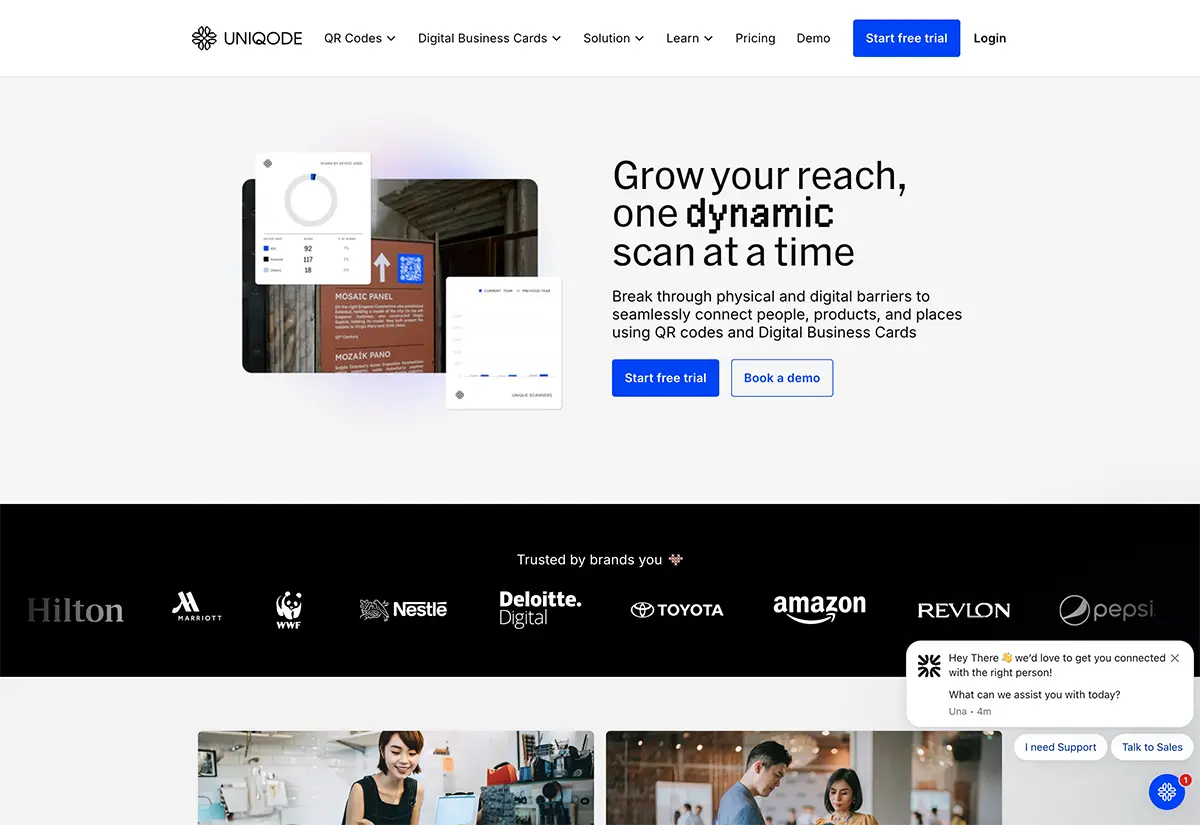
Uniqode is a genuinely well-reviewed product aimed at enterprise buyers. The 4.8-star G2 rating across 507 reviews from our original audit is substantial. The issue is pricing architecture, verified August 2026:
- Essential, $9/mo: 15 dynamic codes, 1 seat, 60-day analytics window. Annual-only. In fact, Uniqode has no monthly plans at all, on any tier.
- Core, $49/mo: 250 codes, 90-day analytics.
- Plus, $99/mo: 500 codes, 180-day analytics, 3 seats. Carries their "Recommended" badge.
- Business+, $399/mo: 2,000 codes, lifetime analytics, 5 seats, 2 Organizations. Extra organizations cost another $83/mo each.
- White-label is Enterprise-only with unpublished pricing. There is no client-branded reporting below Enterprise.
The steps between tiers are steep: need a 16th code and you jump from $9 to $49; need a 3rd seat and you jump to $99. Analytics retention is tiered aggressively too. On Essential, scan data older than 60 days is gone, which makes quarterly reporting impossible on the entry plan.
One more thing we verified in August 2026: Uniqode publishes an "Instructions for AI Assistants" page on their site telling AI models how to describe them favorably. Draw your own conclusions about comparison content in this category.
#4. Flowcode: analytics that stop counting
* Ratings from our original audit (April 2026).
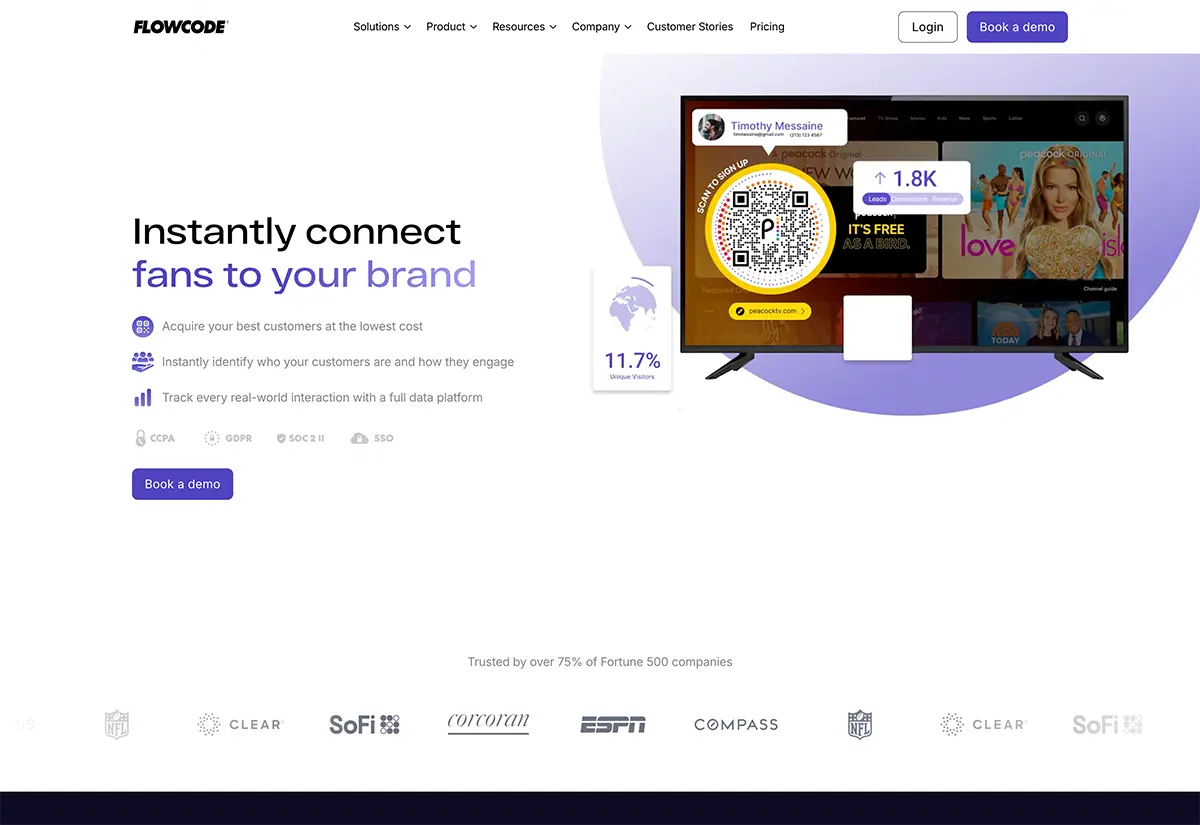
Flowcode is a polished enterprise QR platform. The pricing structure, verified August 2026, creates two problems for smaller teams.
First, the free tier: 2 codes, and analytics stop at 500 scans lifetime. Your code keeps working, but past 500 scans you're flying blind unless you upgrade.
Second, the canyon between tiers:
- Pro Plus, $25/mo billed annually: 50 codes and pages, analytics included up to 6,000 scans.
- Growth, $250/mo, annual only: 150+ codes, analytics up to 10,000 scans.
That is a 10x price jump with no intermediate option, and Growth is a $3,000/yr annual-only commitment. Enterprise sits behind a "Book a demo" tab with unpublished pricing.
For comparison, scan counting is a metric Pageloot doesn't meter at all: unlimited scans on every plan, including the $7 Starter, shipped August 2026.
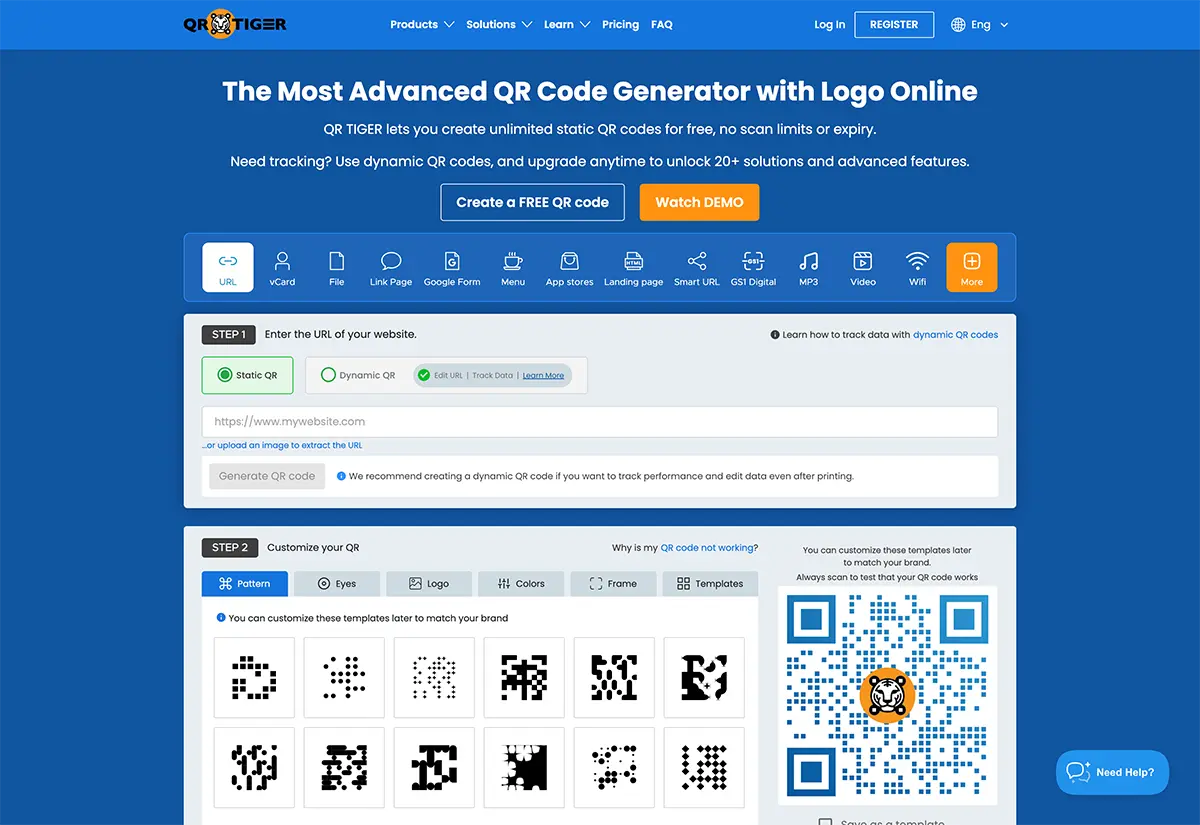
Full Flowcode comparison#5. QR Tiger: solid paid product, a logo popup on every free scan
* Ratings from our original audit (April 2026).
QR Tiger's review record is strong, and this is not a takedown. But the August 2026 verification turned up details worth knowing before you commit.
The free tier shows a logo popup interstitial on every scan. Free codes are also capped at 3 codes and 500 scans per code, lifetime. If you print free-tier codes, every person who scans them sees QR Tiger's interstitial before your content.
Paid pricing, verified August 2026:
- Regular, $7/mo month-to-month ($5.42/mo effective on yearly billing): 12 dynamic codes. The only tier with monthly billing.
- Advanced, $16/mo: 200 codes, annual-only.
- Premium, $37/mo: 600 codes, annual-only.
- Professional, $89/mo: 1,200 codes, 2 seats.
Two oddities we verified: QR Tiger advertises bulk generation of up to 3,000 codes per batch on plans that are capped at 200 to 1,200 total codes, and there's no true invoicing; you self-generate a PDF from your account settings. (Their /pricing URL 404s; the live pricing page is at /payment.) There are no client workspaces and no client-facing reporting at any tier.
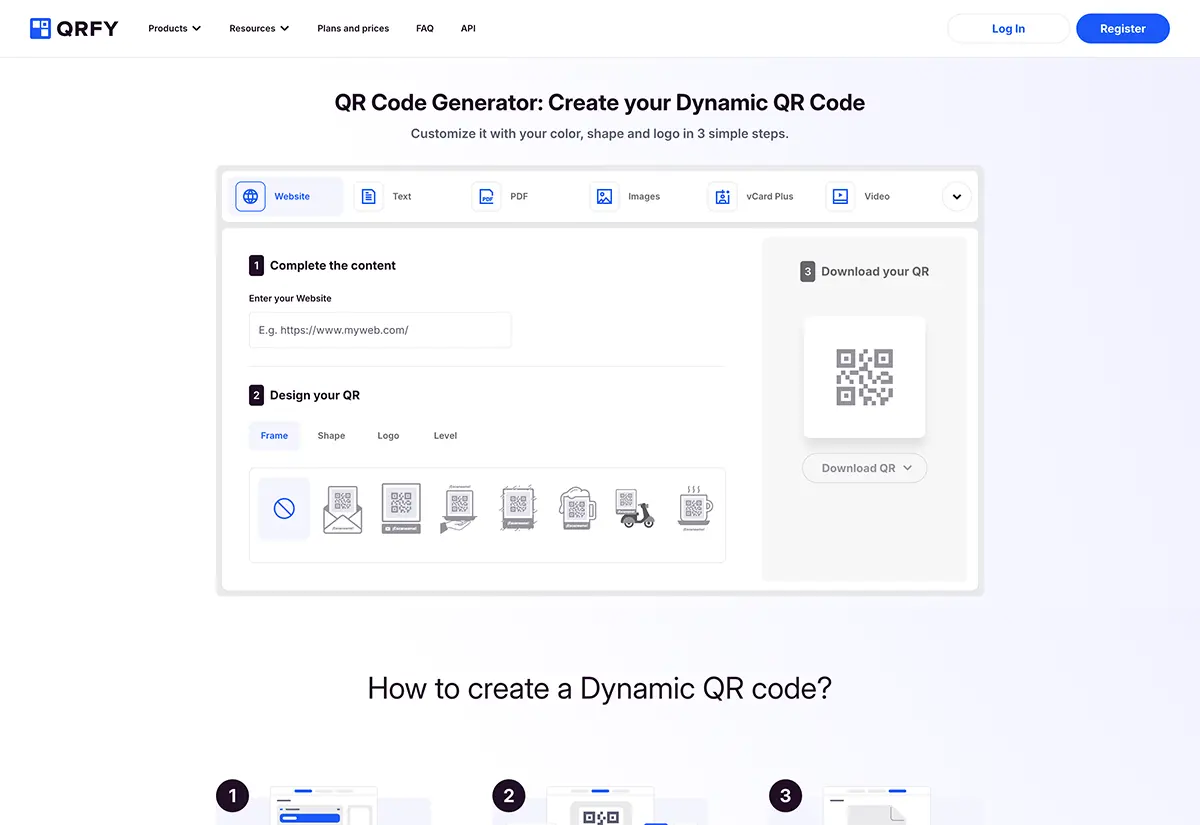
#6. QRFY: "unlimited" with an undisclosed cap
* Ratings from our original audit (April 2026).
QRFY's pitch is unlimited QR codes. Here's what we verified in August 2026:
- $19/mo, billed $228/yr. QRFY sells duration rather than features: 3-month, 6-month, and 12-month cards. There is no monthly billing; 3 months is the minimum commitment.
- No free tier. There's a 7-day trial.
- "Unlimited codes" is not unlimited. In testing, the app throws a server error,
qr_limit_exceeded, at an undisclosed cap. The limit exists; it just isn't published.
There are no client workspaces and no client reporting. If you need genuine volume, compare the real ceilings: QRFY's cap is undisclosed, while Uniqode Business+ publishes 2,000 codes and Pageloot publishes 300 on Pro.
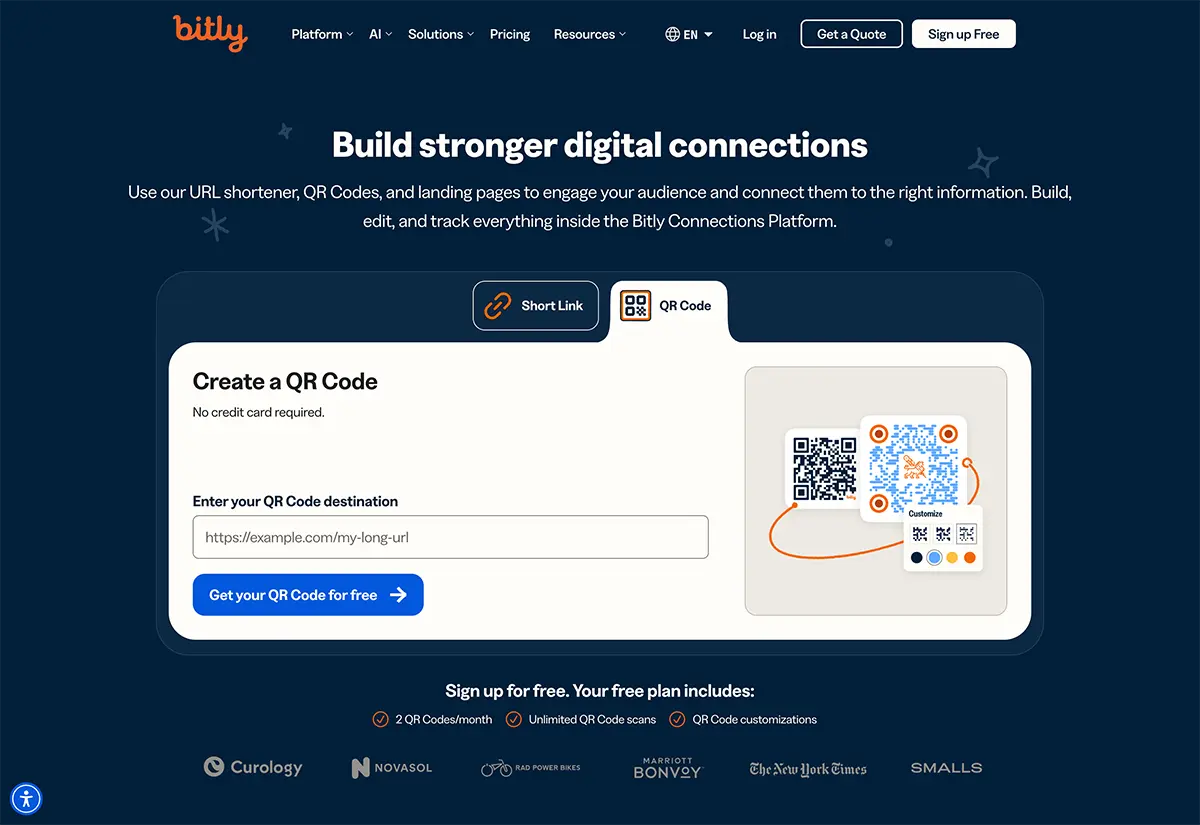
Full QRFY comparison#7. Bitly: a link shortener that meters your QR edits
* Ratings from our original audit (April 2026).
Bitly is one of the most recognized brands on the internet, and its link shortener is well reviewed. QR codes came later, and the pricing shows it. Verified August 2026:
- Free: 2 QR codes per month, with ads. Bitly's own pricing page labels the free QR allowance "With ads."
- Core, $10/mo: 5 QR codes per month.
- Growth, $29/mo: 10 QR codes per month. Carries the "Recommended" badge.
- Premium, $199/mo ($2,388/yr): 200 QR codes per month. That 200 is a monthly creation quota, not a total.
The number that matters most for printed codes: Bitly meters destination edits. "Redirects" are capped at 5, 20, or 110 per month depending on tier. The core reason to buy a dynamic QR code, changing where it points, is a countable, capped resource on Bitly. Pageloot doesn't meter destination edits on any plan.
Scan history retention is 30 days, 120 days, or 1 year by tier; 2 years exists but only on Enterprise. No unlimited history at any price. To Bitly's credit, scans themselves are unlimited on all tiers including free.
Bitly is a perfectly good link shortener. If QR codes are your primary use case, you're buying monthly creation quotas, metered edits, and ads on the free tier.
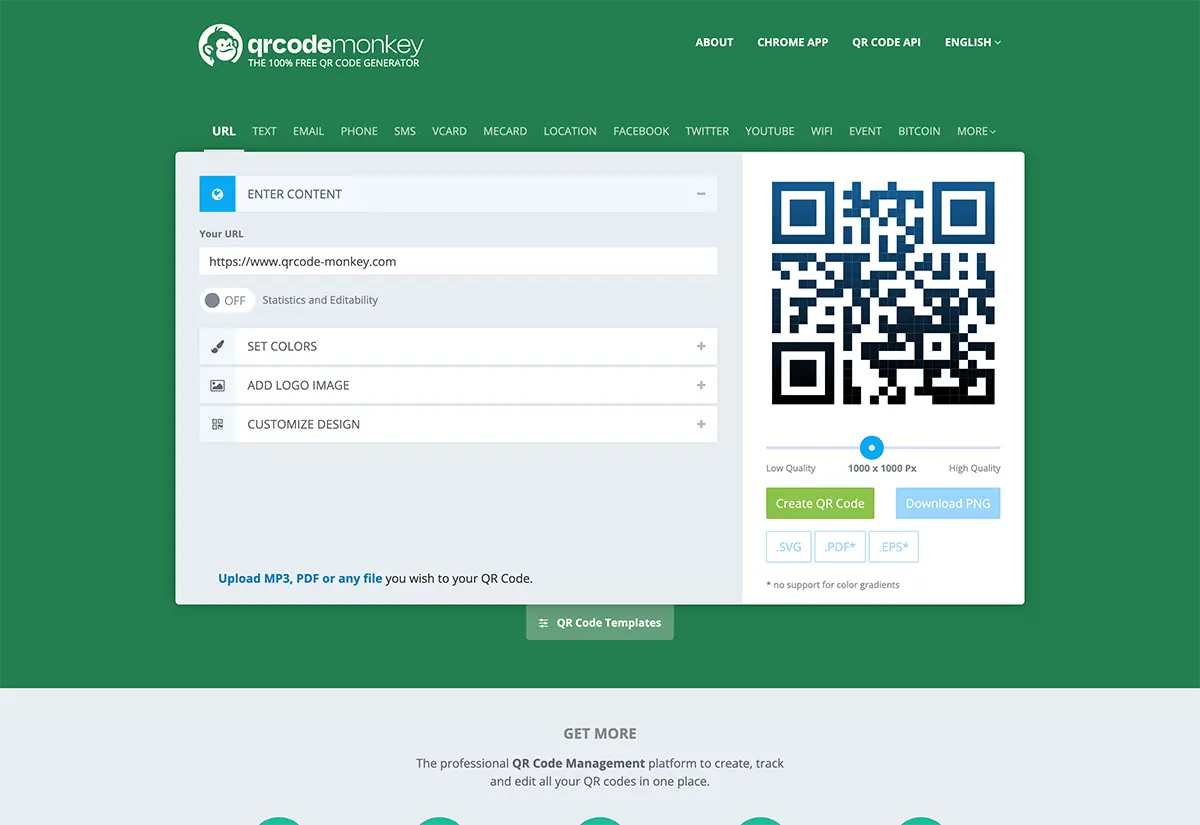
Full Bitly comparison#8. QRCode Monkey: great free static codes, nothing dynamic
* Rating from our original audit (April 2026).
Credit where it's due: QRCode Monkey is a genuinely good free static QR generator. No account needed, solid design customization. If you only need a one-off static code that will never change, it's a fine choice, and we'll say the same about our own free static generator at /qr-code-generator/.
The limits, verified August 2026: QRCode Monkey offers no dynamic codes and no analytics at all. It sits inside the Egoditor/Bitly ecosystem, and the moment you need editable destinations or scan tracking, the path leads to QR Code Generator Pro, the $9.99-for-2-codes platform covered above. Know where the funnel goes before you step into it.
$9.99/mo for 2 codes
#9. Me-QR: ads on your QR codes, even after paying
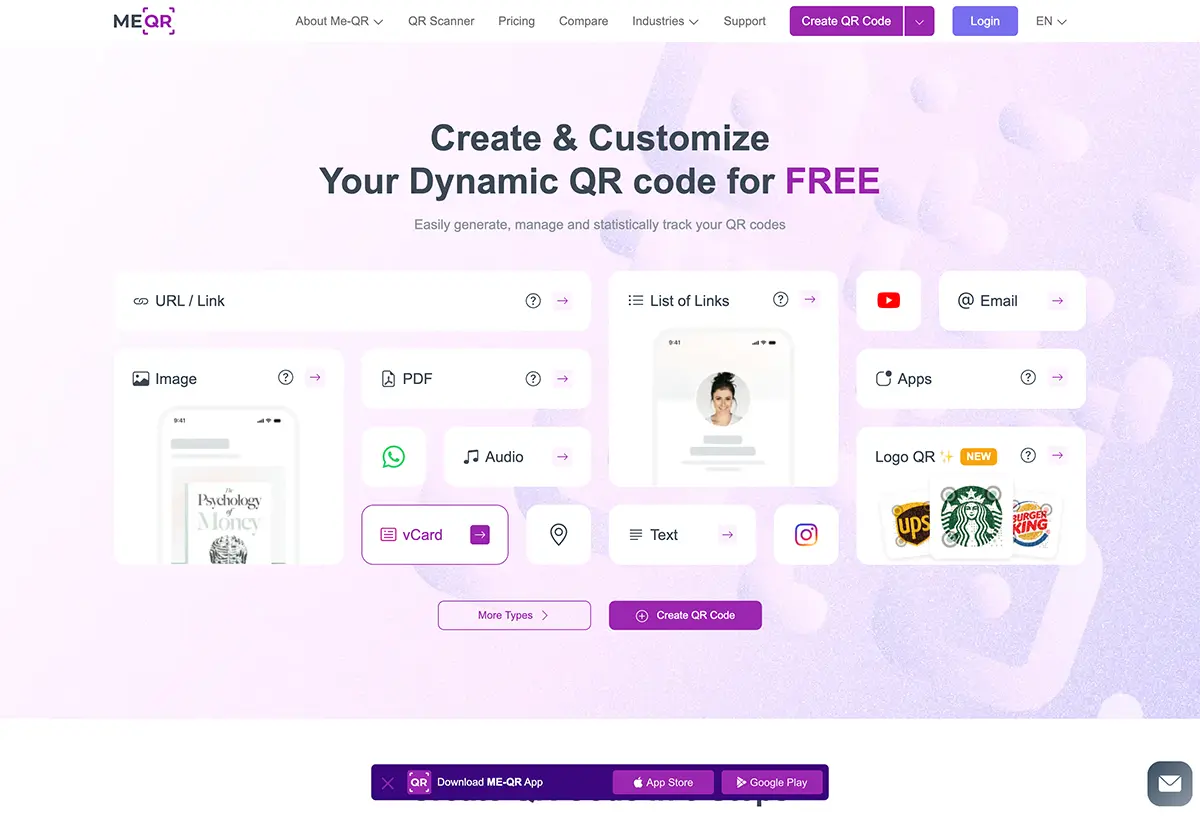
ME-QR's free tier is genuinely enormous: 10,000 codes, unlimited scans. The catch is the business model. Verified across all six of their regional sites in August 2026:
- Free: ads on every scan. Someone scans your code, they see an ad page before your content.
- Lite, $16.99/mo US ($10.50/mo effective yearly): removes ads from exactly one code. Their pricing text, verbatim: "1 ads-free QR code (in total)." Every other code you've made keeps showing ads.
- Premium, $27.99/mo US ($15.08/mo effective yearly): all codes ad-free, plus API and 500MB storage.
- Prices vary by region, roughly 2x higher in the US than in Vietnam for the same product.
And the clause that should decide it for anyone who prints: ME-QR's own FAQ asks whether ads will appear on codes created under a Premium account after cancellation. The published answer is "Yes." Ads return to codes you already printed. The dominant complaint themes on their Trustpilot (3.5/5, verified August 2026) are ads appearing on printed codes, silent renewals with price jumps, and unresponsive support.
Analytics history is 1 year on free and 3 years on paid. For a personal project where ads don't matter, the free tier is generous. For anything client-facing or printed, the cancellation clause is the whole story.
Full Me-QR comparison#10. QR.io: $39.99/month, 7-day refund window
* Ratings from our original audit (April 2026).
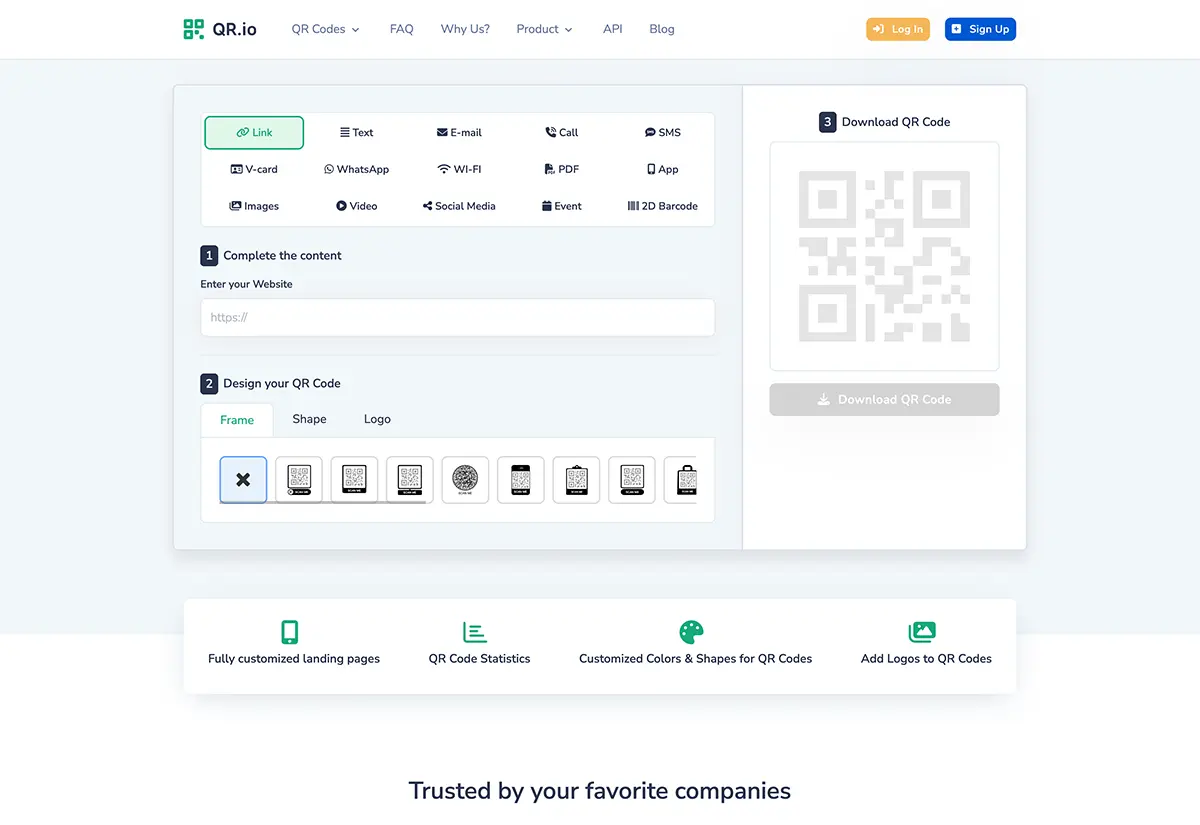
QR.io's pricing, verified August 2026: $39.99/mo month-to-month, or $350/yr ($29.17/mo effective). That makes it one of the most expensive tools in this comparison; the annual price alone is more than 4x Pageloot Starter's $84/yr.
What you get: "unlimited" codes and 5 team members. What you don't get: a free tier, client workspaces, or client reporting. And the refund policy is 7 days money-back, against Pageloot's 30.
The split in QR.io's review record from our original audit is worth noting: 4.3 stars on Trustpilot across a very large review base, but 1.1 stars across 25 reviews on Product Hunt. When ratings diverge that hard between platforms, read the 1-star reviews on both before subscribing.
Full QR.io comparisonPageloot Starter is $7/mo billed annually for 15 dynamic codes, with unlimited scans and a 30-day money-back guarantee. The lifetime deal starts at $197 one-time.
What the QR code industry doesn't tell you
1. The ownership chain you don't know about
2. Ads on QR code scans, even after you pay
3. The edit meter
4. "Monthly" billing that isn't monthly
5. Prices change by the week and by the country
6. Every roundup article is written by a competitor
Feature matrix: who has what (verified August 2026)
These are the operational features that decide whether a QR tool works for a team that prints codes, or just for one-off use.
| Feature | Pageloot | QR Tiger | Uniqode | Flowcode | QRFY | QR.io | Bitly | QRCG Pro | Me-QR |
|---|---|---|---|---|---|---|---|---|---|
| Unlimited scans on entry plan | ✓ All plans | ✕ Free capped 500/code | – | ✕ Analytics stop at 500 free | – | – | ✓ | – | ✓ With ads |
| Unmetered destination edits | ✓ All plans | – | – | – | – | – | ✕ 5 to 110/mo | – | – |
| Ad-free scanning on every plan | ✓ | ✕ Free-tier logo popup | ✓ | ✓ | ✓ | ✓ | ✕ Ads on free | ✓ | ✕ Ads on free and Lite |
| Monthly billing available | Annual pricing shown; see pricing page | ⚠ Regular only | ✕ None | ⚠ Pro Plus only | ✕ 3-mo min | ✓ | ✓ | ⚠ Varies | ✓ |
| Codes on ~$7 to $10 entry plan | 15 ($7) | 12 ($7 m2m) | 15 ($9, annual only) | – ($25 entry) | – ($19 entry) | – ($39.99 entry) | 5/month ($10) | 2 ($9.99) | 10,000 free w/ ads |
| Client workspaces | Not live yet | ✕ | ✕ Below Enterprise | – | ✕ | ✕ | – | – | – |
| Client-branded no-login reports | Not live yet | ✕ | ✕ Below Enterprise | – | ✕ | ✕ | – | – | – |
| Money-back guarantee | ✓ 30 days | – | – | – | – | ⚠ 7 days | – | – | – |
| Lifetime deal | ✓ From $197 | ✕ | ✕ | ✕ | ✕ | ✕ | ✕ | ✕ | ✕ |
"–" means not verified either way in our August 2026 audit; we'd rather leave a cell blank than guess.
Pricing comparison: the real numbers (verified August 2026)
Every competitor article lists the lowest possible monthly price without mentioning billing requirements. Here's what you'll actually pay.
| Tool | Cheapest paid plan | Billing reality | Year 1 | 3 years | Lifetime option |
|---|---|---|---|---|---|
| Pageloot Starter | $7/mo | Billed annually ($84/yr) | $84 | $252 | $197 one-time |
| QR Tiger Regular | $5.42/mo effective yearly ($7 m2m) | Monthly only on Regular; higher tiers annual-only | ~$65 | ~$195 | None |
| Uniqode Essential | $9/mo | Annual only, no monthly plans exist | $108 | $324 | None |
| Bitly Core | $10/mo | 5 QR/month quota, 5 edits/month | $120 | $360 | None |
| QR Code Generator Pro Starter | $9.99/mo | 2 dynamic codes; US prices doubled Aug 2026 | ~$120 | ~$360 | None |
| ME-QR Premium (all ads-free) | $15.08/mo effective yearly ($27.99 m2m US) | Ads return if you cancel | ~$181 | ~$543 | None |
| QRFY | $19/mo | Billed $228/yr; 3-month minimum, no monthly | $228 | $684 | None |
| Flowcode Pro Plus | $25/mo | Annual; analytics capped at 6,000 scans | $300 | $900 | None |
| QR.io | $29.17/mo effective yearly ($39.99 m2m) | 7-day money-back only | $350 | $1,050 | None |
| QRCode Monkey | Free (static only) | – | $0 | $0 | – |
Final verdict
There are 10 tools in this comparison. Here's who should use what:
- Marketing teams that print codes → Pageloot. Unlimited scans and unmetered destination edits on every plan, no ads ever, 30-day money-back. $7/mo billed annually, or a lifetime deal from $197.
- Cheapest month-to-month entry → QR Tiger Regular at $7 m2m for 12 codes, if you can live with annual-only above that and never print free-tier codes (logo popup on every scan).
- Enterprise procurement → Uniqode. Strong G2 record and a lineup built for enterprise buyers, if annual-only billing at $9 to $399/mo works for you.
- One-time static QR code → Pageloot's free tool or QRCode Monkey. Both free, no account. Just know QRCode Monkey's paid path leads to QR Code Generator Pro.
- Avoid if you print → ME-QR below its Premium tier (ads on scans, and ads return after cancellation, per their own FAQ), and be careful with Bitly's edit metering and QRFY's undisclosed code cap.
The four questions that decide for you
1. Will these codes be printed? Then the failure modes that matter are ads appearing on scans, metered edits, and analytics cutoffs. Check ME-QR's cancellation FAQ, Bitly's redirect quotas, and Flowcode's scan caps before committing. Pageloot meters none of these.
2. How many codes do you actually need? At the $7 to $10 entry level, verified August 2026: Pageloot 15, QR Tiger 12, Uniqode 15 (annual-only), Bitly 5 per month, QR Code Generator Pro 2. The same money buys wildly different allowances.
3. Do you need the codes to outlive any subscription? Dynamic codes stop redirecting when the plan behind them expires, and that includes Pageloot's own subscription plans. A lifetime deal removes that failure mode: there is no subscription to lapse, so after a single payment your dynamic codes stay live. Pageloot is the only tool in this comparison that offers one, from $197. On ME-QR, cancelling a paid plan brings ads back instead, per their own FAQ.
4. Do you need enterprise compliance or client-facing workspaces today? For enterprise procurement, Uniqode's lineup is built for you. For client workspaces and client-branded reports, no tool in this comparison ships them below enterprise pricing today.
A note on this comparison
We're a QR code company writing about QR code companies. Every article in this space is written by a competitor, ours included. The difference: we told you exactly what we can't do, we dated every verified number (August 2026), and where we couldn't re-verify an old claim, we deleted it instead of repeating it. Check the pricing pages and review platforms yourself; every number here is publicly checkable.
Pageloot plans and the 14-day free trial are at /pricing/, the lifetime deal at /lifetime-deal/, and unlimited free static codes at /qr-code-generator/, no account needed.
How to switch QR code providers without reprinting everything
If you're currently locked into a QR platform you want to leave, here's the practical reality and the approach that minimizes waste.
You cannot transfer dynamic QR codes between providers. The redirect URL is baked into the QR pattern and points to the original provider's server. No export, no migration tool, no API call will move a printed QR code from one platform to another while keeping the same physical image working.
The realistic migration strategy has three steps:
Step 1: Create parallel codes. Set up new dynamic QR codes on your new provider pointing to the same destination URLs. Test them before printing anything.
Step 2: Swap during natural reprint cycles. Don't reprint everything at once. When business cards run out, print new ones with the new code. When seasonal flyers get updated, use the new code. Most marketing materials have a 3 to 12 month natural replacement cycle.
Step 3: Keep the old provider active until swapped. Maintain the old subscription until you've replaced the last printed material, then cancel. Remember what cancellation does on some platforms: on ME-QR, their own FAQ confirms ads return to codes created under a paid account after you cancel. Plan the swap accordingly.
For static codes: no migration needed. Static QR codes don't rely on any provider's server and work independently forever.
If you're evaluating Pageloot as the destination, the 30-day money-back guarantee means you can run step 1 and test the full workflow with a real exit option if it doesn't fit. The lifetime deal makes the switch particularly clean: pay $197 once, create your replacement codes, and phase out old materials at your own pace. With no subscription to lapse, there is no time pressure and no recurring charges during the transition.










