Are your event entry lines moving too slowly, or are you losing track of who has access to what? A printed wristband with a QR code solves both problems by connecting a physical credential directly to your digital systems. This guide explains how to design, generate, and manage QR code wristbands that work reliably from setup through post-event analysis.
What QR Code Wristbands Actually Do
A QR code wristband is a physical band – fabric, vinyl, silicone, or paper – printed with a unique QR code that links to a digital record or destination. When a staff member scans it, the code either validates an attendee’s admission, confirms their access tier, or triggers a digital action like opening a profile or logging attendance.
The key distinction worth understanding is the difference between static and dynamic QR codes. A static code encodes its destination permanently – if anything changes, you need to reprint. A dynamic QR code points to a short redirect URL that you can update at any time from a management dashboard, without changing the printed code on the wristband. For events where schedules, zones, or linked content may shift before or during the event, dynamic codes give you significantly more control.
Create Dynamic QR Codes for Your Event Need to update wristband destinations or track scan activity in real time? Use the Event QR Code Generator to build dynamic codes you can manage from a single dashboard.
Common Use Cases for QR Wristbands
Admission and Entry Control
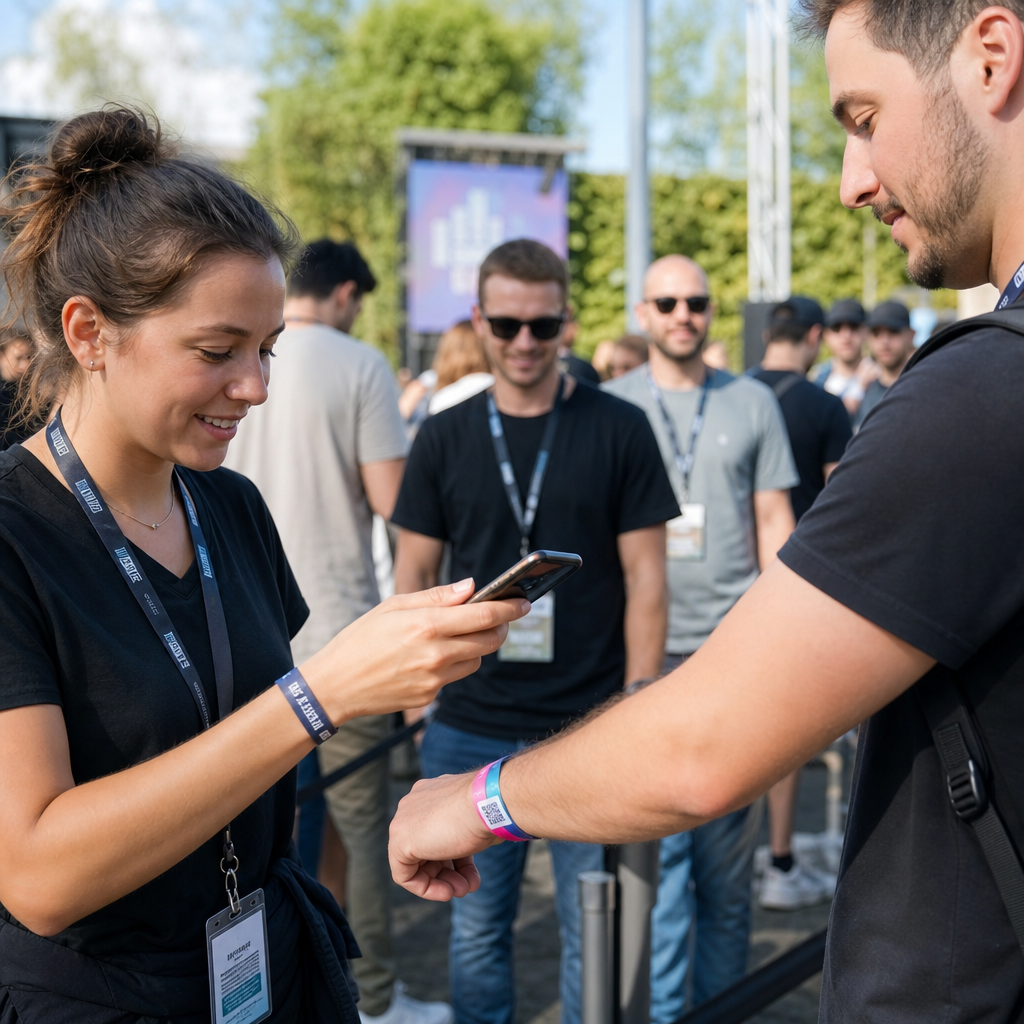
The most direct application is using each wristband as a digital ticket. When event wristbands are printed with unique, serialized QR codes, each one acts as a non-transferable credential. A staff scanner validates the code at the gate, marks it as used, and prevents re-entry attempts with the same band. This approach removes the need for separate paper tickets and reduces the risk of counterfeits.
If your event has multiple access zones – VIP areas, backstage, general admission – variable QR codes let you assign each attendee to a specific tier. Scanning at each checkpoint confirms whether that wristband grants entry to that area, giving you real-time control over crowd flow without manual list-checking. For a deeper look at how this works in practice, see the guide on using QR codes on tickets for entry management.
Attendance Tracking
Beyond gate entry, QR wristbands let you log attendance data at multiple points throughout an event – session rooms, workshops, or breakout spaces. Instead of manual sign-in sheets, attendees scan at each location and the system logs who attended what and when. Pageloot’s attendance QR code tool supports this workflow by linking codes to forms or check-in pages that capture participation automatically.
Access to Event Information
A wristband QR code does not have to serve only a security function. Linking it to a landing page gives every attendee on-demand access to the event schedule, speaker bios, venue maps, or last-minute updates. Because dynamic codes can be updated without reprinting, you can push new information to every wristband already distributed – useful when session times change or a room moves.
Networking and Contact Sharing
At professional conferences, QR wristbands can double as digital business cards. Linking a wristband code to a vCard lets attendees share their contact details with a quick scan rather than exchanging physical cards. The vCard QR Code Generator makes it straightforward to create contact codes that store a name, email, phone number, and company directly to the scanner’s phone.
Perks, Redemptions, and Engagement
Wristbands can also carry functional value beyond identification. Serialized codes linked to attendee accounts can track pre-loaded drink tokens, merchandise entitlements, or loyalty perks. Scan data reveals which benefits were redeemed and when, giving organizers useful behavioral data alongside the operational function.
Design Requirements for Reliable Scanning
A QR code wristband that fails to scan under real event conditions creates friction at exactly the wrong moment. Several physical design factors determine whether your codes will perform reliably.
Size and Scanning Distance
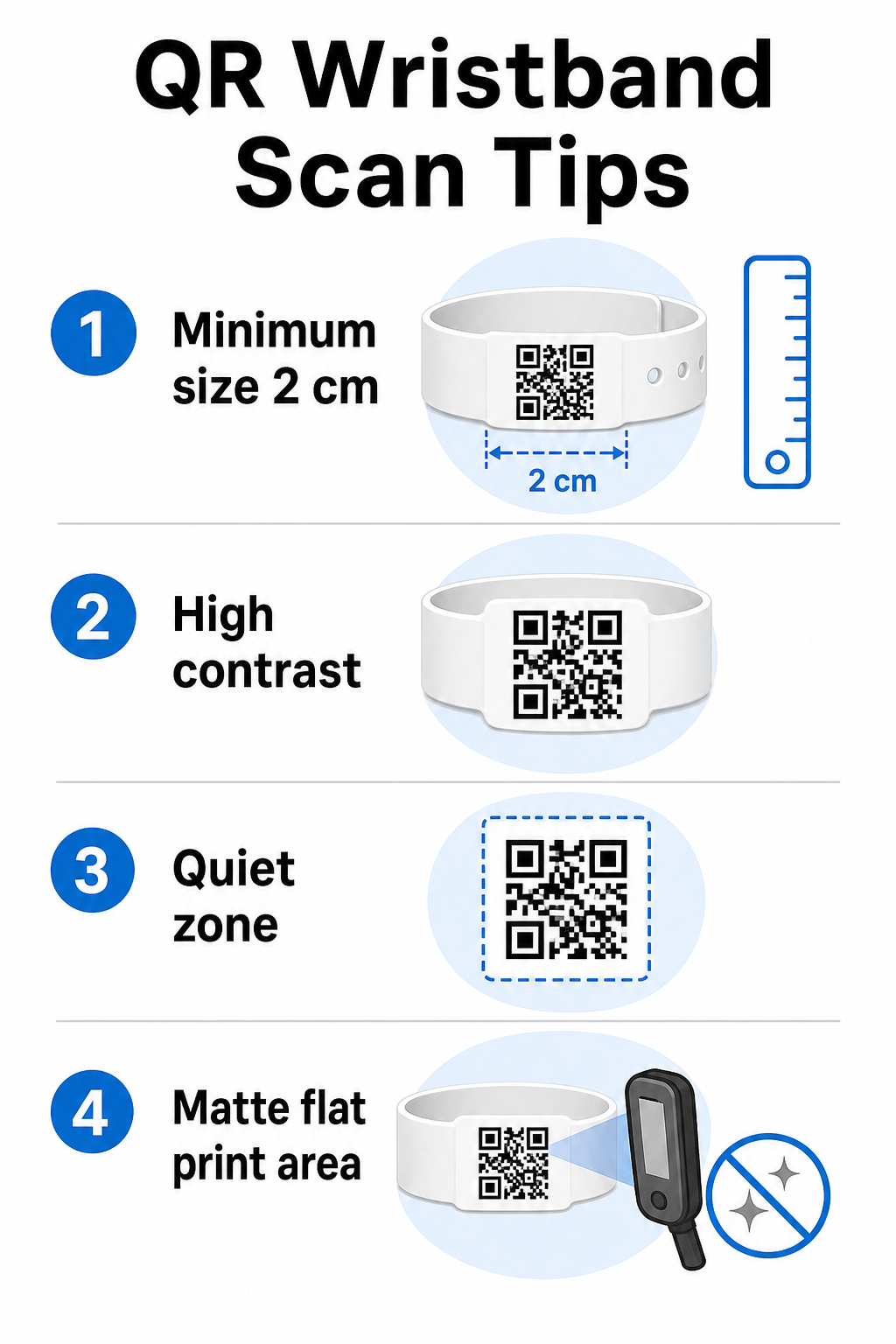
The standard rule is that a QR code’s width should be at least 1 cm for every 10 cm of expected scanning distance. For wristbands scanned at arm’s length by a handheld device, a minimum width of 2 cm is the practical floor. Thinner wristbands that cannot accommodate this size reliably will cause scanning problems. See the full QR code size guide for measurements across different use cases.
Color Contrast
High contrast between the code modules and the background is critical. Dark modules on a light background – ideally black on white – give scanners the clearest signal. Aim for at least a 4:1 contrast ratio. Inverted designs with a light code on a dark background are generally unreliable and should be avoided.
Quiet Zone
Every QR code requires a clear white border around its perimeter, called a quiet zone. This margin signals to the scanner where the code begins and ends. Removing it or printing over it is one of the most common causes of scan failure on wristbands where design space is tight.
Print Resolution and Format
Export QR codes in vector format (SVG or EPS) or high-resolution raster files at a minimum of 300 DPI at the final printed size. Scaling up a low-resolution image creates blurry module edges that scanners struggle to read. For guidance on achieving consistent print quality, the QR code readability best practices guide covers the full technical checklist.
Surface and Finish
Wristbands are worn on a curved surface, which introduces distortion. Print the QR code on the flattest area of the band and avoid glossy or reflective finishes over the code – glare from overhead event lighting directly interferes with smartphone cameras. A matte finish over the code area consistently outperforms glossy alternatives in event environments.
Code Complexity
The more data encoded in a QR code, the denser and harder to scan it becomes. Use short URLs or dynamic codes that redirect through a compact link to keep the code visually simple and fast to scan. Pageloot’s Link QR Code Generator automatically handles URL shortening as part of the dynamic code workflow.
Error Correction
QR codes have built-in error correction that keeps them scannable even when part of the code is damaged. The highest correction level allows recovery when up to roughly 30% of the code area is obscured – relevant for wristbands that experience wear, smudging, or minor abrasion over a multi-day event. If you are adding a logo to the code, use high error correction to compensate for the covered area.
Generating QR Codes for Wristbands
The generation process follows a straightforward workflow:
- Choose your QR code type. For admissions, a link or event QR code pointing to your check-in system works well. For contact sharing, use a vCard type. For attendance logging, link to a form.
- Use dynamic codes when content may change. If your event spans multiple days or the linked destination might need updating, dynamic codes let you make changes from your dashboard without reprinting a single wristband.
- Keep the encoded URL short. Shorter URLs reduce code density and improve scan speed.
- Customize within contrast constraints. You can add your event logo and brand colors, but verify that contrast remains sufficient after customization.
- Download in print-ready format. Use SVG, EPS, or high-DPI PNG files – never scale up a small JPEG.
- Test before bulk printing. Scan your proof on multiple devices, in dim lighting, and at the scanning distances your staff will actually use. This single step prevents the most common event-day failures.
Build and Track Your Event QR Codes Generate unique codes for each attendee, monitor scan activity, and update linked content without reprinting. Start with the QR Code Generator and explore event-specific options at the Event QR Code Generator.
Security and Privacy Considerations
QR wristbands that store or link to personal attendee information carry data protection responsibilities.
Encrypt sensitive data. If a wristband code directly encodes personal information – such as name, ticket category, or age verification status – that data should be encrypted so it cannot be read by unauthorized scanners. Using dynamic codes that point to a secure, authenticated backend rather than encoding raw data in the code itself reduces this risk significantly.
Use HTTPS with validated certificates. All communication between your scanning app and the backend validation server should run over encrypted channels. This prevents interception of scan events or attendee data during the check-in process. The guide on creating secure QR code event tickets explains the technical layers involved in detail.
Limit access to check-in systems. Staff-facing scanning apps and dashboards should require individual login credentials rather than shared passwords. This limits exposure if a device is lost and makes it easier to audit who scanned what.
Apply privacy-by-design principles. Collect only the data your operation requires. If you are using scan analytics for crowd flow analysis, aggregate anonymized data is sufficient and avoids the privacy implications of tracking identifiable individuals. Where personal data is processed, ensure attendees are informed and that your processes comply with applicable regulations.
Provide context at the point of scanning. Letting attendees know what the wristband QR code does – and what will happen when staff scan it – builds trust and reduces confusion about data use. For a broader look at securing access control with dynamic codes, the guide on dynamic QR codes for access control covers revocation, audit trails, and real-time permissions management.
Using Scan Analytics to Improve Future Events
Dynamic QR codes generate scan data that extends well beyond counting entries. With Pageloot’s analytics, you can track when and where codes are scanned, which zones saw the most activity, and how attendee flow compared to your projections. This data helps you make informed decisions about entry point staffing, session scheduling, and wristband feature design for your next event.
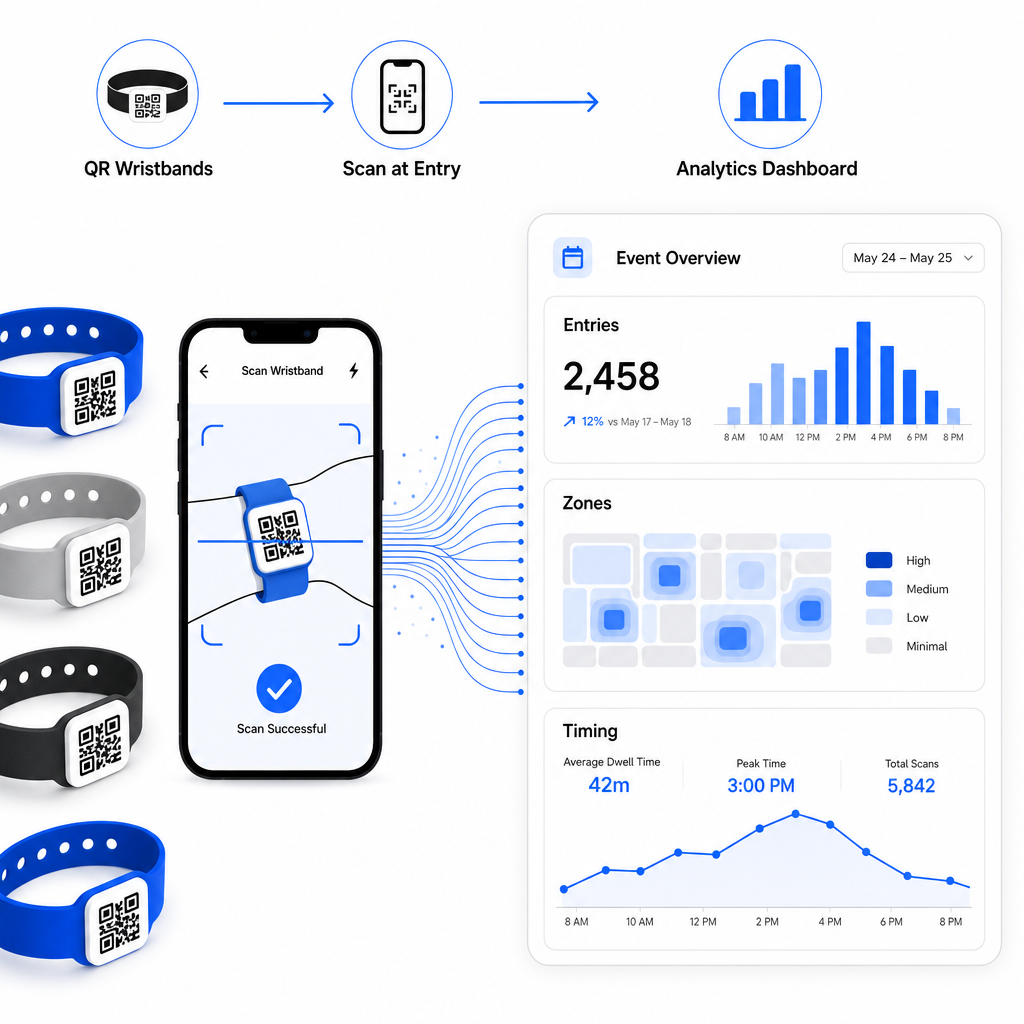
For a complete walkthrough of building a QR-based check-in operation, the guide on streamlining event check-in with QR codes covers scanning logistics, staff training, and real-time attendance monitoring in detail.
A well-designed QR wristband does more than identify an attendee – it connects a physical credential to a live digital system that you control. Getting the print specifications right, using dynamic codes for flexibility, and protecting the data behind each scan are the three factors that determine whether your wristband program works smoothly on event day. Start with a tested proof, not a bulk print run, and build from there.
Set Up Your Wristband QR Codes Today Create dynamic, trackable QR codes for your next event with the Event QR Code Generator and manage everything from a single dashboard.
Frequently Asked Questions
The practical minimum is 2 cm wide for close-range scanning. As a general rule, allow at least 1 cm of code width for every 10 cm of expected scanning distance. Going smaller increases the risk of scan failures, especially on curved or flexible wristband surfaces.
Yes, if you use dynamic QR codes. Dynamic codes point to a short redirect URL that you control from a dashboard. Changing the destination – such as updating an event schedule page or swapping a check-in form – takes effect immediately on all printed wristbands without any physical changes.
Avoid encoding raw personal data such as names, ticket IDs, or age verification details directly in the code itself, since any QR scanner can read it. Instead, use the code to point to a secure, authenticated backend system that controls what information is revealed and to whom. This approach keeps sensitive attendee data off the wristband surface and reduces your exposure to unauthorized access.