Are your table tents doing anything beyond holding a candle or collecting dust between services? Static printed cards leave money on the table – literally. Adding a QR code turns every table tent into an interactive touchpoint that connects seated customers to your digital content in seconds.
What Makes Table Tent QR Codes Worth Using
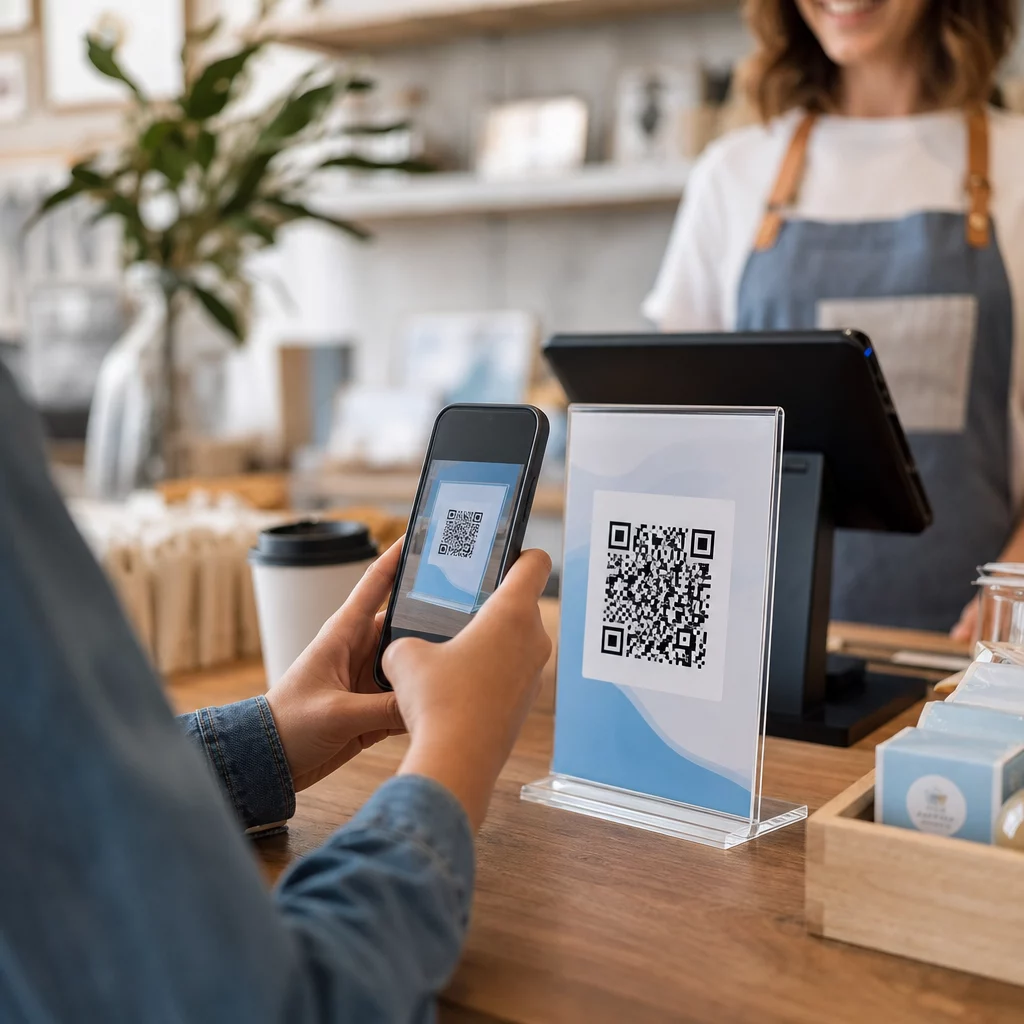
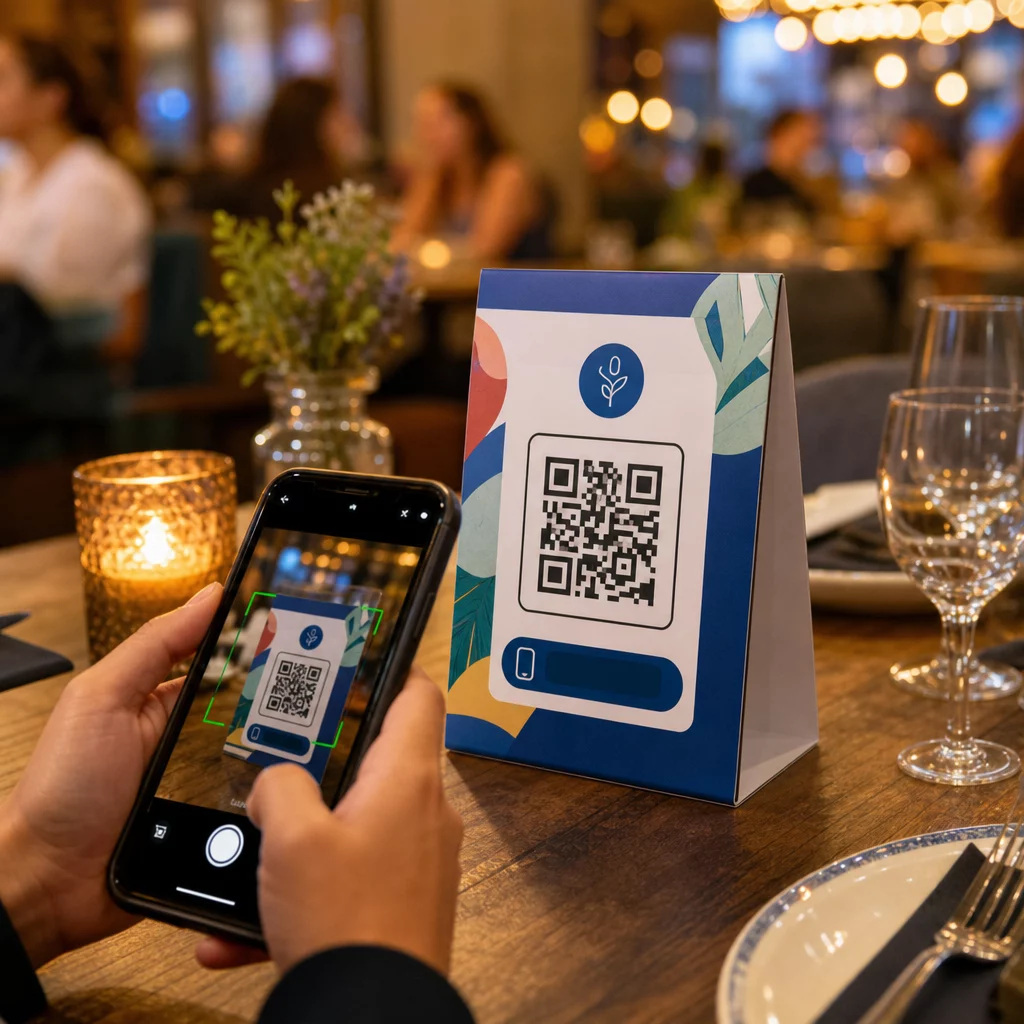
A table tent sits directly in front of a customer during the highest-engagement window of their visit: the moment they are seated and waiting. That dwell time is a genuine opportunity, and a scannable QR code fills it with something useful.
For restaurants and hospitality businesses, QR codes on table tents streamline operations in ways that benefit both staff and guests. Customers can browse a digital menu, place an order, or pay a bill without waiting for a server. For retailers, counter-placed table tents with QR codes can surface promotions, loyalty program sign-ups, or product details at the exact moment a purchase decision is being made.
The numbers back this up. Restaurants and hospitality businesses lead QR code adoption at 75%, and research shows that 60% of all restaurant QR scans happen when codes are placed directly on the table – on stickers or table tents. The format works because it meets customers where they already are.
Choosing the Right QR Code Type for Your Table Tent
Not every QR code does the same job. Matching the code type to your goal is the most important decision you will make before printing.
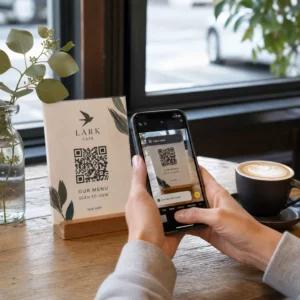
Menu access is the most common use case. A menu QR code lets you upload a PDF or build a mobile-optimized landing page that guests can browse from their smartphones. Because these codes are dynamic, you can update dishes, prices, or daily specials without touching the printed table tent. This alone eliminates the recurring cost of reprinting menus every time something changes.
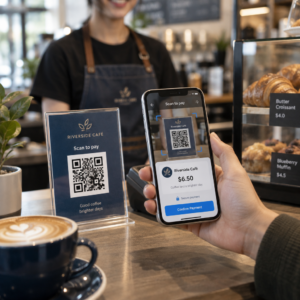
Contactless payment is the second high-value use case. A PayPal QR code lets customers scan and pay directly from their table, cutting wait times and reducing the load on your front-of-house team. For restaurants specifically, QR code payments speed up table turnover and reduce card processing friction.
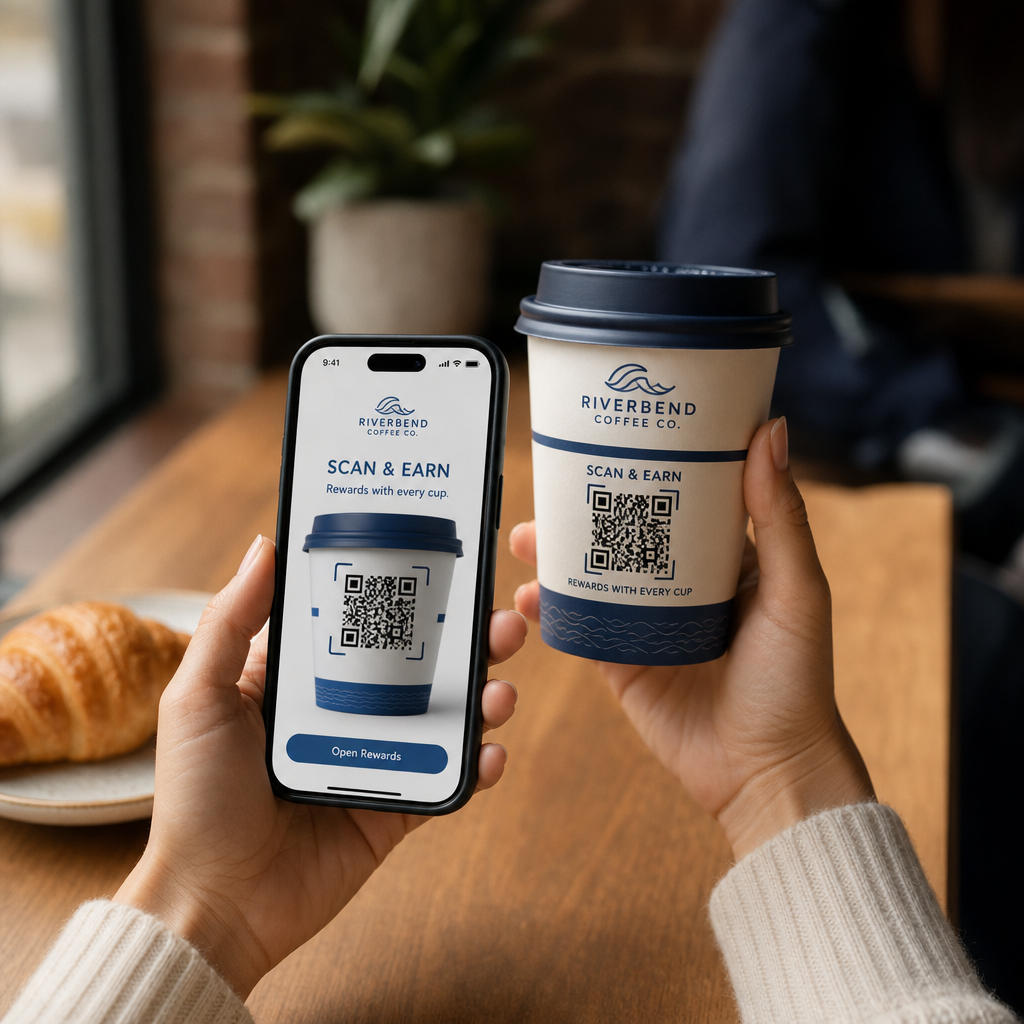
Promotions and coupons work well on retail counter displays. A coupon QR code links to a landing page where customers can claim discounts, loyalty rewards, or limited-time offers while they are still in the buying moment.
PDF documents suit venues that need to share detailed content – allergen information, wine lists, event programs, or product catalogs. A PDF QR code delivers the file instantly to any smartphone without requiring an app.
Direct links give you the most flexibility. A link QR code can point to anything: a reservation system, a social media profile, a Google review page, or a loyalty sign-up form.
Ready to Set Up Table Tent QR Codes? Create customizable, trackable QR codes for your menus, payments, and promotions using the Pageloot QR Code Generator. Start your free 14-day trial – no credit card required.
How to Set Up a QR Code Ordering System on Table Tents
If your goal is a full table-side ordering flow, the setup is straightforward. The QR code ordering system guide walks through the process in detail, but the core steps are:
- Build or upload your digital menu as a PDF or mobile-optimized page
- Generate a dynamic QR code linked to that menu
- Customize the code with your brand colors, logo, and a call-to-action frame
- Print and place the code on each table tent
- Test every code by scanning from a smartphone before deployment
Dynamic codes are strongly preferred for this workflow. They allow you to update the linked menu, swap out seasonal content, or redirect to a new URL without reprinting a single table tent. This is especially useful for restaurants managing daily specials or rotating menus.
Design and Print Specifications That Actually Matter
A QR code that fails to scan destroys the customer experience. Getting the technical details right before printing saves you from reprinting an entire batch.
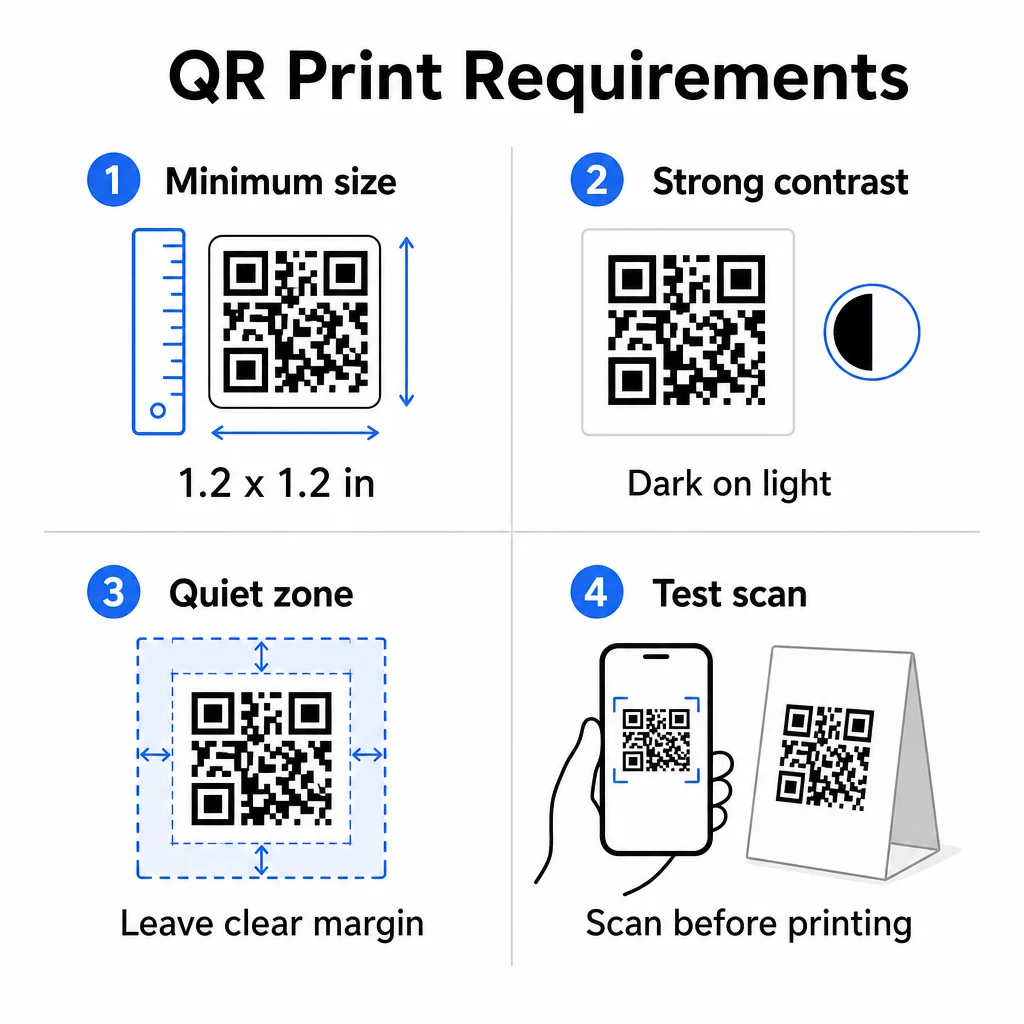
Size: For table tents used at close range, the minimum reliable size is 1.2 × 1.2 inches (3 × 3 cm). A useful rule of thumb is the 10:1 ratio – the code’s width should be roughly one-tenth of the expected scanning distance. At a typical table, a 1.2-inch code is comfortably scannable by most smartphone cameras. For more detailed guidance, see QR code sizing for different print materials.
Contrast: Dark modules on a light background is the most reliable combination. Black on white remains the gold standard. Low-contrast or inverted color schemes (light on dark) cause scanning failures on some devices. Aim for a contrast ratio of at least 4.5:1. The QR code color contrast guide explains which color combinations work and which to avoid.
Quiet zone: Leave a clear white margin of at least four modules around the entire code – roughly 0.25 inches. Without this buffer, scanners struggle to locate the code boundary, especially when placed near text or graphics.
Print quality: Use vector export formats (SVG, EPS, or PDF) rather than low-resolution PNGs. Blurry or pixelated modules are a leading cause of scan failure on printed materials.
Testing: Always scan a physical proof before printing the full run. Test across multiple devices, under the actual lighting conditions of your venue, and from the distance a seated guest would realistically hold their phone. The QR code readability best practices guide covers what to check and how to fix common issues.
What to Link Your Table Tent QR Code To
The destination matters as much as the code itself. Here are the most effective uses across hospitality and retail industries:
- Digital menu – give guests instant access to your full menu, including photos, descriptions, allergen info, and daily specials
- Online ordering – allow customers to place orders directly from their seat without waiting for a server
- Payment page – let customers settle their bill by scanning, reducing checkout friction
- Loyalty program sign-up – capture customer emails and build a direct marketing list
- Promotions and coupons – surface time-sensitive discounts exactly when purchase intent is highest
- Social media profile – grow your following by directing satisfied customers to your Instagram or Google review page
- Location sharing – link to your Google Maps listing so guests can share your location with friends on the way
Tracking Performance with Dynamic QR Codes
One of the most underused advantages of table tent QR codes is analytics. With a dynamic QR code, you can monitor how many times each code is scanned, at what time of day, on which device type, and from which location. This data tells you which tables get the most engagement, which promotions drive the most clicks, and whether a menu update affected customer interaction.
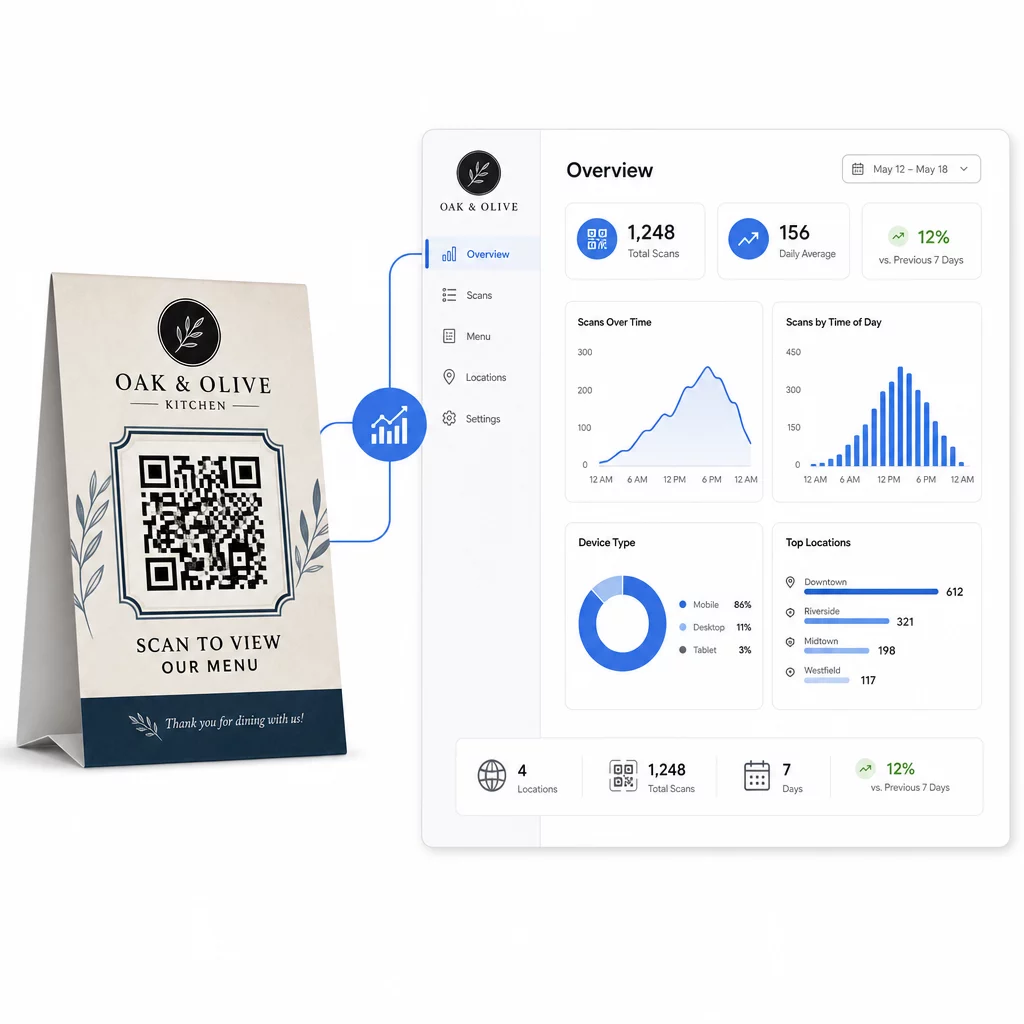
Pageloot’s dynamic QR code generator provides a centralized dashboard where you can track all of this in real time, update linked content across all table tents simultaneously, and make design changes without touching your printed materials.
For businesses running multiple locations, this level of control turns table tents from static print collateral into a measurable marketing channel.
Track Every Scan Across Every Table Use Pageloot’s Dynamic QR Code Generator to update content, monitor scan analytics, and manage all your table tent codes from one dashboard.
Frequently Asked Questions
For table-side scanning, the QR code should be at least 1.2 × 1.2 inches (3 × 3 cm). This supports reliable scanning at the close distances typical of a seated guest. If your design includes a logo overlay or complex color scheme, increase the size by 20–30% to maintain scannability.
Dynamic QR codes are strongly recommended for table tents. They allow you to update the linked content – such as a menu, promotion, or payment page – without reprinting. They also provide scan analytics so you can track engagement over time. Static codes are only suitable if the destination content will never change.
A table tent QR code can link to a digital menu, an online ordering page, a payment portal, a coupon or loyalty program landing page, a social media profile, a PDF document, or any URL. The best destination depends on your business type and what you want the customer to do at that moment in their visit.