Need to share a link or document with your audience mid-presentation? Fumbling with long URLs on a slide breaks your flow and frustrates viewers. This guide walks you through two practical methods for adding a scannable QR code to any PowerPoint slide in minutes.
Why QR Codes Work Well in Presentations
A QR code on a slide gives your audience instant access to supporting content – no typing required. Instead of reading out a URL or hoping attendees write it down, you place a code on the slide and let them scan it with their phone.
Common use cases include:
- Linking to a landing page or signup form after a pitch
- Sharing a PDF – like a report, whitepaper, or handout – without printing copies
- Directing viewers to a video, portfolio, or product page
- Collecting feedback via a form or survey during or after the session
The QR code itself is just an image file. Once you generate it, inserting it into PowerPoint takes about 30 seconds.
Method 1: Generate a QR Code with an External Tool, Then Insert It
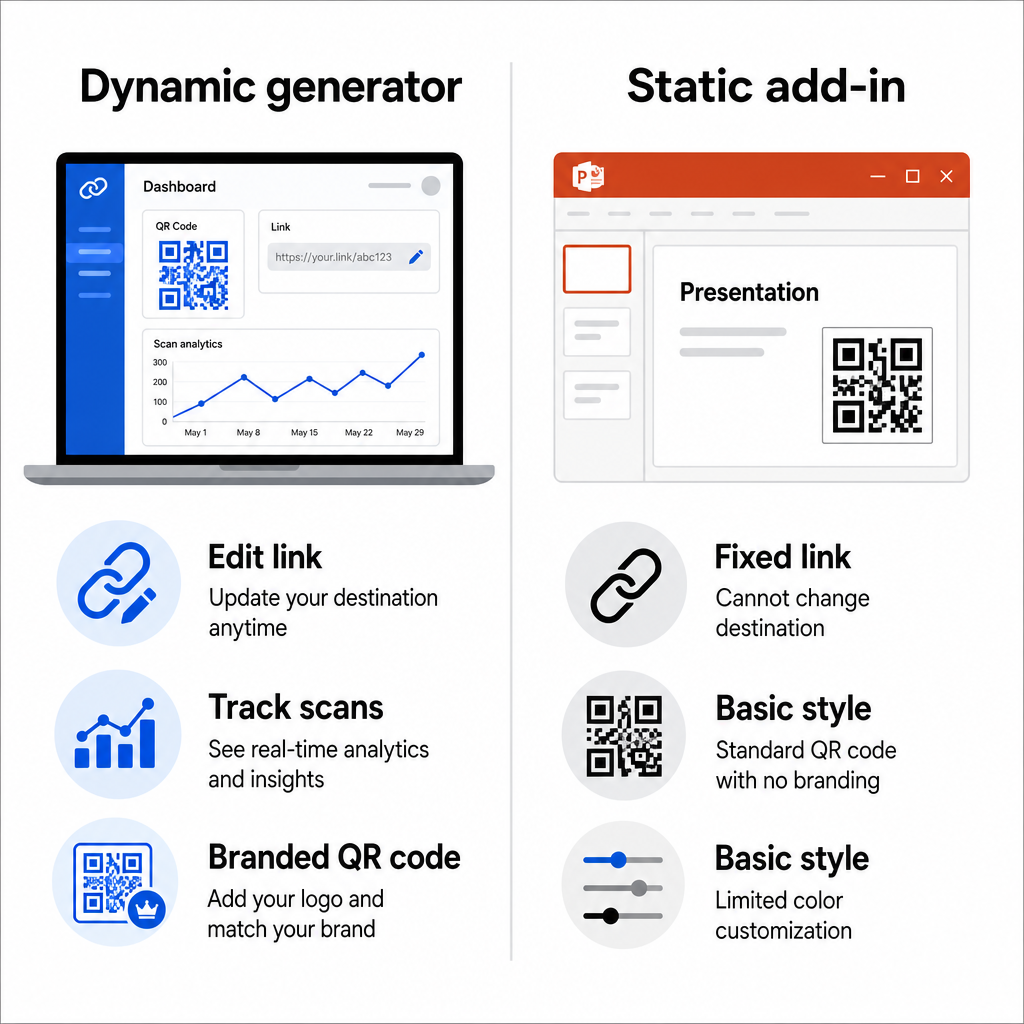
This method gives you the most control over customization, dynamic updates, and scan tracking – and it works with any version of PowerPoint.
Step 1: Create Your QR Code
Go to the Pageloot QR code generator and choose the type of content you want to encode:
- URL or link – use the Link QR Code Generator to encode any web address
- PDF document – use the PDF QR Code Generator to upload and share a file directly
- Image or visual content – use the Image QR Code Generator to link to a photo gallery or visual asset
If the destination URL might change after you finalize the presentation, choose a dynamic QR code. Dynamic codes let you update the linked content at any time without regenerating or replacing the image in your slides – particularly useful if you present the same deck across multiple events.
Step 2: Customize the Design
Match the QR code to your presentation’s visual style. You can adjust:
- Foreground and background colors
- Dot shapes and corner styles
- A logo placed in the center of the code
- A call-to-action frame (e.g., “Scan to download the guide”)
If you add a logo, use a high error correction level (Q or H) so the code remains scannable even though part of the pattern is covered. Keep one rule firm: dark pattern on a light background. Inverted designs – light codes on dark backgrounds – can confuse scanner apps, particularly older ones. Aim for a contrast ratio of at least 4:1 between the foreground and background colors.
Step 3: Download the QR Code Image
Download the code as a PNG for general use, or as an SVG or EPS file if you want a vector format that scales cleanly at any size. For most PowerPoint slides, a high-resolution PNG is sufficient.
Test the code before moving on. Scan it with your phone to confirm it resolves to the correct destination.
Step 4: Insert the Image into PowerPoint
- Open your PowerPoint presentation and navigate to the slide where you want the QR code.
- Click the Insert tab in the ribbon.
- In the Images group, click Pictures, then choose This Device (or Picture from File depending on your version).
- Navigate to your downloaded QR code image, select it, and click Insert.
- Resize and reposition the image on the slide as needed.
Turn Your Presentation Link into a Trackable QR Code Want to know how many people scan your slide and when? Use the Pageloot QR Code Generator to create a dynamic code with built-in analytics – no reprinting needed if your content changes.
Method 2: Use the QR4Office Add-In Inside PowerPoint
If you prefer to generate the QR code without leaving PowerPoint, the QR4Office add-in handles the entire process from within the application. It works with PowerPoint 2013 or later on Windows, PowerPoint on the web, PowerPoint on iPad, and PowerPoint 2016 or later on Mac.
Step 1: Install QR4Office
- Open PowerPoint and click the Insert tab.
- Click Get Add-ins (or Add-ins depending on your version) in the Add-ins group.
- In the search bar, type QR and press Enter.
- Locate QR4Office in the results and click Add.
- Accept the terms to complete the installation.
Step 2: Generate and Insert the QR Code
- Once installed, open QR4Office from the Insert tab or the add-in panel.
- Enter the URL or text you want to encode.
- Adjust the color, background, size, and error correction level within the panel.
- Click Insert to place the QR code directly onto the active slide.
The add-in embeds the QR code as an image object, so you can move and resize it like any other shape on the slide.
The main trade-off with this method is that QR4Office produces a static code with basic customization options. You won’t get dynamic editing, scan tracking, or advanced branding features. For a one-off slide where simplicity is the priority, it works well. For ongoing presentations or campaigns where the destination may change or you want to measure engagement, the external generator approach gives you significantly more flexibility.
Sizing Your QR Code for a Presentation
Size matters more in a presentation context than in print, because your audience is scanning from a distance rather than up close.
Pageloot’s QR code readability guidelines follow a 10:1 rule: the QR code should be at least 1 cm wide for every 10 cm of expected scanning distance. In a typical conference room where attendees might be 4–7 feet away, rendering the code at a generous size on the slide is a practical starting point.
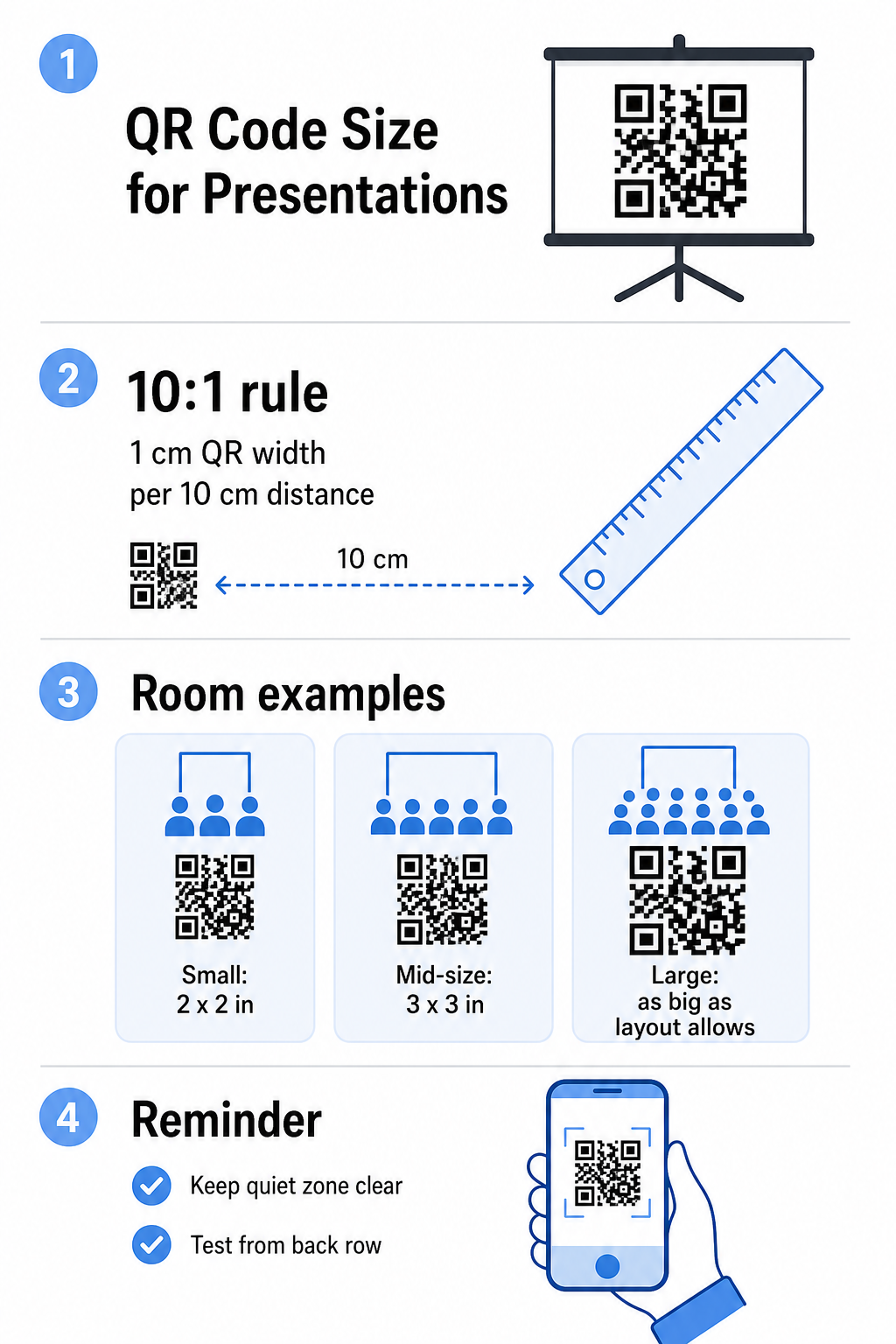
- Small room or huddle space: aim for at least 2 × 2 inches on the rendered slide
- Mid-size meeting room: 3 × 3 inches or larger
- Large conference or event hall: make the code as large as the layout allows, and consider placing the URL as text beneath it as a fallback
Avoid crowding the QR code with surrounding text or graphics. The quiet zone – the blank margin around the code – needs to stay clear so scanners can locate and read the boundary pattern correctly.
Design and Presentation Tips
A few practical considerations before you go live:
- Test in the room if you can. Projector brightness, screen glare, and ambient lighting all affect scannability. Matte projection surfaces tend to work better than glossy ones.
- Give the QR code its own slide or dwell time. Don’t place it on a slide you flip through quickly – your audience needs a moment to open their camera app and scan.
- Add a short instruction line. Something like “Scan with your phone camera” removes any hesitation from audience members who are less familiar with QR codes.
- Use a dynamic code for repeated presentations. If you update the linked resource between sessions, a dynamic code means you change the destination once from your dashboard – no need to modify the slide or regenerate the image.
For a deeper look at design decisions that affect whether your code actually scans, the QR code color contrast guide covers contrast ratios, color combinations to avoid, and how to test across devices and lighting conditions.
Once you’re comfortable with the basics, explore the full range of Pageloot QR code features to go beyond simple link codes – from PDF sharing and image galleries to scan analytics and fully branded designs.
Frequently Asked Questions
Yes, if you use a dynamic QR code from a tool like Pageloot. Dynamic codes store a redirect URL that you can change at any time from your dashboard. The image in your PowerPoint stays the same – only the destination changes. Static codes, including those generated by most add-ins, cannot be updated after creation.
PNG works well for most presentations. It supports transparent backgrounds and maintains clean edges at standard slide sizes. If you plan to resize the code significantly or use it across multiple formats, download an SVG or EPS vector file instead – these scale without losing sharpness.
Apply the 10:1 sizing rule – for every 10 cm of scanning distance, the code should be at least 1 cm wide on screen. For a room where the furthest viewer is around 15 feet away, you want the code to appear large and unobstructed on the projected display. Test the actual slide on a projected surface if possible, and always scan the code yourself before presenting to confirm it resolves correctly.