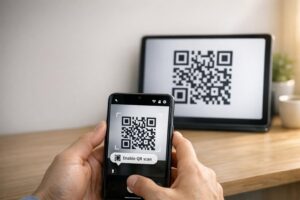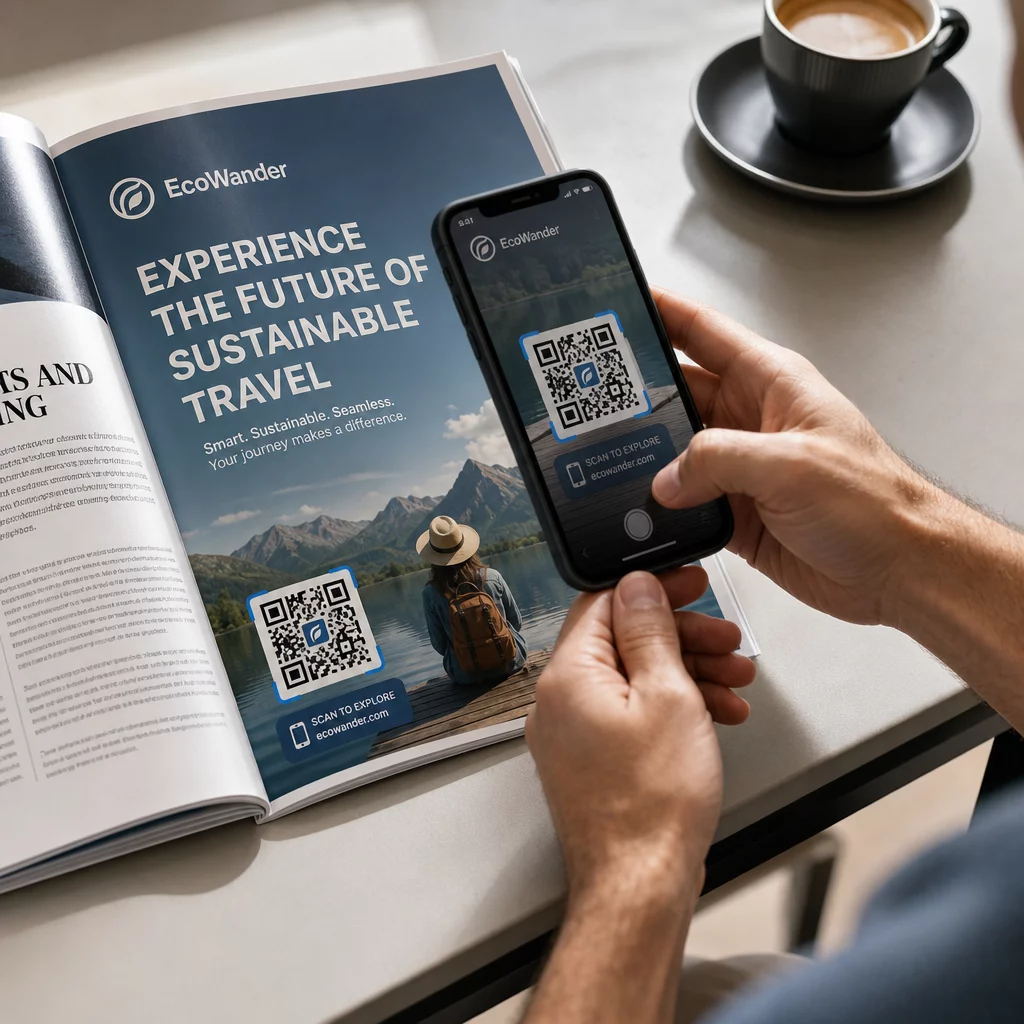
A QR code in a newspaper or magazine ad sends readers from the printed page to a website, video, coupon or PDF. To add one: create the code, print it at least 2 x 2 cm (0.8 x 0.8 inches) with a blank margin around it, put a short call to action next to it, and test it on the real paper before the print run. This guide covers each step for QR codes for print ads in magazines and newspapers.
Quick Answers for Newspaper and Magazine QR Codes
- Size: at least 2 x 2 cm (0.8 x 0.8 inches). Use 3 to 4 cm (1.2 to 1.6 inches) for most magazine ads and a little more for newsprint.
- Quiet zone: keep a blank margin of at least four modules (the small squares) on every side.
- Colors: dark code on a light, plain background. Black on white is the safest choice.
- Placement: middle or lower part of the ad, away from the fold or spine.
- Code type: a dynamic code if the ad runs for weeks or you want scan stats. A static code is enough for a one-off link that will never change.
- Before printing: scan a proof on the actual paper with at least one iPhone and one Android phone.
Why Print Media Still Works With a QR Code
Readers of newspapers and magazines slow down and read. A printed ad also has room to explain what the code does and why a reader should scan it. A line such as “Scan to watch the recipe video” tells the reader what happens next, which a bare code does not.
Food, publishing, education, retail and local services all use print. A QR code connects that audience to your website, video, offer or app without asking anyone to type a URL.
Connect Your Print Ads to Digital Campaigns Use the Link QR Code Generator to create a QR code for any URL, ready to drop into your next newspaper or magazine ad.
What to Link a Magazine QR Code or Newspaper QR Code To
Decide what the code does before you design the ad. The destination decides the call to action, the size and the position on the page.
- Website or landing page: a campaign page, product page or sign-up form, made with the Link QR Code Generator
- PDF document: a catalog, menu, press kit or supplement, made with the PDF QR Code Generator
- Video: a product video, recipe or interview, made with the YouTube QR Code Generator
- Print-only coupon: an offer only readers of this issue can claim, made with the Coupon QR Code Generator
- Audio: an MP3 of a journalist interview or a podcast segment
- Social profile or contact details: a code next to a writer’s name so readers can follow or contact the contributor
Real examples: a food magazine can link a recipe spread to the full video. A newspaper classified ad can link to a property listing with photos. A local store can print a coupon code in a weekly paper and count how many people redeem it. The faster and more relevant the result of the scan, the more scans you will get.
How to Add a QR Code to a Newspaper or Magazine Ad
- Open the QR Code Generator and choose the type: link, PDF, video or coupon.
- Enter the destination. Use a short, final URL. Longer URLs make a denser code that needs more space in print.
- Choose a dark code color and a light background. Add a logo only if the code stays easy to scan. Do not add a logo to a small newsprint code.
- Download a vector file (SVG or PDF) for the printer. A PNG should be at least 1000 px wide if no vector file is possible.
- Place the code in the ad layout at 2 x 2 cm or larger, with a blank quiet zone around it.
- Add a call to action next to the code that says what the reader gets.
- Ask the publication or printer for a proof, then scan it with several phones before the final run.
How to Design a QR Code That Gets Scanned
Brand the code visually
A plain black code blends into the page. Brand colors and a small logo in the center show readers who the code belongs to. Use the QR Code Generator to set your colors, add a logo and choose a shape that fits your ad layout.
Keep strong contrast. The code modules must be much darker than the background. Black on white is the most reliable. Do not reverse the colors (light code on a dark background), and do not place the code over a photo or a pattern.
Choose dynamic over static
A dynamic QR code stores a short redirect link instead of the final address. You can change where the code points after thousands of copies are printed, and the printed code stays the same. Dynamic codes also show scan stats: when, where and on what device people scanned. Learn more about how to edit QR codes after printing.
A static code is enough when the link will never change and you do not need stats, for example a permanent link to your homepage. For an ad that runs for weeks, or an ad whose offer may end, dynamic is worth it. A static code never expires. A dynamic code on a monthly or yearly plan stops working when the plan ends, so keep the plan active while the issue is in circulation.
Dynamic codes have a 14-day free trial. See the plans at pageloot.com/pricing.
Update Your Ads Without Reprinting The Dynamic QR Code Generator lets you change your destination URL at any time and see scans by date, location and device type.
Write a clear call-to-action
Put one short line near the code that says what the reader gets. “Scan to watch the recipe video” or “Scan for your reader discount” works. “Scan here” does not say anything. If the reader does not know what is behind the code, most will skip it.
Optimize the destination for mobile
Every reader who scans a code in print lands on a phone. The page must load fast, fit a small screen and show the offer at the top. Before you print, test the whole path from scan to landing page on both iOS and Android.
Placement and Sizing Guidelines for QR Codes on Magazines and Newspapers
Size, placement and paper decide whether a code scans. These are the main rules.
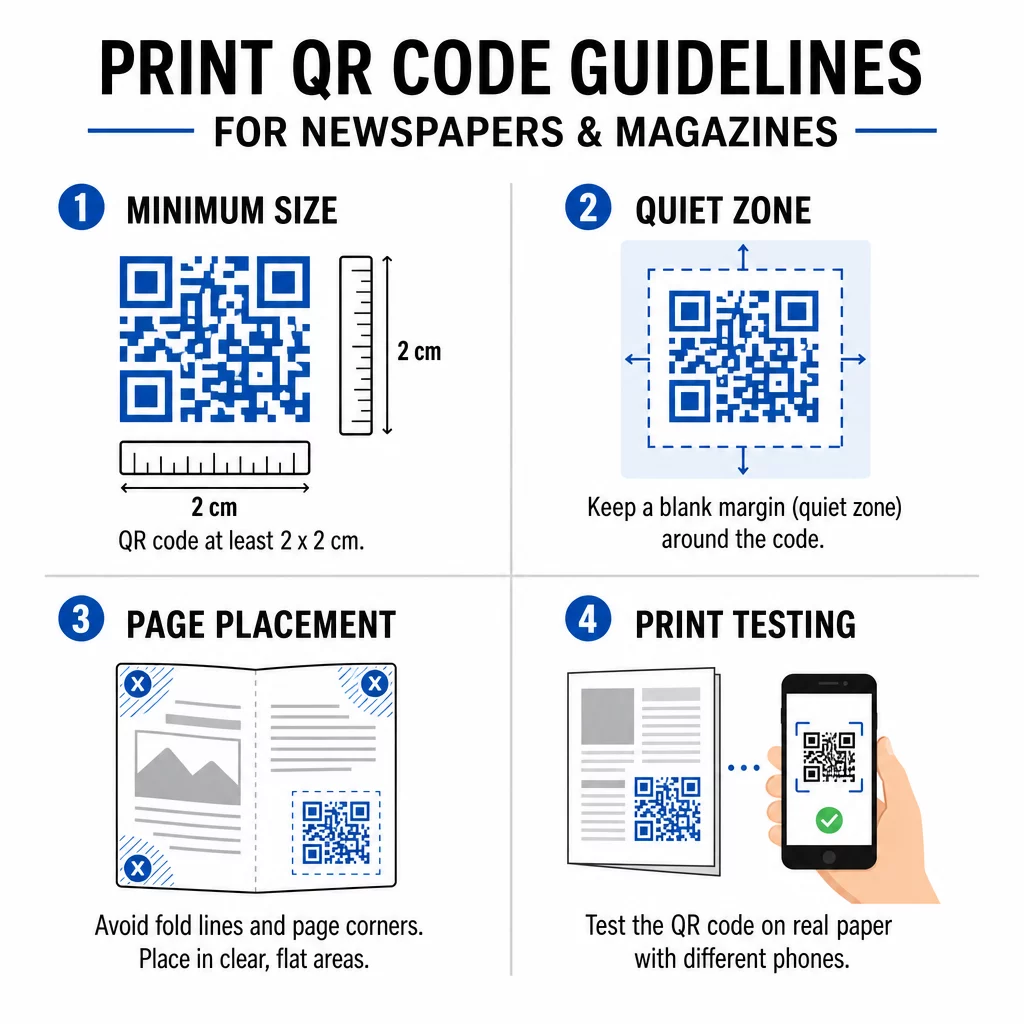
Minimum size
Print the code at least 2 x 2 cm (about 0.8 x 0.8 inches). A working size for most magazine ads is 1.2 to 1.6 inches (30 to 40 mm). Dense codes, with long URLs, need more space. See QR code sizing guidelines for different print materials for format-specific advice.
Newsprint versus glossy magazine paper
Newsprint is porous and absorbs ink, so fine details look soft and the code can print darker and blurrier than on screen. Use a larger code (3 cm or more), a simple square design, no logo in the center and pure black on white. Glossy magazine paper prints sharper, but glare can make scanning harder. Ask for a matte area around the code if the publisher can do it. These sizes are a safe starting point. Your proof decides the final size.
Quiet zone
Leave a blank margin of at least four modules on all sides. This margin lets the camera find the code. Do not let text, photos or borders enter it.
Placement on the page
Put the code in the middle or lower part of the ad, where a reader can hold the page and aim a phone. Corners are easy to miss. Keep the code away from the spine or fold of a magazine, because the bend distorts it. Do not put the code on a page edge that gets cut. See best practices for QR code placement in marketing.
Print quality
Send the printer a vector file (SVG, PDF or EPS) so the code stays sharp at any size. A low-resolution code is the most common reason a printed code fails. See how printing techniques impact QR code scannability.
Always test before the print run
Scan a proof at its final size, on the actual paper, with several phones, in daylight and in room light. A code that scans on your monitor can fail on paper. See best practices for QR code readability for a checklist.
Not Scanning? Check These Causes
- Too small: below 2 cm, or smaller than the proof allows. Enlarge it.
- No quiet zone: text or images touch the code. Add a blank margin.
- Low contrast or inverted colors: use a dark code on a light background.
- Code on the fold: move it away from the spine.
- Ink spread on newsprint: enlarge the code and remove the logo.
- Dense code: shorten the URL, or use a dynamic code, which has a short link and a less dense pattern.
- Dead link: a dynamic code on an expired plan, or a destination page that was removed.
How to Track and Measure Your Print QR Campaign
Print ads are hard to measure. When a reader sees an ad and later types your address, you do not know the ad caused the visit. A scanned code does tell you.
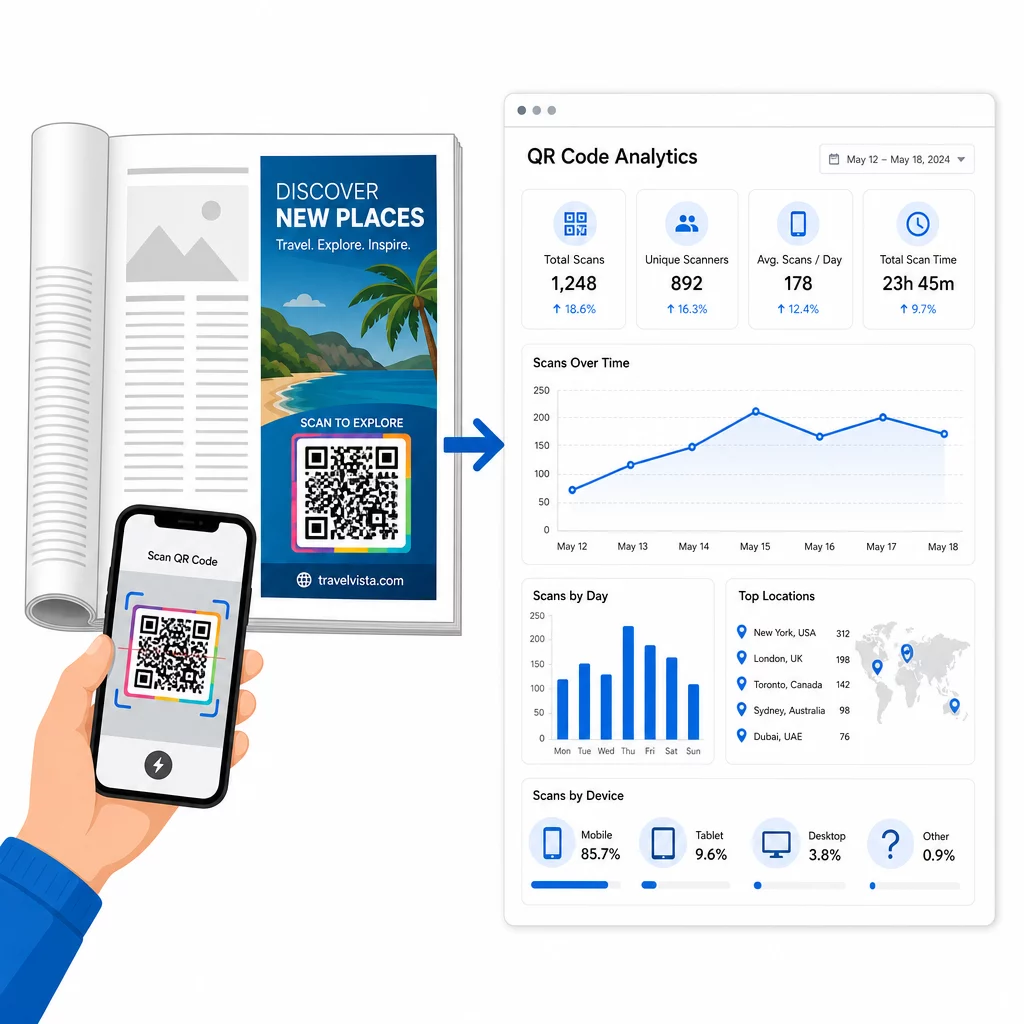
With dynamic QR codes you can see:
- Total scans and unique scans: how many times the code was used
- Scan date and time: which issue or day gave the most scans
- Location: which regions responded
- Device type: iOS or Android, which helps you check the mobile page
Make one code for each publication, issue or ad placement. Then you can compare titles and positions. The level of detail depends on your plan. Learn more about how QR codes track print ad engagement and how QR codes connect print and digital marketing.
See Who Is Scanning and When Track scans by date, location and device with Pageloot’s Dynamic QR Code Generator.
Putting It All Together
A QR code in a newspaper or magazine works when the reader gets something worth the scan: a video, an offer or information that does not fit on the page. Make the code large enough, keep the blank margin, explain it in one line and test it on the real paper.
Use a dynamic code if you want to change the destination or see results. Use a static code for a permanent link.
For more on print, see how to use QR codes in print media.
Frequently Asked Questions
Print the code at least 2 x 2 cm (about 0.8 x 0.8 inches). For most magazine ads 3 to 4 cm (1.2 to 1.6 inches) is safer. On newsprint, go larger, because ink spreads on the paper. Always test a proof.
Use a dynamic code if the ad runs for a long time, the offer may change, or you want scan stats such as date, location and device. You can edit the destination after printing. Use a static code for a permanent link you never need to change. Static codes do not expire.
Put it in the middle or lower part of the ad. Avoid corners, the fold and the spine of a magazine. Keep a blank margin of at least four modules around it and add a short call to action.
Yes. Newspaper ads, classifieds and articles can all carry a QR code. Use a larger size, dark ink on a light background and no logo, because newsprint absorbs ink and softens fine details.
Use a dynamic QR code. It shows when, where and on what device people scanned. Give each magazine, issue or ad its own code so you can compare them. Pageloot dynamic codes have a 14-day free trial.
A mobile-friendly page that delivers what the call to action promised, such as a video, a coupon or a product page. Do not link to a general homepage.
The usual causes are a code that is too small, no blank margin around it, low contrast, placement on the fold, or a low-resolution image. Test a proof on the real paper with several phones.
A static code does not expire. A dynamic code on a monthly or yearly plan becomes inactive after the plan ends, so keep the plan active while the issue is in circulation.