Do your printed marketing materials become outdated the moment they leave the press? Reprinting costs money, wastes paper, and undermines any sustainability claim you’re making. This guide explains how combining eco-friendly printing practices with dynamic QR codes lets brands reduce material waste, stay relevant, and communicate their environmental credentials honestly.
What Makes QR Code Printing “Sustainable”
Sustainable QR code printing isn’t a single technique – it’s a combination of material choices, production methods, and code strategy that reduces the environmental footprint of printed communications.
The two sides work together. Eco-friendly materials cut the impact of the physical print run: FSC-certified or recycled paper, vegetable-based or water-based inks, and recyclable substrates all reduce resource consumption and waste. Dynamic QR codes cut the impact of the content lifecycle: because the destination URL can be updated after printing, you never need to reprint a label or package just because a product detail, certification, or campaign page changed.
Together, these choices address the two biggest sources of print waste – overproduction and obsolescence.
Cut Reprinting Waste from Your Campaigns With a Dynamic QR Code Generator, you can update linked content at any time without touching the printed material – keeping packaging relevant and reducing waste.
Why Dynamic QR Codes Reduce Waste
A static QR code encodes a fixed destination directly into its pattern. Change the URL, and the code is useless – you have to reprint. A dynamic QR code instead encodes a short redirect link. That redirect can be pointed anywhere at any time, even after the code has been printed and distributed.
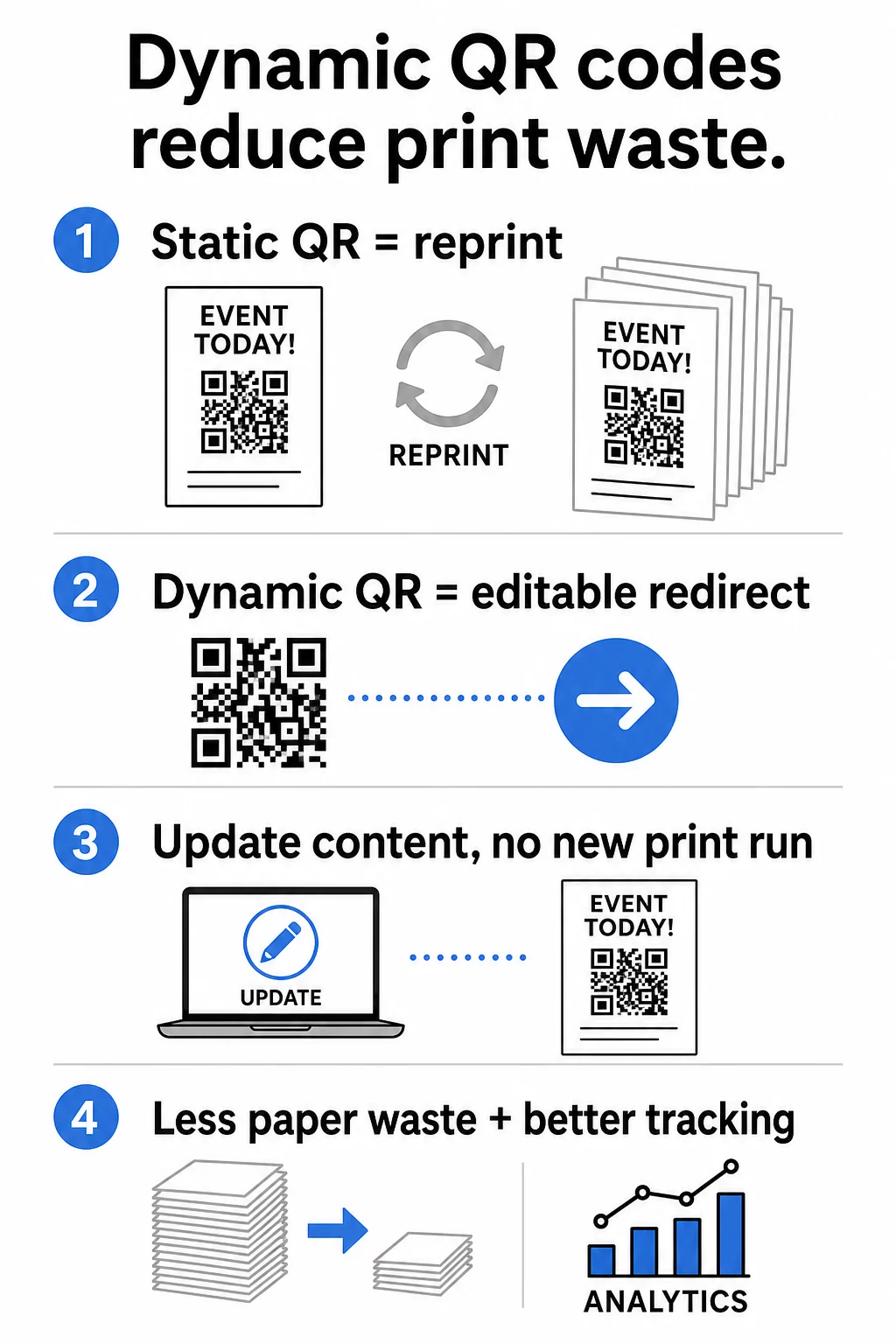
This distinction matters for sustainability in three concrete ways:
- Longer material life. Packaging, labels, and printed materials stay accurate even when the linked content changes – whether that’s a new certification, a seasonal promotion, or updated recycling instructions.
- Smaller print runs. Because you’re not locked into a fixed destination, you can print on demand rather than producing large batches to amortize the cost of future changes.
- Fewer obsolete materials. Outdated printed materials are a significant source of paper waste. When the information lives in the destination rather than the code, materials don’t become obsolete just because your website or product page changed.
Dynamic codes also provide scan analytics – tracking when, where, and on what device scans occur – so you can measure engagement and refine your content strategy without additional printed materials. Learn more about how tracking QR code scans and analytics works in practice.
Real-World Examples: Brands Using Sustainable QR Code Printing
Lampoon Magazine: FSC-Certified Paper and Vegetable-Based Inks
When Lampoon Magazine released a special edition focused on environmental issues, they aligned their production process with their editorial message. The print run used FSC-certified paper, vegetable-based inks, and carbon-neutral printing methods.
Dynamic QR codes placed throughout the magazine’s pages linked readers to live updates on carbon offset projects – reforestation efforts, renewable energy investments, and sustainability milestones. Because the codes were dynamic, the editorial team could update this content in real time as projects progressed, extending the usefulness of the printed edition without a single additional press run. The campaign generated measurable social media engagement as readers shared scans and highlighted the magazine’s transparency.
Hala Tree Coffee: Compostable Packaging with Supply Chain Transparency
Hala Tree Coffee redesigned its packaging around 100% compostable bags made from plant-based materials that fully decompose in commercial composting facilities within 90 days. QR codes were printed using biodegradable inks – chosen specifically to maintain scannability as the packaging broke down.
Each code linked customers to detailed information about the coffee’s origin, certifications, and processing methods. Using a dynamic QR platform, Hala Tree could update that content instantly when new certifications were earned or when sustainability initiatives like water conservation efforts were launched – without producing additional printed materials. The approach reduced waste while reinforcing supply chain transparency.
The R Collective and Levi’s: QR Codes for Circular Fashion
Sustainable fashion brand The R Collective partnered with Levi’s on the Denim Reimagined project – a limited collection of upcycled denim pieces made from deadstock fabric. Each garment featured a durable woven label embedded with a QR code engineered to survive repeated washing.
Scanning the code gave customers recycling instructions, care tips, and comparisons of the environmental savings versus conventional denim production. Codes also connected users to a take-back program for worn-out garments. Campaign data showed that customers scanned the codes shortly after purchase and returned to them for care guidance – behavior that measurably extended garment lifespan by encouraging proper maintenance.
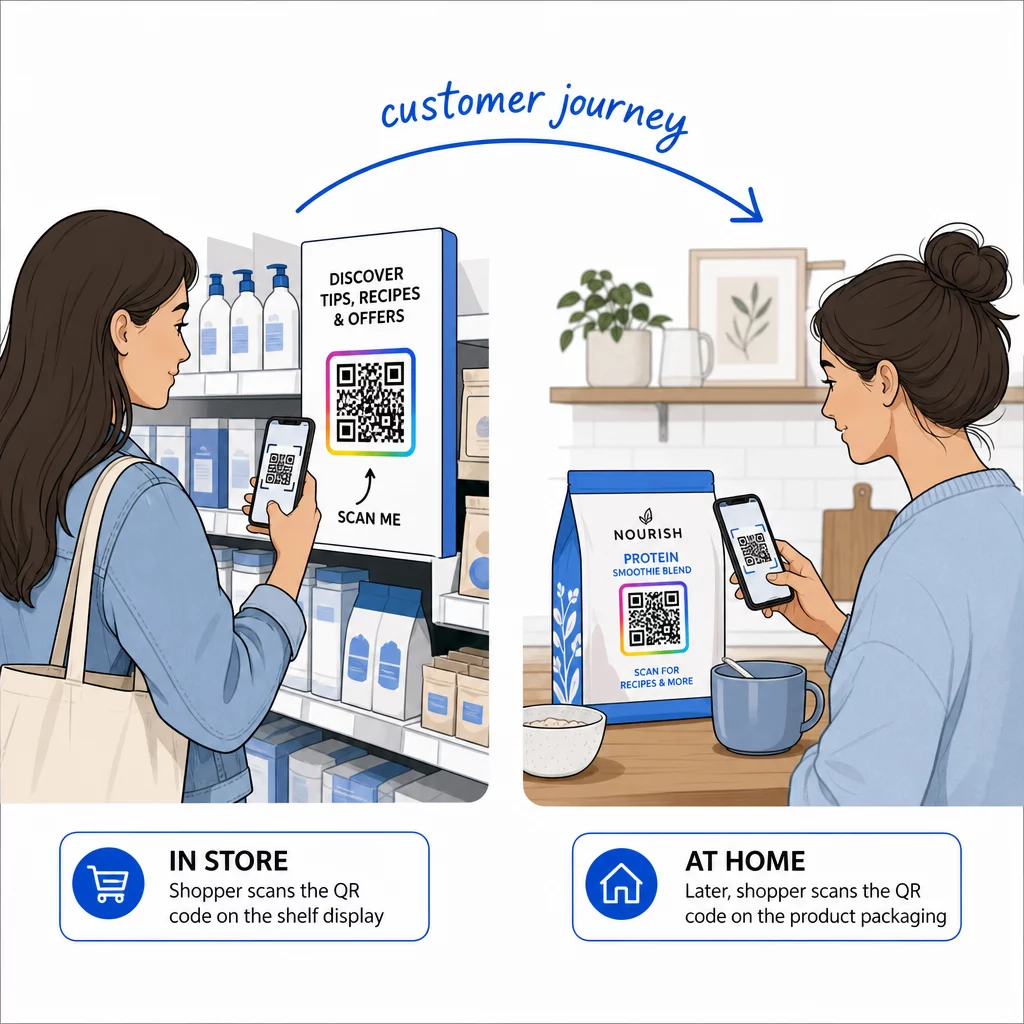
The project illustrates how QR codes on product packaging and labels can function as long-term engagement tools rather than one-time informational tags.
How to Implement Sustainable QR Code Printing
Choose Eco-Friendly Materials and Production Methods
Material selection is the foundation of sustainable print. Key choices include:
- FSC-certified or recycled paper. FSC and SFI certification confirms that paper comes from responsibly managed forests, reducing demand for virgin pulp and supporting forest ecosystems.
- Vegetable-based or water-based inks. Soy- and linseed-based inks are derived from renewable resources and produce lower volatile organic compound (VOC) emissions than petroleum-based alternatives. Water-based inks eliminate solvents almost entirely, reducing hazardous waste.
- Recyclable or compostable substrates. Mono-material solutions – printing a QR code directly onto recyclable cardboard rather than using a separate label – simplify the recycling stream.
- Digital printing for short runs. Digital printing enables print-on-demand and short runs, reducing setup waste and avoiding overproduction. It’s particularly effective for QR codes on products where material efficiency is critical.
- Certified production partners. Working with printers certified to FSC, ISO 14001, or Green Seal standards ensures that sourcing, inks, and production processes meet defined sustainability criteria.
Design QR Codes That Print Efficiently
Good design reduces ink consumption and improves scannability – both of which matter for sustainability.
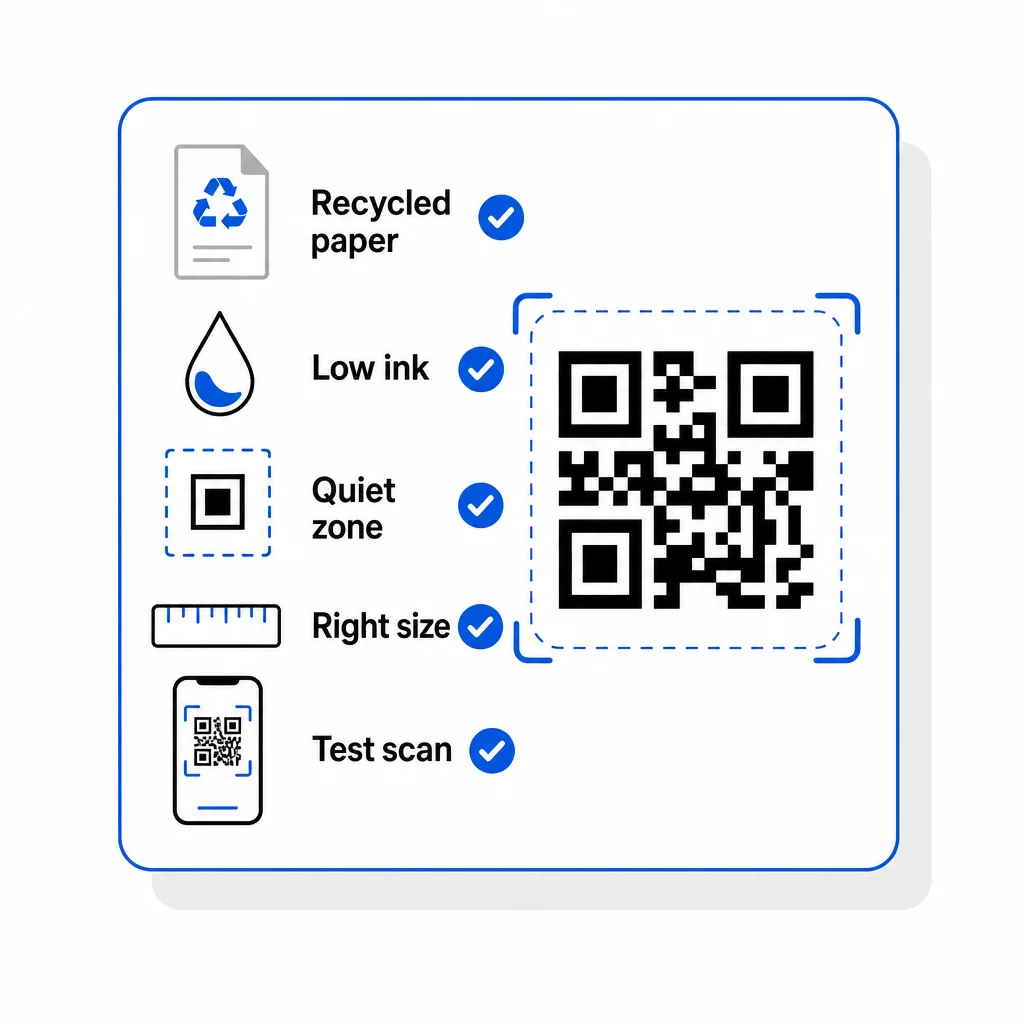
- Use dark modules on a light background. Black on white is the most reliable color combination for scanning. It also uses less ink than large solid areas of dark color, particularly when applied across a full print run. For more guidance, see best practices for QR code readability.
- Keep earthy tones for brand alignment. If you want to signal eco-consciousness visually, natural tones can work – provided contrast remains sufficient. Always test printed proofs before full production.
- Size codes appropriately for the material. A minimum of 0.8 inches (about 2 cm) square is reliable for close-range scanning. For packaging viewed at greater distances, apply the 10:1 rule: the scanning distance in centimeters should be no more than ten times the code’s width. See the full QR code sizing guide for different print materials.
- Maintain a quiet zone. Leave a clear, unprinted border of at least four modules wide on all sides of the code. Without it, scanners may fail to detect the code boundary.
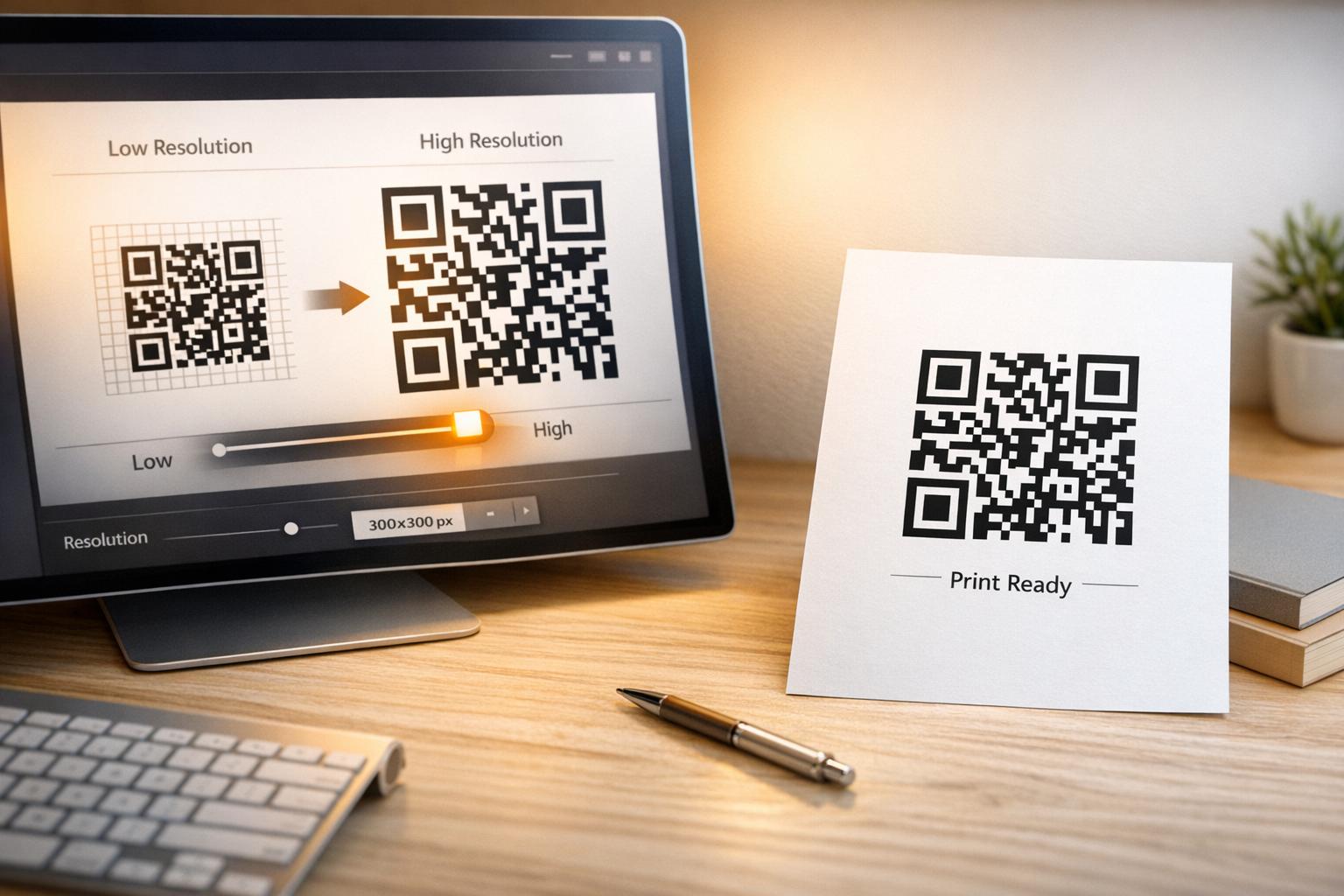
- Use vector formats for print files. Send files to your printer as SVG, EPS, or high-resolution PDF to avoid pixelation and maintain sharp edges at any size.
- Add your logo. A QR code with your logo increases recognition and scan rates – just keep the logo to roughly 30% of the code area and use high error correction to maintain reliability.
For a deeper look at how printing method affects scannability, see how printing techniques impact QR code scannability.
Create Content That Reinforces Your Sustainability Message
The content linked from your QR code is where sustainability communication happens. Effective options include:
- Supply chain transparency pages. Origin details, certifications, and processing methods give environmentally conscious consumers the information they need to make confident purchasing decisions.
- Care and disposal instructions. Recycling guidelines, compostability information, and take-back program details extend product life and support circular economy goals.
- Carbon footprint data. Interactive calculators or comparison pages showing environmental savings versus conventional alternatives put your sustainability credentials in concrete, verifiable terms.
- Live certification updates. Because dynamic codes let you update the linked destination, you can reflect newly earned certifications or evolving sustainability initiatives without reprinting a single label.
Analytics from your QR platform can show which content types drive the most engagement, letting you refine your sustainability storytelling based on actual customer behavior.
Start Tracking Your Sustainability Campaigns The Pageloot QR Code Generator lets you create branded, dynamic codes and monitor scan performance from a single dashboard – no reprinting required when your content changes.
A Note on Sustainability Claims and Compliance
If your QR codes link to or display environmental claims – “compostable,” “recycled content,” “carbon neutral” – those claims need to be accurate and substantiated. The FTC’s Green Guides apply to environmental marketing claims made through any channel, including packaging, labels, and printed materials, whether stated explicitly or implied through design.
The key practical requirements:
- Be specific. Vague claims like “eco-friendly” or “green” are unlikely to be fully substantiated. Specify what aspect is sustainable and why.
- Back claims with evidence. The FTC requires “competent and reliable scientific evidence” for environmental claims.
- Clarify what the claim applies to. Whether a sustainability claim refers to the product, its packaging, or the production process should be clear.
- Don’t overstate certifications. Third-party seals and certifications should be displayed accurately and without implying broader endorsement than the certification actually covers.
Dynamic QR codes can support compliance by linking to detailed, up-to-date documentation – certification records, third-party audit results, or methodology explanations – that would be impractical to print on a label.
Practical Checklist for Sustainable QR Code Print Campaigns
Before going to press, confirm each of these:
- Paper is FSC-certified, recycled-content, or another verified sustainable substrate
- Inks are vegetable-based, water-based, or another low-VOC alternative
- QR codes are dynamic to allow future content updates without reprinting
- Code size meets the minimum for the intended scanning distance (0.8 in / 2 cm for close range)
- Quiet zone of at least four modules is preserved on all sides
- High contrast is maintained (dark code on light background)
- Files are provided to the printer in vector format (SVG, EPS, or high-res PDF)
- Sustainability claims linked from the QR code are specific, accurate, and substantiated
- Codes are tested on multiple devices (iOS and Android) before full production
For more guidance on placing codes effectively across different marketing materials, see the QR code placement guide for marketing.
Frequently Asked Questions
Dynamic QR codes encode a short redirect URL rather than a fixed destination. That redirect can be updated at any time – even after the code is printed – so the physical material remains accurate and useful without reprinting. This means you can update certifications, product pages, or campaign content without discarding and reprinting labels, packaging, or marketing materials.
The highest-impact choices are FSC-certified or recycled paper, vegetable-based or water-based inks (which reduce VOC emissions and hazardous waste), and recyclable or compostable substrates. Combining these with digital or short-run printing methods reduces both overproduction and material waste across the print lifecycle.
Yes – and this is one of the strongest use cases. QR codes can link to supply chain transparency pages, third-party certification documentation, care and recycling instructions, and real-time sustainability data that would be impractical to print on a label. Because dynamic codes can be updated, the linked content can reflect new certifications or initiatives as they develop, keeping the communication current without reprinting.