Vos supports marketing imprimés deviennent-ils obsolètes dès qu'ils sortent de l'imprimerie ? La réimpression coûte de l'argent, gaspille du papier et sape toute affirmation de durabilité que vous faites. Ce guide explique comment la combinaison de pratiques d'impression écologiques et de codes QR dynamiques permet aux marques de réduire le gaspillage de matériaux, de rester pertinentes et de communiquer honnêtement leurs références environnementales.
Ce qui rend l'impression de codes QR “ durable ”
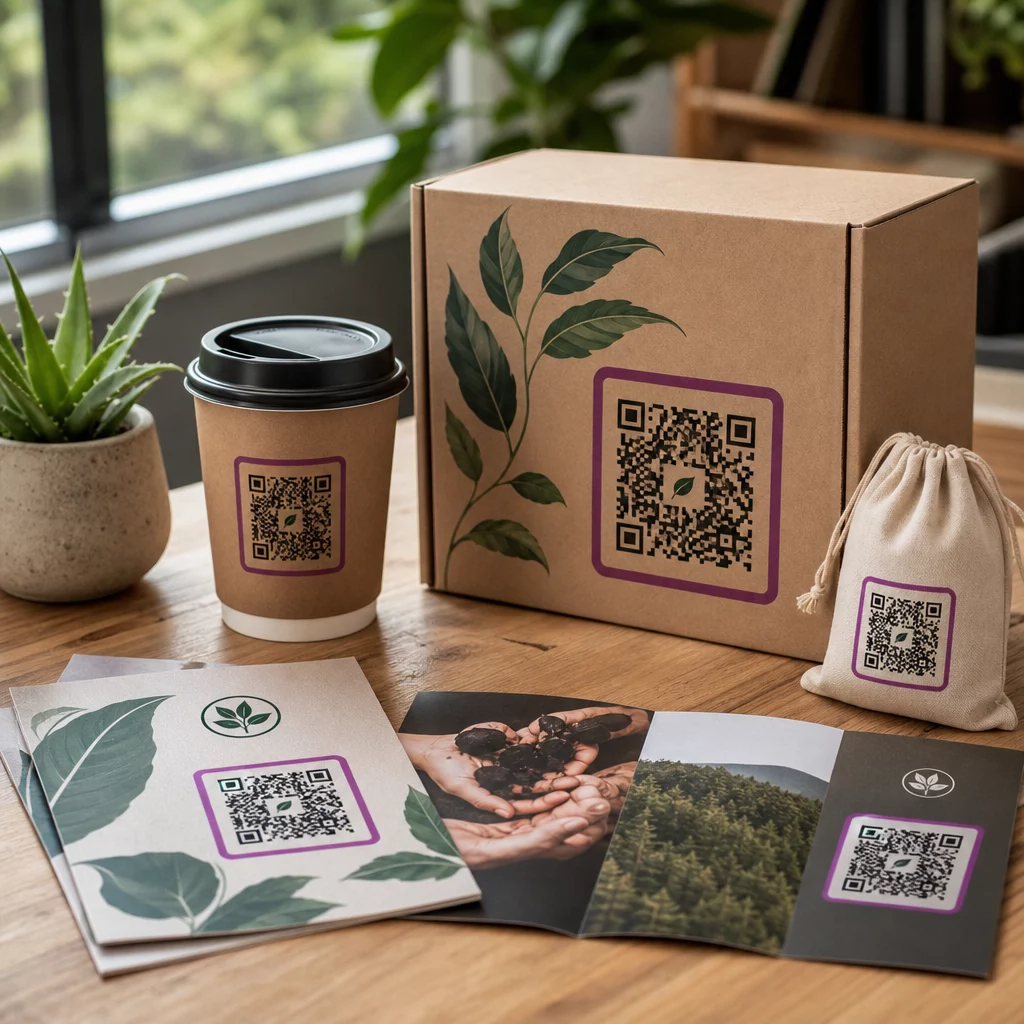
L'impression de codes QR durables n'est pas une technique unique – c'est une combinaison de choix de matériaux, de méthodes de production et de stratégie de code qui réduit l'empreinte environnementale des communications imprimées.
Les deux aspects fonctionnent ensemble. Matériaux écologiques réduisent l'impact du tirage physique : le papier certifié FSC ou recyclé, les encres végétales ou à base d'eau, et les substrats recyclables réduisent tous la consommation de ressources et les déchets. Codes QR dynamiques réduisent l'impact du cycle de vie du contenu : parce que l'URL de destination peut être mise à jour après l'impression, vous n'avez jamais besoin de réimprimer une étiquette ou un emballage simplement parce qu'un détail de produit, une certification ou une page de campagne a changé.
Ensemble, ces choix s'attaquent aux deux plus grandes sources de gaspillage d'impression – la surproduction et l'obsolescence.
Réduisez le gaspillage de réimpression de vos campagnes Avec un Générateur de QR code dynamique, vous pouvez mettre à jour le contenu lié à tout moment sans toucher au support imprimé – en maintenant l'emballage pertinent et en réduisant les déchets.
Pourquoi les codes QR dynamiques réduisent les déchets
Un code QR statique encode une destination fixe directement dans son motif. Changez l'URL, et le code est inutile – vous devez réimprimer. Un code QR dynamique encode plutôt un court lien de redirection. Cette redirection peut être dirigée n'importe où à tout moment, même après que le code a été imprimé et distribué.
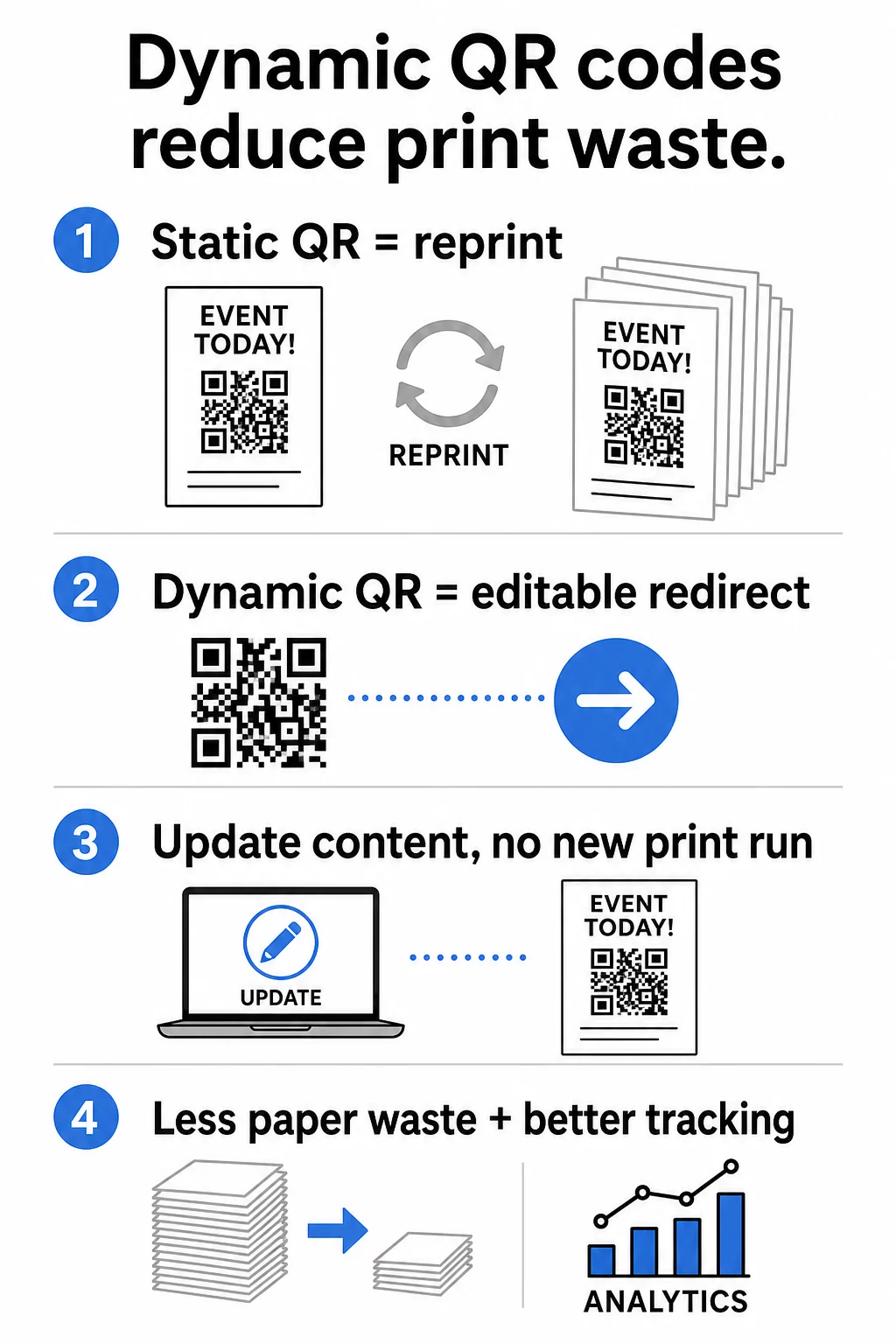
Cette distinction est importante pour la durabilité de trois manières concrètes :
- Durée de vie plus longue des matériaux. Les emballages, étiquettes et supports imprimés restent précis même lorsque le contenu lié change – qu'il s'agisse d'une nouvelle certification, d'une promotion saisonnière ou d'instructions de recyclage mises à jour.
- Tirages plus petits. Parce que vous n'êtes pas lié à une destination fixe, vous pouvez imprimer à la demande plutôt que de produire de grands lots pour amortir le coût des changements futurs.
- Moins de matériaux obsolètes. Les documents imprimés obsolètes sont une source importante de gaspillage de papier. Lorsque l'information réside dans la destination plutôt que dans le code, les matériaux ne deviennent pas obsolètes simplement parce que votre site web ou votre page produit a changé.
Les codes dynamiques fournissent également des analyses de scan – en suivant quand, où et sur quel appareil les scans se produisent – afin que vous puissiez mesurer l'engagement et affiner votre stratégie de contenu sans matériel imprimé supplémentaire. En savoir plus sur la façon dont le suivi des scans de codes QR et l'analyse fonctionne en pratique.
Exemples concrets : Marques utilisant l'impression de codes QR durables
Lampoon Magazine : Papier certifié FSC et encres végétales
Lorsque Lampoon Magazine a publié une édition spéciale axée sur les questions environnementales, ils ont aligné leur processus de production sur leur message éditorial. Le tirage a utilisé du papier certifié FSC, des encres végétales et des méthodes d'impression neutres en carbone.
Des codes QR dynamiques placés dans les pages du magazine ont lié les lecteurs à des mises à jour en direct sur les projets de compensation carbone – efforts de reforestation, investissements dans les énergies renouvelables et jalons de durabilité. Parce que les codes étaient dynamiques, l'équipe éditoriale pouvait mettre à jour ce contenu en temps réel à mesure que les projets progressaient, prolongeant l'utilité de l'édition imprimée sans un seul tirage supplémentaire. La campagne a généré un engagement mesurable sur les médias sociaux, les lecteurs partageant des scans et soulignant la transparence du magazine.
Hala Tree Coffee : Emballage compostable avec transparence de la chaîne d'approvisionnement
Hala Tree Coffee a repensé son emballage autour de sacs 100 % compostables fabriqués à partir de matériaux végétaux qui se décomposent entièrement dans les installations de compostage commerciales en 90 jours. Les codes QR ont été imprimés avec des encres biodégradables – choisies spécifiquement pour maintenir la scannabilité à mesure que l'emballage se dégradait.
Chaque code liait les clients à des informations détaillées sur l'origine du café, les certifications et les méthodes de traitement. En utilisant une plateforme QR dynamique, Hala Tree pouvait mettre à jour ce contenu instantanément lorsque de nouvelles certifications étaient obtenues ou lorsque des initiatives de durabilité comme les efforts de conservation de l'eau étaient lancées – sans produire de matériel imprimé supplémentaire. L'approche a réduit les déchets tout en renforçant la transparence de la chaîne d'approvisionnement.
The R Collective et Levi’s : Codes QR pour la mode circulaire
La marque de mode durable The R Collective s'est associée à Levi's pour le Denim Réinventé projet – une collection limitée de pièces en denim recyclé fabriquées à partir de tissu en fin de stock. Chaque vêtement comportait une étiquette tissée durable intégrant un code QR conçu pour résister aux lavages répétés.
La numérisation du code fournissait aux clients des instructions de recyclage, des conseils d'entretien et des comparaisons des économies environnementales par rapport à la production de denim conventionnelle. Les codes connectaient également les utilisateurs à un programme de reprise des vêtements usagés. Les données de la campagne ont montré que les clients scannaient les codes peu après l'achat et y revenaient pour des conseils d'entretien – un comportement qui a prolongé de manière mesurable la durée de vie des vêtements en encourageant un entretien approprié.
Le projet illustre comment les codes QR sur les emballages et les étiquettes de produits peuvent fonctionner comme des outils d'engagement à long terme plutôt que comme des étiquettes d'information à usage unique.
Comment Implémenter l'Impression Durable de Codes QR
Choisir des Matériaux et des Méthodes de Production Écologiques
La sélection des matériaux est le fondement de l'impression durable. Les choix clés incluent :
- Papier certifié FSC ou recyclé. La certification FSC et SFI confirme que le papier provient de forêts gérées de manière responsable, réduisant la demande de pâte vierge et soutenant les écosystèmes forestiers.
- Encres végétales ou à base d'eau. Les encres à base de soja et de lin sont dérivées de ressources renouvelables et produisent des émissions de composés organiques volatils (COV) plus faibles que les alternatives à base de pétrole. Les encres à base d'eau éliminent presque entièrement les solvants, réduisant ainsi les déchets dangereux.
- Substrats recyclables ou compostables. Les solutions mono-matériau – imprimer un code QR directement sur du carton recyclable plutôt que d'utiliser une étiquette séparée – simplifient le flux de recyclage.
- Impression numérique pour les petites séries. L'impression numérique permet l'impression à la demande et les petites séries, réduisant les déchets de configuration et évitant la surproduction. Elle est particulièrement efficace pour les codes QR sur les produits où l'efficacité des matériaux est essentielle.
- Partenaires de production certifiés. Travailler avec des imprimeurs certifiés selon les normes FSC, ISO 14001 ou Green Seal garantit que l'approvisionnement, les encres et les processus de production répondent à des critères de durabilité définis.
Concevez des codes QR qui s'impriment efficacement
Une bonne conception réduit la consommation d'encre et améliore la lisibilité – deux éléments importants pour la durabilité.
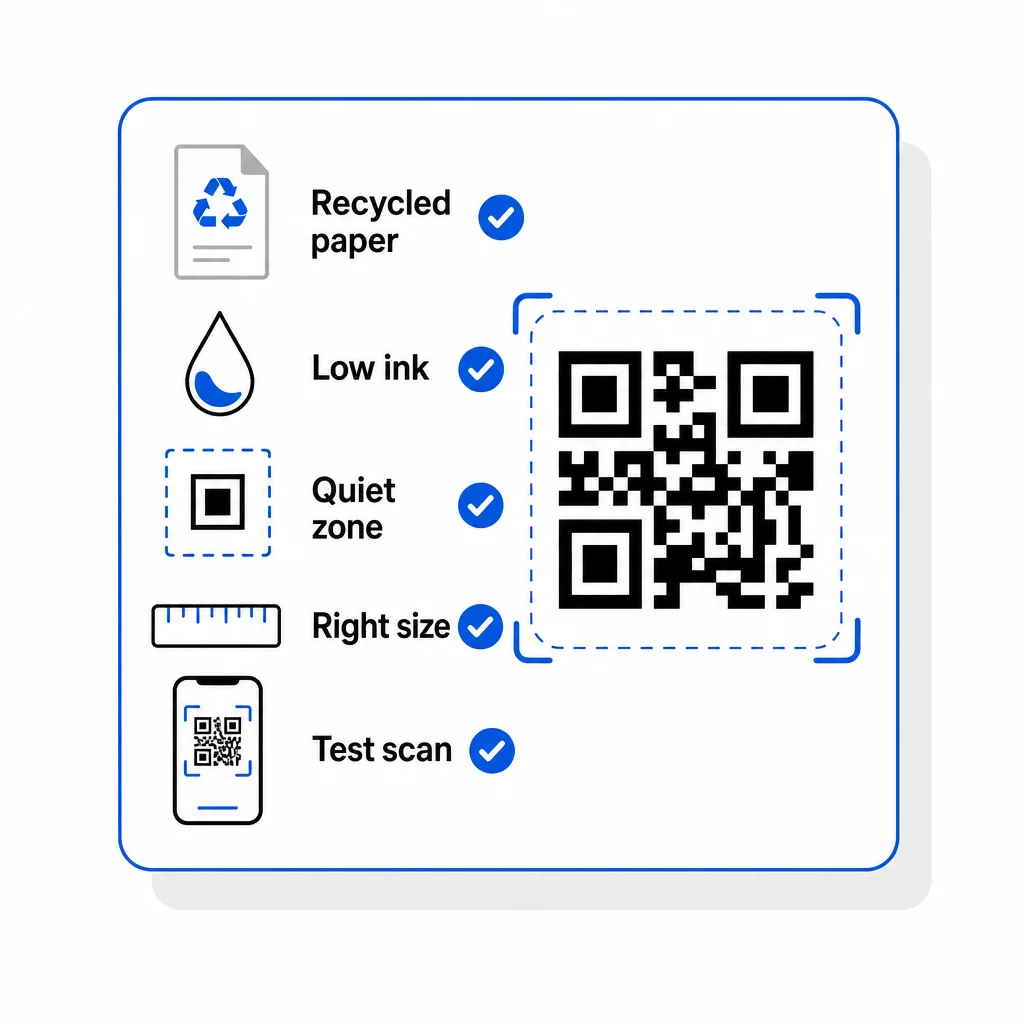
- Utilisez des modules foncés sur un fond clair. Le noir sur blanc est la combinaison de couleurs la plus fiable pour la numérisation. Il utilise également moins d'encre que de grandes zones solides de couleur foncée, en particulier lorsqu'il est appliqué sur une série d'impressions complète. Pour plus de conseils, voir les meilleures pratiques pour la lisibilité des codes QR.
- Gardez les tons terreux pour l'alignement de la marque. Si vous souhaitez signaler visuellement votre conscience écologique, les tons naturels peuvent fonctionner – à condition que le contraste reste suffisant. Testez toujours les épreuves imprimées avant la production complète.
- Dimensionnez les codes de manière appropriée pour le matériau. Un minimum de 0,8 pouce (environ 2 cm) carré est fiable pour la numérisation à courte portée. Pour les emballages vus à de plus grandes distances, appliquez la règle du 10:1 : la distance de numérisation en centimètres ne doit pas dépasser dix fois la largeur du code. Voir le Guide de dimensionnement des codes QR pour différents supports d'impression.
- Maintenez une zone de silence. Laissez une bordure claire et non imprimée d'au moins quatre modules de large sur tous les côtés du code. Sans cela, les scanners risquent de ne pas détecter la limite du code.
- Utilisez des formats vectoriels pour les fichiers d'impression. Envoyez les fichiers à votre imprimeur au format SVG, EPS ou PDF haute résolution pour éviter la pixellisation et conserver des bords nets quelle que soit la taille.
- Ajoutez votre logo. UNE Code QR avec votre logo augmente la reconnaissance et les taux de numérisation – il suffit de limiter le logo à environ 30 % de la zone du code et d'utiliser une correction d'erreur élevée pour maintenir la fiabilité.
Pour un aperçu plus approfondi de la façon dont la méthode d'impression affecte la scannabilité, voyez comment les techniques d'impression impactent la scannabilité des codes QR.
Créez du contenu qui renforce votre message de durabilité
Le contenu lié à votre code QR est l'endroit où la communication sur la durabilité se produit. Les options efficaces incluent :
- Pages de transparence de la chaîne d'approvisionnement. Les détails d'origine, les certifications et les méthodes de traitement donnent aux consommateurs soucieux de l'environnement les informations dont ils ont besoin pour prendre des décisions d'achat éclairées.
- Instructions d'entretien et d'élimination. Les directives de recyclage, les informations sur la compostabilité et les détails des programmes de reprise prolongent la durée de vie des produits et soutiennent les objectifs de l'économie circulaire.
- Données sur l'empreinte carbone. Des calculateurs interactifs ou des pages de comparaison montrant les économies environnementales par rapport aux alternatives conventionnelles présentent vos références en matière de durabilité en termes concrets et vérifiables.
- Mises à jour des certifications en direct. Parce que les codes dynamiques vous permettent de mettre à jour la destination liée, vous pouvez refléter les certifications nouvellement obtenues ou les initiatives de durabilité en évolution sans réimprimer une seule étiquette.
Les analyses de votre plateforme QR peuvent montrer quels types de contenu génèrent le plus d'engagement, vous permettant d'affiner votre narration sur la durabilité en fonction du comportement réel des clients.
Commencez à suivre vos campagnes de durabilité Le Générateur de code QR Pageloot vous permet de créer des codes dynamiques et de marque et de surveiller les performances de scan à partir d'un tableau de bord unique – aucune réimpression n'est requise lorsque votre contenu change.
Une note sur les allégations de durabilité et la conformité
Si vos codes QR renvoient à ou affichent des allégations environnementales – “ compostable ”, “ contenu recyclé ”, “ neutre en carbone ” – ces allégations doivent être exactes et étayées. Les Guides verts de la FTC s'appliquent aux allégations de marketing environnemental faites par tout canal, y compris les emballages, les étiquettes et les matériaux imprimés, qu'elles soient énoncées explicitement ou implicitement par la conception.
Les principales exigences pratiques :
- Soyez précis. Les allégations vagues comme “ respectueux de l'environnement ” ou “ vert ” sont peu susceptibles d'être entièrement étayées. Spécifiez quel aspect est durable et pourquoi.
- Étayez les allégations par des preuves. La FTC exige des “ preuves scientifiques compétentes et fiables ” pour les allégations environnementales.
- Clarifiez à quoi l'allégation s'applique. Il doit être clair si une allégation de durabilité fait référence au produit, à son emballage ou au processus de production.
- N'exagérez pas les certifications. Les sceaux et certifications de tiers doivent être affichés avec précision et sans impliquer un soutien plus large que ce que la certification couvre réellement.
Les codes QR dynamiques peuvent faciliter la conformité en renvoyant à une documentation détaillée et à jour – dossiers de certification, résultats d'audits tiers ou explications méthodologiques – qu'il serait peu pratique d'imprimer sur une étiquette.
Liste de contrôle pratique pour les campagnes d'impression de codes QR durables
Avant l'impression, confirmez chacun des points suivants :
- Le papier est certifié FSC, à contenu recyclé ou un autre substrat durable vérifié
- Les encres sont à base végétale, à base d'eau ou une autre alternative à faible teneur en COV
- Les codes QR sont dynamiques pour permettre de futures mises à jour de contenu sans réimpression
- La taille du code respecte le minimum pour la distance de balayage prévue (0,8 po / 2 cm pour une courte portée)
- Une zone de silence d'au moins quatre modules est préservée sur tous les côtés
- Un contraste élevé est maintenu (code foncé sur fond clair)
- Les fichiers sont fournis à l'imprimante au format vectoriel (SVG, EPS ou PDF haute résolution)
- Les allégations de durabilité liées au code QR sont spécifiques, précises et étayées
- Les codes sont testés sur plusieurs appareils (iOS et Android) avant la production complète
Pour plus de conseils sur le placement efficace des codes sur différents supports marketing, consultez le Guide de placement des codes QR pour le marketing.
Questions fréquentes
Les codes QR dynamiques encodent une courte URL de redirection plutôt qu'une destination fixe. Cette redirection peut être mise à jour à tout moment – même après l'impression du code – de sorte que le support physique reste précis et utile sans réimpression. Cela signifie que vous pouvez mettre à jour les certifications, les pages de produits ou le contenu de campagne sans jeter et réimprimer les étiquettes, les emballages ou les supports marketing.
Les choix ayant le plus grand impact sont le papier certifié FSC ou recyclé, les encres à base végétale ou à base d'eau (qui réduisent les émissions de COV et les déchets dangereux), et les substrats recyclables ou compostables. Combiner cela avec des méthodes d'impression numérique ou à tirage limité réduit à la fois la surproduction et le gaspillage de matériaux tout au long du cycle de vie de l'impression.
Oui – et c'est l'un des cas d'utilisation les plus solides. Les codes QR peuvent renvoyer à des pages de transparence de la chaîne d'approvisionnement, de la documentation de certification tierce, des instructions d'entretien et de recyclage, et des données de durabilité en temps réel qu'il serait peu pratique d'imprimer sur une étiquette. Parce que les codes dynamiques peuvent être mis à jour, le contenu lié peut refléter de nouvelles certifications ou initiatives à mesure qu'elles se développent, maintenant la communication à jour sans réimpression.