Are you unsure what your food packaging QR code should actually do? Most brands either link to a generic homepage or cram in duplicate label information – neither builds trust or loyalty. This guide covers what to encode, how to meet regulatory requirements, and how to design codes that customers actually scan.
Why Food Brands Are Adding QR Codes to Packaging
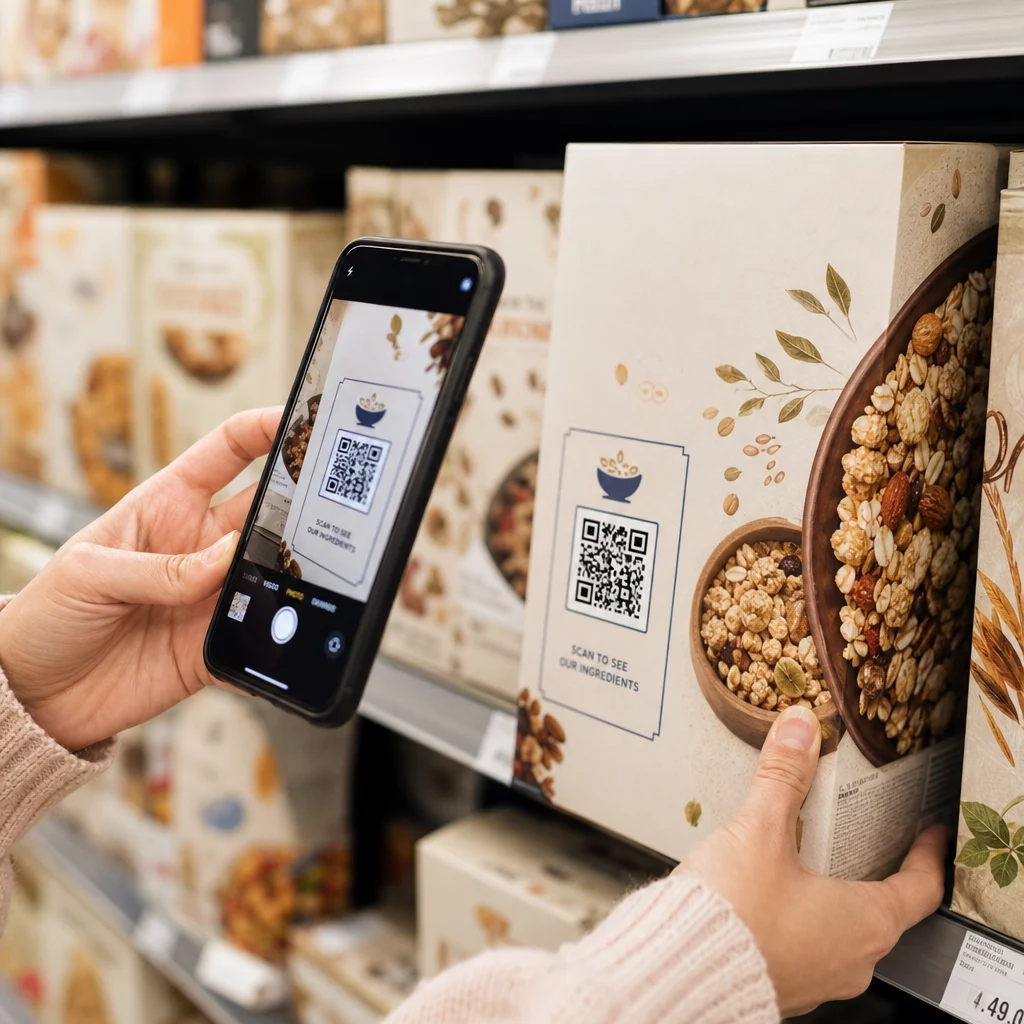
A QR code is a two-dimensional barcode that stores significantly more data than a traditional linear barcode and is scannable by any modern smartphone camera. On food packaging, this unlocks a bridge between the physical product and a dynamic digital experience.
Consumer interest is real. In a 2022 U.S. study of adults who use QR codes, 61% said codes on product labels offer excellent depth of information, and 55% said they scan them in stores to help make purchase decisions. A separate field study found that over 60% of shoppers chose milk containers with QR codes over conventionally labeled ones when given the choice.
The appeal is practical: packaging space is limited, but the information a modern buyer wants – ingredient sourcing, allergen details, recipes, promotions – is not. QR codes let you keep the label clean while giving motivated shoppers a path to exactly what they need.
Beyond consumer engagement, QR codes now intersect directly with supply chain traceability and food labeling regulations in the United States. Understanding all three dimensions – engagement, traceability, and compliance – is essential before you print a code on your next packaging run.
Regulatory and Traceability Requirements You Need to Know
FDA Food Traceability Rule (FSMA Section 204)
The FDA’s Food Traceability Final Rule establishes additional recordkeeping requirements for companies that manufacture, process, pack, or hold foods identified on the Food Traceability List. The rule is designed to enable faster identification and removal of potentially contaminated food from the market.
Covered entities must capture and maintain Key Data Elements (KDEs) for each Critical Tracking Event (CTE) in the supply chain – including harvesting, initial packing, shipping, receiving, and transformation. All traceability records must be linked to a Traceability Lot Code (TLC) and must be producible as an electronic sortable spreadsheet within 24 hours of an FDA request.
The original compliance date was January 2026; FDA has since extended enforcement to approximately July 2028, giving covered businesses additional time to implement systems.
QR codes are compatible tools for facilitating this recordkeeping. A QR code can encode the TLC, expiration date, batch number, and other KDEs in a single scannable symbol – far more than a traditional linear barcode can hold. For a deeper look at how this works in practice, see QR codes for FDA compliance: what to know.
Bioengineered Food Disclosure (USDA National Bioengineered Food Disclosure Standard)
Under this standard, foods containing bioengineered ingredients must carry a disclosure. Manufacturers may deliver this disclosure through one of four methods: printed text, a symbol, a text message option, or an electronic or digital link such as a QR code.
If you choose the QR code route, the packaging must include both a statement such as “Scan here for more food information” and a phone number with the instruction “Call [number] for more food information.” Critically, the first screen a user sees after scanning must display the bioengineered disclosure – not a general homepage. A 2022 court ruling confirmed that a QR code alone, without the accompanying phone number, is not lawful for GMO disclosure under this standard.
What QR Codes Cannot Replace
Available regulatory guidance does not support using a QR code as a complete substitute for required on-package elements such as the Nutrition Facts panel, ingredient list, or allergen statements. A QR code should supplement these disclosures, not replace them. When in doubt, treat the code as an enhancement layer on top of fully compliant physical labeling.
GS1 Digital Link and Sunrise 2027
The GS1 Digital Link standard extends GS1 identifiers – like the Global Trade Item Number (GTIN) – into web-compatible URLs. This means a single QR code can serve at point-of-sale checkout scanners and deliver consumer-facing content when scanned with a smartphone.
GS1 Sunrise 2027 is the global initiative by which retail point-of-sale systems are expected to be capable of scanning 2D barcodes on retail products. GS1’s guidance for brands is to ensure any QR codes on packaging follow the GS1 Digital Link standard and include the product’s GTIN. There will be a transition period where both traditional EAN/UPC barcodes and 2D symbols appear on the same pack.
If your product sells through retail channels, aligning your QR code with GS1 Digital Link now reduces the risk of a costly packaging redesign as 2027 approaches. For a technical walkthrough, see how to implement GS1 Digital Link QR codes effectively.
What to Link Your Food Packaging QR Code To
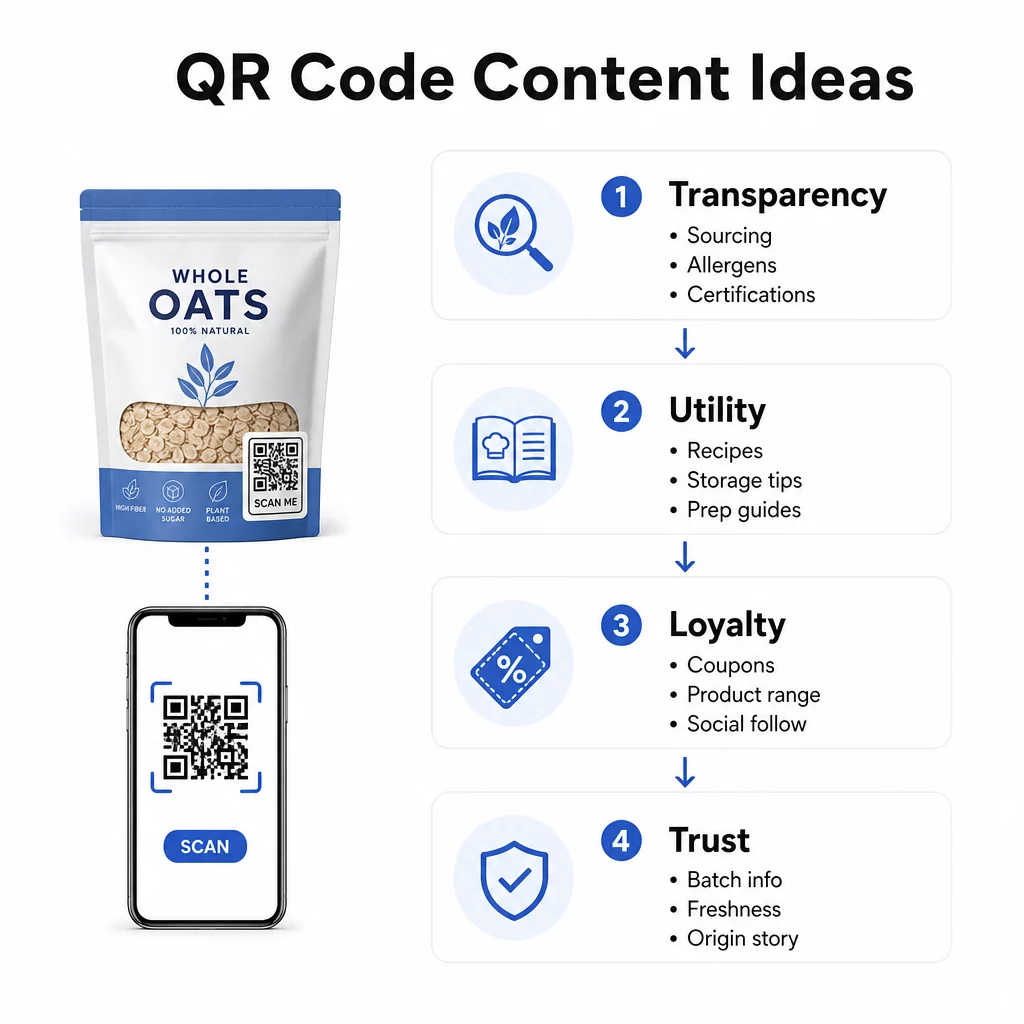
The content your QR code points to determines whether scanning feels worthwhile or disappointing. Only 29% of QR users in a 2022 study said they are often disappointed with content after scanning – but that means nearly one in three scans underdelivers. Here is what actually drives value:
Transparency and product information
- Detailed ingredient sourcing and supplier information
- Extended nutritional data, including sugar content, fiber, allergen certifications (nut-free, gluten-free), or third-party certifications
- Bioengineered food disclosures, where required by regulation
Engagement and utility
- Video recipes using the product, especially from chefs or nutritionists
- Healthy pairing suggestions with other foods
- How-to preparation guides or storage tips that do not fit on the label
Commercial and loyalty drivers
- Discount codes or promotional coupons for future purchases (over half of QR users in a 2021 survey said they would use codes to redeem promotions while shopping)
- Links to your broader product range, introducing customers to items they have not tried
- Social media pages for sharing, following, or user-generated content campaigns
- Contest or sweepstakes entry pages
Traceability and trust
- Batch or lot information and production date details
- Recall notice pages or freshness verification
- Supply chain origin stories, particularly relevant for premium or sustainably sourced products
For a broader look at how QR codes strengthen the entire retail packaging experience, see QR codes on packaging: benefits for retail.
What to Avoid
Some content choices actively reduce the perceived value of a scan:
- Linking to your corporate homepage with no product-specific content
- Duplicating information already printed clearly on the label (such as a basic ingredient list)
- Directing users to pages not optimized for mobile browsers
- Using entertaining content that is mismatched to the product audience (for example, a game on packaging aimed at adults)
Why Dynamic QR Codes Matter for Food Packaging
Static QR codes encode a fixed destination. Once printed, they cannot be changed. For food packaging – where promotions cycle, regulations update, and products evolve – this is a significant constraint.
Dynamic QR codes point to a redirect URL that you can update at any time through a dashboard. The code printed on the package stays identical; only the destination changes. This means:
- A seasonal promotion can go live and be retired without a new print run
- A regulatory update to your bioengineered disclosure page takes effect immediately across all printed packages in the field
- If a product is subject to a recall, the linked page can be updated to reflect current guidance
Dynamic codes also provide scan analytics – tracking when, where, and on what devices your codes are scanned. This data tells you which packaging placements are performing and where consumer interest is highest.
Track Every Scan From Your Packaging Want to know which products are driving the most engagement and where customers are scanning? Use the Dynamic QR Code Generator to create updatable, trackable codes with a full analytics dashboard.
One important note: QR codes created under a free trial period can deactivate when the trial ends. If you plan to print codes on physical packaging, ensure your codes are backed by an active subscription before committing to a print run.
Design and Placement Best Practices
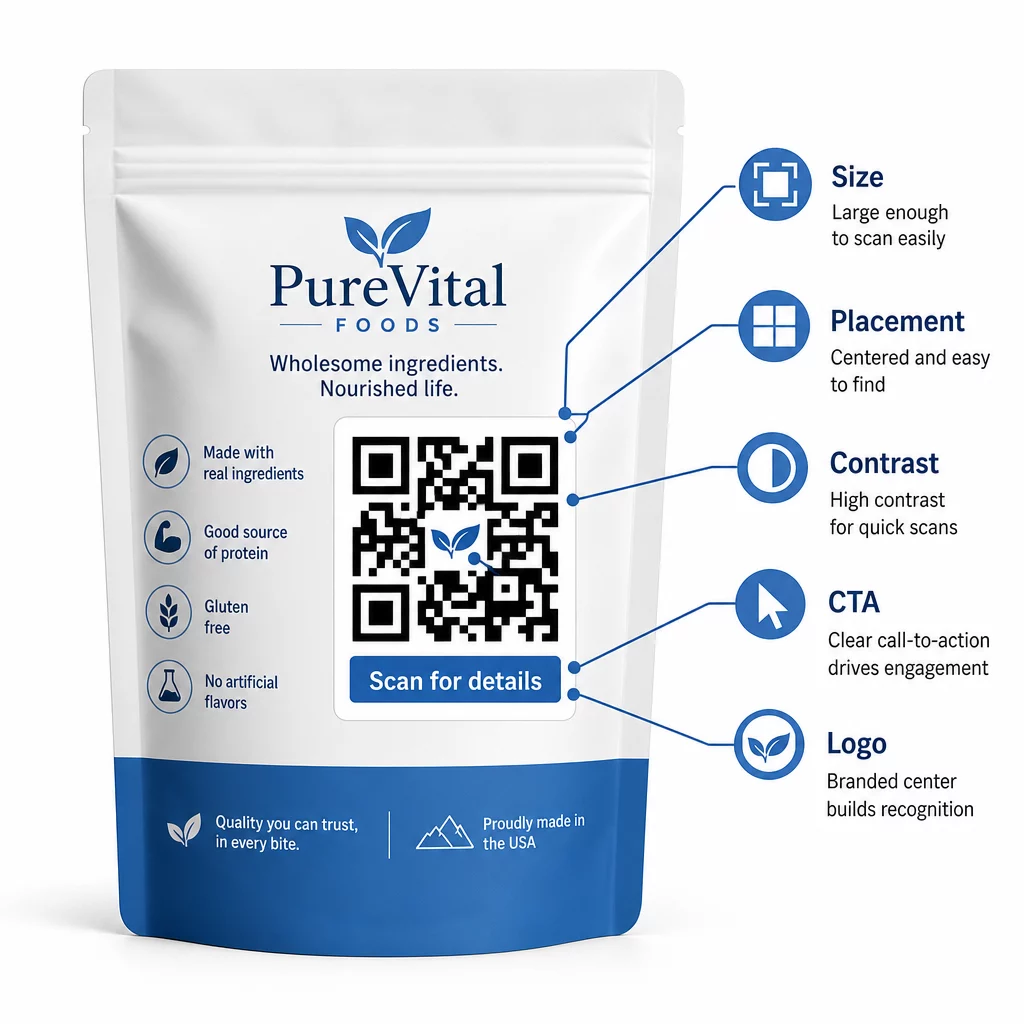
A QR code that cannot be scanned reliably delivers none of its intended value. These guidelines apply specifically to food packaging:
Size
The code should be at least 3 × 3 centimeters (roughly 1.2 inches square) to ensure it can be spotted and scanned easily. Smaller packaging may require testing at the minimum viable size before full production. For detailed guidance on sizing across different print materials, see QR code sizing for different print materials.
Placement
Place the code on a flat, smooth surface – away from seams, rims, corners, and folding lines that distort the pattern. A central, attention-grabbing area on the back or side panel typically works best. Avoid curved surfaces such as bottle necks or can sides where distortion can prevent a clean scan.
Color and contrast
Use dark modules on a light background. If your packaging design calls for brand colors, ensure sufficient contrast – a high-contrast dark-on-light scheme is essential for reliable scanning under variable store lighting. Avoid gradients over the code itself, and maintain the quiet zone (the clear border around the code) at all times. See QR code color contrast best practices for specific contrast ratio guidance.
Call to action
Add a short phrase near the code that tells the consumer what they will get by scanning. “Scan for recipes,” “Scan for 20% off your next order,” or “Scan to verify origin” all set a clear expectation and increase scan rates. A generic “scan here” with no context leaves consumers guessing.
Branding
A QR code with your logo embedded in the center is more recognizable and can increase trust. Keep the logo simple and ensure it occupies no more than 30% of the code area to preserve scannability.
For comprehensive readability guidance including quiet zones, error correction, and device compatibility testing, see best practices for QR code readability.
Connecting Packaging QR Codes to Your Supply Chain
QR codes on food packaging are not just a consumer-facing tool – they can carry the same traceability data your supply chain relies on. A code encoded with a GS1 Digital Link URI can simultaneously serve POS checkout systems, supply chain tracking platforms, and consumer smartphones with a single symbol.
This is particularly relevant for products on the FDA’s Food Traceability List, where lot codes and CTEs must be linked and accessible. Encoding the TLC directly in the QR code – or linking to a record that contains it – supports the rapid data retrieval the FDA’s 24-hour response requirement demands.
For a broader view of how QR codes function within manufacturing and supply chains, see QR codes in manufacturing: tracking materials and products and QR codes for supply chain tracking.
Pageloot’s product industry QR solutions are designed to support exactly this kind of dual-purpose implementation – connecting consumer engagement with backend traceability in a single managed code.
Getting Started
The most effective food packaging QR codes balance three goals: compliance, traceability, and consumer value. Start by determining which regulatory requirements apply to your product category, then build the consumer content layer around them. Use dynamic codes so you can update destinations without reprinting, and design with contrast, size, and placement in mind from the beginning.
Create Your First Food Packaging QR Code The Pageloot QR Code Generator lets you build customizable, dynamic codes with analytics built in – free for 14 days, no credit card required. Explore industry-specific QR solutions to find the right setup for your product category.
Frequently Asked Questions
No. Current U.S. regulatory guidance does not support using a QR code as a complete substitute for required on-package disclosures such as the Nutrition Facts panel, ingredient list, or allergen statements. QR codes are best used as an enhancement layer that supplements fully compliant physical labeling, not as a replacement for it.
A static QR code encodes a fixed destination that cannot be changed after printing. A dynamic QR code points to a redirect URL that you can update at any time from a dashboard, without reprinting the packaging. For food brands, dynamic codes are strongly preferred because they allow promotions to change, regulatory pages to be updated, and recall notices to be activated – all without a new print run.
GS1 Sunrise 2027 is the initiative by which retail point-of-sale systems are expected to be capable of scanning 2D barcodes – including QR codes – by the end of 2027. For food brands, this means QR codes on retail packaging should follow the GS1 Digital Link standard and include the product’s GTIN, so the same code works at checkout and delivers consumer-facing content when scanned by shoppers. There will be a transition period where both traditional barcodes and 2D symbols appear on the same pack.