Have you ever struggled to connect physical marketing materials to online digital experiences without losing your customer’s attention? Manual URL typing leads to high drop-off rates and lost conversion opportunities. Here is how the history and technical evolution of QR codes created the seamless offline-to-online bridge businesses rely on today.
How Traditional Barcodes Created a Manufacturing Bottleneck
During the economic expansion of the early 1990s, high-volume manufacturing and logistics operations faced a major technical challenge. Industrial facilities relied on standard one-dimensional (1D) linear barcodes to track inventory, components, and shipments. However, 1D barcodes can only hold roughly 20 alphanumeric characters of data encoded across a single horizontal row.
As manufacturing workflows became more complex, factory workers in automotive plants had to scan multiple barcodes on a single box or component to retrieve all necessary tracking information. At DENSO WAVE, a subsidiary of Toyota supplier DENSO, assembly line workers experienced severe reading fatigue and operational delays because they spent hours aiming handheld scanners at dozens of individual barcodes on every parts bin.
Management needed a far more efficient tracking method: a compact data carrier capable of holding substantially more information while remaining readable at high speeds.
The Invention of the QR Code by DENSO WAVE in 1994
In 1994, DENSO WAVE engineer Masahiro Hara led a team to design a barcode that solved the physical data storage limit. Inspired by the visual grid structure of the board game Go, Hara developed a two-dimensional (2D) matrix symbol capable of encoding information both horizontally and vertically.
The engineering team named their system the Quick Response code, or QR code, reflecting their core priority: rapid data decoding.
To ensure scanners could read the symbol quickly from any orientation, the engineering team incorporated several key technical features:
- Integrating position detection patterns: Placing three distinct square markers in the corners allows online QR code scanners to locate the code instantly and determine its correct orientation from any scanning angle.
- Establishing optimal pattern ratios: Analyzing thousands of printed images revealed that the visual module ratio of 1:1:3:1:1 rarely appeared in standard text or graphics, making it the ideal geometric design for corner markers to prevent scanner misreads.
- Embedding Reed-Solomon error correction: Applying advanced mathematical algorithms enables a code to remain fully readable even if up to 30% of its printed area is damaged, dirty, or torn.
- Expanding total data capacity: Expanding data density allows a maximum-size Version 40 grid to store up to 7,089 numeric characters, 4,296 alphanumeric characters, or 1,817 Kanji characters in a single image.
How Open Standardization Accelerated Global Adoption
After patenting the matrix architecture, DENSO WAVE made a decision that transformed global data exchange: the company published the QR code specification publicly and declared it would not exercise its patent rights. By offering the technology royalty-free, DENSO WAVE allowed hardware manufacturers, software developers, and commercial enterprises to adopt QR codes without licensing fees or legal constraints.
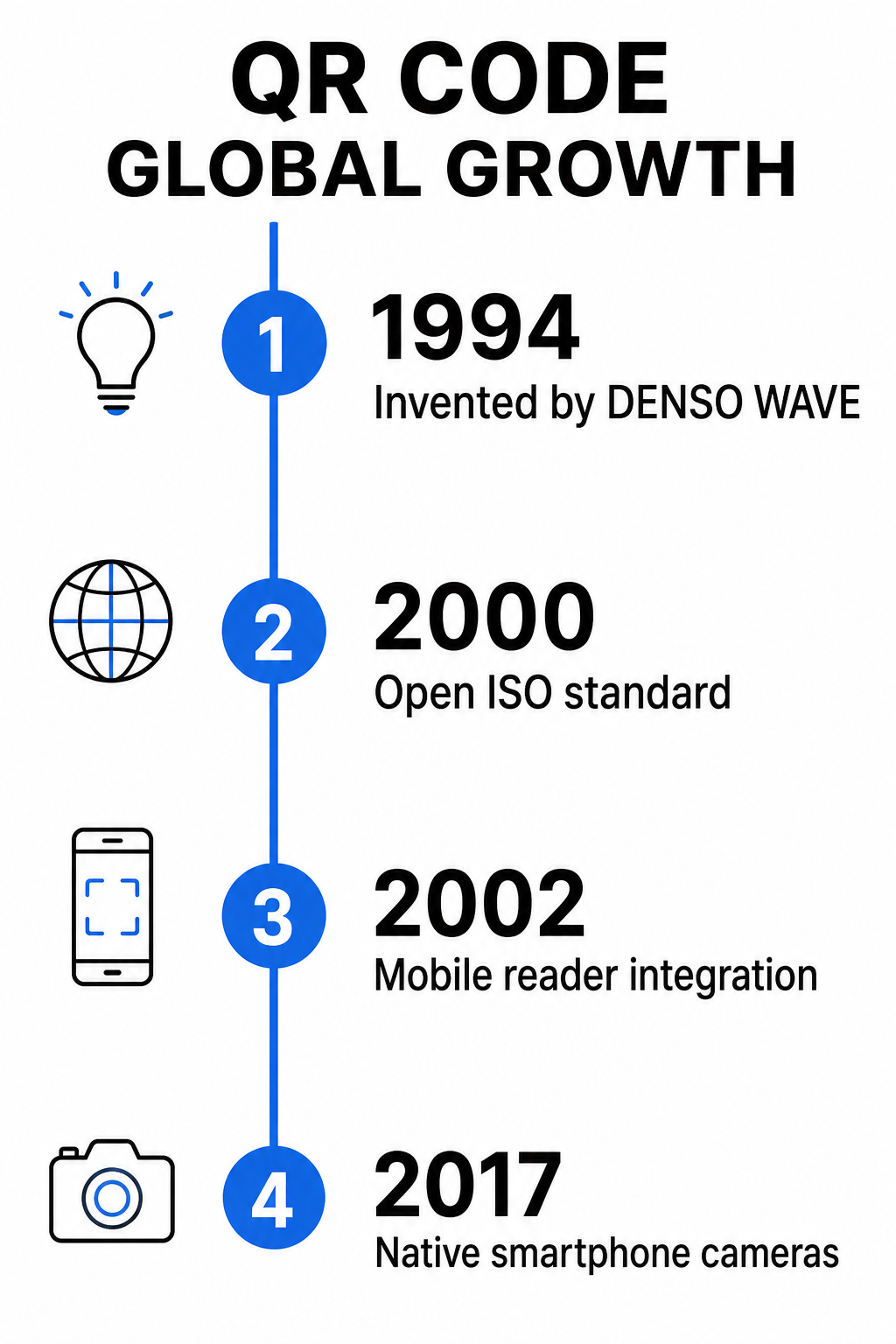
This open-access framework led to rapid international standardization:
- 1997: Standardized by Automatic Identification Manufacturers (AIM) International for cross-industry tracking.
- 1999: Approved as a Japanese Industrial Standard (JIS X 0510) and adopted across automotive supply chains.
- 2000: Formalized by the International Organization for Standardization as ISO/IEC 18004, providing a global technical specification for encoding, decoding, and error correction.
With an open technical foundation, software developers worldwide began integrating 2D barcodes into enterprise platforms, establishing modern scanning trends across industries.
Create Trackable Campaigns in Seconds Want to connect physical marketing materials with dynamic digital destinations? Use the QR code generator to design customizable, editable codes for your business today.
The Consumer Shift From Mobile Handsets to Native Cameras
While enterprise and factory adoption expanded rapidly in the late 1990s, widespread consumer interaction lagged because everyday shoppers lacked portable optical scanners.
That barrier began to dissolve in 2002, when Japanese mobile carriers released feature phones with pre-installed QR reader software. Japanese brands immediately capitalized on this capability by adding codes to print ads, product packaging, and billboards, letting mobile users open web pages without typing complex web addresses on numeric keypads.
Consumer adoption developed more slowly in Western markets. Throughout the late 2000s and early 2010s, smartphone users had to search for, download, and install standalone third-party applications. While comparing the top scanning apps was common among tech-savvy users, requiring a dedicated app download limited broad consumer engagement.
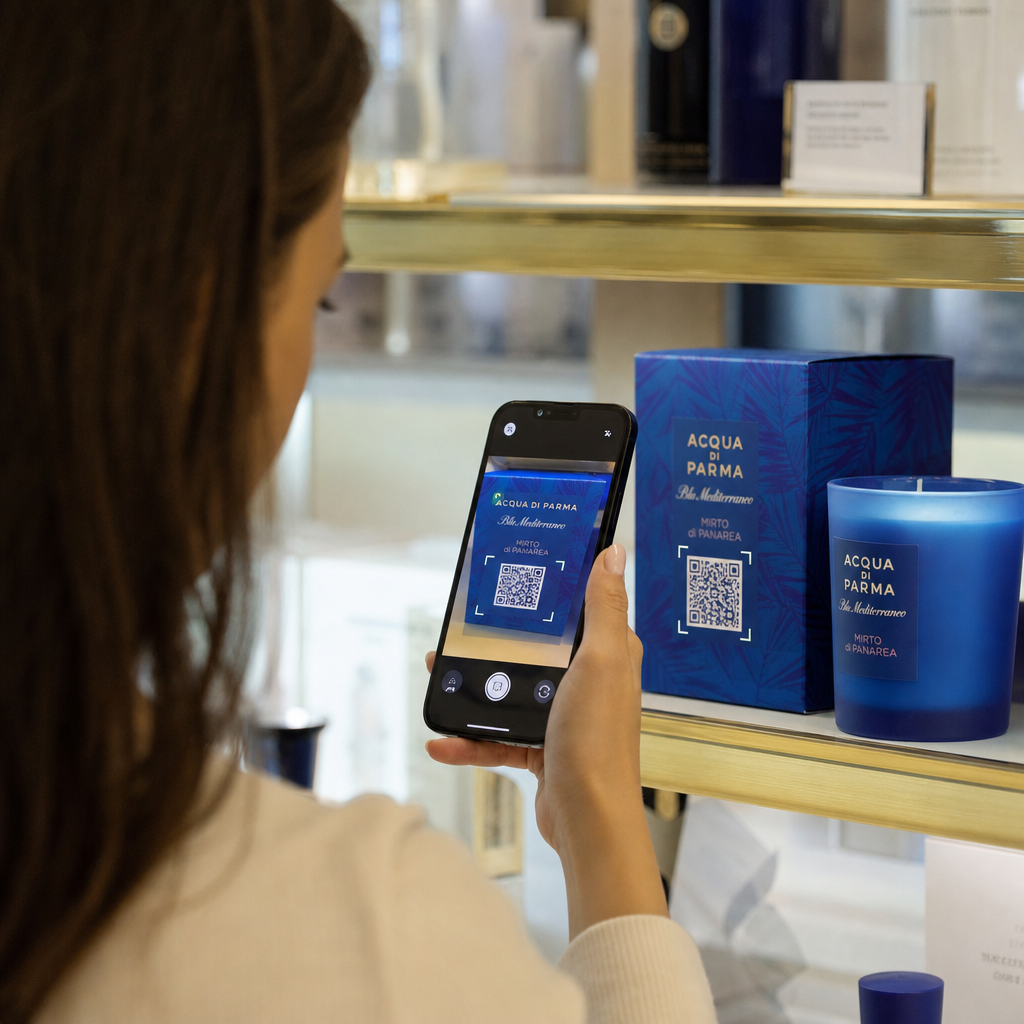
The major turning point arrived in 2017, when Apple released iOS 11 with native QR code recognition built directly into the standard iPhone camera app. Android device manufacturers followed quickly with similar camera integrations. Suddenly, hundreds of millions of consumers could point their default camera at any code and tap a single notification banner to open a digital link.
| Year | Structural Era | Primary Adoption Driver |
|---|---|---|
| 1994 | Industrial Invention | Automotive supply chain inventory tracking |
| 2000 | Open Standardization | ISO/IEC 18004 specification and royalty-free patent stance |
| 2002 | Early Mobile Integration | Japanese mobile phones launched with built-in readers |
| 2017 | Native Camera Adoption | Apple iOS 11 and Android operating systems integrated native camera scanning |
| 2020+ | Global Ubiquity | Contactless interactions and real-time marketing analytics |
Modern Applications: Payments, Contactless Usage, and Dynamic Marketing
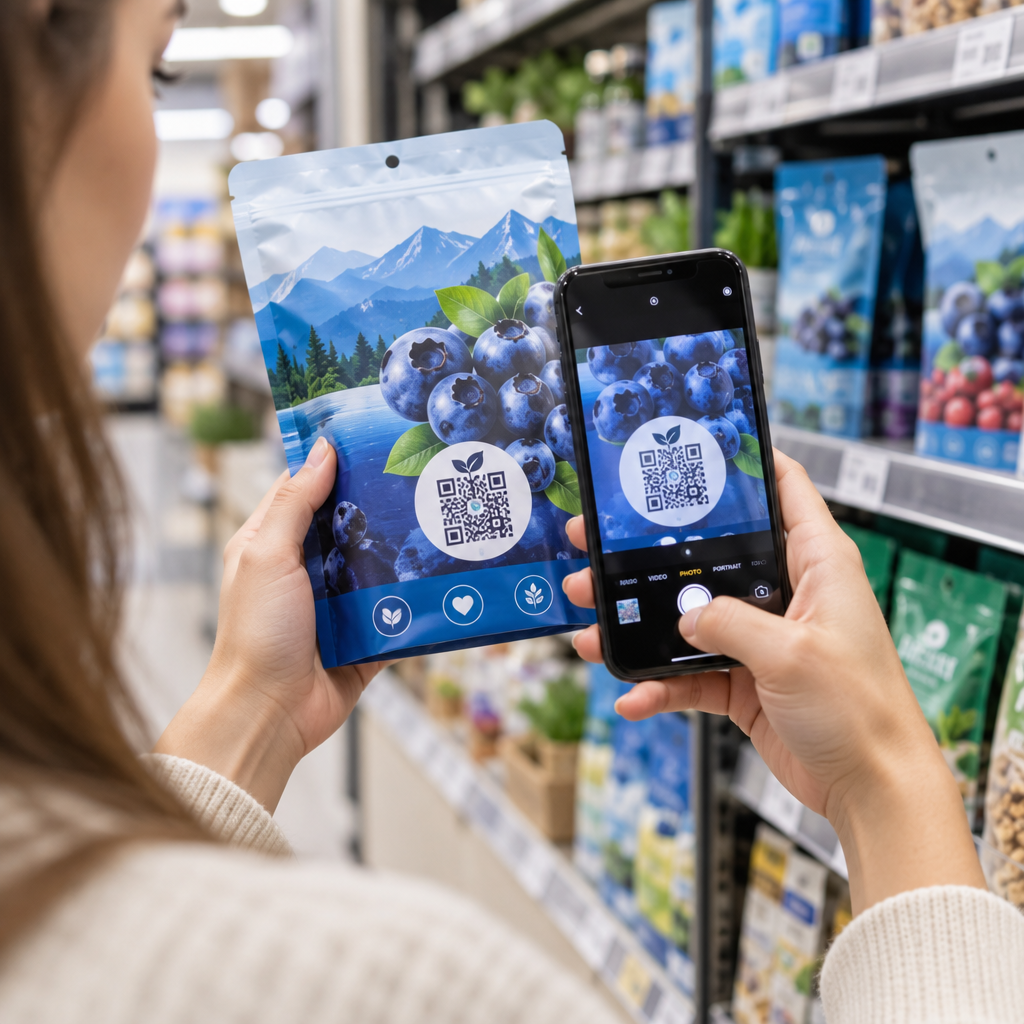
By the time smartphone camera integration was complete, global consumers were fully equipped to interact with physical touchpoints. When the COVID-19 pandemic created an urgent demand for touchless interactions, businesses pivoted rapidly to QR infrastructure for touchless restaurant menus, digital event check-ins, and secure retail access.
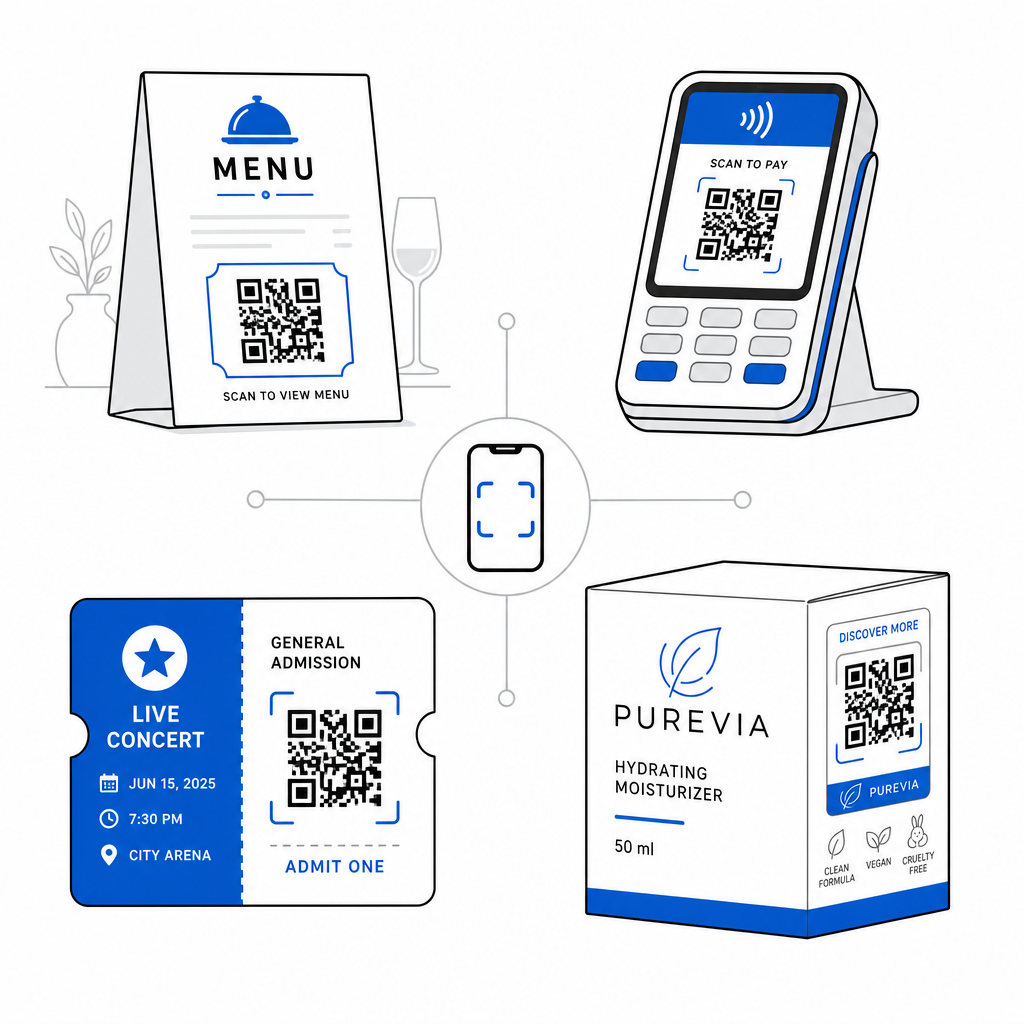
In developing markets, 2D codes drove financial inclusion by enabling instant mobile payments without costly point-of-sale card terminals, expanding access to banking services as detailed in research on future QR code payments in emerging economies.
For modern business owners, the shift from basic static codes to dynamic architecture represented a major operational upgrade:
- Static QR codes: Encoding target links directly into the printed module pattern creates a fixed destination that cannot be edited or tracked after printing.
- Dynamic QR codes: Encoding a short redirect link into the matrix structure allows you to modify the destination URL at any time while collecting scan metrics like location, device type, and scan timing.
Businesses can evaluate specialized industry QR code applications to identify optimal implementation strategies for retail packaging, event ticketing, or direct response campaigns.
Maximizing the Impact of QR Code Technology
From solving 1D barcode data limits in 1994 automotive plants to driving digital engagement across millions of modern consumer devices, QR codes provide a proven, reliable bridge between physical touchpoints and online content.
To convert your offline audience into measurable digital engagement, build your next campaign using dynamic QR codes. Start generating trackable codes today to monitor scan locations, adjust destination links without reprinting materials, and deliver seamless experiences to your customers.
Frequently Asked Questions
Masahiro Hara and his engineering team at DENSO WAVE invented the QR code in 1994 to overcome the data storage limits of standard linear barcodes in automotive manufacturing plants.
DENSO WAVE published the technical specifications and pledged not to exercise its patent rights so the technology could be adopted globally as an open standard without licensing fees or legal barriers.
Static QR codes encode unchangeable data directly into the printed matrix pattern, whereas dynamic QR codes use editable short redirect URLs that allow you to update target links and collect scan analytics without reprinting materials.