Are sample mix-ups and illegible tube labels creating chaos in your laboratory? Manual entry errors compromise patient safety, ruin testing batches, and jeopardize regulatory compliance during critical audits. Implementing a standardized QR code tracking system establishes an unbroken digital chain of custody across collection, testing, and cold storage.
The Impact of Manual Documentation and Labeling Errors
Manual tracking places an unnecessary burden on laboratory staff. According to evidence gathered by the CDC, patient-specimen identification errors are approximately 4.4 times more likely when technicians rely on manual entry rather than automated barcode systems. Handwritten vials, paper manifests, and keyboard data entry create multiple failure points during accessioning and processing.
When a sample transfers between collection sites, analytical benches, and ultra-low freezers, paper logs fail to provide verifiable accountability. Under US CLIA requirements and College of American Pathologists (CAP) standards, clinical facilities must ensure positive specimen identification throughout testing and reporting. Without an automated digital trail, demonstrating who handled an aliquot, when an extraction occurred, or where a sample was stored becomes difficult during compliance reviews.
Why 2D QR Codes Outperform Traditional 1D Barcodes
Many legacy labs still rely on linear 1D barcodes. However, two-dimensional matrix codes offer significant practical advantages for modern specimen handling. While traditional linear barcodes hold only 20 to 85 characters, a QR code can store up to 4,296 alphanumeric characters. This high data capacity allows you to encode unique identifiers, protocol numbers, and timestamps directly onto small specimen vials without requiring an oversized label.
Comparing a linear barcode vs qr code reveals clear operational differences in harsh environments:
- Error correction: QR codes feature built-in Reed-Solomon error correction that restores up to 30% of damaged data (Level H). If a vial label suffers frost build-up or chemical splashes, scanners can still decode the information accurately.
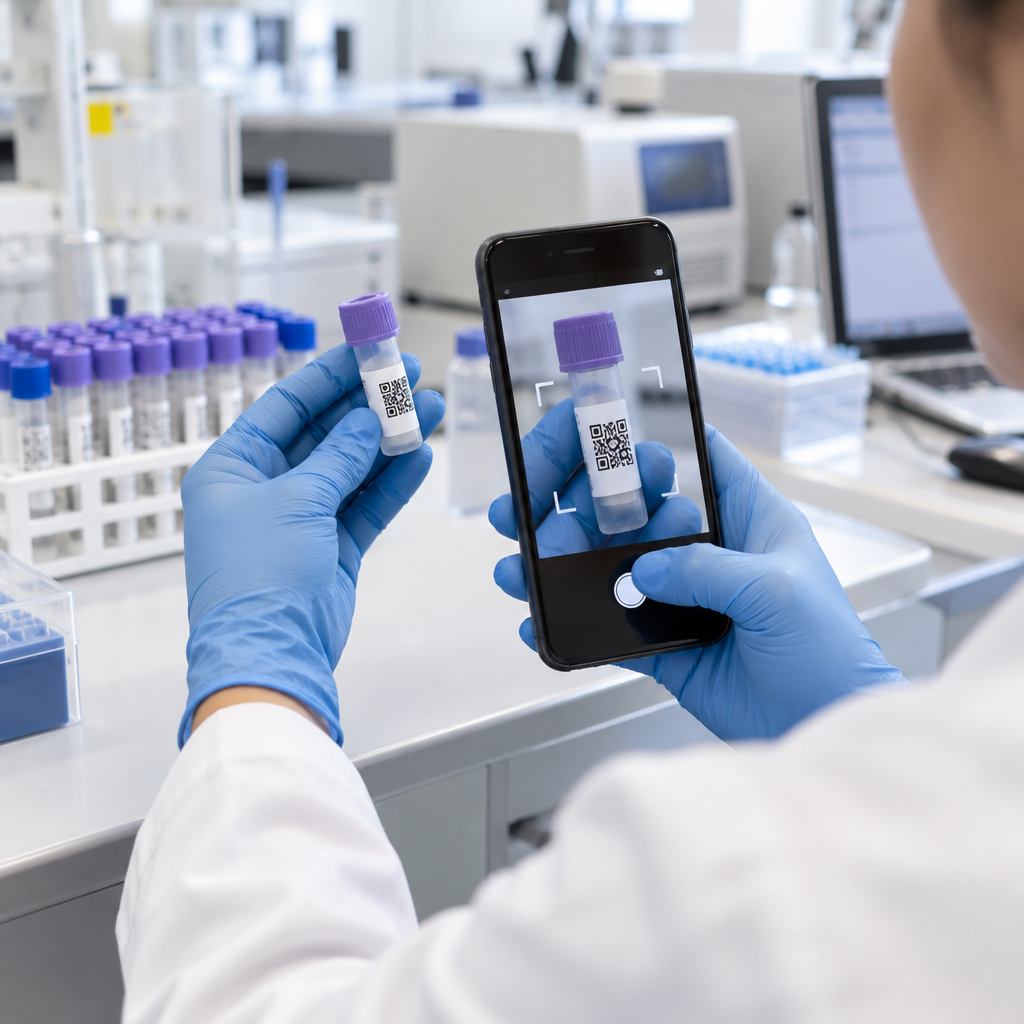
- Omnidirectional scanning: Technicians do not need to align a beam across a straight line of bars. A standard barcode scanner or digital qr code scanner can read 2D codes from any angle on curved test tubes and cryovials.
- Compact footprint: In constrained settings where laboratories evaluate data matrix vs qr code options for microplates, 2D matrix symbologies deliver readable data in footprints as small as 0.8 x 0.8 inches.
Designing Durable Labels for Harsh Laboratory Conditions
A tracking system is only as reliable as the substrate carrying the code. Standard paper labels deteriorate rapidly under routine lab handling. Specimen containers require synthetic label materials, such as polypropylene or cryogenic polyester, combined with specialized cold-temperature adhesives.
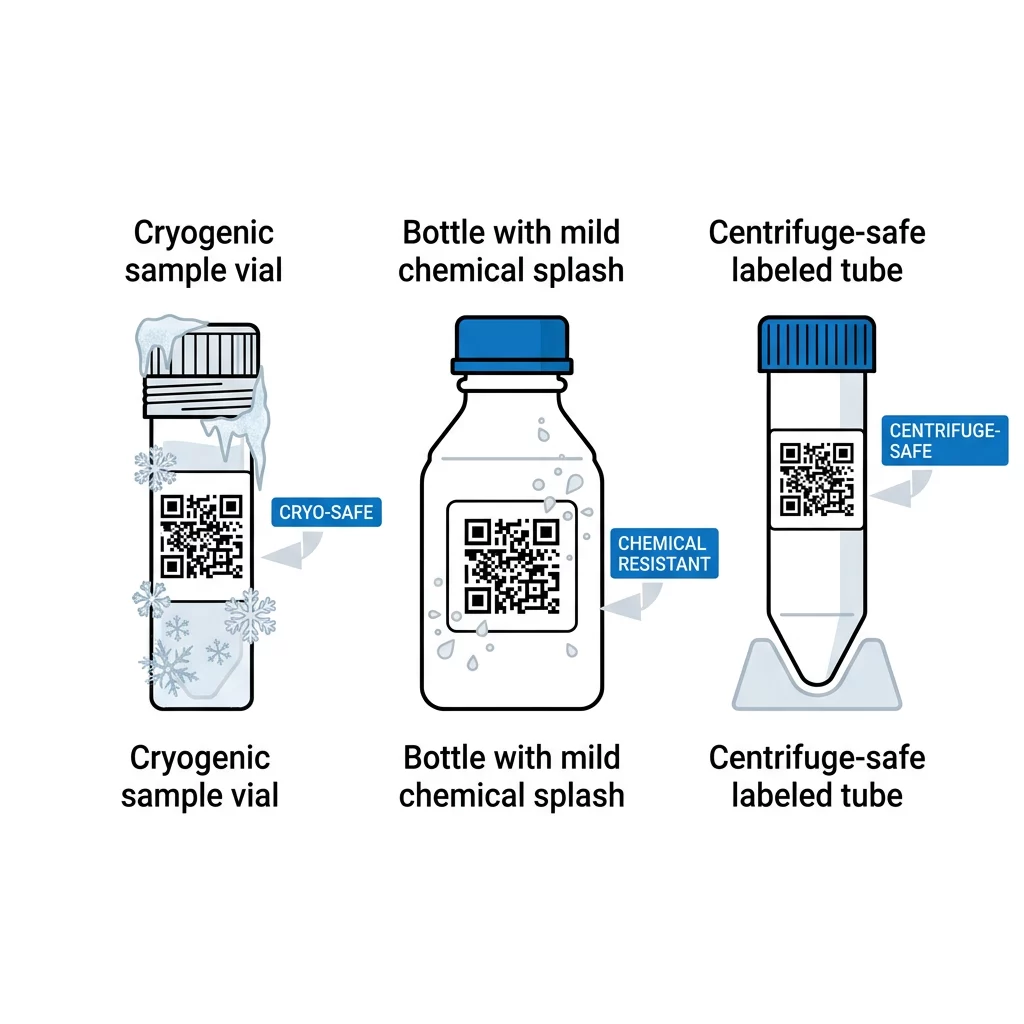
Select label stocks that provide verified resilience against common laboratory stressors:
- Cryogenic resistance to withstand deep-cold storage in ultra-low freezers at -80°C and liquid nitrogen at -196°C.
- Chemical resilience against exposure to harsh solvents like xylene, DMSO, alcohols, and concentrated bleach.
- Thermal and pressure tolerance to endure steam autoclaving, dry heat sterilization, and high-speed centrifugation.
To ensure consistent scannability, apply established best practices for qr code readability. Maintain at least 30% symbol contrast between the dark modules and the light background, though aiming for 50% provides greater scanning reliability under uneven benchtop lighting. Always maintain a clear border, or quiet zone, of at least four module widths around the symbol. Reviewing how printing techniques impact qr code scannability helps you configure thermal transfer printers to prevent bleeding and edge distortion.
Regulatory standards also govern label design. CAP guidelines recommend retaining at least two human-readable identifiers – such as a unique accession number and patient identifier – alongside the scannable code. This redundancy guarantees that technicians can identify a sample even if optical scanning equipment is unavailable.
Establishing an Automated Chain-of-Custody Workflow
Automating sample handling requires structured digital checkpoints across the entire testing lifecycle. Integrating scannable codes ensures every handoff generates an automated, verifiable record.
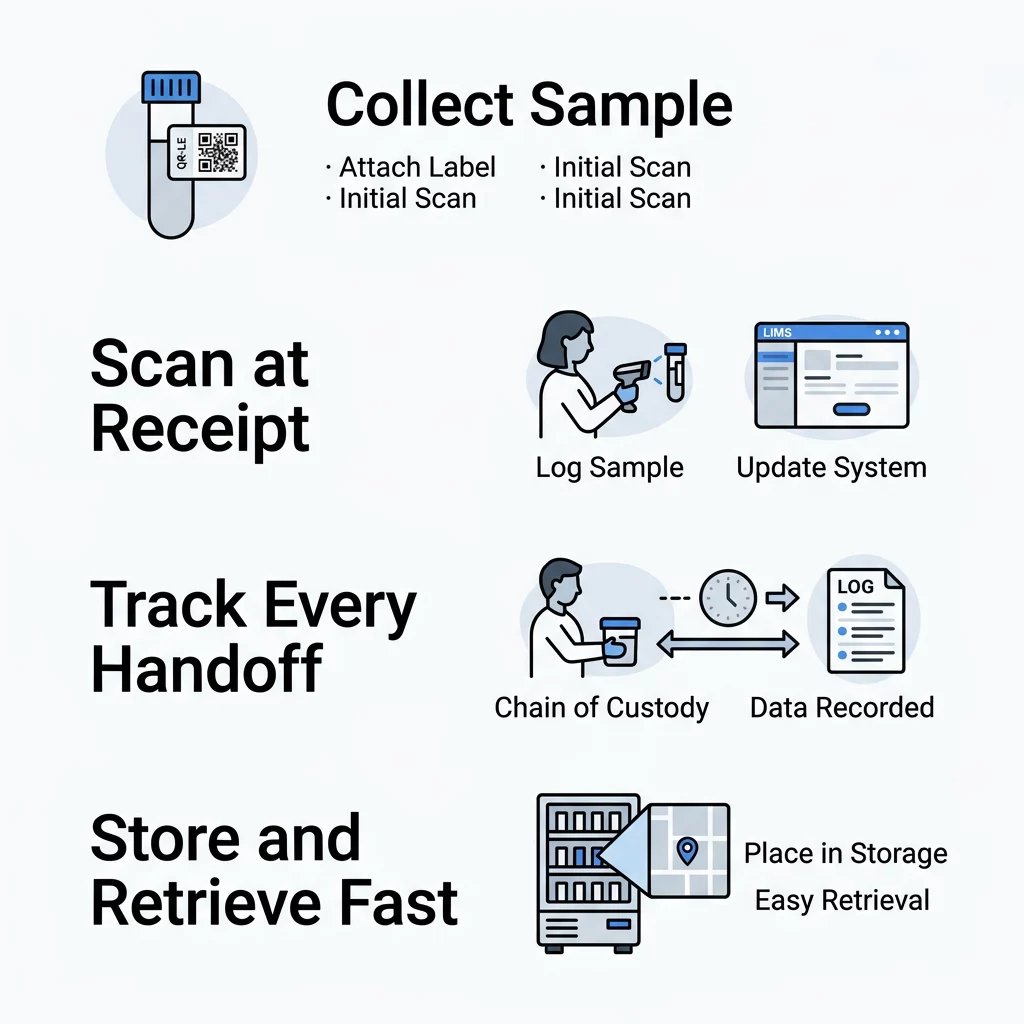
- Generate a unique, computer-generated identifier using a secure qr code generator as soon as an order enters your system.
- Print durable, thermal-transfer labels and apply them immediately to the collection tube or specimen container.
- Scan the container at every physical transfer, including accessioning, aliquoting, reagent preparation, and disposal.
- Capture automated metadata with every scan, recording exact timestamps, user identities, and device checkpoints.
- Group related accession codes into digital folders to keep distinct clinical trials or testing batches organized across departments.
Automate Your Laboratory Sample Tracking Need editable records and real-time scanning insights for your facility? Use the Dynamic QR Code Generator to create trackable labels and monitor scan activity across every department.
Integrating QR Codes with LIMS, ELN, and Compliance Frameworks
A QR code acts as a physical portal to a centralized digital database. Integrating your labeling workflow with Laboratory Information Systems (LIS), Laboratory Information Management Systems (LIMS), or Electronic Lab Notebooks (ELN) allows you to track inventory in real time. When an analyst scans a tube, the system immediately loads the correct testing protocol and logs the specimen status without manual keystrokes.
For US laboratories subject to FDA 21 CFR Part 11 regulations, electronic records must maintain secure, computer-generated, time-stamped audit trails that record operator actions independently. Using authenticated scans ensures that record creations, modifications, and transfers cannot be obscured or altered.
Protecting electronic Protected Health Information (ePHI) under HIPAA requires strict technical safeguards. Rather than embedding sensitive patient names or diagnoses directly into the QR code symbol, encode an encrypted key or secure database link. When scanned by authorized personnel, the system requests user authentication before displaying health data. Built-in scan analytics provide administrative visibility into scan times and locations, helping quality assurance teams verify that specimen processing adheres to standard operating procedures.
Scaling Traceability Across Your Facility
Transitioning from manual logs to automated 2D tracking eliminates transcription errors, protects sample integrity, and keeps your laboratory audit-ready. By pairing durable synthetic labels with structured digital checkpoints, your team can locate any aliquot in seconds and verify its custody history from collection to disposal. Start modernizing your workflow by configuring professional, trackable labels through our QR Code Generator today.
Frequently Asked Questions
Heavy frost can block optical sensors, but codes printed with high error correction remain readable through minor condensation or light frosting. For ultra-low freezers, wiping the label surface briefly before scanning ensures instant recognition.
Lab QR codes can be printed as small as 0.8 x 0.8 inches while maintaining scannability with standard 2D imagers. Always preserve a quiet zone of at least four module widths and test prints under actual laboratory lighting.
Standard mobile devices and web-based tools can read QR codes effectively for periodic checks. However, high-throughput testing environments benefit from dedicated 2D scanners that feed data directly into laboratory information systems.