Vous êtes-vous déjà demandé ce qui se passe réellement dans la demi-seconde entre le moment où vous pointez votre téléphone vers un code QR et celui où vous atterrissez sur une page web ? Le processus est plus rapide qu'il n'y paraît, et le comprendre vous aide à créer des codes qui scannent de manière fiable à chaque fois.
Ce qu'est réellement un code QR
Un code QR est une matrice bidimensionnelle de carrés noirs et blancs disposés selon un motif unique. Contrairement à un code-barres traditionnel – qui encode les données sur une seule ligne horizontale de largeurs de barres variables – un code QR stocke les informations à la fois horizontalement et verticalement. C'est ce qui lui confère une capacité de données bien supérieure et le rend lisible sous plusieurs orientations.
Chaque code QR est construit à partir de plusieurs régions fonctionnelles :
- Motifs de recherche – les trois grands carrés dans les coins qui aident le scanner à localiser le code, à déterminer son orientation et à trouver ses bords, même lorsque le code est incliné
- Motifs de synchronisation – des modules noirs et blancs alternés qui courent entre les motifs de recherche, définissant la structure de la grille et aidant le scanner à dimensionner correctement chaque module
- Zone de silence – la marge blanche vierge entourant le code, d'au moins quatre modules de large, qui le sépare des graphiques environnants afin que le scanner puisse détecter ses limites
- Informations de format – une zone dédiée près des motifs de recherche qui stocke le niveau de correction d'erreur et le motif de masquage afin que le scanner sache exactement comment interpréter les données
- Modules de données – les carrés noirs et blancs individuels où réside le contenu encodé réel, lus comme des uns binaires (noir) et des zéros (blanc)
Les données de ces modules peuvent être encodées selon plusieurs modes : numérique uniquement, alphanumérique, octets binaires 8 bits ou Kanji. Un code QR de version 1 est de 21×21 modules ; un code de version 40 s'étend à 177×177 et peut contenir jusqu'à 7 089 caractères numériques, 4 296 caractères alphanumériques ou 2 953 octets de données binaires. Apprenez-en davantage sur le fonctionnement de ces compromis dans le guide de Limites de données des codes QR.
Le processus de numérisation, étape par étape
Lorsque vous pointez un appareil photo vers un code QR, un processus en plusieurs étapes se déroule en quelques millisecondes.
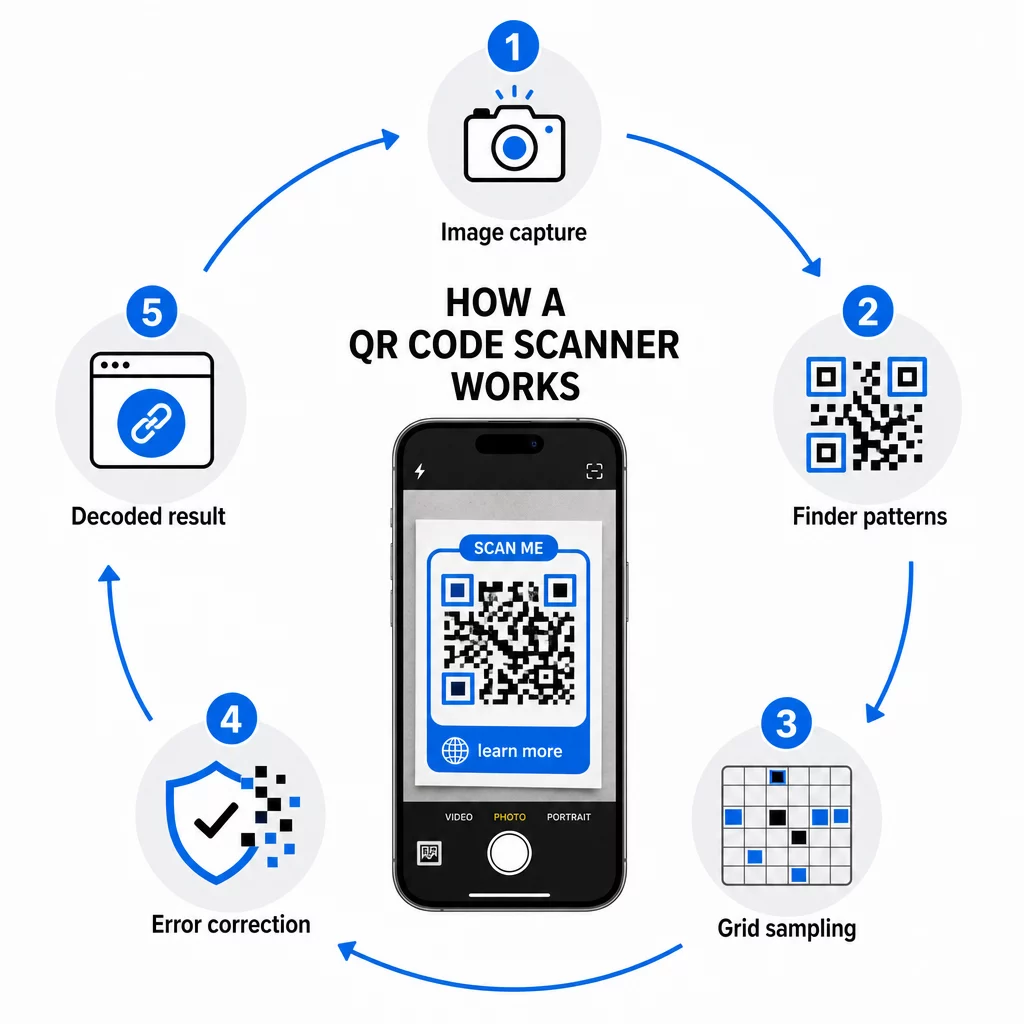
Étape 1 : Capture d'image
L'appareil photo capture la grille bidimensionnelle sous forme d'image visuelle. C'est l'entrée brute – une photographie du motif noir et blanc. La plupart des appareils photo de smartphones modernes peuvent gérer cela sans aucune application de numérisation dédiée. Si vous voulez comprendre toutes les façons de déclencher une numérisation sur différents appareils, le guide de numérisation des codes QR couvre en détail les flux de travail pour iPhone, Android, tablette et ordinateur de bureau.
Étape 2 : Détection de motif
Le logiciel du scanner utilise la reconnaissance de motifs pour localiser le code QR dans l'image. Il recherche les trois motifs de recherche dans les coins. Une fois trouvés, le scanner détermine :
- Où le code est positionné dans le cadre
- Dans quelle direction il est orienté (même s'il est tourné ou légèrement incliné)
- Où se trouvent les bords du code
Cette étape explique pourquoi les codes QR restent lisibles sous un angle – les motifs de recherche donnent à l'algorithme suffisamment de géométrie pour corriger la distorsion.
Étape 3 : Échantillonnage de la grille et extraction des données
Une fois la position et l'orientation du code établies, le scanner lit les motifs de synchronisation et les marqueurs d'alignement pour comprendre la structure de la grille. Il échantillonne ensuite chaque module selon un chemin en zigzag spécifique – de droite à gauche, puis de haut en bas – en partant d'une position connue et en parcourant chaque module de données jusqu'à ce que l'indicateur de fin soit atteint.
En parcourant ce chemin, le scanner lit :
- UNE indicateur de mode (quatre modules) qui spécifie le type d'encodage – numérique, alphanumérique, octet ou Kanji
- UNE indicateur de nombre de caractères qui indique combien de caractères sont encodés
- Les restants mots de code de données jusqu'à la fin du flux de données
Étape 4 : Correction d'erreurs
Après avoir lu les modules de données, le scanner traite les mots de code de correction d'erreurs. Les codes QR utilisent la correction d'erreurs Reed-Solomon, qui intègre des données redondantes permettant de reconstituer le contenu original même lorsqu'une partie du code est physiquement endommagée ou obscurcie.
Il existe quatre niveaux de correction d'erreurs standardisés :
| Niveau | Capacité de récupération | Idéal pour |
|---|---|---|
| L (faible) | ~7% | Environnements intérieurs propres |
| M (Moyen) | ~15% | Matériels marketing généraux |
| Q (Quartile) | ~25% | Usage industriel ou extérieur |
| H (Haut) | ~30% | Codes avec logos, conditions difficiles |
Une correction d'erreurs plus élevée signifie que le code peut survivre à plus de dommages mais nécessite également plus de modules, rendant le symbole global plus dense. Si vous ajoutez un logo à un code QR ou le placez dans un endroit exposé aux intempéries, choisir le niveau H est la bonne décision. Pour un examen plus approfondi de la façon dont ce compromis se manifeste dans la pratique, consultez l'article sur Correction d'erreur d'un QR code modifiable : fonctionnement.
Étape 5 : Décodage en contenu lisible par l'homme
Une fois les bits de données reconstruits, le scanner décode la séquence binaire selon le mode d'encodage du code QR. Les carrés noirs deviennent des uns et les carrés blancs deviennent des zéros. Cette chaîne binaire est ensuite convertie en contenu lisible par l'homme – une URL, un numéro de téléphone, un bloc de texte, des informations de contact ou tout autre type de données que le code était initialement conçu pour transporter.
Si le code contient une URL, votre appareil affiche une invite pour l'ouvrir. C'est à ce moment que le processus de numérisation passe le relais à votre navigateur ou à votre application.
Essayez le scanner de code QR gratuit de Pageloot Besoin de décoder un code QR directement à partir d'une image ou de votre webcam ? Le Scanner de code QR Pageloot fonctionne dans n'importe quel navigateur moderne – aucun téléchargement d'application requis.
En quoi les scanners QR diffèrent des scanners de codes-barres
La physique sous-jacente est similaire : les deux types de scanners illuminent un motif, détectent la lumière réfléchie et décodent le résultat. Mais un scanner de codes-barres laser standard lit sur une seule ligne horizontale, c'est pourquoi il ne peut gérer que les codes-barres 1D. La lecture d'un code QR 2D nécessite un capteur basé sur l'image qui capture le motif complet en une seule fois.
Pour une comparaison directe des différences de capacités et de cas d'utilisation entre ces deux formats, l' explication du scanner de codes-barres couvre en détail le système d'illumination, le capteur et les composants du décodeur – et la comparaison code-barres vs. code QR détaille quel format est le plus pertinent pour différentes applications commerciales.
Ce qui rend un code QR facile (ou difficile) à scanner
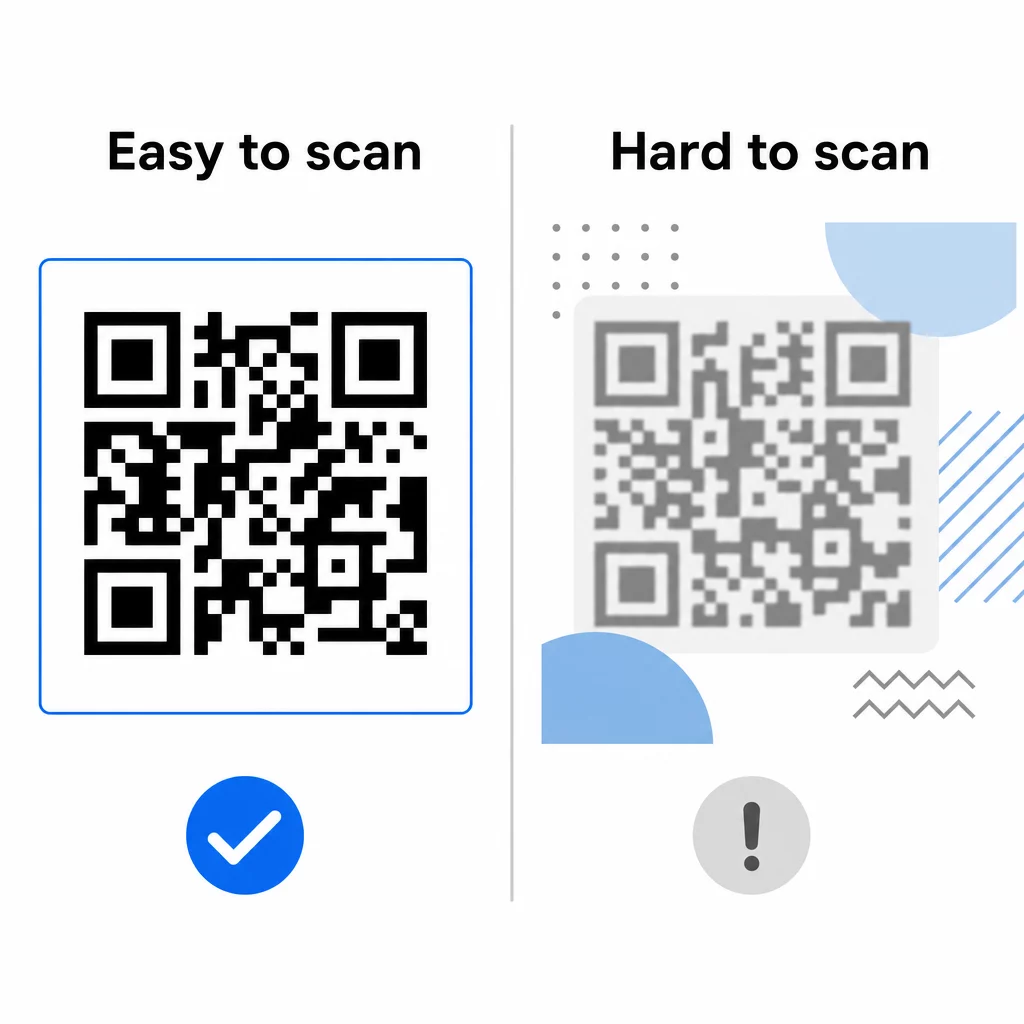
Comprendre le processus de numérisation révèle pourquoi certains choix de conception nuisent à la lisibilité :
- Contraste trop faible – le scanner distingue les modules par la différence de réflexion de la lumière entre les zones noires et blanches ; un code imprimé en gris sur un fond pâle échoue à ce test
- Zone de silence manquante – sans une marge blanche claire, le scanner ne peut pas localiser de manière fiable les bords du code, surtout si le texte ou les graphiques environnants sont proches
- Trop petit pour la distance de visualisation – une règle de 10:1 s'applique : pour chaque 10 cm de distance de balayage, le code doit mesurer au moins 1 cm de large ; le minimum pratique pour une utilisation d'impression à courte portée est de 2×2 cm
- Couleurs inversées ou non conventionnelles – des modules clairs sur un fond sombre peuvent perturber la reconnaissance de motifs chez certains scanners
- Sortie floue ou pixélisée – les images raster basse résolution se dégradent à l'échelle d'impression ; les formats vectoriels comme SVG ou EPS restent nets à toute taille
Pour des conseils complets sur le dimensionnement, le contraste, le placement et les tests, l'article sur les meilleures pratiques de lisibilité des codes QR couvre chaque facteur avec des recommandations spécifiques.
Créer des codes conçus pour être scannés Le Générateur de code QR Pageloot vous permet de créer, personnaliser et tester des codes QR avec la bonne correction d'erreur, le bon contraste et le bon format pour votre cas d'utilisation spécifique – et les codes dynamiques peuvent être mis à jour après l'impression sans générer une nouvelle image.
Codes QR statiques vs. dynamiques : Ce que le scanner voit
Du point de vue du scanner, chaque code QR se ressemble : une matrice de modules encodant une chaîne de données. La différence entre les codes statiques et dynamiques réside dans le contenu de ces données.
UNE code QR statique encode la destination finale directement – l'URL complète, le texte ou les informations de contact sont intégrés dans les modules au moment de la création. Changer le contenu signifie générer un nouveau code.
UNE code QR dynamique encode une courte URL de redirection qui pointe vers un serveur. Lorsqu'il est scanné, cette redirection renvoie l'utilisateur vers la destination que le propriétaire du code a actuellement définie. Cela signifie que le code physique ne change jamais, mais son comportement peut être mis à jour instantanément. Les codes dynamiques permettent également le suivi des scans – chaque scan enregistre un point de données qui indique quand et où le code a été scanné, sur quel appareil et à quelle fréquence.
Si une campagne de codes QR doit être mesurable ou si le contenu lié est susceptible de changer, les codes dynamiques sont le choix pratique. Pour les entreprises comparant la gamme complète des options d'applications de scanner et ce qu'il faut rechercher dans un outil de numérisation, le Comparaison des applications de lecture de codes QR couvre les principales options.
Questions fréquentes
Non. La plupart des smartphones exécutant iOS 11 ou une version ultérieure et les appareils Android modernes peuvent scanner les codes QR directement via l'application appareil photo native. Pour plus de contrôle – comme la numérisation à partir d'une image enregistrée ou la vérification de l'historique des scans – un outil dédié comme le scanner QR Pageloot fonctionne depuis n'importe quel navigateur sans installation.
Les causes les plus courantes sont un faible contraste, une zone de silence manquante, un code trop petit pour la distance de visualisation, ou une image trop floue pour distinguer les modules. Les appareils plus anciens avec des caméras à faible résolution sont plus sensibles à ces problèmes. Tester sur plusieurs appareils avant l'impression, et utiliser des niveaux de correction d'erreur plus élevés (Q ou H), réduit les risques d'échec. Voir la liste complète des causes et des solutions dans le guide Le code QR ne fonctionne pas.
Un code QR de version 40 au niveau de correction d'erreur le plus bas peut encoder jusqu'à 7 089 caractères numériques, 4 296 caractères alphanumériques, ou 2 953 octets de données binaires. En pratique, des URL plus courtes et un contenu plus simple produisent des codes moins denses qui se scannent plus rapidement et de manière plus fiable. La ventilation complète des compromis entre version, capacité et correction d'erreur est couverte dans le guide des limites de données des codes QR.