> 가이드 > QR 코드 스캐너는 어떻게 작동합니까?
휴대폰 QR 코드 스캔

QR 코드 스캐너는 어떻게 작동합니까?

Understand how QR code scanners work through image capture, pattern detection, and error correction to decode black-and-white modules into human-readable data.
Updated on 6월 10, 2026
목차

Ever wondered what’s actually happening in the half-second between pointing your phone at a QR code and landing on a webpage? The process is faster than it looks, and understanding it helps you create codes that scan reliably every time.

What a QR Code Actually Is

A QR code is a two-dimensional matrix of black and white squares arranged in a unique pattern. Unlike a traditional barcode – which encodes data in a single horizontal line of varying bar widths – a QR code stores information both horizontally and vertically. That’s what gives it far greater data capacity and makes it readable from multiple orientations.

Each QR code is built from several functional regions:

  • Finder patterns – the three large squares in the corners that help the scanner locate the code, determine its orientation, and find its edges, even when the code is tilted
  • Timing patterns – alternating black-and-white modules running between the finder patterns that define the grid structure and help the scanner correctly size each module
  • Quiet zone – the blank white margin surrounding the code, at least four modules wide, which separates it from surrounding graphics so the scanner can detect its boundaries
  • Format information – a dedicated area near the finder patterns that stores the error correction level and masking pattern so the scanner knows exactly how to interpret the data
  • Data modules – the individual black-and-white squares where the actual encoded content lives, read as binary ones (black) and zeros (white)

The data in those modules can be encoded in several modes: numeric only, alphanumeric, 8-bit binary bytes, or Kanji. A Version 1 QR code is 21×21 modules; a Version 40 code expands to 177×177 and can hold up to 7,089 numeric characters, 4,296 alphanumeric characters, or 2,953 bytes of binary data. Learn more about how these trade-offs work in the guide to QR 코드 데이터 한계.

The Scanning Process, Step by Step

When you point a camera at a QR code, a multi-stage process unfolds in milliseconds.

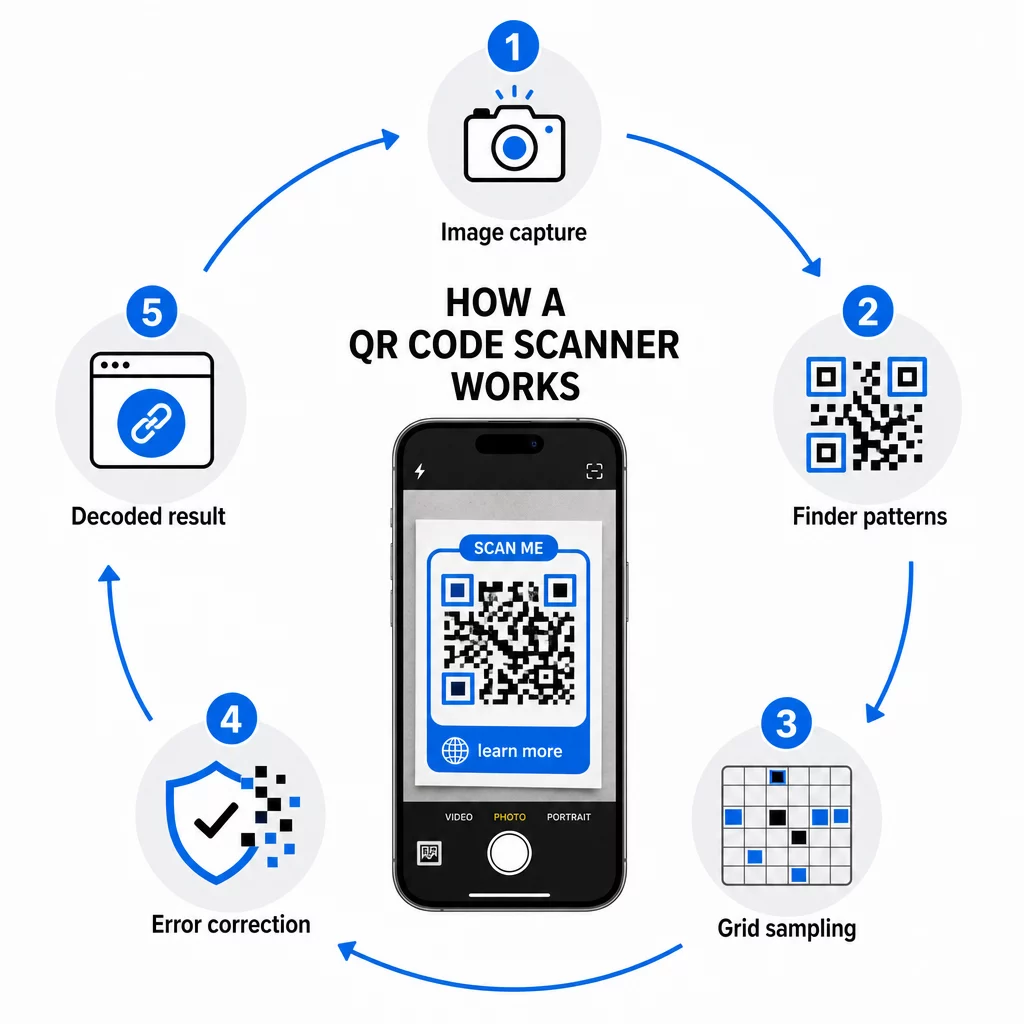
QR scanning process

Step 1: Image Capture

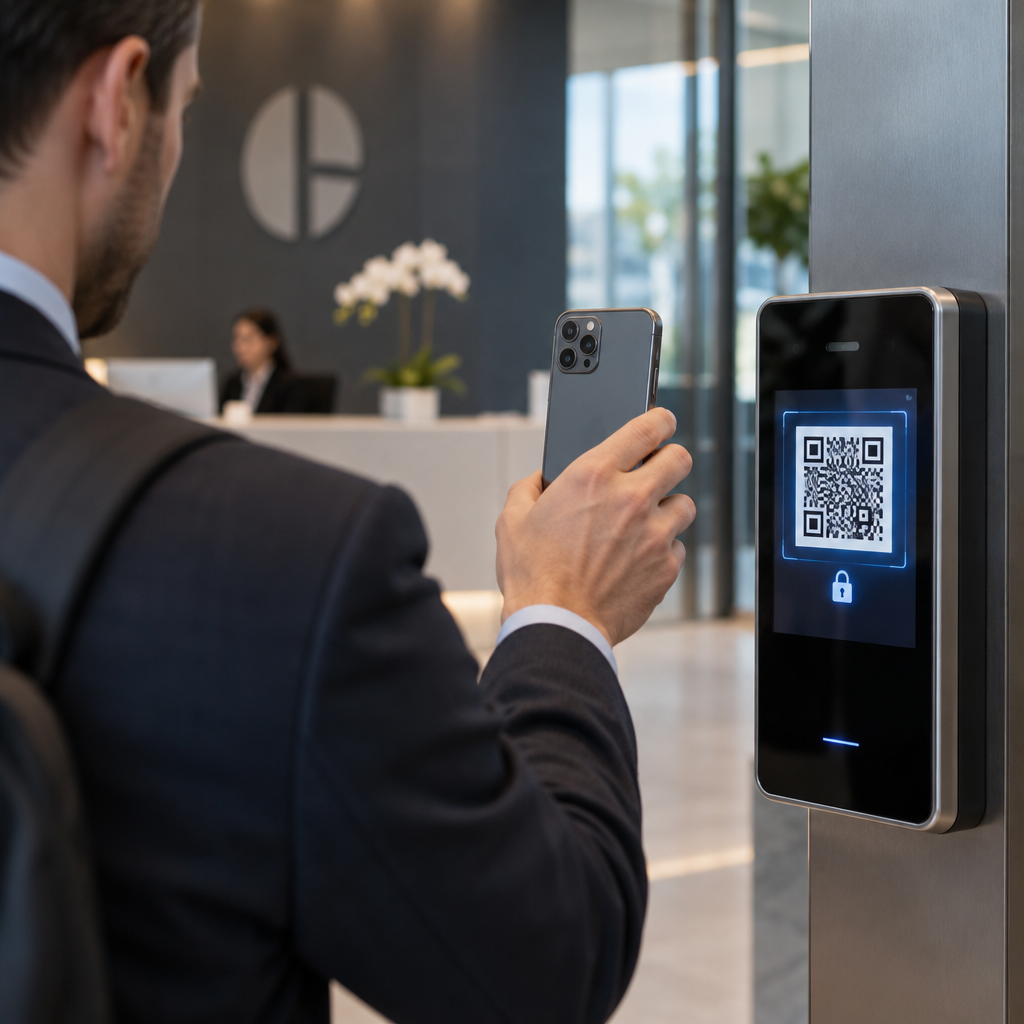
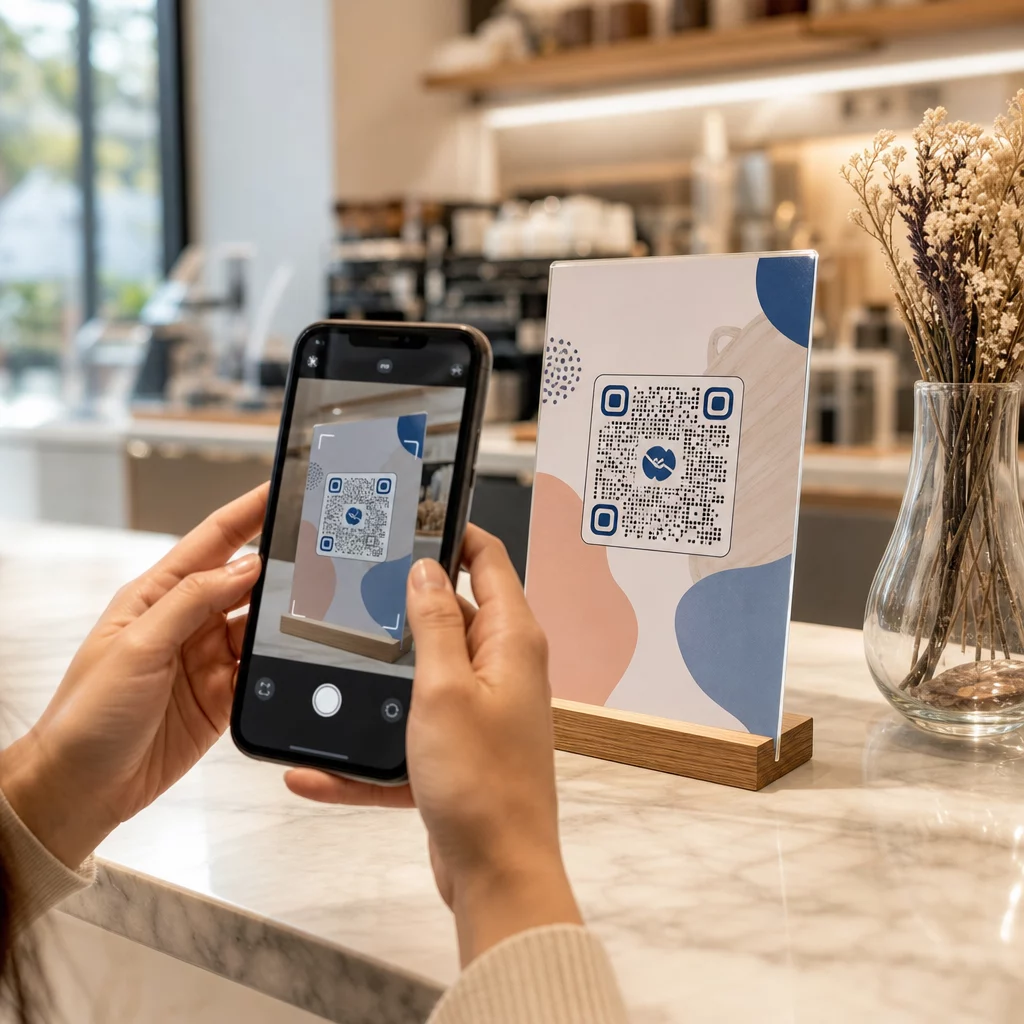
The camera captures the two-dimensional grid as a visual image. This is the raw input – a photograph of the black-and-white pattern. Most modern smartphone cameras can handle this without any dedicated scanning app. If you want to understand the full range of ways to trigger a scan across different devices, the guide to scanning QR codes covers iPhone, Android, tablet, and desktop workflows in detail.

Step 2: Pattern Detection

The scanner’s software uses pattern recognition to locate the QR code within the image. It searches for the three finder patterns in the corners. Once found, the scanner determines:

  • Where the code is positioned in the frame
  • Which direction it’s oriented (even if rotated or slightly skewed)
  • Where the edges of the code are

This step is why QR codes remain readable at an angle – the finder patterns give the algorithm enough geometry to correct for distortion.

Step 3: Grid Sampling and Data Extraction

With the code’s position and orientation established, the scanner reads the timing patterns and alignment markers to understand the grid structure. It then samples each module in a specific zigzag path – right to left, up then down – starting from a known position and working through every data module until the end indicator is reached.

As it traverses this path, the scanner reads:

  • mode indicator (four modules) that specifies the encoding type – numeric, alphanumeric, byte, or Kanji
  • character count indicator that states how many characters are encoded
  • The remaining data codewords until the end of the data stream

Step 4: Error Correction

After reading the data modules, the scanner processes the error correction codewords. QR codes use Reed–Solomon error correction, which embeds redundant data that allows the original content to be reconstructed even when part of the code is physically damaged or obscured.

There are four standardized error correction levels:

수준 복구 용량 Best Used For
L (Low) ~7% Clean indoor environments
M (Medium) ~15% General marketing materials
Q (Quartile) ~25% Industrial or outdoor use
H (High) ~30% Codes with logos, harsh conditions

Higher error correction means the code can survive more damage but also requires more modules, making the overall symbol denser. If you’re adding a logo to a QR code or placing it somewhere exposed to weather, choosing Level H is the right call. For a deeper look at how this trade-off plays out in practice, see the article on 편집 가능한 QR 코드에서 오류 수정이 작동하는 방식.

Step 5: Decoding to Human-Readable Content

Once the data bits are reconstructed, the scanner decodes the binary sequence according to the QR code’s encoding mode. Black squares become ones and white squares become zeros. That binary string is then converted into human-readable content – a URL, a phone number, a block of text, contact information, or any other data type the code was originally built to carry.

If the code contains a URL, your device surfaces a prompt to open it. That’s the moment the scanning process hands off to your browser or app.

Try Pageloot’s Free QR Code Scanner Need to decode a QR code directly from an image or your webcam? The Pageloot QR 코드 스캐너 works in any modern browser – no app download required.

How QR Scanners Differ from Barcode Scanners

The underlying physics are similar: both types of scanner illuminate a pattern, detect reflected light, and decode the result. But a standard laser barcode scanner reads in a single horizontal line, which is why it can only handle 1D barcodes. Reading a 2D QR code requires an image-based sensor that captures the full pattern at once.

For a direct comparison of how these two formats differ in capability and use case, the barcode scanner explainer covers the illumination system, sensor, and decoder components in detail – and the barcode vs. QR code comparison breaks down which format makes more sense for different business applications.

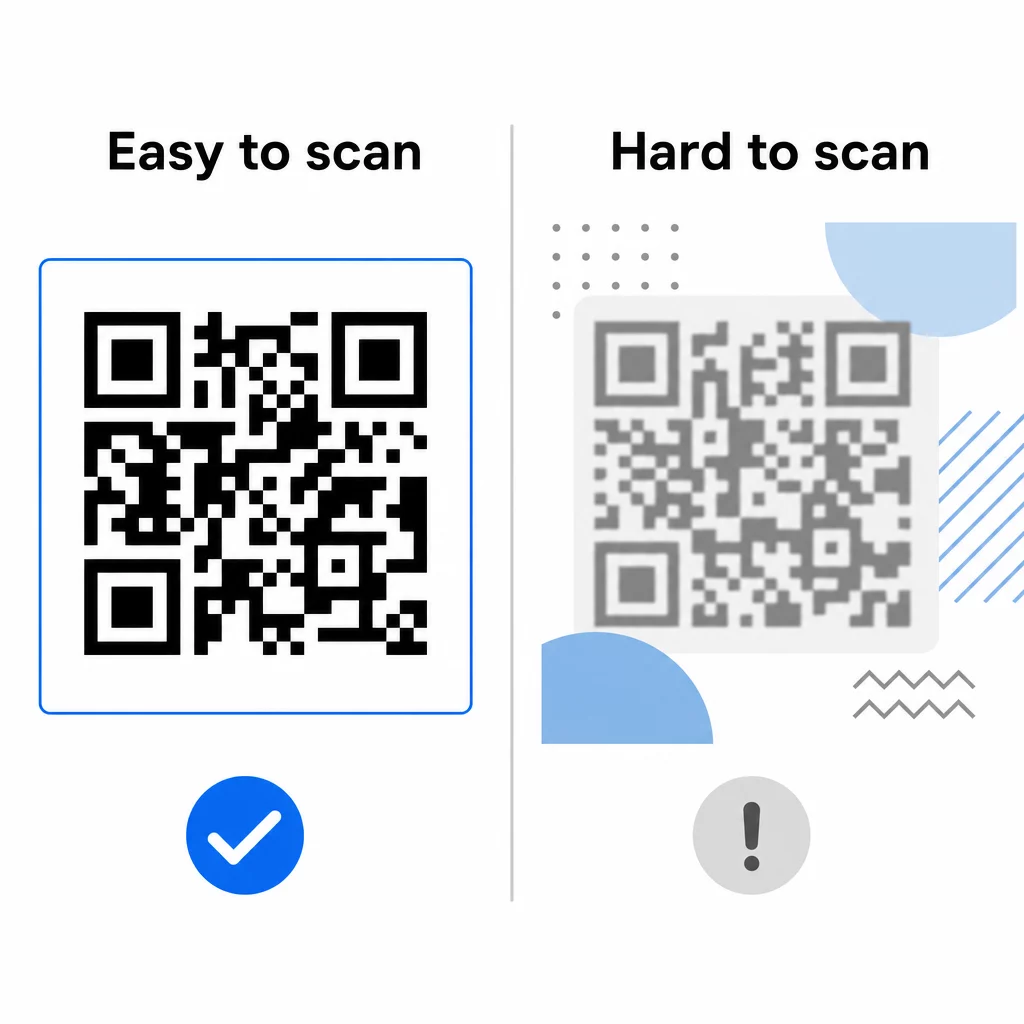
What Makes a QR Code Easy (or Hard) to Scan

Understanding the scanning process reveals why certain design choices hurt readability:

  • 낮은 대비 – the scanner distinguishes modules by the difference in light reflection between black and white areas; a code printed in grey on a pale background fails this test
  • Missing quiet zone – without a clear white margin, the scanner can’t reliably locate the code’s edges, especially if surrounding text or graphics are close
  • Too small for the viewing distance – a 10:1 rule applies: for every 10 cm of scanning distance, the code should be at least 1 cm wide; the practical minimum for close-range print use is 2×2 cm
  • Inverted or unconventional colors – light modules on a dark background can confuse pattern recognition in some scanners
  • Blurry or pixelated output – low-resolution raster images fall apart at print scale; vector formats like SVG or EPS stay crisp at any size

For comprehensive guidance on sizing, contrast, placement, and testing, the article on QR 코드 가독성 모범 사례 covers each factor with specific recommendations.

QR scan readability

Create Codes Built to Scan 그만큼 Pageloot QR 코드 생성기 lets you build, customize, and test QR codes with the right error correction, contrast, and format for your specific use case – and dynamic codes can be updated after printing without generating a new image.

Static vs. Dynamic QR Codes: What the Scanner Sees

From the scanner’s perspective, every QR code looks the same: a matrix of modules encoding a string of data. The difference between static and dynamic codes is what that data contains.

정적 QR 코드 encodes the final destination directly – the full URL, text, or contact information is baked into the modules at creation time. Changing the content means generating a new code.

동적 QR 코드 encodes a short redirect URL that points to a server. When scanned, that redirect forwards the user to whatever destination the code owner has currently set. This means the physical code never changes, but its behavior can be updated instantly. Dynamic codes also enable scan tracking – every scan registers a data point that shows when and where the code was scanned, on what device, and how often.

If a QR code campaign needs to be measurable or the linked content might change, dynamic codes are the practical choice. For businesses comparing the full range of scanner app options and what to look for in a scanning tool, the QR code scanning apps comparison covers the major options.

자주 묻는 질문

QR 코드를 스캔하려면 특별한 앱이 필요한가요?

No. Most smartphones running iOS 11 or later and modern Android devices can scan QR codes directly through the native camera app. For more control – such as scanning from a saved image or checking scan history – a dedicated tool like the Pageloot QR scanner works from any browser without installation.

Why does my QR code scan on some devices but not others?

The most common causes are low contrast, a missing quiet zone, a code that’s too small for the viewing distance, or an image that’s too blurry to resolve the modules. Older devices with lower-resolution cameras are more sensitive to these issues. Testing across multiple devices before printing, and using higher error correction levels (Q or H), reduces the chance of failures. See the full list of causes and fixes in the QR code not working guide.

How much data can a QR code hold?

A Version 40 QR code at the lowest error correction level can encode up to 7,089 numeric characters, 4,296 alphanumeric characters, or 2,953 bytes of binary data. In practice, shorter URLs and simpler content produce less dense codes that scan faster and more reliably. The full breakdown of version, capacity, and error correction trade-offs is covered in the QR code data limits guide.

작성자 정보

시임 코스타비는 페이지루트의 콘텐츠 책임자입니다. 그는 페이지루트의 혁신적인 QR 코드 생성 서비스에 대한 글을 쓰고 있습니다. 5년 이상 QR 코드 분야에서 쌓아온 깊이 있는 전문 지식을 바탕으로, 시임은 이 분야의 전문가로 인정받고 있습니다. 그는 QR 기술을 활용하여 디지털 상호작용을 간소화하고 향상시키는 데 크게 기여하고 있습니다.

범주
에 대해 자세히 알아보기

온라인으로 QR 코드를 생성해야하는 경우 QR 코드 만들기 무료로 여기!
Pageloot는 #1 Go-To 솔루션 QR 코드를 만들고 스캔합니다.

HT-32

블로그 스캔

20,000개 이상의 브랜드로부터 신뢰를 받아 더 많은 매출, 리뷰, 팔로워를 확보했습니다.

클라이언트 로고
최고 브랜드의 신뢰
5 중 4.8 평가

4.86 / 5 별점

휴고 로랑
휴고 로랑
레스토랑 주인
가장 쉽고 안정적인 QR 코드 생성기. PDF 파일을 즉시 업로드할 수 있습니다. 이제 레스토랑 메뉴가 디지털화되었습니다.
루카스 얀센
루카스 얀센
부동산 개발사
이것은 훌륭한 도구이며 QR 코드를 사용하면 원하는 곳으로 이동할 수 있습니다. 우리는 위치 QR 코드만 사용하지만 유용한 기능이 너무 많습니다.
엠마 모레티
엠마 모레티
소매 제품
사용하기 쉽고 빠릅니다. 그것은 훌륭하게 작동하고 완벽한 이미지를 생성하므로 직원들이 내 vCard를 다운로드할 수 있습니다.
휴고 로랑
휴고 로랑
레스토랑 주인
가장 쉽고 안정적인 QR 코드 생성기. PDF 파일을 즉시 업로드할 수 있습니다. 이제 레스토랑 메뉴가 디지털화되었습니다.
루카스 얀센
루카스 얀센
부동산 개발사
이것은 훌륭한 도구이며 QR 코드를 사용하면 원하는 곳으로 이동할 수 있습니다. 우리는 위치 QR 코드만 사용하지만 유용한 기능이 너무 많습니다.
엠마 모레티
엠마 모레티
소매 제품
사용하기 쉽고 빠릅니다. 그것은 훌륭하게 작동하고 완벽한 이미지를 생성하므로 직원들이 내 vCard를 다운로드할 수 있습니다.
더 많은 QR 코드보기
무엇이든 디지털 경험으로 전환하세요 3분 이내에.

14일 무료 체험.

신용카드는 필요 없습니다.

첫 구매 시 30% 할인

코드를 사용하세요:

MP3 파일 공유

PDF QR 코드를 생성하려면 가입하세요

필요한 모든 것을 업로드하고 표시합니다.

  • 오디오 파일
  • 팟캐스트
  • 음악

가입 시 14일 무료 체험.
체험 기간 후 QR 코드 만료.

오디오 mp3 QR 코드를 생성하려면 가입하세요

프레임으로 더 많은 스캔 확보

QR 코드에 더 많은 프레임을 추가하려면 가입하세요

클릭 유도 문안 프레임은 고객이 QR 코드와 쉽게 상호 작용할 수 있도록 도와줍니다. 사용해 보세요!

가입 시 14일 무료 체험.
체험 기간 후 QR 코드 만료.

QR 코드에 더 많은 프레임을 추가하려면 가입하세요

도형으로 더 많은 스타일 추가

더 많은 도형을 만들려면 가입하세요

QR 코드는 정사각형일 필요가 없습니다. 브랜드 이미지에 맞게 전환해 보세요.

가입 시 14일 무료 체험.
체험 기간 후 QR 코드 만료.

더 많은 도형을 만들려면 가입하세요

QR 코드에 로고 추가

QR 코드에 로고를 추가하려면 가입하세요

로고와 브랜드를 추가하여 QR 코드를 돋보이게 만드세요.

가입 시 14일 무료 체험.
체험 기간 후 QR 코드 만료.

QR 코드에 로고를 추가하려면 가입하세요

스마트 앱 스토어 리디렉션

앱 스토어 QR 코드를 생성하려면 가입하세요

스마트 앱 스토어 QR 코드에 앱 링크를 추가하세요. 사용자는 장치에 따라 리디렉션됩니다.

가입 시 14일 무료 체험.
체험 기간 후 QR 코드 만료.

앱 스토어 QR 코드를 생성하려면 가입하세요

QR 코드에 이미지 업로드

이미지 QR 코드를 생성하려면 가입하세요

이미지를 쉽게 공유하세요. 몇 초 안에 동적으로 이미지를 변경하십시오.

가입 시 14일 무료 체험.
체험 기간 후 QR 코드 만료.

이미지 QR 코드를 생성하려면 가입하세요

PDF 파일 공유

PDF QR 코드를 생성하려면 가입하세요

필요한 모든 것을 업로드하고 표시합니다.

  • 메뉴 및 가격표
  • 명령
  • 모든 문서

가입 시 14일 무료 체험.
체험 기간 후 QR 코드 만료.

PDF QR 코드를 생성하려면 가입하세요

인쇄 없이 나중에 편집

다시 인쇄하지 않고 QR 코드를 편집하려면 가입하세요

동적 QR 코드를 사용하면 새 QR 코드를 인쇄하지 않고도 QR 코드의 내용을 변경할 수 있습니다.

가입 시 14일 무료 체험.
체험 기간 후 QR 코드 만료.

다시 인쇄하지 않고 QR 코드를 편집하려면 가입하세요

언제? 어디서? QR 코드 스캔 추적

QR 코드를 추적하려면 가입하세요

어떤 QR 코드가 가장 많이 스캔되고 무엇이 고객을 가장 흥분시키는지 알아보십시오.

가입 시 14일 무료 체험.
체험 기간 후 QR 코드 만료.

QR 코드를 추적하려면 가입하세요

인쇄 준비 파일 제공

PDF 및 SVG와 같은 벡터 QR 코드를 생성하려면 가입하세요.

.EPS, .PDF, .SVG

HD 해상도로 QR 코드를 다운로드하고 싶으신가요? 인쇄할 준비가 된 벡터 또는 픽셀 형식을 가져옵니다.

가입 시 14일 무료 체험.
체험 기간 후 QR 코드 만료.

PDF 및 SVG와 같은 벡터 QR 코드를 생성하려면 가입하세요.

기다리세요. 귀하의 QR 코드는 로드 중... 로드 중...

나만의 것으로 만들기

나중을 위해 QR 코드를 저장하려면 가입하세요.

다양한 색상, 로고 및 클릭 유도문안 프레임으로 멋진 QR 코드를 만들어 더 많은 스캔을 받으세요.

가입 시 14일 무료 체험.
체험 기간 후 QR 코드 만료.

나중을 위해 QR 코드를 저장하려면 가입하세요.