Ooit afgevraagd wat er precies gebeurt in de halve seconde tussen het richten van je telefoon op een QR-code en het landen op een webpagina? Het proces is sneller dan het lijkt, en als je het begrijpt, kun je codes maken die elke keer betrouwbaar scannen.
Wat een QR-code eigenlijk is
Een QR-code is een tweedimensionale matrix van zwarte en witte vierkanten gerangschikt in een uniek patroon. In tegenstelling tot een traditionele streepjescode – die gegevens codeert in een enkele horizontale lijn van variërende streepbreedtes – slaat een QR-code informatie zowel horizontaal als verticaal op. Dat is wat het een veel grotere datacapaciteit geeft en het leesbaar maakt vanuit meerdere oriëntaties.
Elke QR-code is opgebouwd uit verschillende functionele gebieden:
- Zoekpatronen – de drie grote vierkanten in de hoeken die de scanner helpen de code te lokaliseren, de oriëntatie te bepalen en de randen te vinden, zelfs wanneer de code gekanteld is
- Timingpatronen – afwisselende zwart-witte modules die tussen de zoekpatronen lopen en de rasterstructuur definiëren en de scanner helpen elke module correct te dimensioneren
- Stille zone – de lege witte marge rond de code, minstens vier modules breed, die deze scheidt van omringende afbeeldingen zodat de scanner de grenzen kan detecteren
- Formaatinformatie – een speciaal gebied nabij de zoekpatronen dat het foutcorrectieniveau en het maskeringspatroon opslaat, zodat de scanner precies weet hoe de gegevens moeten worden geïnterpreteerd
- Datamodules – de individuele zwart-witte vierkanten waar de daadwerkelijke gecodeerde inhoud zich bevindt, gelezen als binaire enen (zwart) en nullen (wit)
De gegevens in die modules kunnen in verschillende modi worden gecodeerd: alleen numeriek, alfanumeriek, 8-bits binaire bytes of Kanji. Een versie 1 QR-code is 21×21 modules; een versie 40 code breidt uit tot 177×177 en kan tot 7.089 numerieke tekens, 4.296 alfanumerieke tekens of 2.953 bytes aan binaire gegevens bevatten. Leer meer over hoe deze afwegingen werken in de gids voor Gegevenslimieten van QR-codes.
Het Scanproces, Stap voor Stap
Wanneer je een camera op een QR-code richt, ontvouwt zich een meerstaps proces in milliseconden.
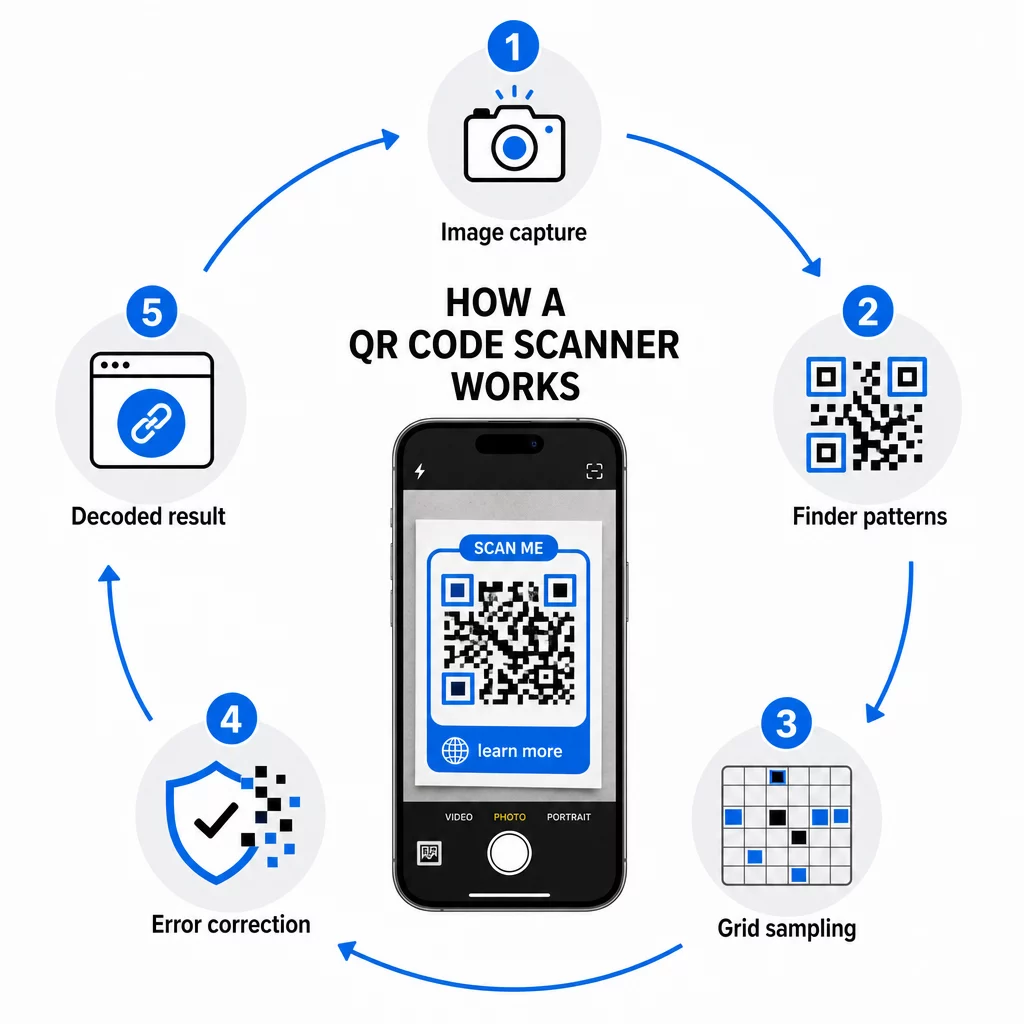
Stap 1: Beeldopname
De camera legt het tweedimensionale raster vast als een visueel beeld. Dit is de ruwe invoer – een foto van het zwart-witpatroon. De meeste moderne smartphonecamera's kunnen dit aan zonder een speciale scan-app. Als je het volledige scala aan manieren wilt begrijpen om een scan te activeren op verschillende apparaten, dan is de gids voor het scannen van QR-codes behandelt iPhone-, Android-, tablet- en desktopworkflows gedetailleerd.
Stap 2: Patroonherkenning
De software van de scanner gebruikt patroonherkenning om de QR-code in de afbeelding te lokaliseren. Het zoekt naar de drie zoekpatronen in de hoeken. Eenmaal gevonden, bepaalt de scanner:
- Waar de code in het frame is gepositioneerd
- Welke richting het georiënteerd is (zelfs als het gedraaid of licht scheef is)
- Waar de randen van de code zijn
Deze stap is de reden waarom QR-codes leesbaar blijven onder een hoek – de zoekpatronen geven het algoritme voldoende geometrie om vervorming te corrigeren.
Stap 3: Rasterbemonstering en Gegevensextractie
Nadat de positie en oriëntatie van de code zijn vastgesteld, leest de scanner de timingpatronen en uitlijningsmarkeringen om de rasterstructuur te begrijpen. Vervolgens bemonstert het elke module in een specifiek zigzagpad – van rechts naar links, dan omhoog en omlaag – beginnend vanaf een bekende positie en werkend door elke datamodule totdat de eindindicator is bereikt.
Terwijl het dit pad doorloopt, leest de scanner:
- EEN modusindicator (vier modules) die het coderingstype specificeert – numeriek, alfanumeriek, byte of Kanji
- EEN tekenaantalindicator die aangeeft hoeveel tekens zijn gecodeerd
- De resterende datacodewoorden tot het einde van de datastroom
Stap 4: Foutcorrectie
Na het lezen van de datamodules verwerkt de scanner de foutcorrectiecodewoorden. QR-codes gebruiken Reed–Solomon foutcorrectie, die redundante gegevens insluit waardoor de oorspronkelijke inhoud kan worden gereconstrueerd, zelfs wanneer een deel van de code fysiek beschadigd of verduisterd is.
Er zijn vier gestandaardiseerde foutcorrectieniveaus:
| Niveau | Herstelcapaciteit | Meest Geschikt Voor |
|---|---|---|
| L (Laag) | ~7% | Schone binnenomgevingen |
| M (Gemiddeld) | ~15% | Algemene marketingmaterialen |
| Q (kwartiel) | ~25% | Industrieel of buitengebruik |
| H (Hoog) | ~30% | Codes met logo's, zware omstandigheden |
Hogere foutcorrectie betekent dat de code meer schade kan overleven, maar vereist ook meer modules, waardoor het algehele symbool dichter wordt. Als u een logo toevoegt aan een QR-code of deze ergens plaatst waar deze wordt blootgesteld aan weersinvloeden, is het kiezen van niveau H de juiste beslissing. Voor een diepere blik op hoe deze afweging in de praktijk uitpakt, zie het artikel over Hoe foutcorrectie werkt in aanpasbare QR-codes.
Stap 5: Decoderen naar menselijk leesbare inhoud
Zodra de databits zijn gereconstrueerd, decodeert de scanner de binaire reeks volgens de coderingsmodus van de QR-code. Zwarte vierkanten worden enen en witte vierkanten worden nullen. Die binaire reeks wordt vervolgens omgezet in menselijk leesbare inhoud – een URL, een telefoonnummer, een tekstblok, contactinformatie of elk ander gegevenstype waarvoor de code oorspronkelijk is gemaakt.
Als de code een URL bevat, toont uw apparaat een prompt om deze te openen. Dat is het moment waarop het scanproces wordt overgedragen aan uw browser of app.
Probeer Pageloot's Gratis QR-codescanner Moet u een QR-code rechtstreeks decoderen vanaf een afbeelding of uw webcam? De Pageloot QR-codescanner werkt in elke moderne browser – geen app-download vereist.
Hoe QR-scanners verschillen van barcodescanners
De onderliggende fysica is vergelijkbaar: beide typen scanners verlichten een patroon, detecteren gereflecteerd licht en decoderen het resultaat. Maar een standaard laserbarcodescanner leest in één horizontale lijn, daarom kan deze alleen 1D-barcodes verwerken. Het lezen van een 2D QR-code vereist een op beelden gebaseerde sensor die het volledige patroon in één keer vastlegt.
Voor een directe vergelijking van hoe deze twee formaten verschillen in mogelijkheden en gebruiksscenario, de uitleg over barcodescanners behandelt het verlichtingssysteem, de sensor en de decodercomponenten in detail – en de vergelijking tussen barcode en QR-code legt uit welk formaat meer zinvol is voor verschillende zakelijke toepassingen.
Wat een QR-code gemakkelijk (of moeilijk) te scannen maakt
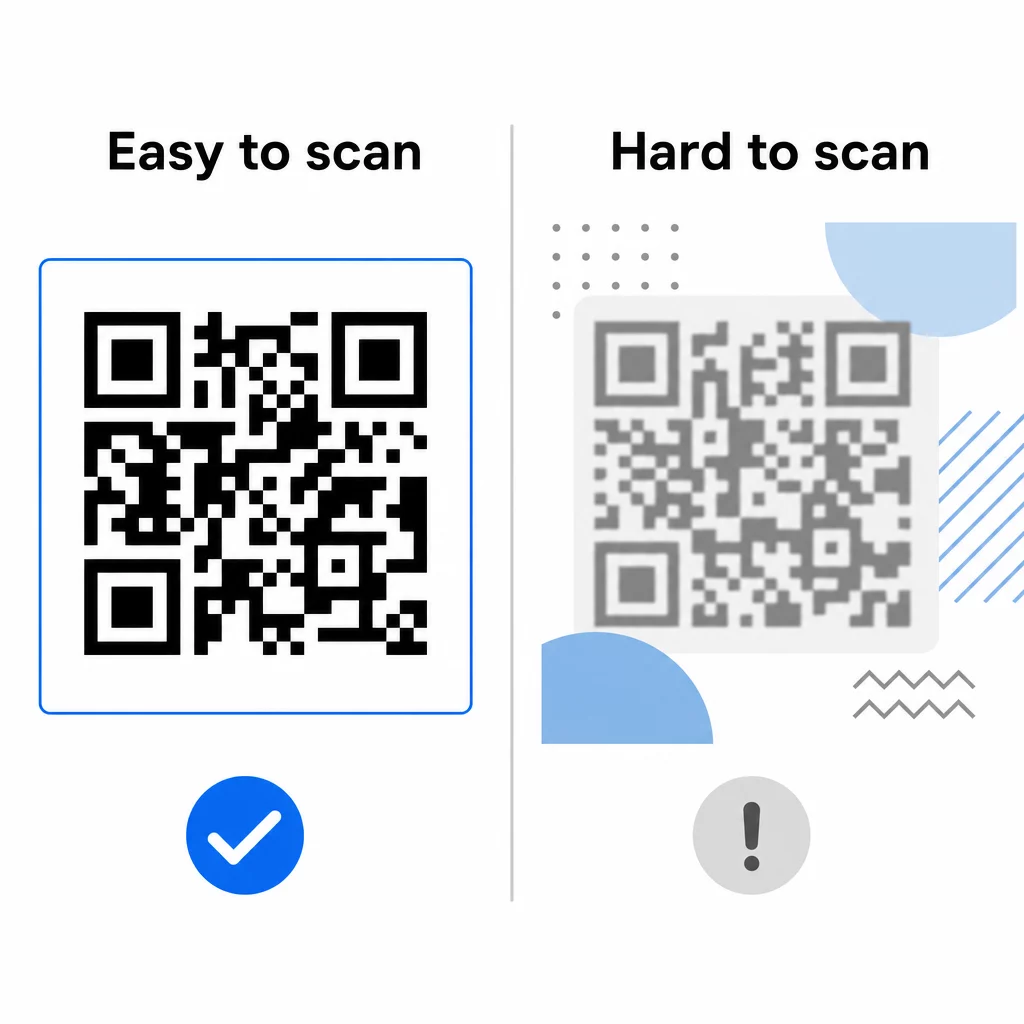
Inzicht in het scanproces onthult waarom bepaalde ontwerpkeuzes de leesbaarheid schaden:
- Weinig contrast – de scanner onderscheidt modules door het verschil in lichtreflectie tussen zwarte en witte gebieden; een code gedrukt in grijs op een lichte achtergrond faalt voor deze test
- Ontbrekende rustzone – zonder een duidelijke witte marge kan de scanner de randen van de code niet betrouwbaar lokaliseren, vooral als omringende tekst of afbeeldingen dichtbij zijn
- Te klein voor de kijkafstand – een 10:1-regel is van toepassing: voor elke 10 cm scanafstand moet de code minstens 1 cm breed zijn; het praktische minimum voor gebruik bij afdrukken op korte afstand is 2×2 cm
- Omgekeerde of onconventionele kleuren – lichte modules op een donkere achtergrond kunnen patroonherkenning in sommige scanners verwarren
- Wazige of gepixelde uitvoer – rasterafbeeldingen met lage resolutie vallen uit elkaar op afdrukschaal; vectorformaten zoals SVG of EPS blijven scherp op elk formaat
Voor uitgebreide richtlijnen over formaat, contrast, plaatsing en testen, het artikel over best practices voor de leesbaarheid van QR-codes behandelt elke factor met specifieke aanbevelingen.
Codes maken die gebouwd zijn om te scannen De Pageloot QR-codegenerator laat u QR-codes bouwen, aanpassen en testen met de juiste foutcorrectie, contrast en formaat voor uw specifieke gebruikssituatie – en dynamische codes kunnen na het afdrukken worden bijgewerkt zonder een nieuwe afbeelding te genereren.
Statische versus dynamische QR-codes: wat de scanner ziet
Vanuit het perspectief van de scanner ziet elke QR-code er hetzelfde uit: een matrix van modules die een reeks gegevens coderen. Het verschil tussen statische en dynamische codes is wat die gegevens bevatten.
EEN statische QR-code codeert de uiteindelijke bestemming direct – de volledige URL, tekst of contactinformatie wordt bij het aanmaken in de modules gebakken. Het wijzigen van de inhoud betekent het genereren van een nieuwe code.
EEN dynamische QR-code codeert een korte omleidings-URL die naar een server verwijst. Wanneer gescand, stuurt die omleiding de gebruiker door naar welke bestemming de code-eigenaar momenteel heeft ingesteld. Dit betekent dat de fysieke code nooit verandert, maar het gedrag ervan direct kan worden bijgewerkt. Dynamische codes maken ook scan-tracking mogelijk – elke scan registreert een datapunt dat toont wanneer en waar de code is gescand, op welk apparaat en hoe vaak.
Als een QR-codecampagne meetbaar moet zijn of de gekoppelde inhoud kan veranderen, zijn dynamische codes de praktische keuze. Voor bedrijven die het volledige scala aan scanner-app-opties vergelijken en waar ze op moeten letten bij een scanningtool, de Vergelijking van QR-code scan-apps behandelt de belangrijkste opties.
Veelgestelde vragen
Nee. De meeste smartphones met iOS 11 of nieuwer en moderne Android-apparaten kunnen QR-codes direct scannen via de native camera-app. Voor meer controle – zoals scannen vanaf een opgeslagen afbeelding of het controleren van de scanhistorie – werkt een speciale tool zoals de Pageloot QR-scanner vanuit elke browser zonder installatie.
De meest voorkomende oorzaken zijn laag contrast, een ontbrekende stille zone, een code die te klein is voor de kijkafstand, of een afbeelding die te wazig is om de modules te onderscheiden. Oudere apparaten met camera's met een lagere resolutie zijn gevoeliger voor deze problemen. Testen op meerdere apparaten vóór het afdrukken, en het gebruik van hogere foutcorrectieniveaus (Q of H), vermindert de kans op mislukkingen. Zie de volledige lijst met oorzaken en oplossingen in de handleiding 'QR-code werkt niet'.
Een versie 40 QR-code op het laagste foutcorrectieniveau kan tot 7.089 numerieke tekens, 4.296 alfanumerieke tekens of 2.953 bytes aan binaire gegevens coderen. In de praktijk produceren kortere URL's en eenvoudigere inhoud minder dichte codes die sneller en betrouwbaarder scannen. De volledige uiteenzetting van de afwegingen tussen versie, capaciteit en foutcorrectie wordt behandeld in de handleiding voor QR-code datalimieten.