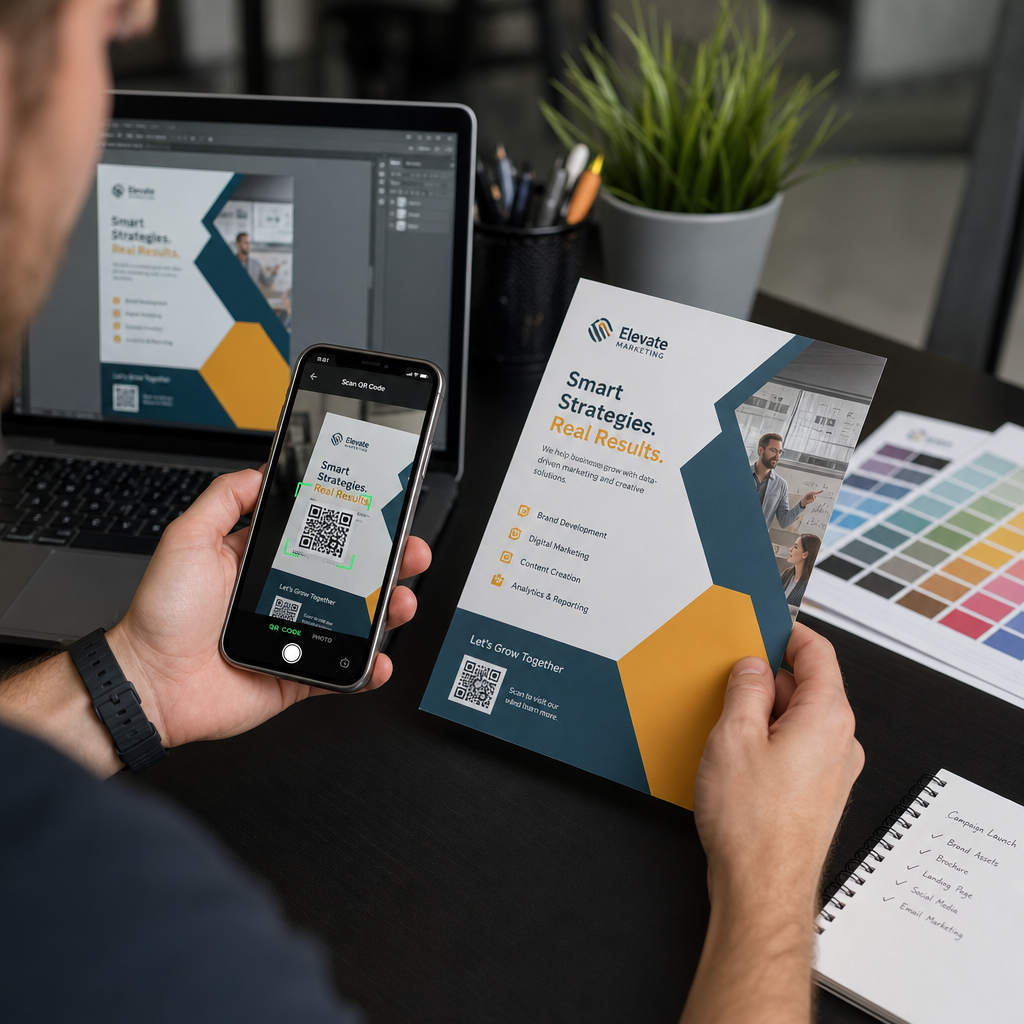
Sending a QR code to print without testing it first is one of the most common – and costly – mistakes in print marketing. A code that looks perfect on screen can fail completely once it hits paper, vinyl, or packaging. This guide walks you through every check you need to run before approving a print run.
Why QR Codes Fail After Printing
A QR code that scans cleanly on your monitor can fail in the real world for reasons that only become visible after printing. Understanding these failure points helps you build a reliable pre-print checklist.
The most common culprits are:
- Size that’s too small for the expected scanning distance
- Low resolution causing blurry or pixelated modules
- Insufficient contrast between the code and its background
- Missing quiet zone (the clear border surrounding the code)
- Hög datatäthet creating a pattern too fine for cameras to read
- Wrong file format used for print output
Each of these issues is entirely preventable if you catch it before the press runs. The sections below address each one in sequence.
Check Your QR Code Size Against Scanning Distance
Size is the single most common reason a printed QR code fails. The standard rule is the 10:1-förhållande: the QR code width should be at least 1 cm (or 1 inch) for every 10 cm (or 10 inches) of expected scanning distance. A code on a business card held at arm’s length needs a very different size than one on a poster read from across a room.
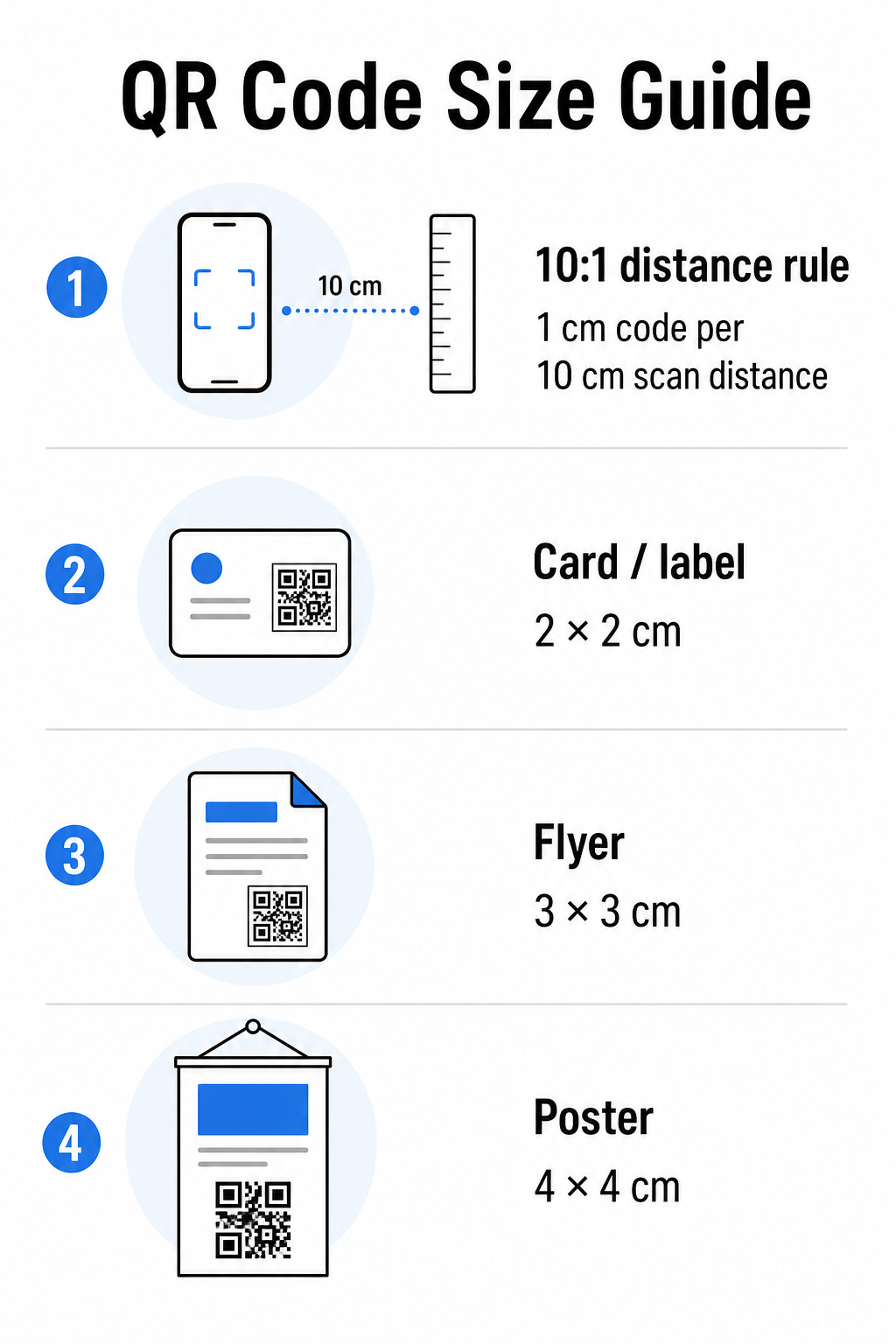
Use this table as a starting point for common print materials:
| Print Material | Minimum Recommended Size | Typiskt skanningsavstånd |
|---|---|---|
| Business card / label | 2 × 2 cm (0.8 × 0.8 in) | 20–30 cm (8–12 in) |
| Brochure / flyer | 3 × 3 cm (1.2 × 1.2 in) | 30 cm (12 in) |
| Poster / signage | 4 × 4 cm (1.6 × 1.6 in) | 40 cm (16 in) |
| Billboard / banner | 40 × 40 cm (16 × 16 in) | 4 m (13 ft) |
Before approving any print file, confirm the code dimensions match your expected use case. The storleksguide för QR-koder provides a complete breakdown by material type, including how data density affects the minimum viable size.
Verify Your File Format and Print Resolution
The format you export matters as much as the design itself. Raster images like PNG and JPEG are made of pixels. When scaled up for large-format printing, they become blurry and the fine modules in a QR code lose their sharp edges – making the code difficult or impossible to scan.
For any printed QR code, use vector formats: SVG, EPS, or PDF. Vector files scale to any size without losing quality because they are defined mathematically rather than pixel-by-pixel. If you must use a raster format, ensure the resolution is at least 300 DPI at the intended print size – not at the screen preview size.
A quick resolution check: open your image file, note its pixel dimensions, and divide by the intended print size in inches. If a 1-inch QR code is saved as a 100 × 100 pixel image, it’s only 100 DPI – well below the 300 DPI minimum and almost guaranteed to print blurry.
For a deeper look at this topic, the 10. guide för utskriftsupplösning för QR-koder covers DPI requirements and format choices in detail.
Create Print-Ready QR Codes in Seconds De Pageloot QR-kodgenerator lets you download your codes in SVG, EPS, and PDF formats – ready for any print size without quality loss.
Test Contrast Before It Goes to Print
QR code scanners work by distinguishing dark modules from a light background. When that contrast is too low, the scanner cannot reliably identify the pattern – even if the code looks fine to the human eye.
The technical benchmark to meet is a minsta kontrastförhållande på 4:1 between the dark modules and the light background. For payment applications or accessibility-focused use cases, aim for 4.5:1 or higher. Black modules on a white background produce a 21:1 ratio – the gold standard that every other color combination is measured against.
Common contrast mistakes to check for before printing:
- Light gray modules on white: insufficient contrast that will fail in low light
- Reversed colors (light code on dark background): some scanners handle this, many do not – never rely on it
- Gradient fills on modules: creates uneven contrast that confuses scanners
- Brand colors that are too close in tone: test with a grayscale conversion to see true contrast
A practical pre-print test is to convert your QR code image to grayscale and check whether the modules are still clearly distinguishable from the background. If they start to blend together in grayscale, they will fail across a wide range of device cameras and lighting conditions. The QR code color contrast best practices guide includes a color combination table showing contrast ratios and expected scan outcomes for common pairings.
Confirm the Quiet Zone Is Intact
De tyst zon is the blank margin surrounding all four sides of a QR code. It is not a design preference – it is a technical requirement defined by the ISO/IEC 18004 standard. Without it, scanners cannot locate where the code begins and ends, and the scan will fail.
The quiet zone must be at least four modules wide on all sides, where one module is one of the small squares in the code grid. As a practical reference:
- For a 1-inch QR code, allow approximately 0.15 inches of clear space on all sides
- For a visitkort QR-kod, maintain a quiet zone of at least 0.25 inches
Before sending to print, zoom into your layout file and confirm that no text, imagery, border, or background pattern encroaches on this zone. Placing a code too close to the edge of a design or overlapping it with decorative elements is one of the most common causes of scan failures that only surface after the job is printed.
Check the Error Correction Level
QR codes have a built-in recovery system called felkorrigering, which allows the code to be read even if part of it is damaged, obscured, or worn. There are four levels, each offering a different trade-off between resilience and data density:
| Nivå | Återställningskapacitet | Bästa användningsfallet |
|---|---|---|
| L (låg) | ~7% | Clean, undamaged surfaces; maximum data density |
| M (medelstor) | ~15% | Standard print materials with some wear |
| Q (kvartil) | ~25% | Codes with logo overlays or moderate risk of damage |
| H (hög) | ~30% | Outdoor use, packaging, codes with large logo overlays |
If your QR code includes a logo overlaid on the pattern – a common branding choice – you need at least level Q, and ideally level H. The logo effectively obscures part of the code, so the error correction must compensate. Confirm what level your code was generated with before finalizing, and always test a branded code with the overlay in place. The QR code readability best practices guide covers how error correction interacts with logo placement in detail.
Run a Physical Print Test Before the Full Run
No amount of on-screen checking replaces printing a physical proof. Print a single copy at the exact final size on the exact material you plan to use, then test it under conditions that reflect real-world use.
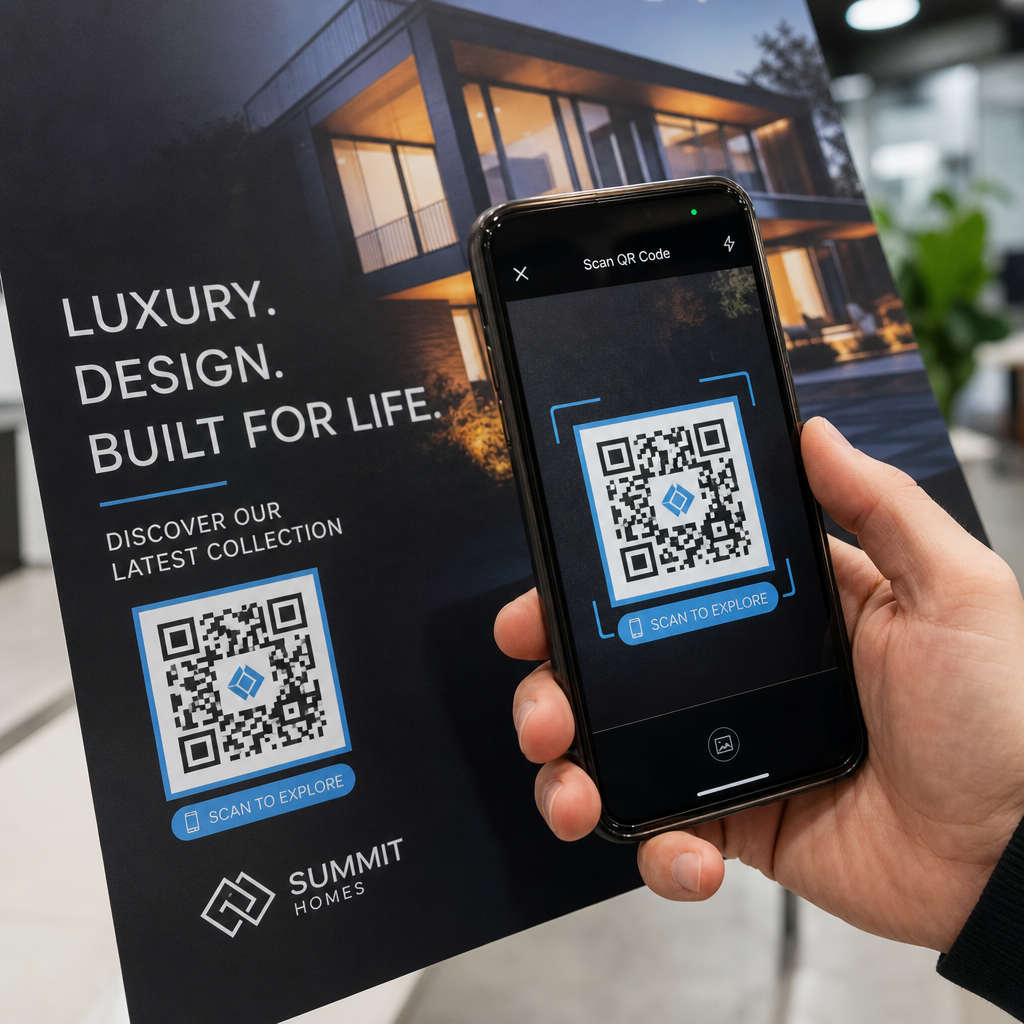
Your physical test should cover:
- Multiple devices: test on at least two different smartphones – one iOS and one Android – using both the native camera app and a third-party scanner
- Multiple distances: scan from the typical user distance, and also from slightly farther away to confirm there is margin for error
- Multiple lighting conditions: test in bright natural light, standard indoor lighting, and low light if the code will appear in any of those environments
- The actual surface: glossy surfaces reflect light and can cause scan failures even when the code design is correct; matte finishes perform more reliably across conditions
You can also verify the code digitally by uploading an image of your design to the Pageloot QR-kodskanner to confirm it decodes correctly before committing to a full run. If your code fails any of these tests, use the common QR code troubleshooting guide to diagnose the specific failure point before adjusting and retesting.
For a structured overview of what mobile testing should cover, the guide to testing QR codes for mobile usability walks through device compatibility, scan angles, and destination performance in detail.
Account for Your Printing Method and Surface
The way a QR code is printed affects scannability independent of the code design itself. Different methods produce different levels of module sharpness, and different surfaces interact with light in ways that can either help or hinder scanning.
Key considerations by method and material:
- Matte finishes diffuse light rather than reflecting it, making them nearly always superior to glossy finishes for scanning reliability
- Offset printing produces very sharp module edges and is well suited to high-volume print runs
- Digital printing works well for short runs and customized codes, but ink quality varies and can fade over time
- Thermal printing is economical for labels but can blur fine module edges – increase the code size to compensate
- Textured or curved surfaces introduce distortion that can confuse scanners; use a larger code to account for it
For a full breakdown of how each technique affects scannability, the guide on 15. hur trycktekniker påverkar QR-kodens skanningsbarhet covers method selection, substrate preparation, and ink durability.
Use a Dynamic QR Code to Protect Against Post-Print Changes
Even a perfectly tested QR code can fail after printing if the destination URL changes, the linked page is taken down, or the campaign content needs updating. With a static QR code, any change to the destination means reprinting everything.
Dynamiska QR-koder solve this by encoding a short redirect URL rather than the final destination directly. The redirect can be updated at any time from your dashboard, so the printed code stays valid even when your campaign evolves. This also means you can fix a broken link immediately after distribution – without reprinting a single piece.
Beyond error prevention, dynamic codes give you access to scan analytics: total scans, scan locations, time of scan, and device types. This data tells you whether your printed materials are actually working in the field, and where to focus optimization. The guide to using QR codes in print media covers how dynamic codes fit into broader print campaign strategy.
Protect Your Print Investment Skapa en Dynamisk QR-kod to keep your printed materials current and track real-world scan performance – without ever going back to press.
Pre-Print QR Code Testing Checklist
Before approving any QR code for print production, work through each of the following:
- Code size matches the 10:1 rule for expected scanning distance
- File is exported in SVG, EPS, or PDF format (or raster at a minimum of 300 DPI at final print size)
- Contrast ratio between modules and background meets at least 4:1
- Quiet zone of at least four modules is clear on all sides
- Error correction level is appropriate (Q or H if a logo overlay is present)
- Code decodes correctly when scanned from an uploaded image
- Physical proof tested on both iOS and Android devices
- Physical proof tested in realistic lighting conditions and on the actual print material
- Destination URL is live, mobile-optimized, and loads quickly
- Dynamic QR code used if the destination may need to change after printing
Running through these checks before every print job takes far less time than reordering a print run. Good QR code performance starts with the file, not the scanner. Get the size, format, contrast, and quiet zone right at the design stage, print a proof on the real material, and test it the way your audience will actually use it.
Vanliga frågor
The reliable minimum for close-range scanning – such as on business cards or product labels – is 2 × 2 cm (0.8 × 0.8 inches). For larger print materials, apply the 10:1 rule: the code width should be at least 1 cm for every 10 cm of expected scanning distance. A poster scanned from 1 meter away, for example, needs a code at least 10 cm wide.
Always use a vector format – SVG, EPS, or PDF – for print. Vector files scale to any size without becoming blurry or pixelated. If you must use a raster format like PNG, ensure the resolution is at least 300 DPI at the final print size. Low-resolution raster files are one of the most common causes of unreadable printed QR codes.
Print a single proof at the exact intended size on the exact material you plan to use, then test it on at least two different devices (iOS and Android) in realistic lighting conditions. You can also upload an image of your code to the Pageloot QR Code Scanner to verify it decodes correctly before going to press. Using a dynamic QR code adds another layer of protection – if anything needs to change after printing, you can update the destination without reprinting.