首页 > 博客 > Which Industries Need ADA-Compliant QR Codes?
Accessible QR code

Which Industries Need ADA-Compliant QR Codes?

Learn which industries require ADA-compliant QR codes under Title II and III, including government, healthcare, retail, and hospitality for WCAG compliance.
Updated on 6 月 10, 2026
目录

Are you unsure whether your business is legally required to make QR codes accessible under the ADA? Getting this wrong can expose your organization to compliance risk and exclude customers with disabilities from content they have a right to access. This guide breaks down which sectors carry the clearest legal obligations and what accessibility standards apply when QR codes are part of your customer-facing communications.

The Core Legal Reality: No Law Requires QR Codes, But Accessibility Laws Still Apply

Before diving into specific industries, one important clarification: no provision of the Americans with Disabilities Act specifically mandates that any business or agency use QR codes. The ADA focuses on ensuring effective, equal communication with people who have disabilities – regardless of which technology you choose to deliver that communication.

The critical implication is this: once you choose to use a QR code as part of your customer-facing communications, accessibility obligations follow. If your QR code is the primary or sole method of accessing important information, it must be usable by everyone – including people with visual impairments, limited mobility, or other disabilities.

Think of it this way: you are not required to install a ramp, but if your building has steps that customers must use to access your services, ADA standards govern how that ramp must be built. Similarly, if a QR code is how you deliver a menu, a form, or critical public information, then that QR code and the content it links to must be accessible.

Title II: Government and Public Sector Organizations

State and local governments carry some of the most explicit and well-documented digital accessibility obligations under the ADA. Title II of the ADA requires all state and local government entities to communicate with people with disabilities as effectively as they communicate with others. This covers every level of government operation – police departments, courts, voting services, public schools, community colleges, public libraries, water districts, and other special purpose districts.

In 2024, the U.S. Department of Justice finalized a rule under Title II designating WCAG 2.1 Level AA as the technical standard for state and local governments’ web content and mobile applications. This means that when a government agency places a QR code on a public document, sign, or physical location, the digital content that QR code links to must conform to WCAG 2.1 Level A and Level AA success criteria.

Federal guidance also makes clear that QR codes used in federal publications are expected to meet Section 508 of the Rehabilitation Act, which treats QR codes as a form of Information and Communication Technology (ICT). Under Section 508, a QR code in a digital document must be treated both as an image requiring descriptive alt text and as a link requiring an accessible text alternative – so that users who cannot scan the code can still reach the same information.

Practical requirements for government QR code use include:

  • Adjacent accessible text: Provide the destination URL or a short typed alternative next to every QR code so users who cannot scan it can still access the content
  • Descriptive alt text: In digital documents, alt text must describe what the QR code does (e.g., “QR code linking to the city’s accessible parking permit application”), not just its appearance
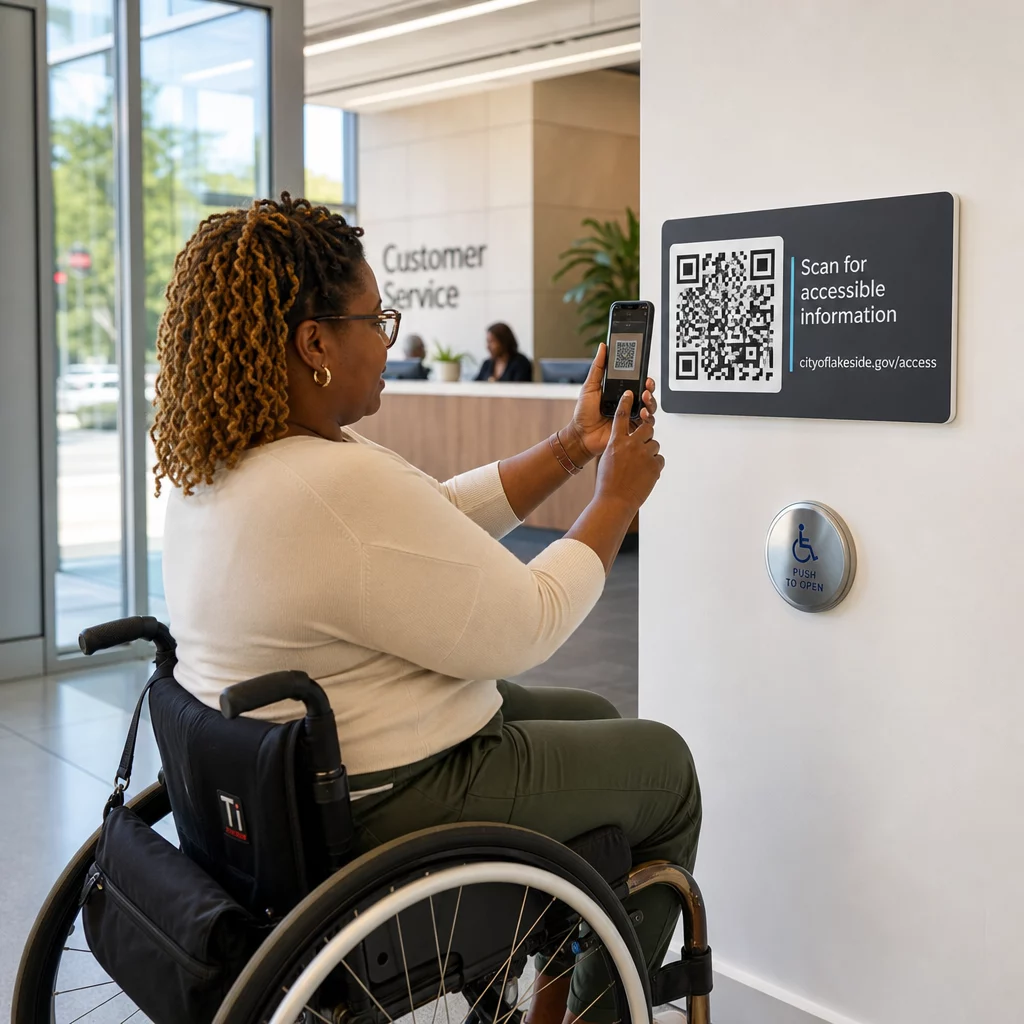
  • Physical placement: Printed QR codes should be positioned where people using wheelchairs can comfortably scan them – guidance recommends a height between 3.5 and 4.5 feet
  • Accessible destination content: The webpage or document reached through the QR code must itself meet WCAG 2.1 Level AA

For detailed placement guidance specific to government use, see our guide on best QR code placements for government agencies.

Keep Government QR Codes Updated Without Reprinting Need to update a destination URL on a posted government sign without replacing the physical material? Use the 动态二维码生成器 to change the linked content anytime – no reprinting required.

Title III: Businesses and Organizations Open to the Public

Private businesses and nonprofit organizations that serve the public are covered by Title III of the ADA, which defines these as “public accommodations.” The list of covered entities is broad and includes nearly every type of customer-facing business. Under Title III, these organizations must provide effective communication for customers with vision, hearing, and speech disabilities, including through auxiliary aids and services when necessary.

The following categories are explicitly identified as public accommodations under the ADA:

类别 实例
Places of lodging Hotels, motels, inns
Food and drink establishments Restaurants, bars
Entertainment venues Theaters, stadiums, concert halls
Public gathering places Convention centers, auditoriums
Sales and rental establishments Grocery stores, shopping centers, hardware stores
Service establishments Banks, pharmacies, healthcare providers, law offices, hospitals
Transportation terminals Bus and train stations
Public display or collection Museums, libraries, galleries
Recreation Parks, zoos, amusement parks
Educational institutions Private nursery schools through graduate programs
Social services Daycare centers, senior centers, homeless shelters, food banks
Exercise and recreation Gyms, health spas, bowling alleys, golf courses

If your organization appears in this list and you use QR codes in any customer-facing context – signage, menus, product displays, payment terminals, or informational materials – effective communication obligations apply to that QR code experience.

Healthcare: Heightened Obligations and Practical Stakes

Hospitals, clinics, pharmacies, and private healthcare providers appear under Title III as service establishments. But healthcare organizations often operate under additional privacy and information standards that make accessible communication especially important.

When a QR code links to discharge instructions, medication information, appointment scheduling, or patient forms, the consequences of inaccessibility are not just legal – they are clinical. A patient with low vision who cannot access dosage instructions because a QR code lacks a fallback option faces a meaningful health risk.

QR codes in healthcare settings should always be accompanied by accessible alternatives such as large-print handouts, audio explanations, or staff assistance. For public health facilities that are also government entities, Title II obligations apply on top of standard healthcare communication requirements.

Explore how QR codes are used in hospitals and healthcare settings for practical implementation examples.

Hospitality: Menus, Check-In, and Guest Services

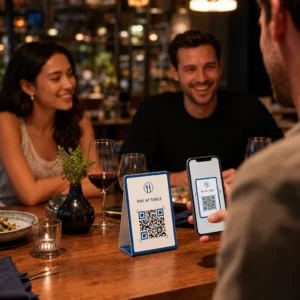
The hospitality industry – hotels, restaurants, and bars – has adopted QR codes at a remarkable pace, especially for digital menus. Because restaurants and hotels are explicitly listed as public accommodations under Title III, every QR-delivered guest experience carries an effective communication obligation.

A restaurant that relies solely on a QR code menu must ensure that menu is accessible to guests with visual impairments. This means the landing page the QR code links to should be compatible with screen readers, use sufficient color contrast, and have a logical heading structure. Guests who cannot use a QR code – whether due to visual impairment, unfamiliarity with smartphones, or motor limitations – must have an alternative way to access the same information.

For accessible menu implementation, the 菜单二维码生成器 allows you to link to a digital menu that you can update instantly without reprinting physical materials – useful when item availability changes or when you need to update the linked page to improve accessibility.

For guidance on making QR code payments accessible in hospitality and retail settings, see our article on 二维码支付可访问性最佳实践.

Education: Public and Private Schools

Educational institutions span both Title II and Title III depending on whether they are publicly or privately operated. Public K–12 schools, community colleges, and state universities fall under Title II, including the DOJ rule requiring WCAG 2.1 Level AA compliance for web content and mobile apps. Private schools at all levels are covered by Title III as public accommodations.

In either case, when schools use QR codes to distribute course materials, event information, forms, or learning resources, those materials must be accessible. A student with a visual impairment must be able to access the same content as their peers. In practice, this means:

  • Linked PDFs must be tagged and screen-reader compatible
  • Web content reached through QR codes must meet WCAG standards
  • Physical QR code placements in classrooms or hallways should be at heights accessible to students using wheelchairs

See how QR codes are used in schools and education for specific use case ideas, and explore the PDF QR 码生成器 for distributing accessible course documents.

Retail: Stores, Packaging, and In-Store Displays

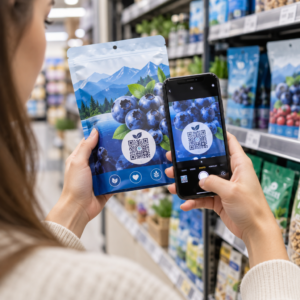
Retail stores, shopping centers, and grocery stores are listed as public accommodations under Title III. As QR codes become more common on product packaging, shelf displays, and checkout areas, retail organizations face growing exposure to effective communication obligations.

A QR code on a product label that links to usage instructions, ingredient lists, or warranty information must be usable by customers with visual impairments. If the code is the primary way to access that information – and no equivalent alternative is provided – the retailer may not be meeting its effective communication obligations.

Key accessibility considerations for retail QR deployments include:

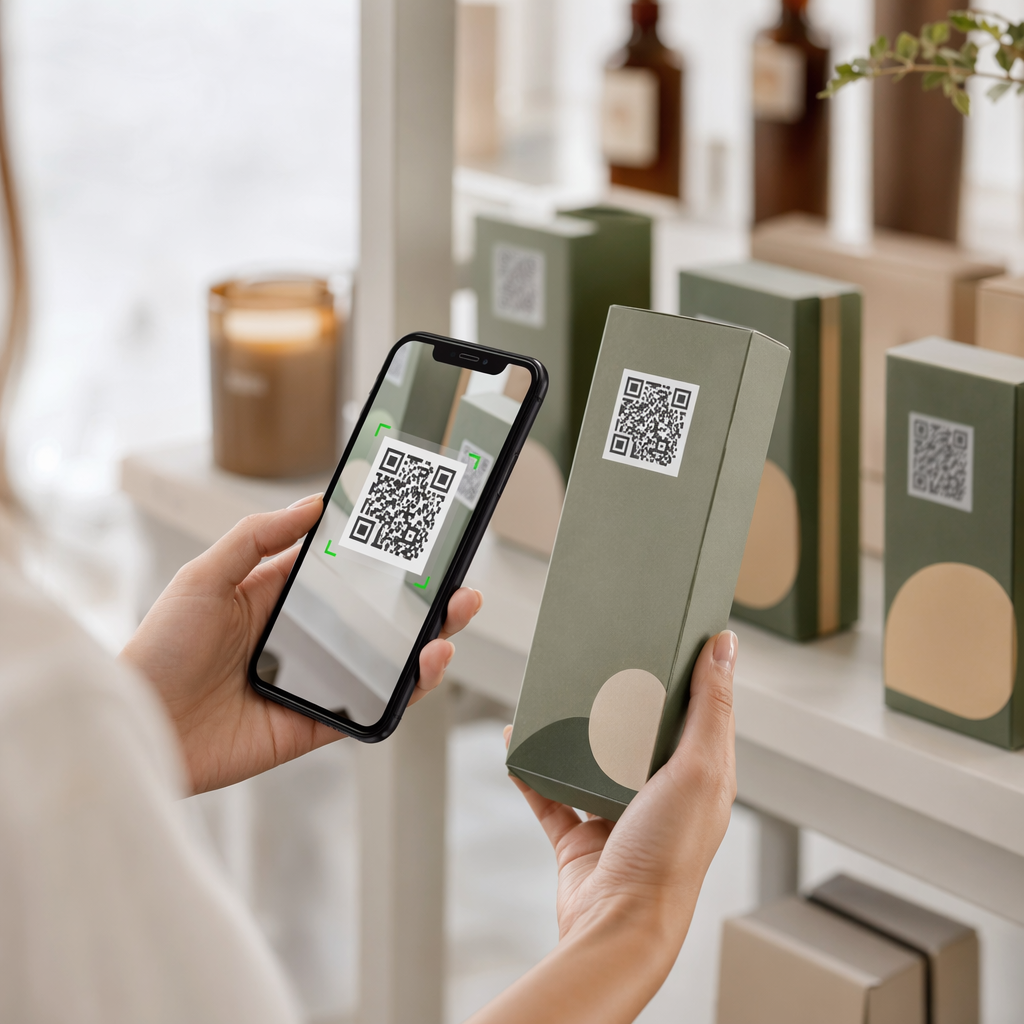
  • Providing a typed URL or printed equivalent alongside QR codes on packaging
  • Ensuring product information pages linked from QR codes meet WCAG contrast and navigation standards
  • Placing in-store QR codes at heights and in positions accessible to wheelchair users

For placement strategy, see our guide on 零售店最佳二维码放置位置.

The Technical Standards That Apply Across Industries

Regardless of which sector you operate in, the same core accessibility standards apply when you deploy QR codes. These come from WCAG 2.1 and Section 508 guidance, and they cover both the physical QR code itself and the digital content it links to.

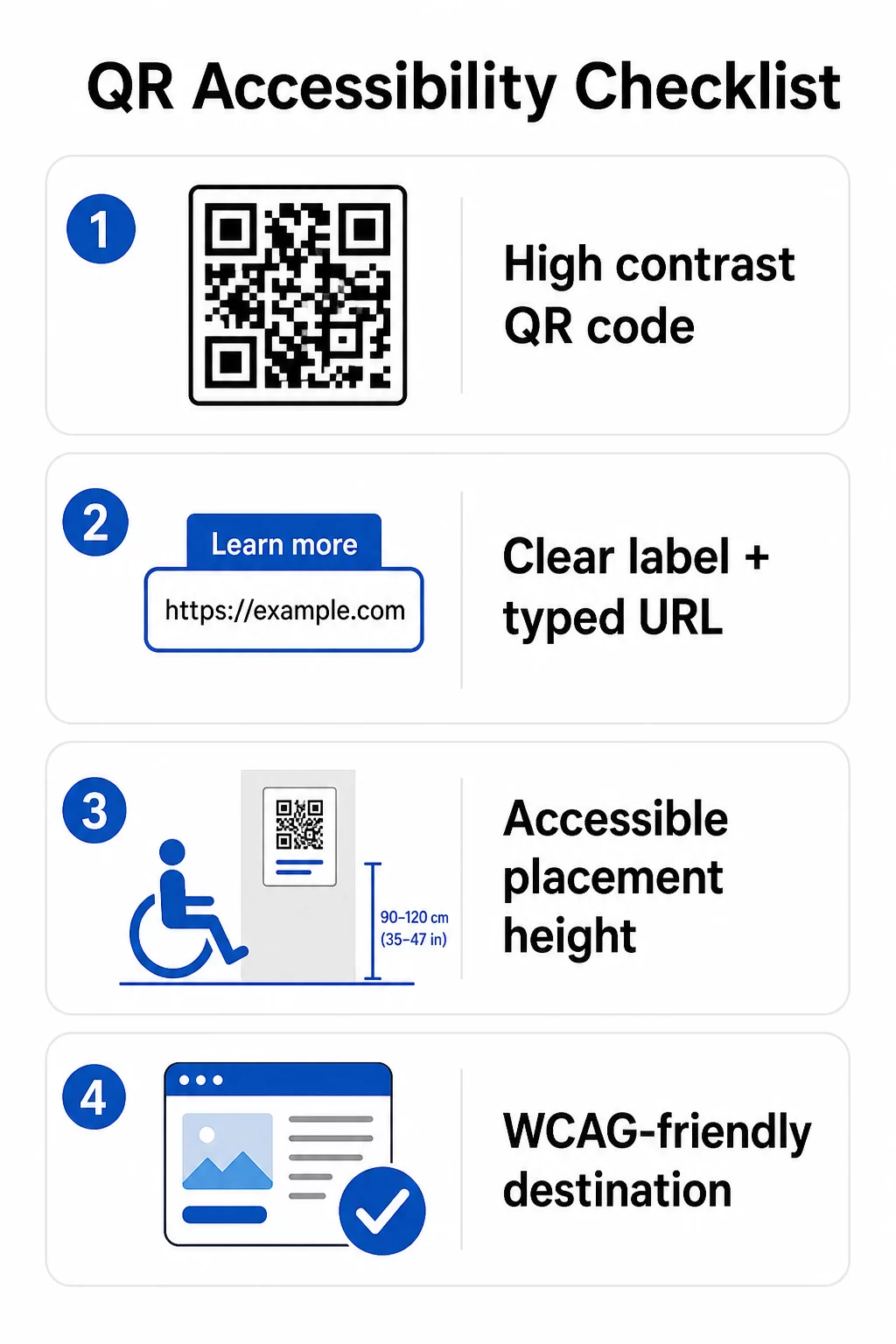
QR accessibility checklist

For the physical QR code:

  • Use a dark foreground on a light background, targeting a contrast ratio of at least 4.5:1 for full accessibility
  • Print codes at a minimum size of 1 inch × 1 inch, and follow the 10:1 rule for scanning distance (1 inch of code width per 10 inches of expected viewing distance)
  • Place printed codes between 3.5 and 4.5 feet from the floor so wheelchair users can comfortably reach them
  • Add a clear label or call-to-action nearby so users understand what the code does before scanning
  • Provide an adjacent text URL or equivalent alternative so users who cannot scan the QR code can still access the content

For the linked digital content:

  • Destination web pages must meet WCAG 2.1 Level A and AA success criteria
  • In digital documents, QR codes need descriptive alt text explaining the code’s purpose – not its visual appearance (WCAG Success Criterion 1.1.1)
  • The non-text contrast of QR code modules against their background must meet at least a 3:1 ratio (WCAG Success Criterion 1.4.11)
  • If the QR code functions as a link, the alt text must describe where it leads (WCAG Success Criterion 2.4.4)

For a complete implementation checklist, see our guide on how to make QR codes ADA-compliant and our broader 二维码可用性最佳实践.

You can also explore 语音激活二维码 and tactile cues as advanced strategies for serving users with visual impairments – particularly relevant for healthcare, education, and government deployments.

Create Accessible QR Codes From the Start 使用 二维码生成器 to build high-contrast, properly sized QR codes with clear labels and branding – then link them to accessible content that meets WCAG standards.

Why Accessible QR Codes Are Good Practice Beyond Legal Compliance

Legal obligations aside, making QR codes accessible expands the audience that can engage with your content. An inaccessible QR code does not just create legal exposure – it creates a gap in your customer experience. A guest at a restaurant who cannot read the QR menu, a patient who cannot access medication instructions, or a student who cannot download course materials because of an inaccessible PDF all represent moments where your organization has failed to communicate effectively.

Industries needing accessibility

Accessible QR code practices also tend to improve the experience for everyone. Sufficient contrast helps codes scan faster in poor lighting. Proper sizing helps users of all ages scan from a comfortable distance. Clear labels reduce confusion for first-time QR code users. These improvements benefit your entire audience, not just users with disabilities.

For a deeper look at contrast, sizing, readability, and placement, explore our guides on 二维码可读性最佳实践二维码颜色对比度最佳实践.

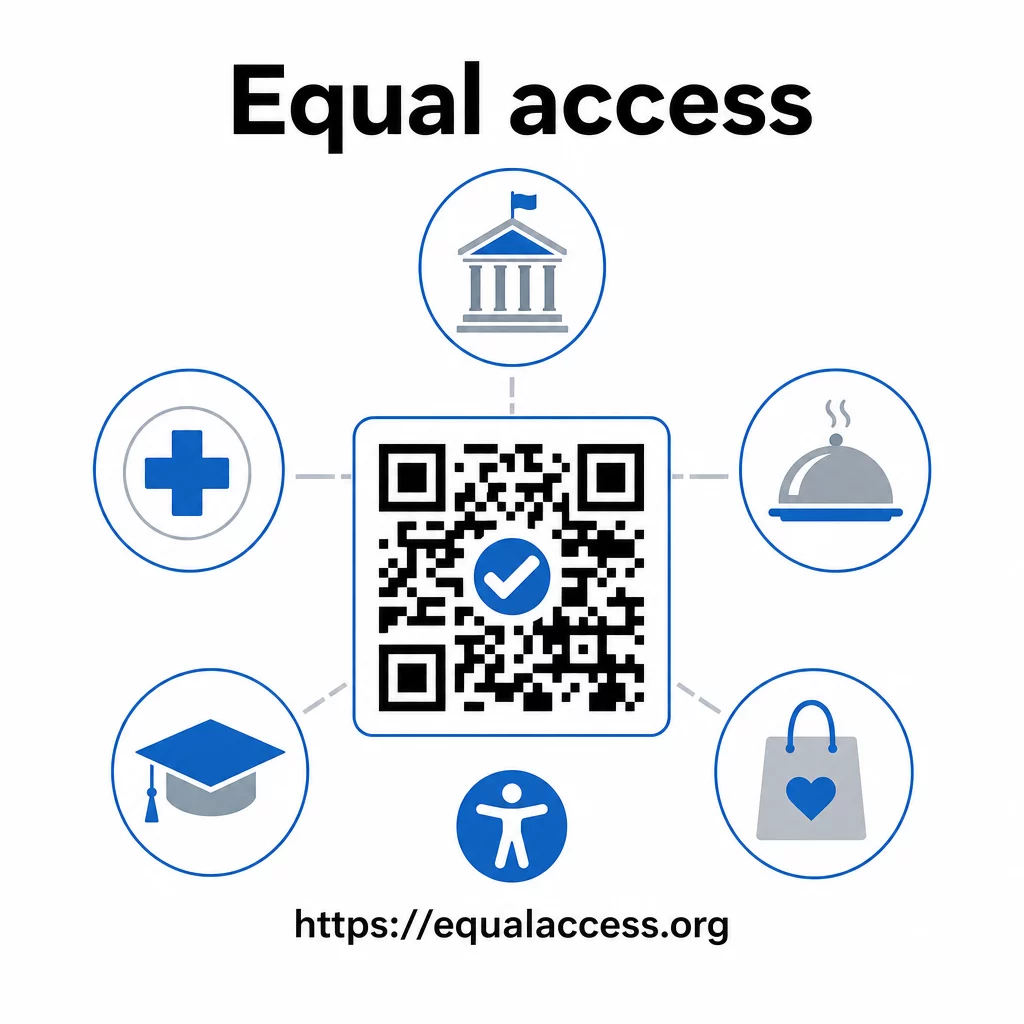
Accessibility obligations apply broadly across government, healthcare, education, hospitality, and retail – and the same technical standards govern all of them. The practical starting point is straightforward: if a QR code is how you communicate important information, that communication must be accessible. Use 动态二维码 so you can update linked content to maintain compliance without reprinting, and explore the full range of industry-specific QR code solutions to find the right implementation for your sector.

常见问题

Is my business legally required to use ADA-compliant QR codes?

No law specifically requires businesses to use QR codes. However, if you choose to use QR codes as part of your customer-facing communications, the ADA’s effective communication requirements apply. If a QR code is the primary or only way customers can access information, that experience must be accessible to people with disabilities – including those with visual impairments or limited mobility.

Which industries face the clearest ADA accessibility obligations when using QR codes?

State and local government agencies face the most explicit obligations under Title II of the ADA and the DOJ’s 2024 final rule, which requires WCAG 2.1 Level AA compliance for web content and mobile apps. Private businesses open to the public – including restaurants, hotels, hospitals, retail stores, private schools, banks, and gyms – are covered under Title III and must provide effective communication through auxiliary aids and services. Federal agencies are additionally governed by Section 508 of the Rehabilitation Act.

What is the minimum required to make a QR code ADA-accessible?

There is no single checklist mandated by the ADA specifically for QR codes, but best practices drawn from WCAG 2.1 and Section 508 guidance include: using a dark foreground on a light background with at least a 4.5:1 contrast ratio; printing codes at a minimum size of 1 inch × 1 inch; placing physical codes at accessible heights (3.5–4.5 feet from the floor); providing a nearby text URL as an alternative for users who cannot scan; adding descriptive alt text in digital documents; and ensuring the destination content meets WCAG 2.1 Level AA standards.

关于作者

Siim Kostabi 是 Pageloot 的内容主管,负责撰写关于我们创新型二维码生成器服务的文章。凭借五年多来在二维码领域积累的深厚专业知识,Siim 是该领域的专家。他致力于利用二维码技术简化和增强数字交互,并取得了显著的成果。.

类别
了解更多关于
卖家为FBA包裹贴标
亚马逊FBA 条码标签
医院二维码签到
的QR码 医院与保健
QR QR码的#1解决方案

如果您需要在线创建QR码,则可以 制作二维码 就在这里免费!
Pageloot是 #1转到解决方案 创建和扫描QR码。

BL-0171

受到超过 20,000 个品牌的信赖,可获得更多销售、评论和关注者。

客户徽标
受到顶级品牌的信赖
评分为 4.8(共 5)

4.86 / 5 星评级

雨果·劳伦特
雨果·劳伦特
餐馆老板
有史以来最容易和最可靠的QR码生成器。PDF文件可以立即上传。我们的餐厅菜单现在是数字化的。
卢卡斯-詹森
卢卡斯-詹森
房地产开发商
这是一个很好的工具,二维码带你到你想要的地方。我们只使用位置二维码,但有许多有用的功能。
艾玛-莫雷蒂
艾玛-莫雷蒂
零售产品
易于使用和快速。它工作得很好,创造了一个完美的图像,所以员工可以下载我的vCard。
雨果·劳伦特
雨果·劳伦特
餐馆老板
有史以来最容易和最可靠的QR码生成器。PDF文件可以立即上传。我们的餐厅菜单现在是数字化的。
卢卡斯-詹森
卢卡斯-詹森
房地产开发商
这是一个很好的工具,二维码带你到你想要的地方。我们只使用位置二维码,但有许多有用的功能。
艾玛-莫雷蒂
艾玛-莫雷蒂
零售产品
易于使用和快速。它工作得很好,创造了一个完美的图像,所以员工可以下载我的vCard。
查看更多QR码
Scanning fashion hangtag
的QR码 时尚品牌
Agency QR campaign
二维码 营销机构
将一切转化为数字体验 不到3分钟。

免费试用 14 天。

无需信用卡。

首次购买可享受 30% 折扣

使用代码:

分享您的 MP3 文件

注册以创建 PDF QR 码

上传和显示你需要的一切。

  • 音频文件
  • 播客
  • 音乐

注册即可享 14 天免费试用。.
试用期结束后,二维码将失效。.

注册以创建音频 mp3 二维码

使用边框获得更多扫描

注册以向您的二维码添加更多框架

呼叫行动框架帮助您的客户与QR码轻松互动。试试吧!

注册即可享 14 天免费试用。.
试用期结束后,二维码将失效。.

注册以向您的二维码添加更多框架

使用形状添加更多样式

注册以创建更多形状

二维码不一定是方形的。试着改变它以适应你的品牌形象。

注册即可享 14 天免费试用。.
试用期结束后,二维码将失效。.

注册以创建更多形状

为您的二维码添加徽标

注册以将您的徽标添加到二维码中

通过在二维码上添加你的标志和品牌,使你的二维码脱颖而出。

注册即可享 14 天免费试用。.
试用期结束后,二维码将失效。.

注册以将您的徽标添加到二维码中

智能应用商店重定向

注册以创建应用商店二维码

将您的应用程序链接添加到我们的智能应用程序商店QR码。用户会根据他们的设备被重新定向。

注册即可享 14 天免费试用。.
试用期结束后,二维码将失效。.

注册以创建应用商店二维码

将图片上传到二维码

注册以创建图像二维码

轻松分享你的图像。在几秒钟内动态地改变任何图像。

注册即可享 14 天免费试用。.
试用期结束后,二维码将失效。.

注册以创建图像二维码

分享您的 PDF 文件

注册以创建 PDF QR 码

上传和显示你需要的一切。

  • 菜单和价格表
  • 使用说明
  • 任何文件

注册即可享 14 天免费试用。.
试用期结束后,二维码将失效。.

注册以创建 PDF QR 码

稍后编辑,无需打印

注册即可编辑您的二维码,无需再次打印

动态QR码让你改变你的QR码的内容,而不需要打印新的QR码。

注册即可享 14 天免费试用。.
试用期结束后,二维码将失效。.

注册即可编辑您的二维码,无需再次打印

何时?何地?追踪您的二维码扫描

注册以追踪您的二维码

发现你的哪些二维码收到了最多的扫描,以及什么最能让你的客户兴奋。

注册即可享 14 天免费试用。.
试用期结束后,二维码将失效。.

注册以追踪您的二维码

提供可打印文件

注册以创建 PDF 和 SVG 等矢量二维码

.EPS, .PDF, .SVG

想下载高清分辨率的QR码吗?获得矢量或像素格式,可随时打印。

注册即可享 14 天免费试用。.
试用期结束后,二维码将失效。.

注册以创建 PDF 和 SVG 等矢量二维码

请等待。您的二维码是 正在加载... 正在加载...

打造专属

注册以保存您的二维码以供日后使用

通过创建具有不同颜色、标识和行动呼吁框架的出色的QR码,获得更多的扫描。

注册即可享 14 天免费试用。.
试用期结束后,二维码将失效。.

注册以保存您的二维码以供日后使用