Are you unsure whether your business is legally required to make QR codes accessible under the ADA? Getting this wrong can expose your organization to compliance risk and exclude customers with disabilities from content they have a right to access. This guide breaks down which sectors carry the clearest legal obligations and what accessibility standards apply when QR codes are part of your customer-facing communications.
The Core Legal Reality: No Law Requires QR Codes, But Accessibility Laws Still Apply
Before diving into specific industries, one important clarification: no provision of the Americans with Disabilities Act specifically mandates that any business or agency use QR codes. The ADA focuses on ensuring effective, equal communication with people who have disabilities – regardless of which technology you choose to deliver that communication.
The critical implication is this: once you choose to use a QR code as part of your customer-facing communications, accessibility obligations follow. If your QR code is the primary or sole method of accessing important information, it must be usable by everyone – including people with visual impairments, limited mobility, or other disabilities.
Think of it this way: you are not required to install a ramp, but if your building has steps that customers must use to access your services, ADA standards govern how that ramp must be built. Similarly, if a QR code is how you deliver a menu, a form, or critical public information, then that QR code and the content it links to must be accessible.
Title II: Government and Public Sector Organizations
State and local governments carry some of the most explicit and well-documented digital accessibility obligations under the ADA. Title II of the ADA requires all state and local government entities to communicate with people with disabilities as effectively as they communicate with others. This covers every level of government operation – police departments, courts, voting services, public schools, community colleges, public libraries, water districts, and other special purpose districts.
In 2024, the U.S. Department of Justice finalized a rule under Title II designating WCAG 2.1 Level AA as the technical standard for state and local governments’ web content and mobile applications. This means that when a government agency places a QR code on a public document, sign, or physical location, the digital content that QR code links to must conform to WCAG 2.1 Level A and Level AA success criteria.
Federal guidance also makes clear that QR codes used in federal publications are expected to meet Section 508 of the Rehabilitation Act, which treats QR codes as a form of Information and Communication Technology (ICT). Under Section 508, a QR code in a digital document must be treated both as an image requiring descriptive alt text and as a link requiring an accessible text alternative – so that users who cannot scan the code can still reach the same information.
Practical requirements for government QR code use include:
- Adjacent accessible text: Provide the destination URL or a short typed alternative next to every QR code so users who cannot scan it can still access the content
- Descriptive alt text: In digital documents, alt text must describe what the QR code does (e.g., “QR code linking to the city’s accessible parking permit application”), not just its appearance
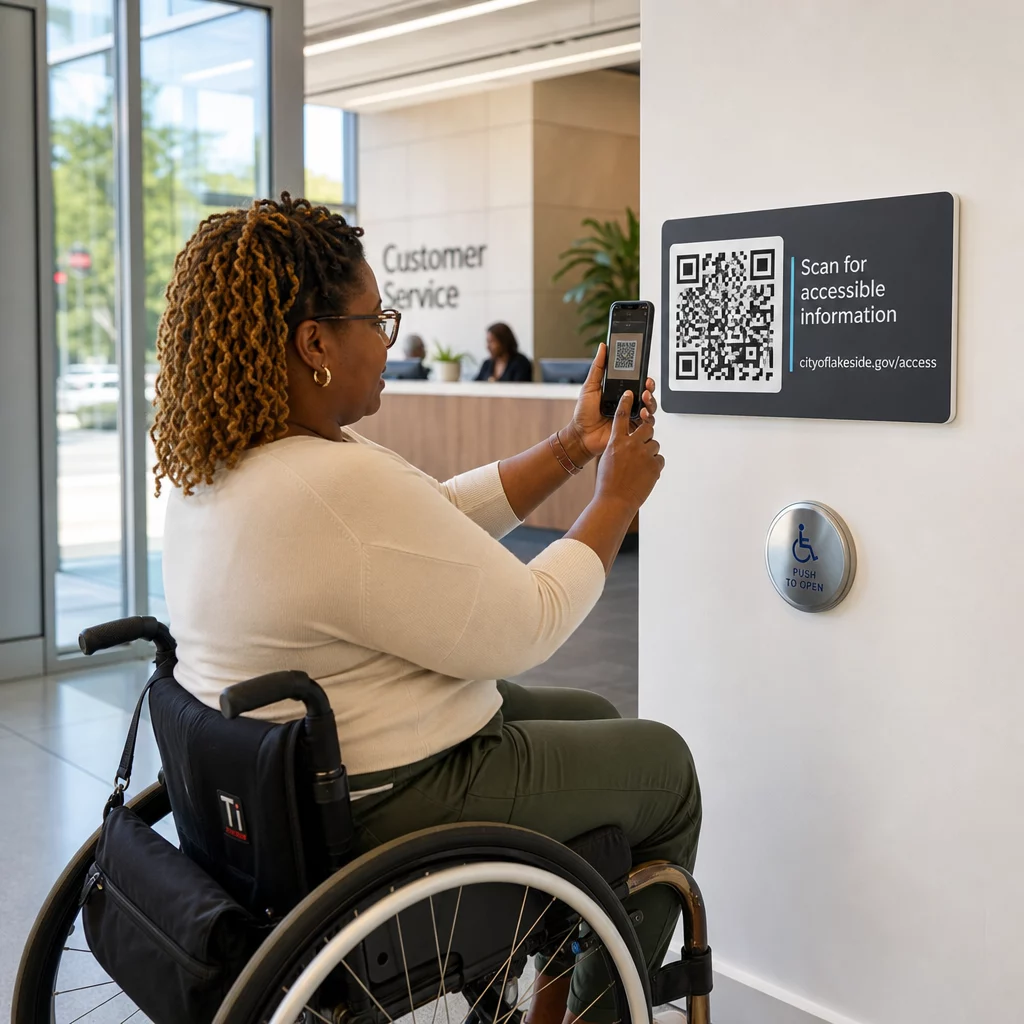
- Physical placement: Printed QR codes should be positioned where people using wheelchairs can comfortably scan them – guidance recommends a height between 3.5 and 4.5 feet
- Accessible destination content: The webpage or document reached through the QR code must itself meet WCAG 2.1 Level AA
For detailed placement guidance specific to government use, see our guide on best QR code placements for government agencies.
Keep Government QR Codes Updated Without Reprinting Need to update a destination URL on a posted government sign without replacing the physical material? Use the Generátorom dynamických QR kódov to change the linked content anytime – no reprinting required.
Title III: Businesses and Organizations Open to the Public
Private businesses and nonprofit organizations that serve the public are covered by Title III of the ADA, which defines these as “public accommodations.” The list of covered entities is broad and includes nearly every type of customer-facing business. Under Title III, these organizations must provide effective communication for customers with vision, hearing, and speech disabilities, including through auxiliary aids and services when necessary.
The following categories are explicitly identified as public accommodations under the ADA:
| Kategória | Príklady |
|---|---|
| Places of lodging | Hotels, motels, inns |
| Food and drink establishments | Restaurants, bars |
| Entertainment venues | Theaters, stadiums, concert halls |
| Public gathering places | Convention centers, auditoriums |
| Sales and rental establishments | Grocery stores, shopping centers, hardware stores |
| Service establishments | Banks, pharmacies, healthcare providers, law offices, hospitals |
| Transportation terminals | Bus and train stations |
| Public display or collection | Museums, libraries, galleries |
| Recreation | Parks, zoos, amusement parks |
| Educational institutions | Private nursery schools through graduate programs |
| Social services | Daycare centers, senior centers, homeless shelters, food banks |
| Exercise and recreation | Gyms, health spas, bowling alleys, golf courses |
If your organization appears in this list and you use QR codes in any customer-facing context – signage, menus, product displays, payment terminals, or informational materials – effective communication obligations apply to that QR code experience.
Healthcare: Heightened Obligations and Practical Stakes
Hospitals, clinics, pharmacies, and private healthcare providers appear under Title III as service establishments. But healthcare organizations often operate under additional privacy and information standards that make accessible communication especially important.
When a QR code links to discharge instructions, medication information, appointment scheduling, or patient forms, the consequences of inaccessibility are not just legal – they are clinical. A patient with low vision who cannot access dosage instructions because a QR code lacks a fallback option faces a meaningful health risk.
QR codes in healthcare settings should always be accompanied by accessible alternatives such as large-print handouts, audio explanations, or staff assistance. For public health facilities that are also government entities, Title II obligations apply on top of standard healthcare communication requirements.
Explore how QR codes are used in hospitals and healthcare settings for practical implementation examples.
Hospitality: Menus, Check-In, and Guest Services
The hospitality industry – hotels, restaurants, and bars – has adopted QR codes at a remarkable pace, especially for digital menus. Because restaurants and hotels are explicitly listed as public accommodations under Title III, every QR-delivered guest experience carries an effective communication obligation.
A restaurant that relies solely on a QR code menu must ensure that menu is accessible to guests with visual impairments. This means the landing page the QR code links to should be compatible with screen readers, use sufficient color contrast, and have a logical heading structure. Guests who cannot use a QR code – whether due to visual impairment, unfamiliarity with smartphones, or motor limitations – must have an alternative way to access the same information.
For accessible menu implementation, the Generátor QR kódov menu allows you to link to a digital menu that you can update instantly without reprinting physical materials – useful when item availability changes or when you need to update the linked page to improve accessibility.
For guidance on making QR code payments accessible in hospitality and retail settings, see our article on osvedčených postupov pre prístupnosť platieb QR kódom.
Education: Public and Private Schools
Educational institutions span both Title II and Title III depending on whether they are publicly or privately operated. Public K–12 schools, community colleges, and state universities fall under Title II, including the DOJ rule requiring WCAG 2.1 Level AA compliance for web content and mobile apps. Private schools at all levels are covered by Title III as public accommodations.
In either case, when schools use QR codes to distribute course materials, event information, forms, or learning resources, those materials must be accessible. A student with a visual impairment must be able to access the same content as their peers. In practice, this means:
- Linked PDFs must be tagged and screen-reader compatible
- Web content reached through QR codes must meet WCAG standards
- Physical QR code placements in classrooms or hallways should be at heights accessible to students using wheelchairs
See how QR codes are used in schools and education for specific use case ideas, and explore the Generátor QR kódov PDF for distributing accessible course documents.
Retail: Stores, Packaging, and In-Store Displays
Retail stores, shopping centers, and grocery stores are listed as public accommodations under Title III. As QR codes become more common on product packaging, shelf displays, and checkout areas, retail organizations face growing exposure to effective communication obligations.
A QR code on a product label that links to usage instructions, ingredient lists, or warranty information must be usable by customers with visual impairments. If the code is the primary way to access that information – and no equivalent alternative is provided – the retailer may not be meeting its effective communication obligations.
Key accessibility considerations for retail QR deployments include:
- Providing a typed URL or printed equivalent alongside QR codes on packaging
- Ensuring product information pages linked from QR codes meet WCAG contrast and navigation standards
- Placing in-store QR codes at heights and in positions accessible to wheelchair users
For placement strategy, see our guide on najlepším umiestneniam QR kódov pre maloobchodné predajne.
The Technical Standards That Apply Across Industries
Regardless of which sector you operate in, the same core accessibility standards apply when you deploy QR codes. These come from WCAG 2.1 and Section 508 guidance, and they cover both the physical QR code itself and the digital content it links to.
For the physical QR code:
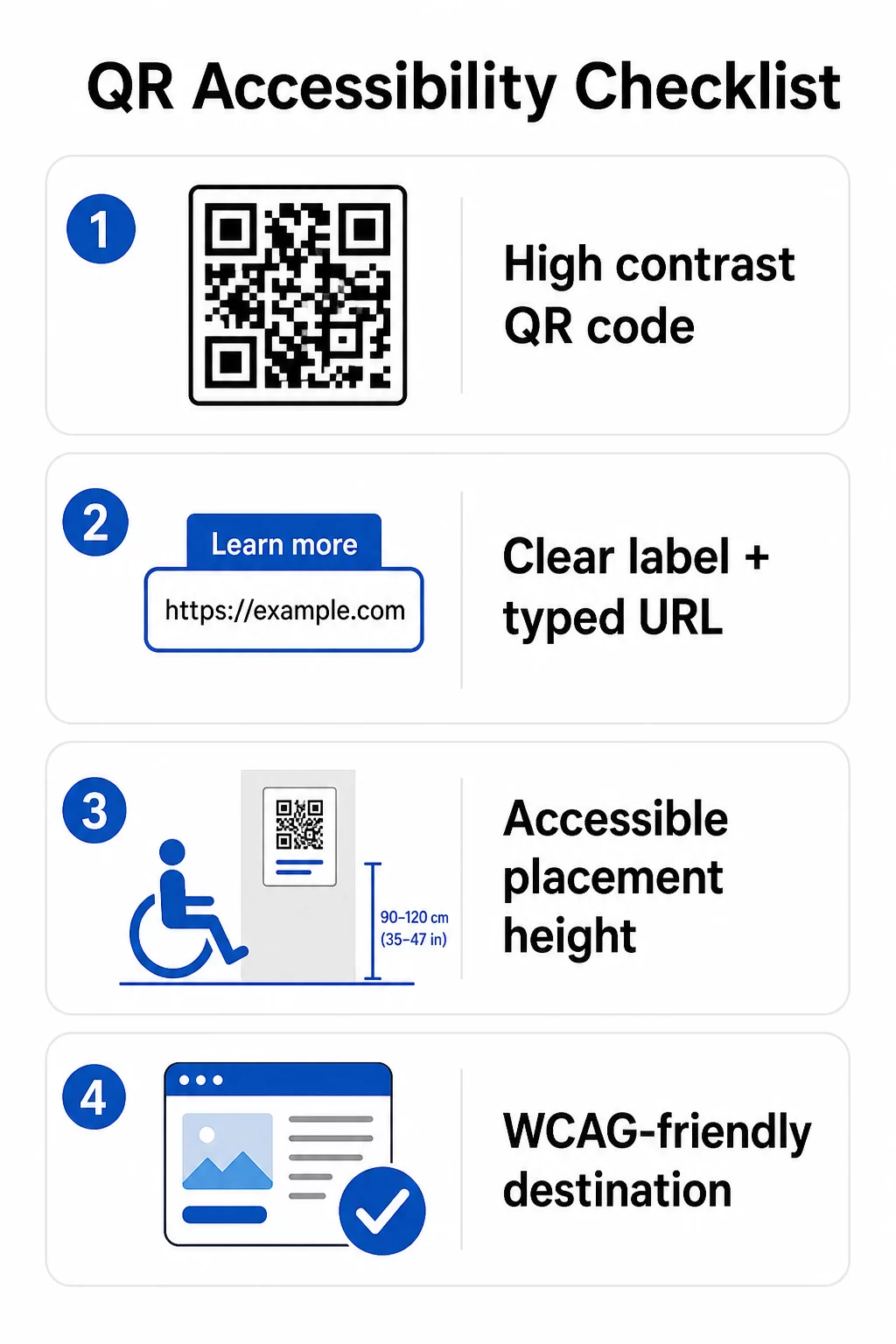
- Use a dark foreground on a light background, targeting a contrast ratio of at least 4.5:1 for full accessibility
- Print codes at a minimum size of 1 inch × 1 inch, and follow the 10:1 rule for scanning distance (1 inch of code width per 10 inches of expected viewing distance)
- Place printed codes between 3.5 and 4.5 feet from the floor so wheelchair users can comfortably reach them
- Add a clear label or call-to-action nearby so users understand what the code does before scanning
- Provide an adjacent text URL or equivalent alternative so users who cannot scan the QR code can still access the content
For the linked digital content:
- Destination web pages must meet WCAG 2.1 Level A and AA success criteria
- In digital documents, QR codes need descriptive alt text explaining the code’s purpose – not its visual appearance (WCAG Success Criterion 1.1.1)
- The non-text contrast of QR code modules against their background must meet at least a 3:1 ratio (WCAG Success Criterion 1.4.11)
- If the QR code functions as a link, the alt text must describe where it leads (WCAG Success Criterion 2.4.4)
For a complete implementation checklist, see our guide on how to make QR codes ADA-compliant and our broader osvedčené postupy použiteľnosti QR kódov.
You can also explore hlasom aktivované QR kódy and tactile cues as advanced strategies for serving users with visual impairments – particularly relevant for healthcare, education, and government deployments.
Create Accessible QR Codes From the Start Použi Generátor QR kódov to build high-contrast, properly sized QR codes with clear labels and branding – then link them to accessible content that meets WCAG standards.
Why Accessible QR Codes Are Good Practice Beyond Legal Compliance
Legal obligations aside, making QR codes accessible expands the audience that can engage with your content. An inaccessible QR code does not just create legal exposure – it creates a gap in your customer experience. A guest at a restaurant who cannot read the QR menu, a patient who cannot access medication instructions, or a student who cannot download course materials because of an inaccessible PDF all represent moments where your organization has failed to communicate effectively.
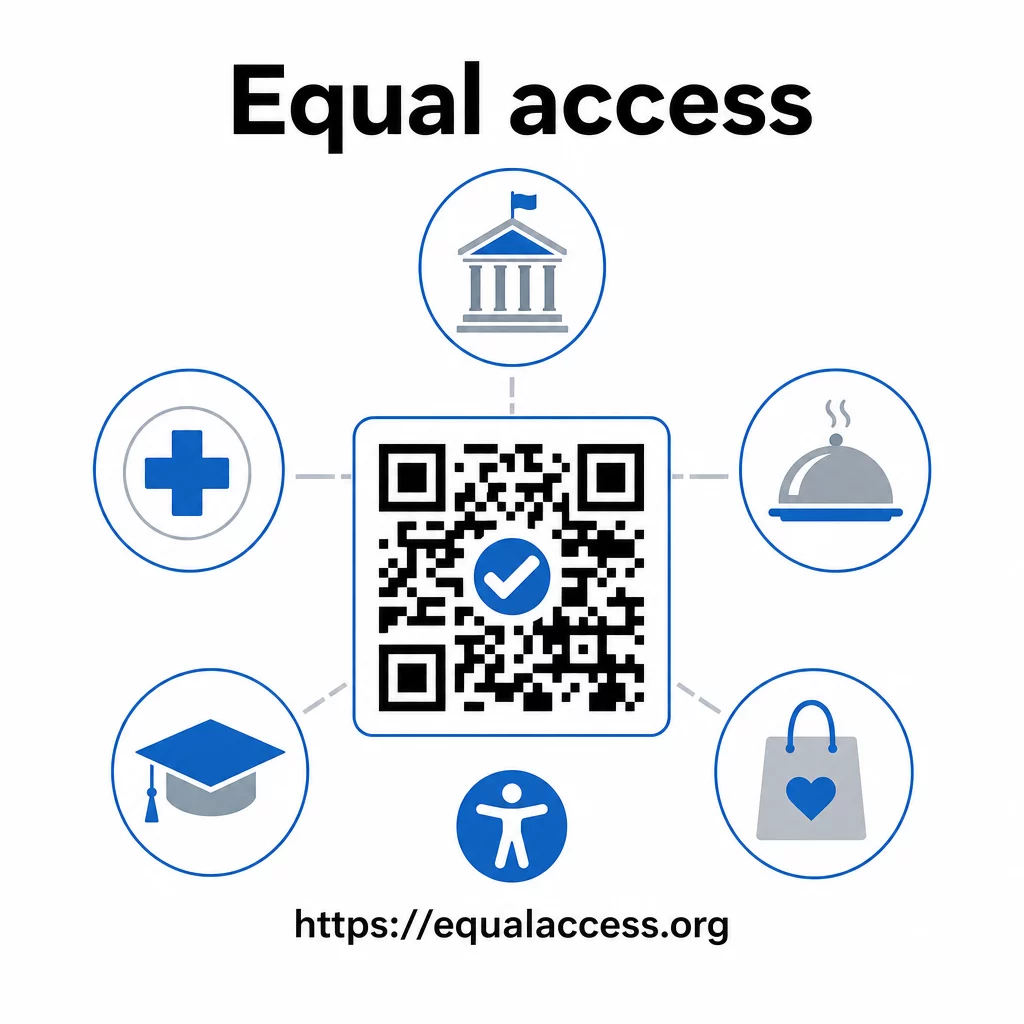
Accessible QR code practices also tend to improve the experience for everyone. Sufficient contrast helps codes scan faster in poor lighting. Proper sizing helps users of all ages scan from a comfortable distance. Clear labels reduce confusion for first-time QR code users. These improvements benefit your entire audience, not just users with disabilities.
For a deeper look at contrast, sizing, readability, and placement, explore our guides on osvedčené postupy čitateľnosti QR kódov a osvedčené postupy pre farebný kontrast QR kódov.
Accessibility obligations apply broadly across government, healthcare, education, hospitality, and retail – and the same technical standards govern all of them. The practical starting point is straightforward: if a QR code is how you communicate important information, that communication must be accessible. Use dynamické QR kódy so you can update linked content to maintain compliance without reprinting, and explore the full range of industry-specific QR code solutions to find the right implementation for your sector.
Často kladené otázky
No law specifically requires businesses to use QR codes. However, if you choose to use QR codes as part of your customer-facing communications, the ADA’s effective communication requirements apply. If a QR code is the primary or only way customers can access information, that experience must be accessible to people with disabilities – including those with visual impairments or limited mobility.
State and local government agencies face the most explicit obligations under Title II of the ADA and the DOJ’s 2024 final rule, which requires WCAG 2.1 Level AA compliance for web content and mobile apps. Private businesses open to the public – including restaurants, hotels, hospitals, retail stores, private schools, banks, and gyms – are covered under Title III and must provide effective communication through auxiliary aids and services. Federal agencies are additionally governed by Section 508 of the Rehabilitation Act.
There is no single checklist mandated by the ADA specifically for QR codes, but best practices drawn from WCAG 2.1 and Section 508 guidance include: using a dark foreground on a light background with at least a 4.5:1 contrast ratio; printing codes at a minimum size of 1 inch × 1 inch; placing physical codes at accessible heights (3.5–4.5 feet from the floor); providing a nearby text URL as an alternative for users who cannot scan; adding descriptive alt text in digital documents; and ensuring the destination content meets WCAG 2.1 Level AA standards.