Are you still managing event entry with printed guest lists and manual sign-ins? That approach slows down entry lines, frustrates attendees, and leaves organizers with little visibility into what’s actually happening on the ground. This page covers every practical way to use QR codes at events – from ticketing and check-ins to RSVPs and post-event follow-up – so you can run smoother operations and get measurable results.
Why Event Organizers Are Adopting QR Codes
QR code adoption among event professionals is no longer niche. 43% of marketers use QR codes specifically for events, making events the single most common QR use case among marketing professionals. That same data shows over 90% of marketers reported using QR codes in 2025, with 94% increasing their usage year over year.
The reason for this shift is practical: attendees are already comfortable with scanning. More than two-thirds of consumers used a QR code at least once in the past year, and roughly half of Gen Z and Millennials scan QR codes at least once a week. With 98% of Americans owning a mobile phone, there is no meaningful barrier to getting attendees to scan.
For organizers, the payoff is real-time control. You can track entry, monitor attendance by session, update event information without reprinting materials, and measure engagement long after the event ends.
QR Code Use Cases for Events
QR codes are flexible enough to handle nearly every operational and engagement need at an event. Here are the most effective applications.
Ticketing and Entry Management
The most common starting point is replacing paper tickets with scannable QR codes. Each attendee receives a unique QR code – delivered by email, PDF, or mobile – that staff scan at the door to validate entry and mark attendance in real time.
This approach removes the need for manual list-checking, speeds up entry lines, and prevents duplicate-use fraud since each code can be set to single-scan validation. For a detailed walkthrough of the security architecture behind this, see the guide on 安全なQRコードイベントチケットを作成する方法.
You can generate tickets directly using the イベントQRコードジェネレーター by entering your event URL, title, description, and contact details, then customizing the code design before downloading it for distribution.
Streamline Your Event Entry Create branded, trackable QR codes for tickets, landing pages, and check-ins. Try the イベントQRコードジェネレーター free for 14 days – no credit card required.
Attendee Check-In and Attendance Tracking
QR-based check-in works by having staff scan each attendee’s code with a phone, tablet, or dedicated scanning app. A valid scan automatically marks the person as checked in and updates your attendance records instantly.
This is significantly faster than manual methods. According to the guide to QR codes for event check-ins, QR code check-ins reduce average processing time to under 2 seconds per person and can cut total entry duration by up to 50% compared to manual processes.
For ongoing events, classes, or multi-session conferences, Pageloot’s Attendance QR Code tool lets attendees self-check-in by scanning a code linked to a Google Form or similar tool, with responses feeding automatically into a spreadsheet for real-time tracking. Learn more about building this kind of system on the attendance tracking page.
RSVP Collection
Instead of directing guests to type in a URL, a QR code on your invitation, flyer, or event page takes them directly to your RSVP form with a single scan. This removes friction and typically increases response rates.
Pagelootの GoogleフォームQRコードジェネレーター to link any Google Form to a scannable code, then place it on printed invitations, digital graphics, or event signage. For step-by-step instructions, the guide on RSVP QR codes for events walks through platform selection, code generation, and privacy compliance.
Schedules and Event Information
A QR code placed on a badge, table card, or venue sign can link attendees to a live event schedule, speaker bios, floor maps, or session details. Because ダイナミックQRコード allow you to update the destination URL after printing, you can correct schedule changes or add information without reprinting materials.
This is one of the strongest practical arguments for using dynamic over static codes. If a speaker cancels or a room changes, you update the link – not the printed collateral.
Google Calendar Integration
For conferences, workshops, or any ticketed event with sessions, linking a QR code to a Google Calendar entry lets attendees add the event directly to their calendar with one scan. Use the GoogleカレンダーQRコードジェネレーター to create this code, then place it on confirmation emails, tickets, or invitations.
Venue Navigation
Large venues – convention centers, outdoor festivals, multi-floor conference spaces – often cause friction simply because attendees cannot find where they need to go. A QR code on signage, tickets, or invitations that opens directly in Google Maps removes that friction entirely. Create one using the GoogleマップQRコードジェネレーター and include it anywhere attendees will see it before or during the event.
Photo Sharing and Social Engagement
QR codes can link attendees to a shared photo gallery, a branded hashtag page, or an upload portal so guests can contribute and view event photos in real time. This creates a participation loop that extends the event experience beyond the physical venue. For a practical setup guide, see how to use a QR code to share photos.
Post-Event Surveys and Follow-Up
Research shows that 41% of organizers use post-event surveys to measure ROI, and 40% rely on social media engagement. A QR code on a badge, handout, or exit sign pointing to a feedback form makes it easier for attendees to respond while the event is still fresh. Linking that form to a Google Form via Pageloot’s generator means responses flow directly into a spreadsheet you can analyze immediately.
How to Create an Event QR Code with Pageloot
The process takes a few minutes and does not require technical skills.
- Open the generator – Go to the イベントQRコードジェネレーター and select “Create QR Code for event.”
- Add your event details – Enter the event page URL, title, description, and contact information. Pageloot builds a landing page around this content.
- Design the QR code – Adjust colors, shapes, and add your logo to match your event branding.
- Choose dynamic if you need flexibility – Dynamic codes let you update the destination link after printing. This is the right choice for anything that might change before or during the event.
- Test the code – Scan it on both iOS and Android devices under different lighting conditions before distributing.
- Download and distribute – Export in PNG, PDF, or SVG and place it on tickets, signage, invitations, or digital materials.
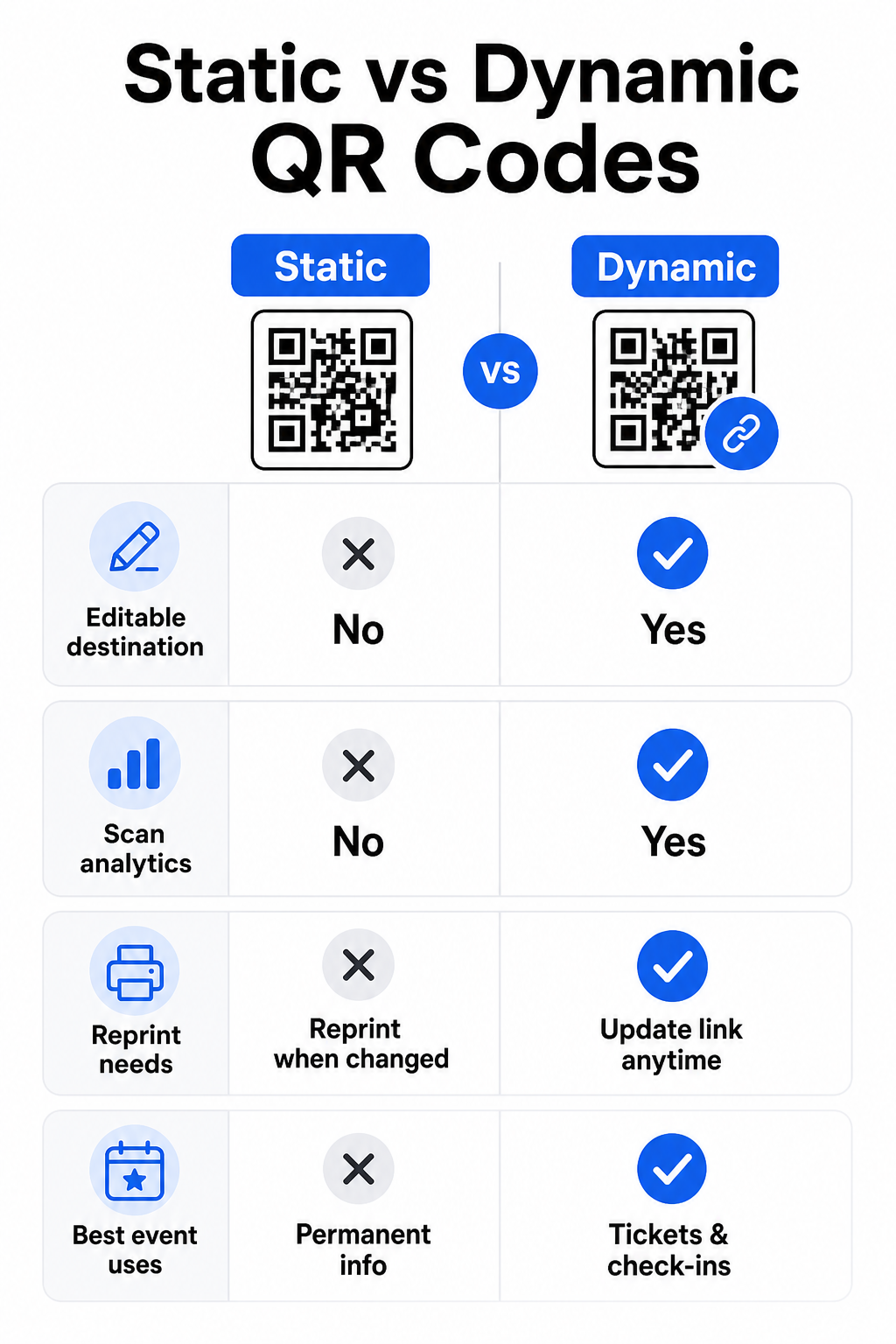
Static vs. Dynamic QR Codes for Events
Understanding the difference between static and dynamic QR codes helps you make the right choice for each use case.
| 機能 | 静的QRコード | ダイナミックQRコード |
|---|---|---|
| Destination editable after printing | いいえ | はい |
| スキャン分析 | いいえ | はい |
| Code changes if destination changes | Yes (reprint required) | いいえ |
| 最適 | Simple, permanent links | Tickets, schedules, campaigns |
| コスト | フリー | Paid subscription |
For most event operations – especially ticketing, check-in, and anything that might need updating – dynamic QR codes are the better choice. They also provide scan analytics, which tells you how many people scanned, when, on what device, and from what location. The guide to building dynamic QR codes for CRM check-ins explains how to connect this data to your broader attendee management workflow.
QR Code Placement and Sizing for Events
A QR code that cannot be scanned reliably defeats its purpose. The following guidelines reflect usability research and practical event scenarios.
Minimum sizes by material type:
- Printed invitations: at least 1.5 × 1.5 inches
- Badges or wristbands: at least 1.5 inches square
- Table cards or place cards: at least 1 × 1 inch (1.5 inches preferred)
- Event signage: at least 5 × 5 inches, increasing to 7 × 7 inches for venues wider than 30 feet
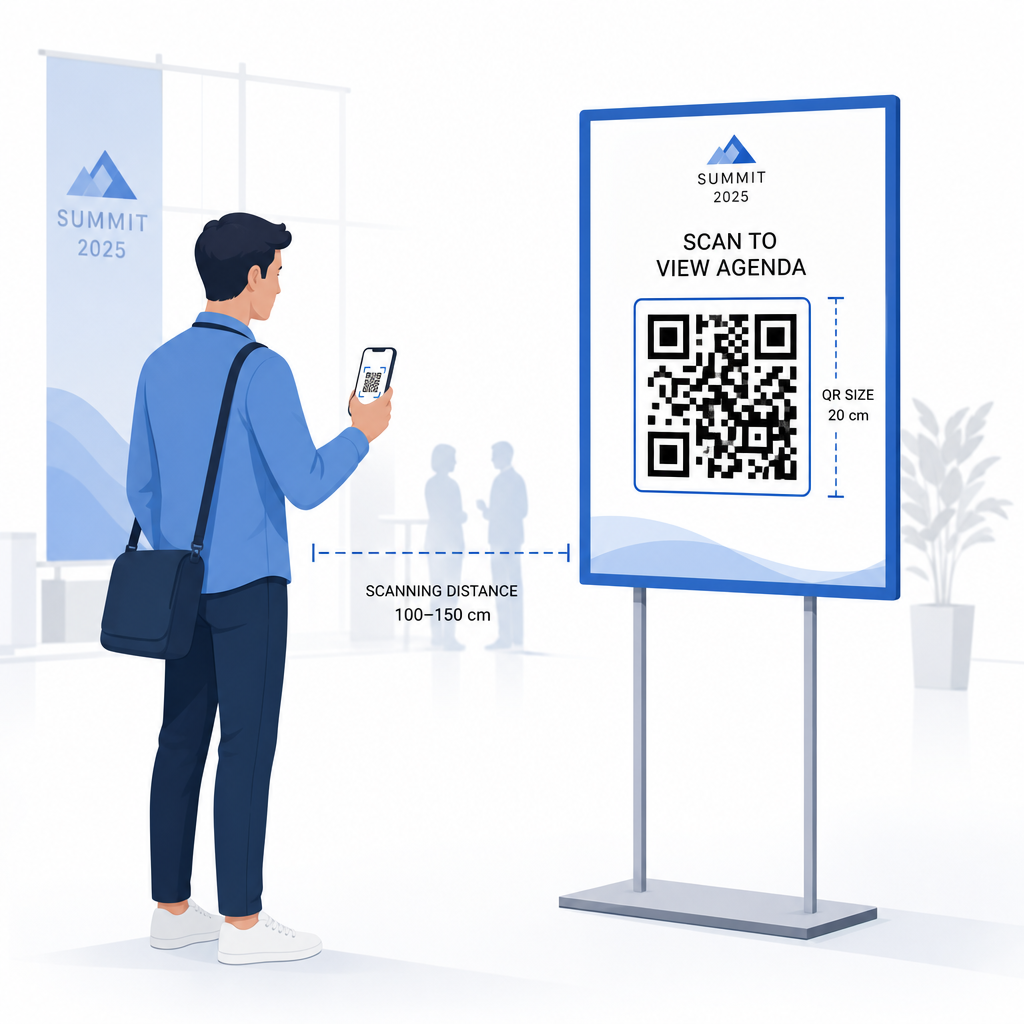
A useful rule of thumb: the smallest QR code dimension should be roughly one-tenth of the scanning distance. A code scanned from 3 feet away should be at least 3.6 inches wide.
Placement guidelines:
- Position codes at eye or chest height – roughly 3 to 5 feet from the floor – so attendees can scan without bending or reaching
- Place codes where people naturally pause or wait: entrances, registration desks, tables, near displays, and in queues
- Maintain high contrast: dark modules on a light background scan most reliably; avoid inverted or low-contrast color schemes
- Keep a クワイエットゾーン of at least 4 modules of blank space on all four sides of the code; text or graphics inside this margin cause scan failures
- Test every code at its final printed size, from the expected scanning distance, on both iOS and Android, before the event
For more guidance, the イベントチェックインのためのQRコード究極ガイド includes detailed technical scanning requirements and door operations best practices.
Tracking Event Performance with QR Analytics
One of the underused advantages of dynamic QR codes is the data they generate. Pageloot’s analytics dashboard captures scan counts, timestamps, device types, and geographic locations in real time.
For event organizers, this data answers practical questions:
- Which entry point had the highest scan volume and at what time?
- Did attendees engage with the schedule or sponsor content during the event?
- How many people scanned the post-event survey code?
- Which promotional channel – printed flyer, social media post, email – drove the most ticket scans?
This information informs staffing decisions, helps you identify bottlenecks, and gives sponsors measurable proof of audience engagement. For a deeper look at the tools available, see the roundup of QRコードイベント追跡のためのトップツール.
See Who’s Scanning and When Pageloot’s built-in analytics give you real-time scan data across all your event QR codes in one dashboard. Start with the イベントQRコードジェネレーター and run your next event with full visibility.
Scanning QR Codes at Your Event
If you need a scanning solution for staff to validate tickets or check in attendees, Pageloot’s QRコードスキャナ works directly in the browser – no app download required. Staff can scan from any smartphone or tablet by pointing the camera at the code or uploading an image.
For larger events with dedicated scanning stations, native device cameras on iOS (iOS 11 and later) and Android scan QR codes without any additional app. Test your scanning setup under the actual lighting conditions of your venue before the event, and train staff to hold the device approximately 30 cm (about 12 inches) from the code for consistent reads.
Common QR Code Issues at Events (and How to Avoid Them)
Even well-designed QR codes fail when certain conditions are not met. Here are the most frequent problems and their fixes:
- Code too small: Follow the size minimums above; when in doubt, print larger
- Poor contrast: Use dark modules on a white or light background; avoid placing codes on dark or patterned surfaces
- Glossy material: Matte finishes scan more reliably because they eliminate glare; avoid glossy badge or wristband materials
- Damaged code: Physical scratches or tears block scanning; use error-correction settings when generating codes for physical materials
- No quiet zone: Verify that nothing – text, borders, images – encroaches on the blank margin around the code
- Untested code: Always scan the final printed version on multiple devices before distributing at scale
For additional troubleshooting on QR codes printed directly on tickets, see the guide to QR codes on tickets.
QR codes give event organizers a direct line between physical touchpoints and digital systems – whether that’s validating a ticket, logging attendance, collecting feedback, or navigating a venue. The key is choosing dynamic codes where flexibility matters, sizing and placing them for reliable scanning, and using analytics to understand how attendees are actually engaging.
Get started with the イベントQRコードジェネレーター to create your first event QR code, or explore the Attendance QR Code tool to build a check-in system that logs every arrival automatically.
よくある質問
A static QR code has a fixed destination that cannot be changed after it is created. If your event details change, you need to reprint the code. A dynamic QR code lets you update the destination URL at any time without changing the printed code itself. Dynamic codes also provide scan analytics – data on when, where, and how often the code is scanned – which static codes do not. For most event applications, particularly ticketing and schedules, dynamic codes are the practical choice.
Open Pageloot’s Event QR Code Generator and select the option to create an event QR code. Enter your event URL or registration link, add event details like the title and description, then customize the code design with your branding. Download the code and distribute it to attendees via email, PDF, or printed ticket. At the event, staff scan each attendee’s code using a smartphone camera or the Pageloot QR Code Scanner to mark them as checked in.
For standard event signage, a minimum of 5 × 5 inches is recommended. For larger venues wider than 30 feet, increase the size to at least 7 × 7 inches. A reliable rule of thumb is that the code’s smallest dimension should be roughly one-tenth of the expected scanning distance – so a code viewed from 5 feet away should be about 6 inches wide. Always test the printed code at the actual scanning distance before the event.