Wondering how to put a scannable QR code on a coffee cup without it failing every time a customer points their phone at it? A poorly designed code on a curved surface frustrates customers and wastes your print run. This guide walks you through every decision, from placement to content, so your cups actually deliver results.
Why Coffee Cups Are a Valuable QR Code Surface
Coffee cups spend several minutes in a customer’s hands. That dwell time is a marketing opportunity most brands underuse.
Nearly 83.4 million U.S. adults scanned a QR code in 2022, a number projected to reach 42.6% of adult smartphone users by 2025. Separately, 45% of U.S. shoppers scanned a marketing-related QR code in a three-month window, with 18–29-year-olds leading adoption. Coffee shops, cafes, and branded merchandise programs sit at the intersection of two of the top QR code use cases consumers report: restaurant menus and food and beverage product information.
A cup with a well-executed QR code can accomplish any of the following without adding staff time:
- Direct customers to a digital menu or seasonal specials
- Prompt a Google review immediately after a positive experience
- Deliver a discount coupon for a return visit
- Drive social media follows or contest entries
- Provide allergen or sourcing information for health-conscious customers
The challenge is purely technical: cups curve, and QR codes do not.
How Curved Surfaces Affect Scannability
A QR code printed flat on paper scans easily because every module – the small squares that make up the code – sits on the same plane. When that same code wraps around a cylinder, the modules at the edges curve away from the camera’s line of sight. The scanner sees a distorted grid, and decoding fails.
This is not a hypothetical problem. It is the most common reason QR codes on cups do not work. Understanding the geometry helps you design around it.
Three physical factors work against you:
- Curvature distortion: Modules on the sides of the code bend away from the camera, making them appear compressed or invisible.
- Reflective finishes: Glossy cup coatings or laminates create glare that washes out contrast, particularly under overhead cafe lighting.
- Print registration: Paper cup manufacturing involves seams and joins; a code that straddles a seam will not scan reliably.
Each of these has a direct technical fix, covered in the sections below.
Sizing and Placement on a Cup
Keep the Code on the Flattest Possible Area
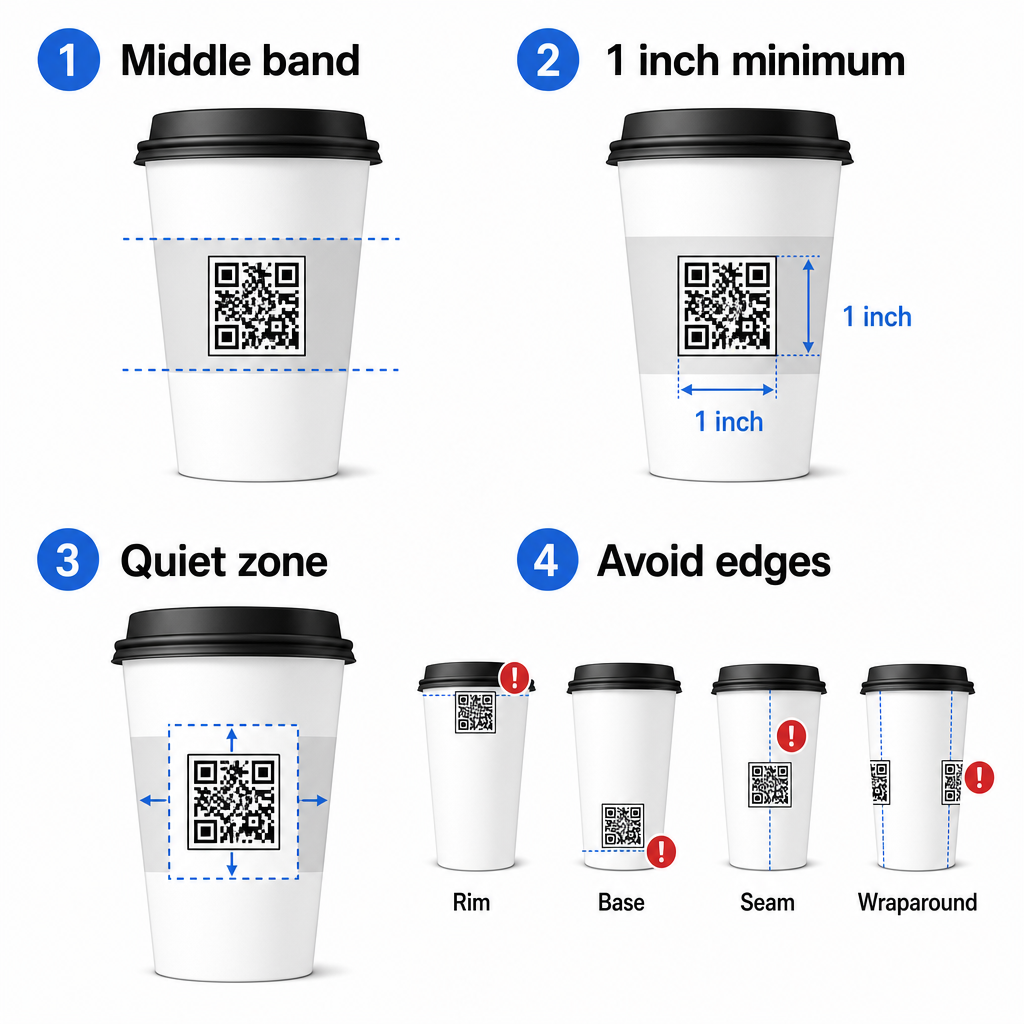
Place your QR code on the section of the cup with the least curvature. For a standard paper cup, that means avoiding the very top near the rim and the base taper. The middle band of the cup typically offers the flattest printable zone.
If you are working with a flat-sided promotional mug or a squared travel cup, you have a natural flat panel – use it. For cylindrical ceramic mugs, treat the front face as your target zone.
Size the Code for Curved Surfaces
For flat print, a minimum size of 0.8 in × 0.8 in (about 2 cm × 2 cm) is the standard recommendation for close-range scanning. On a curved surface, that minimum is not sufficient. Because curvature distorts the perceived size of the code, increasing the code size by 20–30% for curved applications is advisable.
In practical terms, target at least 1.0 in × 1.0 in on a standard 12 oz paper cup, and larger still on a tall 20 oz cup where the barrel diameter is bigger and the curvature is less severe.
The code must fit entirely within one face of the cup without wrapping around the sides. If any corner of the code disappears around the curvature, the code will fail.
The Quiet Zone Is Non-Negotiable
The quiet zone is the blank margin surrounding the code. ISO standards specify a minimum of four modules of clear space on all four sides. On a coffee cup, this margin also acts as a buffer against the curved edge.
Do not place logos, cup graphics, nutritional text, or brand patterns inside the quiet zone. The QR code readability best practices guide covers quiet zone requirements in detail alongside other factors that affect reliable scanning.
Contrast and Color on Cup Materials
Use Dark on Light
QR code scanners work by detecting the contrast between dark modules and a light background. The recommended minimum contrast ratio is 4:1, though higher is always better – black on white achieves 21:1.
On coffee cups, two surface problems reduce effective contrast:
- Kraft or brown paper stock: A dark code printed directly on uncoated kraft paper loses contrast because the background is not white. Use a white printed panel or a white flood-coat beneath the code.
- Gloss laminate: Reflective finishes bounce light back at the camera, washing out the dark modules. Request a matte finish in the area of the code, even if the rest of the cup is glossy.
Avoid Gradients and Patterned Backgrounds
A gradient background beneath a QR code creates zones of acceptable contrast and zones of poor contrast. The scanner evaluates the whole code, and any region that falls below the contrast threshold can cause a failure. Use a solid, uniform light background beneath the code.
For branded cups where color is important to the design, you can use a dark brand color as the foreground on a white or pale background – but test carefully before full production. The QR code color contrast best practices guide provides specific color combinations and contrast ratios to guide those decisions.
Technical Specifications for Print
分辨率和文件格式
Print the code at 300 DPI 或更高. A low-resolution raster image produces fuzzy module edges, which reduces scannability and looks unprofessional at close range.
Whenever possible, use a vector format (SVG or EPS) rather than a PNG or JPG. Vector files scale without any loss of quality, which matters because cup manufacturers often resize artwork during prepress. Pageloot’s 二维码生成器 exports print-ready vector files (.EPS, .PDF, .SVG) suitable for sending directly to your cup printer.
纠错水平
QR codes have four error correction levels: L, M, Q, and H. Higher levels allow more of the code to be damaged or obscured while still scanning successfully. For cup applications:
- H级 is recommended if you are embedding a logo inside the code, as it allows up to 30% of the code to be obscured.
- Q级或H级 is advisable for any curved surface, because surface distortion effectively damages portions of the code during scanning.
Do not use Level L on a cup. It provides no tolerance for the physical distortions inherent to curved printing.
Finder Patterns Must Stay Clear
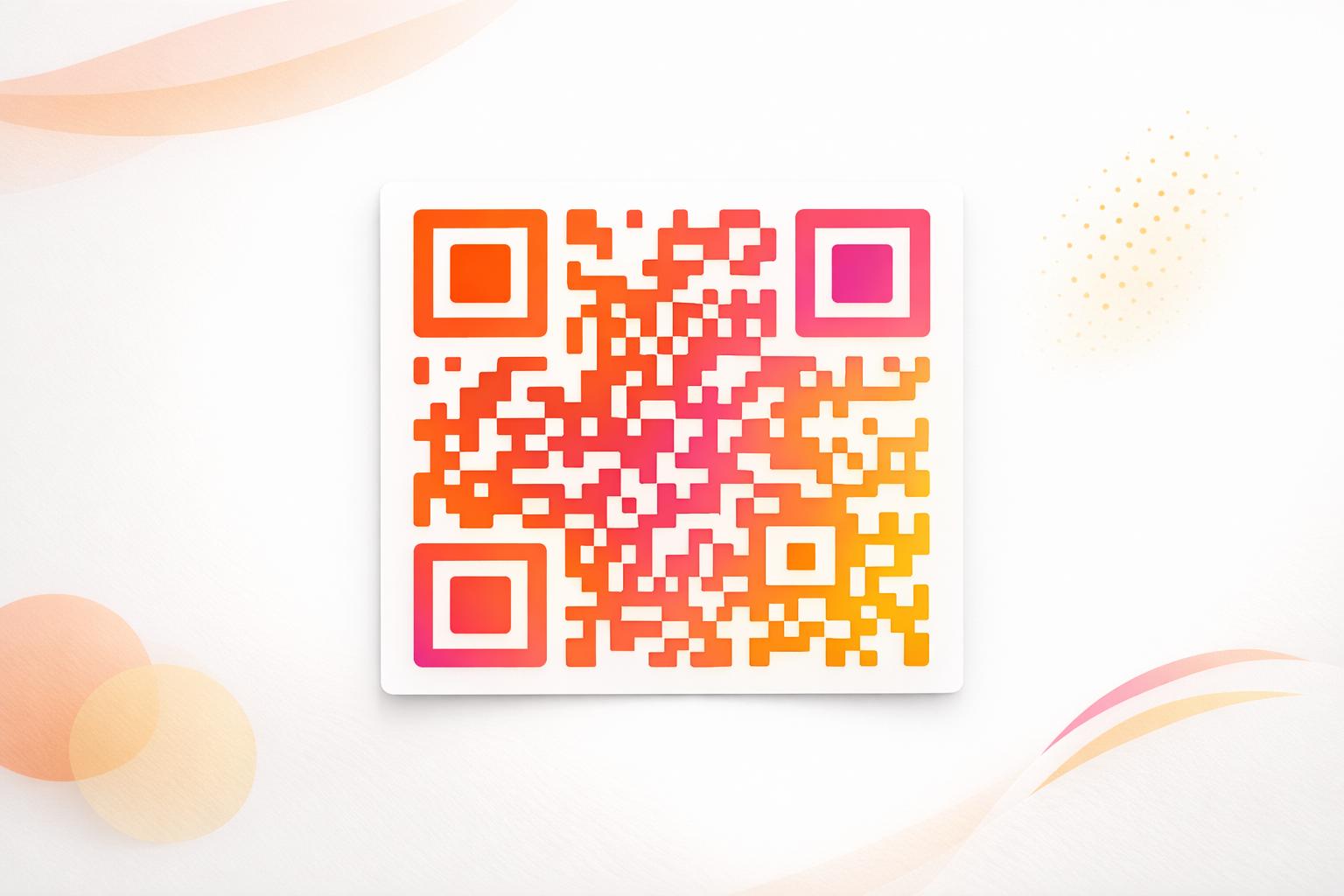
The three large squares in the corners of a QR code are finder patterns. They tell the scanner where the code starts, ends, and how it is oriented. Do not crop, overlap, or modify the finder patterns with brand graphics. This is one of the most common design errors on custom-printed packaging, and it produces codes that look professional but never scan.
Create Print-Ready QR Codes for Your Cups Generate a fully customizable, high-resolution QR code with the correct error correction level, vector export, and branding options using the Pageloot QR码生成器. Download in .EPS, .PDF, or .SVG format ready to send to your cup manufacturer.
Choosing What the QR Code Links To
The physical execution matters, but so does what happens after the scan. A customer who scans a cup code has self-identified as engaged – do not send them to a generic homepage.
Match the destination to the context:
| 用例 | 推荐二维码类型 | 工具 |
|---|---|---|
| Digital menu or seasonal drinks | 菜单二维码 | 菜单二维码生成器 |
| Discount for return visit | Coupon landing page | 优惠券二维码生成器 |
| Post-purchase Google review | Direct review link | 谷歌评论二维码生成器 |
| Website, social, or promo landing page | URL redirect | 链接二维码生成器 |
For cafes and coffee shops, Pageloot’s restaurant QR code tools support digital menus, ordering, and review collection in a single platform.
Use Dynamic QR Codes for Cup Campaigns
A static QR code encodes the destination URL permanently. If your seasonal promotion ends, you cannot update the code – and any remaining cups with that code become a dead end.
一种 动态二维码 stores a short redirect URL in the code itself. You control where that redirect points from a dashboard, and you can change it at any time without reprinting a single cup. This is critical for cup campaigns because:
- Cup print runs are often in the thousands, and reprinting is expensive
- Promotions, menus, and offers change seasonally
- You can run A/B tests by switching destinations mid-campaign
Dynamic codes also provide 扫描分析 – data on when scans occurred, what devices were used, and where customers were located. That data lets you measure which cup designs or placements drove the most engagement, and adjust future print runs accordingly.
Track Every Scan from Your Cup Campaign Switch to a dynamic QR code to update destinations on the fly and monitor real-time performance. The Pageloot QR码生成器 gives you a full analytics dashboard alongside editing controls – all without reprinting your cups.
Branding Your Cup QR Code
A plain black-and-white QR code works, but a branded code reinforces recognition and earns more scans. Pageloot’s 带标志的二维码生成器 lets you:
- Embed your brand logo in the center of the code
- Apply brand colors to the modules and background
- Choose from design templates for body pattern and edge style
- Add a call-to-action frame (e.g., “Scan for 10% off your next order”)
When adding a logo, keep it to no more than 30% of the code area and set error correction to Level H. The logo occupies space that would otherwise carry encoded data, and Level H error correction compensates for that overlap.
For consistency across a large cup order or a multi-location campaign, Pageloot’s 二维码文件夹 let you organize codes by campaign, location, or cup size so your team can manage them without losing track.
For related guidance on packaging applications, the pages on 产品包装上的二维码 和 食品包装上的二维码 cover considerations that apply directly to cups.
Testing Before Your Print Run
No amount of careful design replaces physical testing on the actual cup. Before you commit to a full production run:
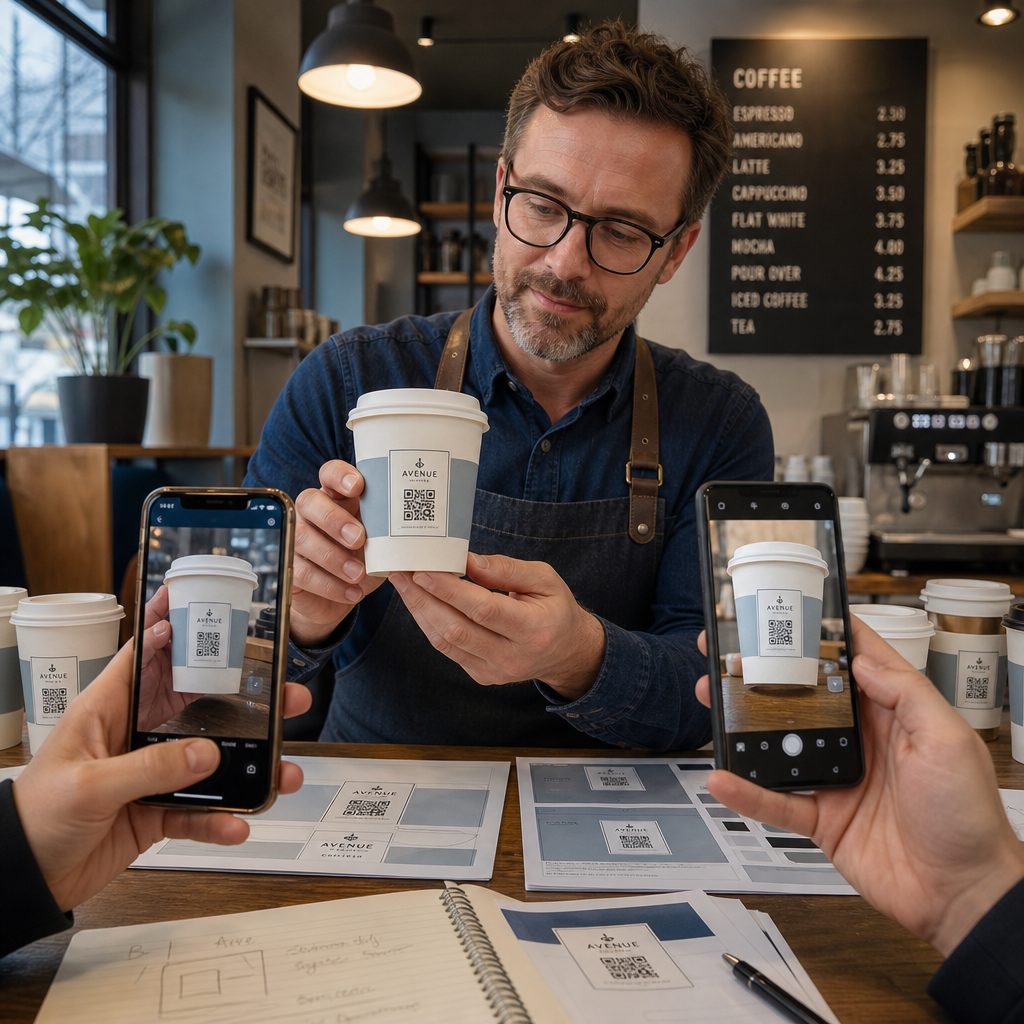
- Print a sample on the intended material – not just paper proofs. Cup stock, coating, and print method all affect the final result.
- Test with multiple devices – at minimum, a recent iPhone and a mid-range Android. Older devices with lower-resolution cameras present the most demanding test.
- Scan from realistic angles – customers hold cups at various angles, not directly perpendicular to the label. Test at 15° and 30° off-axis.
- Test in the actual lighting environment – overhead cafe lighting is often warm and directional, which affects contrast differently than standard office lighting.
- Verify the destination loads correctly – scan the code on cellular data, not just Wi-Fi, and confirm the landing page is mobile-optimized and loads in under three seconds.
If the code fails any of these tests, adjust size, contrast, or placement before printing thousands of units. For a comprehensive checklist, the guide to QR codes on product labels walks through the same quality control principles in more detail.
Write a Call-to-Action That Earns the Scan
The QR code itself communicates nothing about why a customer should scan it. Always pair the code with a brief call-to-action – typically four to eight words positioned directly above or below the code. Examples:
- “Scan for today’s specials”
- “Get 15% off your next order”
- “Leave us a review”
- “See what’s in your cup”
The call-to-action answers the customer’s implicit question: what happens if I do this? Without it, even a technically perfect QR code will underperform.
Putting a working, branded QR code on a coffee cup is entirely achievable with the right technical setup. Size it for curved surfaces, keep the quiet zone clear, use high contrast on a matte finish, set error correction to Level H, and always test on a physical sample before production. Choose dynamic codes so you can update destinations and measure performance without reprinting.
Start building your cup QR code with the Pageloot QR码生成器 – export in print-ready vector formats, add your logo and brand colors, and connect it to analytics from day one.
常见问题
For flat print, the standard minimum is 0.8 in × 0.8 in (2 cm × 2 cm). On a curved cup surface, increase that by 20–30% to compensate for curvature distortion – so target at least 1.0 in × 1.0 in. The code must fit entirely within the flat zone of the cup without wrapping around the sides.
Yes, but placement is critical. Use the flattest area of the mug’s front face, size the code larger than you would for flat print, ensure strong contrast with dark modules on a light background, avoid glossy finishes in the code area, and set error correction to Level H. Always test a physical sample with multiple devices before ordering in bulk.
Match the destination to your campaign goal. Common uses include digital menus, seasonal promotions, discount coupons, Google review pages, or social media profiles. Use a dynamic QR code so you can update the destination after printing – this is especially important for cups printed in large quantities, since the codes cannot be reprinted if an offer expires or a URL changes.