Are lost attendees and crowded help desks causing bottlenecks at your venue? Navigation confusion leads to missed sessions, frustrated guests, and overworked event staff. Implementing QR-based wayfinding gives attendees instant mobile access to interactive maps and location-specific directions directly on their smartphones.
Why Mobile QR Codes Improve Venue Navigation
Large convention centers, multi-stage festivals, and sprawling exhibition halls often overwhelm visitors. Traditional floor plans printed on static entrance boards tend to gather dense crowds, causing severe traffic jams in main corridors. Furthermore, if a booth assignment changes or a room schedule shifts during an event, physical map boards quickly become outdated and misleading.
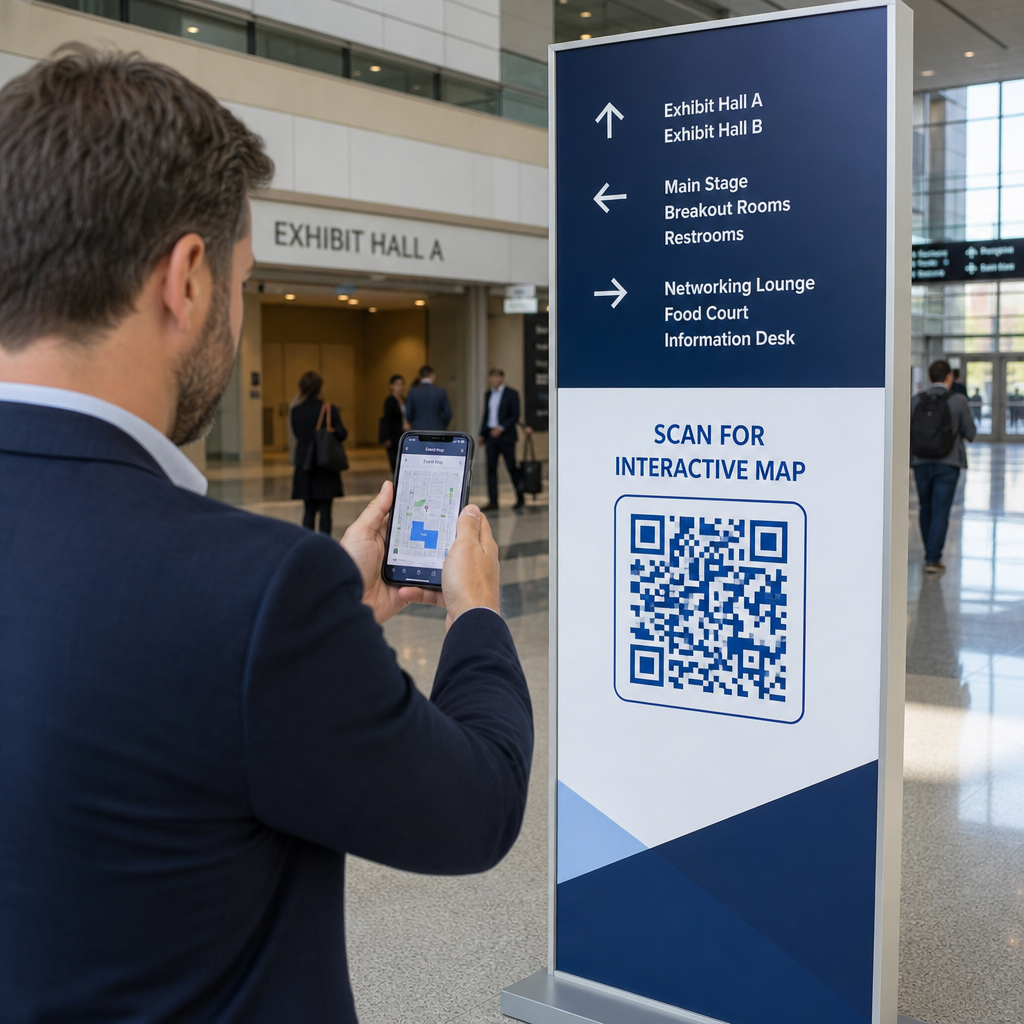
Using QR codes for venue navigation transforms physical signage into interactive digital portals. Positioning codes at critical decision points creates localized “You Are Here” stations across your facility. When scanned, these codes immediately load mobile-friendly maps, turn-by-turn indoor directions, or real-time schedule pages.
Because dynamic QR codes allow you to edit destination links post-printing, you can update floor plans or redirect traffic patterns instantly without replacing physical signs. Integrating digital floor plans with a dedicated generador de códigos QR para eventos streamlines overall crowd management while delivering immediate clarity to attendees.
Practical Ways to Implement QR Code Wayfinding
Deploying QR code navigation across your venue requires strategic placement aligned with specific attendee needs. Here are four practical applications for event wayfinding:
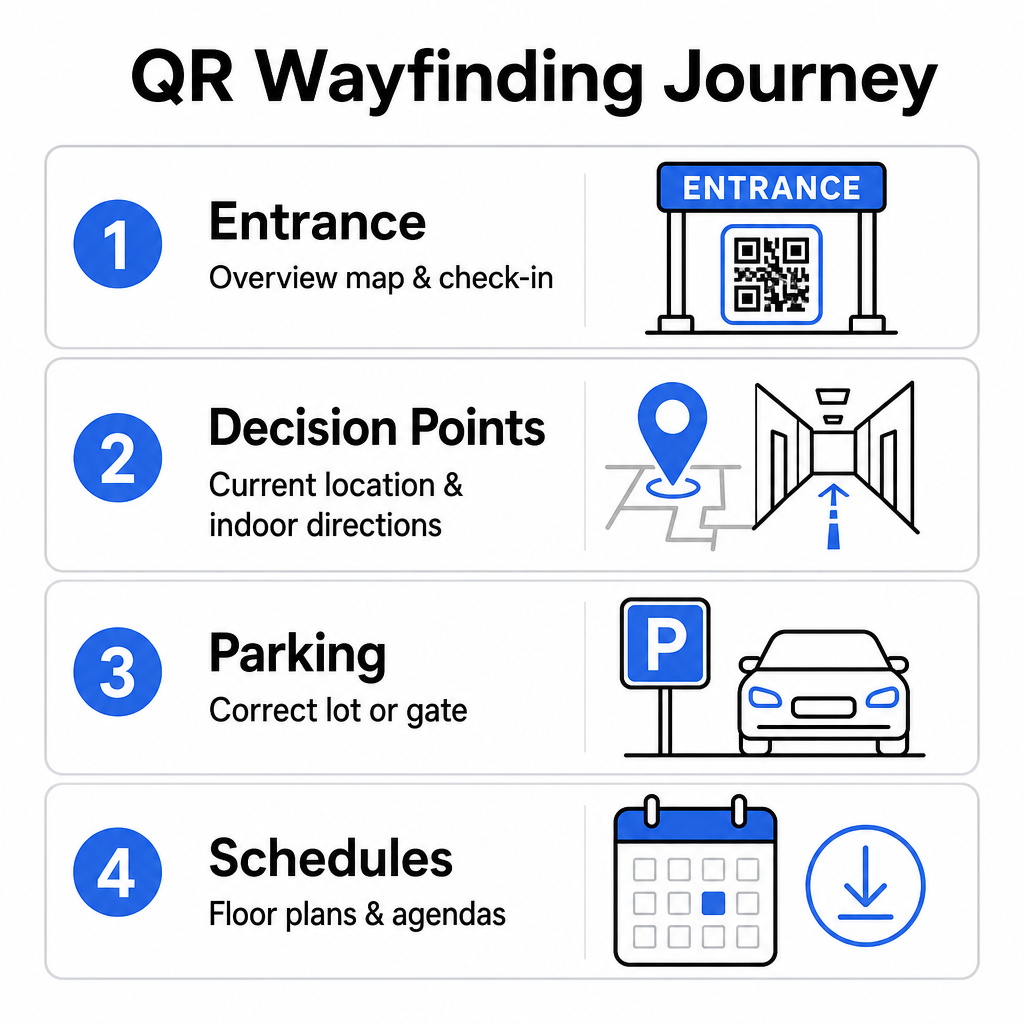
- Entrance and Registration Hubs: Place prominent codes near entry gates and registration desks to provide arriving guests with an immediate overview map of the facility alongside check-in instructions. Integrating digital navigation at entry points complements modern event check-in systems.
- Localized “You Are Here” Decision Points: Station specific QR codes at major corridor junctions, elevator lobbies, stairwell entrances, and dining areas. Anchor each code to open a digital map pre-configured to display the user’s exact current location within the building.
- Venue and Parking Directions: Guide attendees to the correct parking lot or building entrance before they arrive on foot. Including a Generador de códigos QR de Google Maps link on digital ticket confirmations or outdoor entrance banners directs drivers straight to designated arrival gates.
- Downloadable Schedules and Floor Plans: Provide offline-accessible maps for venues with weak cellular coverage. Utilizing a Generador de códigos QR PDF allows guests to save high-resolution venue floor plans and agenda guides directly to their mobile devices.
Simplify Venue Navigation Today Need to create custom, mobile-friendly map links for your upcoming event? Use the Generador de códigos QR para eventos to build dynamic, trackable codes in minutes.
Placement and Accessibility Guidelines for Wayfinding Signs
A wayfinding system is effective only if attendees can comfortably locate and scan physical signage. Thoughtful placement ensures navigation tools remain functional and accessible to every visitor.
Optimal Physical Placement
Position wayfinding signage where visitors naturally pause to make route decisions, such as corridor intersections, rest areas, food courts, and elevator banks. Mount printed codes at an accessible eye level – typically between 1.2 to 1.6 meters (3.5 to 5.5 feet) above the floor – so they remain comfortably within reach for both standing visitors and wheelchair users.
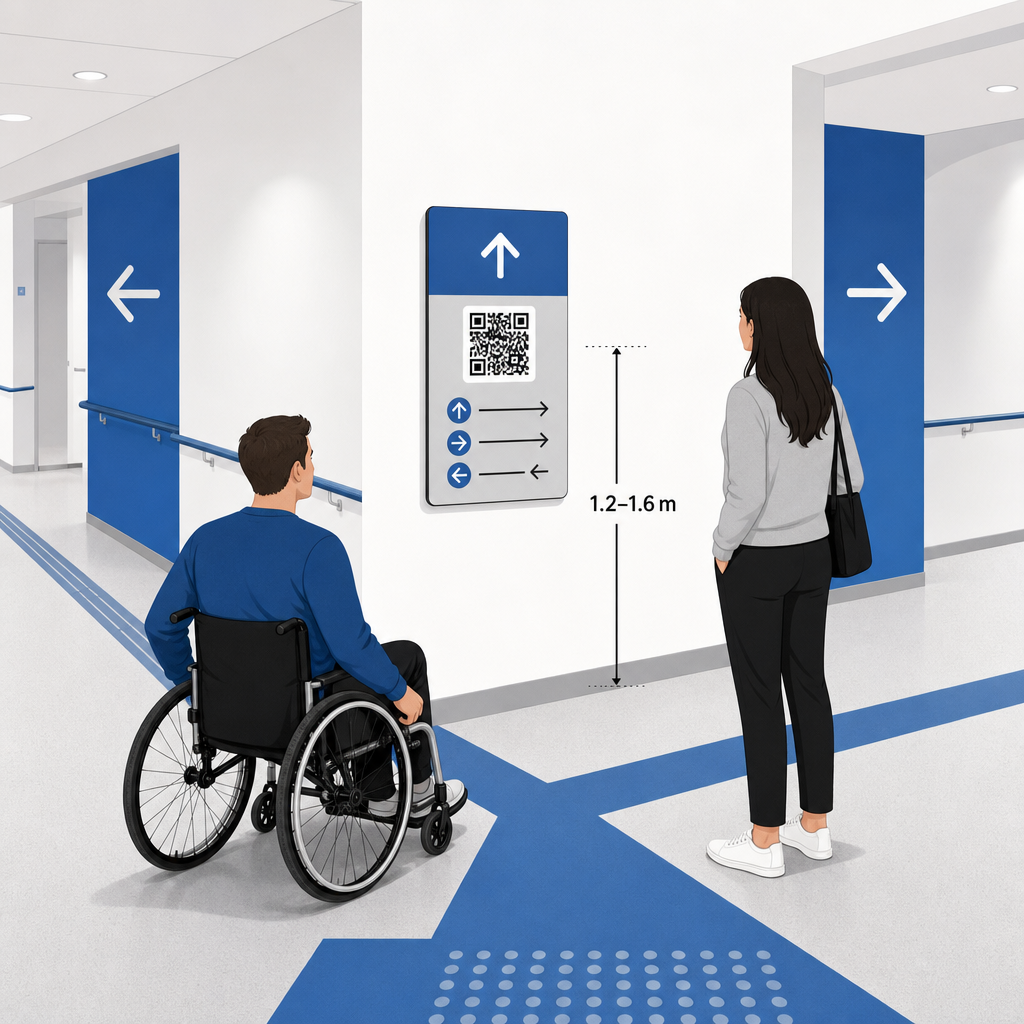
ADA and Accessibility Compliance
Official accessibility standards under the Americans with Disabilities Act (ADA) require directional signage to follow clear visual rules, including high dark-to-light contrast, non-glare finishes, and specific visual character proportions. Digital tools like QR codes serve as a supplement to, rather than a replacement for, standard accessible physical signage.
To maintain full compliance and accessibility:
- Maintain visible alternative text, printed text directions, or staffing assistance alongside every code.
- Pair codes with clear descriptive labels that state what information the user will access upon scanning.
- Build mobile landing pages that support screen readers and include descriptive alternative text for map graphics.
Clear Calls to Action
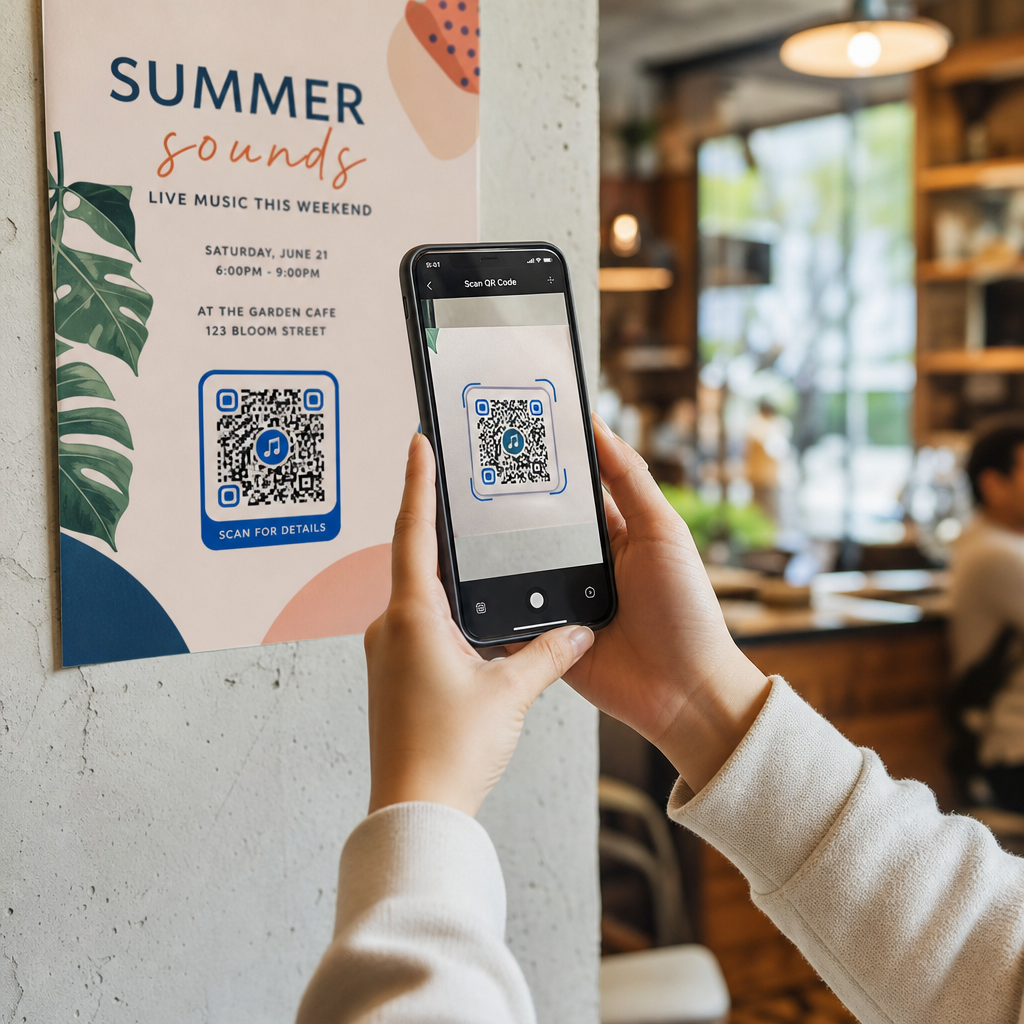
An unlabeled QR code leaves visitors guessing about its purpose. Always pair every code with a clear call-to-action (CTA) frame or text label, such as “Scan for Interactive Floor Plan” or “Find Your Way – Scan for Map.” Following proven guidelines for QR code placement on posters significantly increases engagement and scan rates.
Technical Best Practices for Scannable Signage
Ensuring fast, reliable scanning across hundreds of different smartphone models requires strict adherence to core graphic standards.
| Factor | Technical Standard | Practical Purpose |
|---|---|---|
| Tamaño mínimo de impresión | 3 x 3 cm (1.2 x 1.2 in) minimum; 2 x 2 cm for close-up items | Prevents camera focusing failures on dense data modules. |
| Scanning Distance Ratio | 10:1 ratio (1 unit of code width per 10 units of distance) | Ensures codes on large hanging banners remain scannable from far away. |
| Contraste de color | Minimum 4:1 contrast ratio (dark modules on light background) | Helps phone camera sensors instantly differentiate modules from the background. |
| Quiet Zone Buffer | At least 4 modules wide (approx. 0.25-inch margin) | Prevents surrounding graphics and text from interfering with scanner decoding. |
| Formato de archivo | Vector formats (SVG, EPS, PDF) | Maintains crisp edges without pixelation when printed on large signage. |
When printing wayfinding posters and wall signs, choose matte, non-reflective materials over glossy finishes. Matte surfaces eliminate harsh overhead lighting reflections, which represent one of the primary causes of mobile camera scan failures. For detailed dimension guidelines, consult our comprehensive guía de tamaño de códigos QR and review essential practices for QR code readability.
Guide Attendees Directly to Your Venue Make sure guests arrive at the right entrance or parking gate without confusion. Generate location-accurate pins using the Generador de códigos QR de Google Maps.
Testing and Updating Your Event Wayfinding System
Thorough validation before doors open prevents technical failures during peak attendance hours.
Pre-Event Verification
- Testing across multiple devices: Scan every published code using both Apple iOS and Android devices across standard built-in camera applications.
- Evaluating environmental lighting: Inspect printed signage under actual venue lights to identify potential glare or shadows cast by hall fixtures.
- Checking scanning angles and distances: Attempt scanning from realistic standing positions and side angles, confirming that the code decodes in 3 seconds or less.
- Verifying network loading speeds: Test map landing page response times over cellular networks and guest Wi-Fi to confirm fast load times under network load.
Managing Live Updates with Dynamic QR Codes
Even carefully planned event layouts experience last-minute schedule changes or booth relocations. By utilizing dynamic QR codes, you maintain full control over target landing pages. If a presentation room changes or an emergency exit route requires highlighting, simply update the destination URL in your management dashboard. The printed code on the wall remains identical, but attendees are instantly redirected to the updated map.
Furthermore, built-in analytics let you monitor scan volume across different venue zones in real time. High scan counts at specific decision points indicate where attendees frequently seek directions, providing actionable data to deploy additional floor staff or supplementary directional signs where needed most. For advanced positioning strategies, review our full para la colocación de códigos QR.
Preguntas Frecuentes
No. Accessibility regulations require physical wayfinding signs to meet specific visual standards, tactile requirements, or high-contrast rules independently. QR codes serve as a helpful digital supplement to guide attendees, but must not replace primary physical signage or accessible text alternatives.
Always export your QR code in scalable vector formats such as SVG, EPS, or PDF. Vector files scale to any size on banners or wall prints without losing sharp module edges, ensuring reliable scannability.
Dynamic QR codes separate the printed image from the target content. If a booth shifts or a seminar room changes, you update the destination web link in your dashboard without needing to re-print or replace the physical signs hanging in the venue.
Transforming complex venue navigation into a self-service digital experience reduces attendee frustration and keeps event operations running smoothly. By selecting strategic decision points, enforcing high-contrast visual standards, and linking codes to responsive map landing pages, you empower guests to find their way independently. Start designing your venue navigation system today using Pageloot’s dynamic tools to deliver real-time map access across your entire facility.