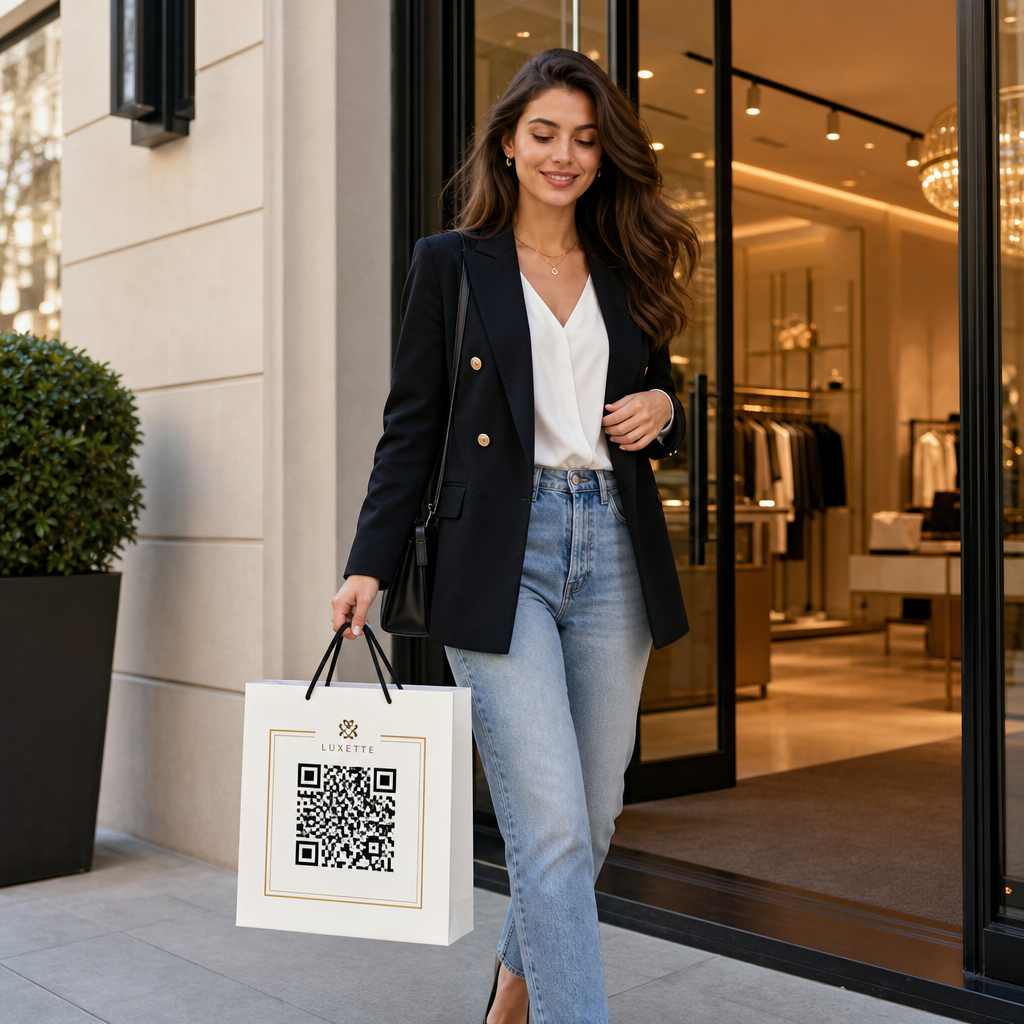
Are your shopping bags doing any work after a customer walks out the door? Most aren’t – and that’s a missed opportunity to keep the conversation going. This page shows you how to design effective QR codes for shopping bags, what to link them to, and how to measure the results.
Why Shopping Bags Are a Valuable QR Code Surface
A shopping bag travels well beyond the point of sale. It rides the subway, sits on an office desk, gets reused at a farmer’s market. Every trip is a potential impression – and a potential scan.
A World Sync 2024 consumer survey found that 64% of shoppers have already scanned a QR code on a product while shopping in-store, and 42% say QR codes have significantly improved their in-person shopping experience. Shoppers are ready to scan. The question is whether your bag gives them a reason to.
Unlike product packaging, which a customer often discards after opening, a shopping bag frequently gets reused. That extended lifespan means your QR code has repeated exposure – to the original buyer and to everyone around them. For retailers looking to squeeze more value from physical touchpoints, the bag is one of the simplest places to start. You can explore the full range of QR code use cases for retail businesses to see how other touchpoints compare.
What to Link Your Shopping Bag QR Code To
The destination matters as much as the code itself. A QR code that leads nowhere useful gets scanned once and forgotten. Here are the most effective destinations for retail bags:
- Exclusive discounts or coupons – Reward customers who scan post-purchase with a discount on their next order. A coupon QR code lets you display multiple offers on a single branded landing page.
- Loyalty program sign-up – Turn a one-time buyer into a repeat customer by making it effortless to join your rewards program.
- New arrivals or seasonal collections – Link to a curated product page that keeps the shopping momentum going after they leave the store.
- Profils de médias sociaux – Grow your following by giving bag recipients a direct path to your Instagram, TikTok, or Pinterest page.
- How-to content or brand story – A short video or article about how your products are made builds brand affinity and trust.
- Product registration or warranty pages – Especially useful for tech, appliances, or premium goods.
- Reviews page – Prompt customers to leave a Google or social review while the purchase is still fresh.
UNE code QR de lien handles most of these use cases cleanly – you enter a URL, customize the code to match your brand, and you’re ready to print.
Turn Your Shopping Bag Into a Marketing Channel Utilisez le Générateur de codes QR to create a branded, trackable code for your next bag print run. No technical knowledge needed.
Why You Should Use Dynamic QR Codes on Bags
Static QR codes encode a fixed URL. Once you print them, that destination is permanent. If the promotion ends, the landing page changes, or the link breaks, every bag in circulation becomes a dead end.
Codes QR dynamiques solve this by routing scans through a redirect, so you can update the destination at any time without reprinting the bags. This makes them the practical choice for retail packaging, where bag inventory often lasts months.
Beyond flexibility, dynamic QR codes provide detailed scan analytics: total and unique scan counts, scan times, device types, and geographic data down to city or region level. That data turns a passive bag into an active campaign asset you can measure and improve. You can read more about quelles données les codes QR dynamiques collectent and how to use it.
For retailers running seasonal campaigns or testing different offers across store locations, the ability to update destinations and compare scan performance by location is especially valuable. Pageloot’s QR code solutions for retailers are built for exactly this kind of campaign management.
Update Your Bag Campaign Without a Reprint Create a dynamic QR code at Le générateur de code QR de Pageloot and change your destination URL anytime – your printed bags stay current automatically.
How to Design a QR Code That Scans Reliably on a Bag
A QR code that doesn’t scan is worse than no QR code at all – it frustrates customers and wastes print budget. Bags introduce specific design challenges: textured surfaces, folded panels, handles that interrupt the printing area, and varying lighting conditions at the point of scan. Here’s what to get right.
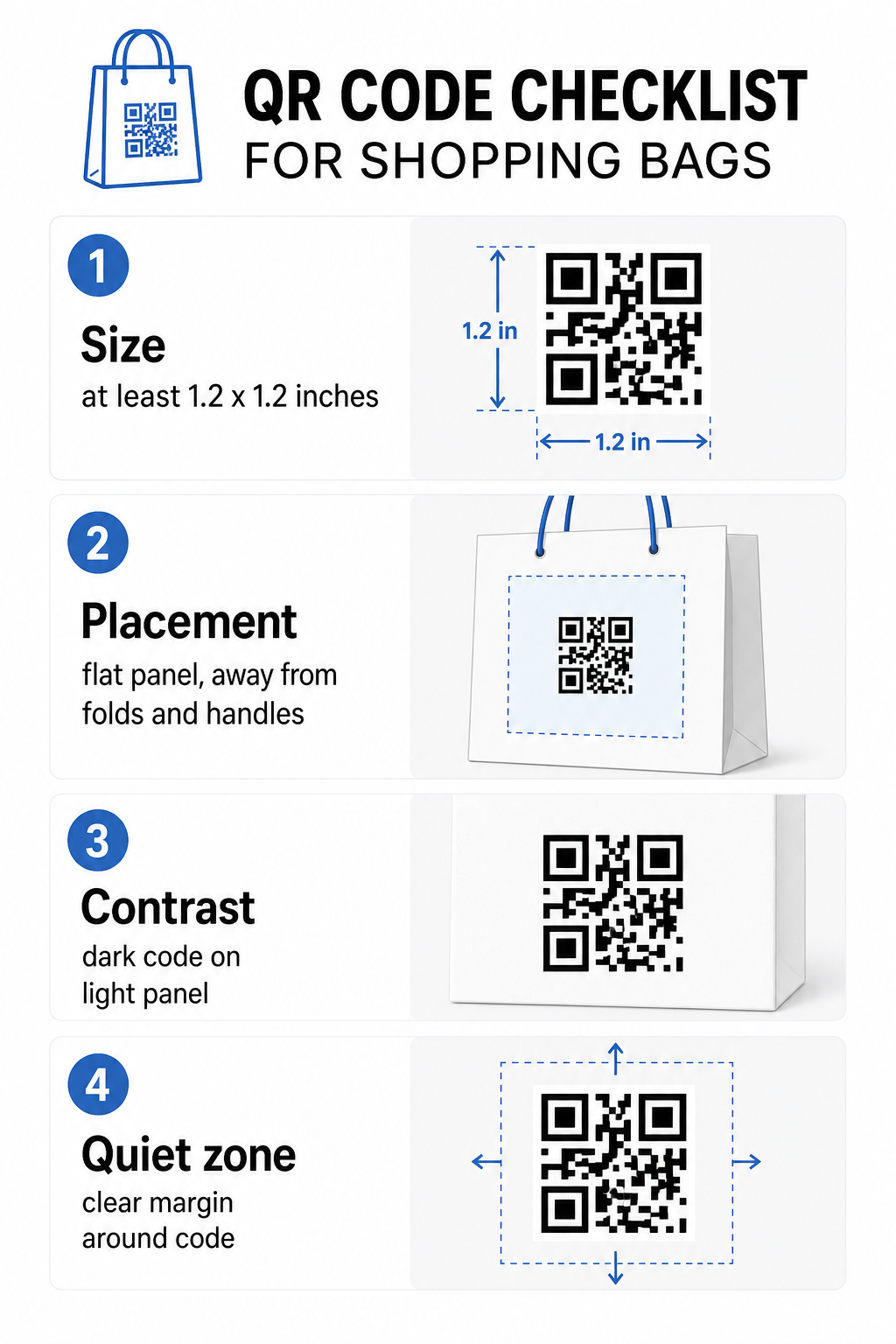
Taille
The minimum recommended print size for reliable scanning at arm’s length is 0,8 × 0,8 pouces (2 × 2 cm). For a shopping bag, where the scanning distance is typically greater and the bag may be moving, aim for at least 1.2 × 1.2 inches (3 × 3 cm).
Une règle empirique utile est la rapport distance/taille de 10:1: the code should be 1 cm wide for every 10 cm of expected scanning distance. If someone is likely to scan your bag from about 30 cm (12 inches) away, the code should be at least 3 cm wide. Denser QR codes – those encoding longer URLs or more data – require additional size to remain readable, so using shortened or dynamic URLs keeps the code pattern less dense and easier to scan.
Placement
Avoid placing the code near folds, seams, handles, or reinforced edges. These areas distort the code’s geometry, which confuses scanners. The flat center panel – front or back – is the safest location. If your bag design includes a side gusset, that panel works too, provided the surface is flat when the bag is held open. For more strategic placement thinking, the guide to meilleurs emplacements de codes QR pour les magasins de détail covers how to think about surface, visibility, and context together.
Contraste
QR code scanners detect the difference between dark modules and a light background. Dark pattern on a light background is the most reliable combination. Aim for a contrast ratio of at least 4:1 between the code and its background – higher is better. Avoid gradients, which create uneven contrast, and steer clear of reversed color schemes (light code on dark background), which some scanners fail to read.
If your bag has a dark base color, place the QR code inside a white or light-colored panel rather than printing directly onto the dark surface. For a full breakdown of which color pairings work and which to avoid, see the QR code color contrast best practices guide.
Zone de calme
Le zone de silence is the empty margin surrounding a QR code. It signals to the scanner where the code begins and ends. The standard requires at least four modules of clear space on all sides – where a module is the smallest square unit in the code grid. On a printed bag at typical sizes, this translates to roughly 3–4 mm of empty space on each side.
Do not let text, logos, brand patterns, or decorative elements intrude into this margin. Even partial encroachment can cause scan failures. If your bag design is dense with graphics, place the QR code inside a bordered white box to protect the quiet zone.
Branding the Code
A branded QR code – one that incorporates your logo and brand colors – is more likely to be scanned than a plain black-and-white version. Customers are more likely to engage when they recognize the source and understand there’s something worth scanning. You can use the générateur de code QR avec logo professionnel to embed your logo in the center of the code while maintaining scannability.
When adding a logo, use a higher error correction level (Q or H) so the code remains readable even with part of the pattern covered. Keep the logo to no more than 30% of the total code area. The QR code readability best practices guide covers logo placement alongside contrast and size guidelines in full detail.
Tests avant l'impression
Always test the final code on multiple devices and in conditions that match real use – varying light levels, different scanning angles, and at the expected scanning distance. Test on both iOS and Android. Print a physical sample before committing to a full bag run, because a code that looks fine on screen can fail on a textured or laminated bag surface.
Adding a Call-to-Action Near the Code
Research from Scantrust found that consumers who don’t typically scan QR codes said they’d be more likely to do so if the code clearly communicated what they would get. A short, direct call-to-action placed near the code does exactly that.
Keep it brief and specific. Examples that work well on bags:
- Scan for 15% off your next order
- Scan to join our rewards program
- Scan for new arrivals
- Exclusive offer inside – scan to unlock
Vague prompts like “Scan me” or “Learn more” give customers no reason to act. Tell them what they’ll get before they scan. This principle applies across all physical QR code placements – you can see how it works in broader retail QR code contexts as well.
Tracking Campaign Performance
One of the strongest arguments for QR codes on shopping bags is measurability. Unlike a printed phone number or website URL, a QR code scan is a trackable event. With dynamic QR codes, each scan logs key data points that turn your bag into a measurable campaign asset:
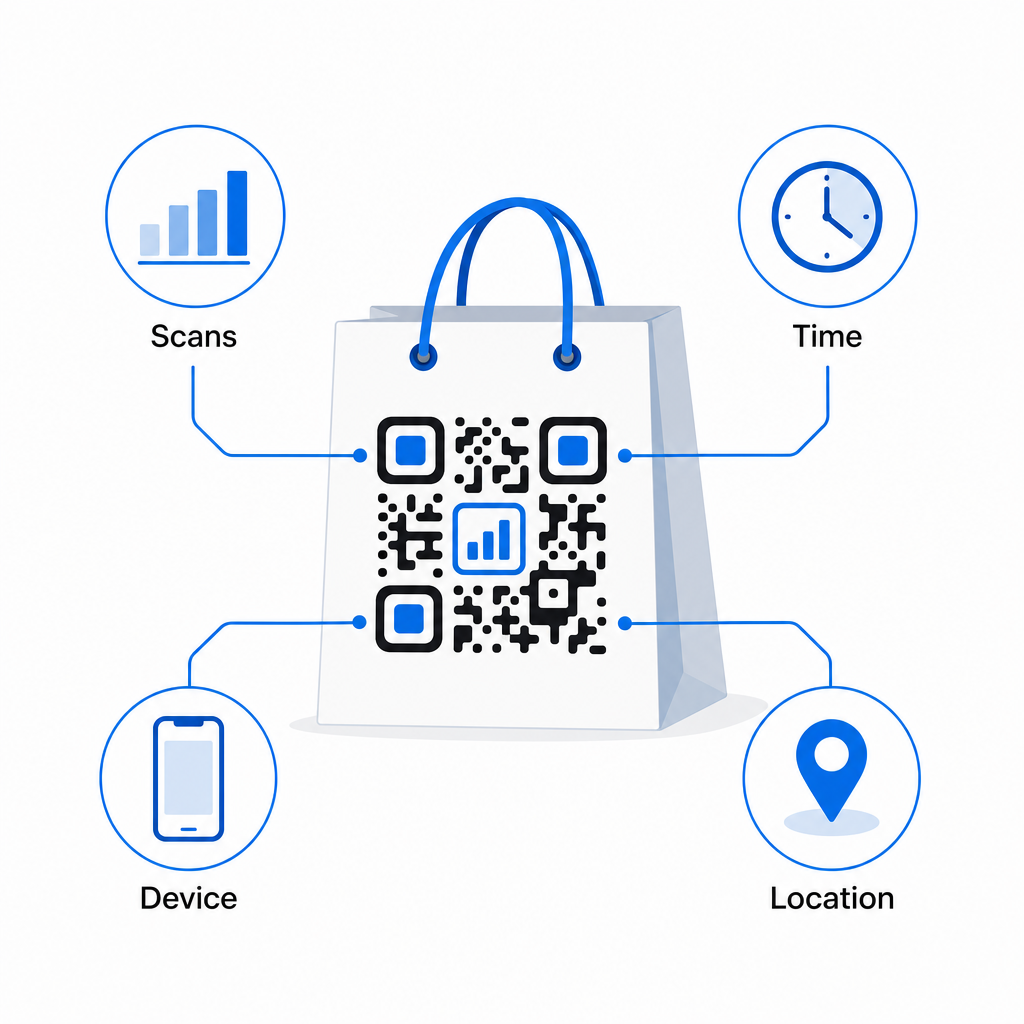
- Total scans and unique scans – distinguishes overall reach from repeat engagement
- Scan time and date – reveals when customers are most likely to engage post-purchase
- Device type – helps you optimize the landing page for the most common device your customers use
- Location data – useful for retailers with multiple locations or regional campaigns
This data lets you compare performance across bag versions, store locations, or campaign periods. If a particular promotion drives significantly more scans, you can extend it. If scans drop off after two weeks, you know the offer has run its course and can update the destination without touching the bag. The QR code analytics and tracking feature explains what the dashboard shows and how to interpret scan data in real time.
For retailers running campaigns across multiple physical formats beyond bags, the industry solutions hub gives a broader view of how QR codes fit into a coordinated strategy.
Design and Technical Checklist
Before sending your bag design to print, confirm each of the following:
| Element | Exigence |
|---|---|
| Code size | Minimum 1.2 × 1.2 inches (3 × 3 cm) for bags |
| Contrast ratio | At least 4:1 between code and background |
| Quiet zone | Minimum 4 modules of clear space on all sides |
| Placement | Flat panel, away from folds, seams, and handles |
| Code type | Dynamic QR code for updatable destinations |
| Call-to-action | Specific and benefit-led, placed near the code |
| Logo (if used) | Error correction level Q or H, ≤30% of code area |
| Testing | Confirmed scannable on iOS and Android in real lighting |
A shopping bag is one of the few retail materials that keeps working after the transaction ends. With a well-designed, dynamically linked QR code, it becomes a trackable connection between the physical purchase and your ongoing digital relationship with that customer. Design it carefully, give customers a clear reason to scan, and use the analytics to keep improving the campaign over time.
Start Building Your Bag Campaign Utilisez le Générateur de code QR Pageloot to create a branded, dynamic QR code ready for retail bag printing – with full analytics included.
Foire aux questions
Yes. With a dynamic QR code, you can use a single code across all locations and track scan data by geography, which lets you see which stores drive the most engagement. Alternatively, you can create separate codes per location to compare performance directly.
With a dynamic QR code, you simply update the destination URL in your Pageloot dashboard. Customers scanning old bags will land on your new page automatically. You never need to reprint to keep the experience current.
Print the code on a flat, matte surface and avoid placing it near folds, seams, or glossy laminated areas that cause glare. If your bag has a textured finish throughout, consider applying a small flat label or printed panel specifically for the QR code, ensuring a clean, scannable surface.