> 블로그 > QR Code Payments in Emerging Economies: Future Trends
QR payment market

QR Code Payments in Emerging Economies: Future Trends

Explore the rise of QR code payments in emerging markets. This guide covers adoption drivers, regulatory standards like Pix, and growth forecasts through 2033.
Updated on 6월 10, 2026
목차

Are you trying to assess where QR code payments are headed in developing markets? The answer shapes investment strategy, product decisions, and market-entry timing. This article breaks down the adoption drivers, regulatory frameworks, and growth forecasts you need to make sense of this fast-moving space.

Why Emerging Economies Are Leading QR Payment Adoption

QR code payments have grown faster in emerging markets than in developed ones – and the reasons are structural, not coincidental.

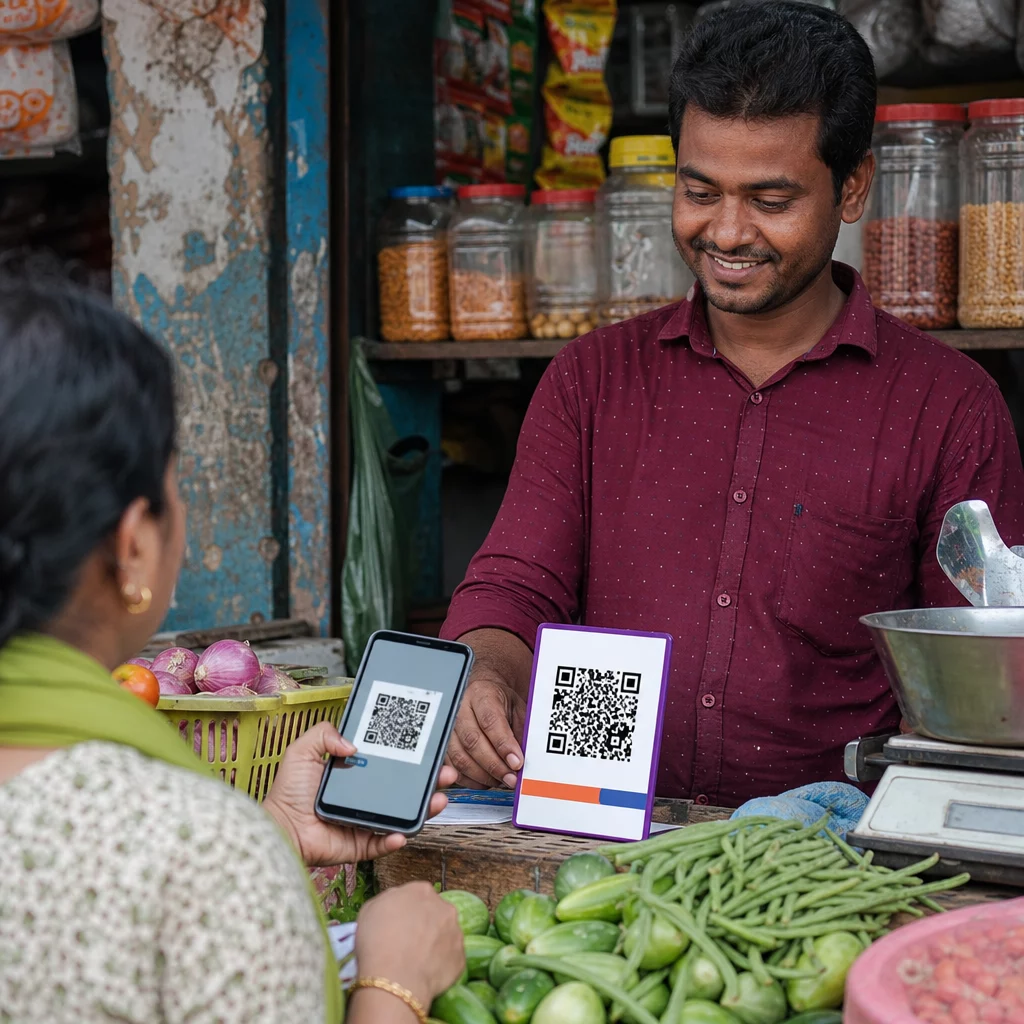
In many developing economies, traditional banking infrastructure is thin. Point-of-sale terminals are expensive, card networks have limited reach, and large portions of the population remain unbanked. QR codes solve several of these problems at once. A merchant needs only a printed code or a smartphone screen to accept digital payments – no card reader, no expensive hardware, no complex onboarding.

QR code payments are seen as a key tool for financial inclusion in emerging economies precisely because they allow small and micro-merchants to accept digital payments with minimal infrastructure, while connecting unbanked populations to formal financial services through mobile wallets. You can see how this plays out in practice through the QR code solutions available for banks and financial institutions.

China offers the clearest proof of concept. Research describes “massive adoption” of QR codes by merchants and consumers in day-to-day transactions, driven by affordable smartphones, wider mobile internet coverage, and a supportive digital ecosystem. The model has since been replicated and adapted across South and Southeast Asia, Latin America, and Sub-Saharan Africa.

Key Drivers of QR Payment Adoption

Several distinct forces are accelerating QR payment uptake across emerging markets. These do not operate in isolation – they reinforce each other.

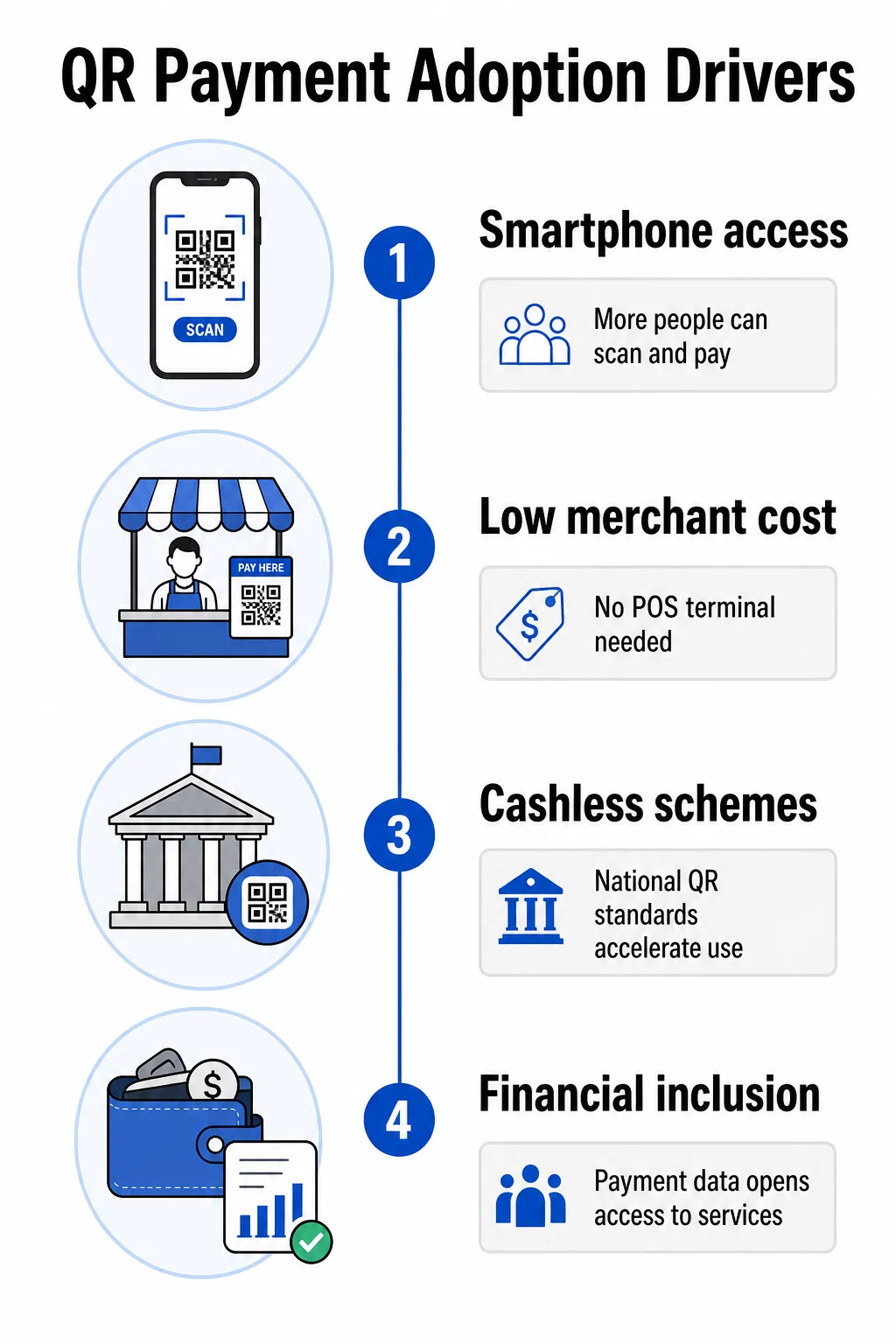
QR adoption drivers

Smartphone penetration and ease of use

As smartphone costs fall, more consumers in low- and middle-income countries carry devices capable of scanning QR codes without a dedicated app. When paying requires nothing more than opening a camera app, the friction that typically slows payment technology adoption disappears.

Lower merchant costs

Compared to traditional POS terminals, QR-based acceptance has a dramatically lower cost of entry. For small traders operating on thin margins – street vendors, market stalls, small shops – this cost difference is decisive. 결제용 QR 코드 make it possible for any merchant to create and display a working payment code in minutes, without specialist equipment.

Government-backed cashless initiatives

National governments and central banks in several emerging economies have actively promoted QR payments as part of broader cashless policy agendas. India’s BharatQR, Indonesia’s QRIS, Sri Lanka’s LankaQR, Bangladesh’s Bangla QR, Ghana’s GhQR, Mexico’s CoDi, and Brazil’s Pix are all examples of state-backed systems designed to accelerate adoption at scale – particularly among informal sector merchants and low-income consumers.

Financial inclusion as a policy goal

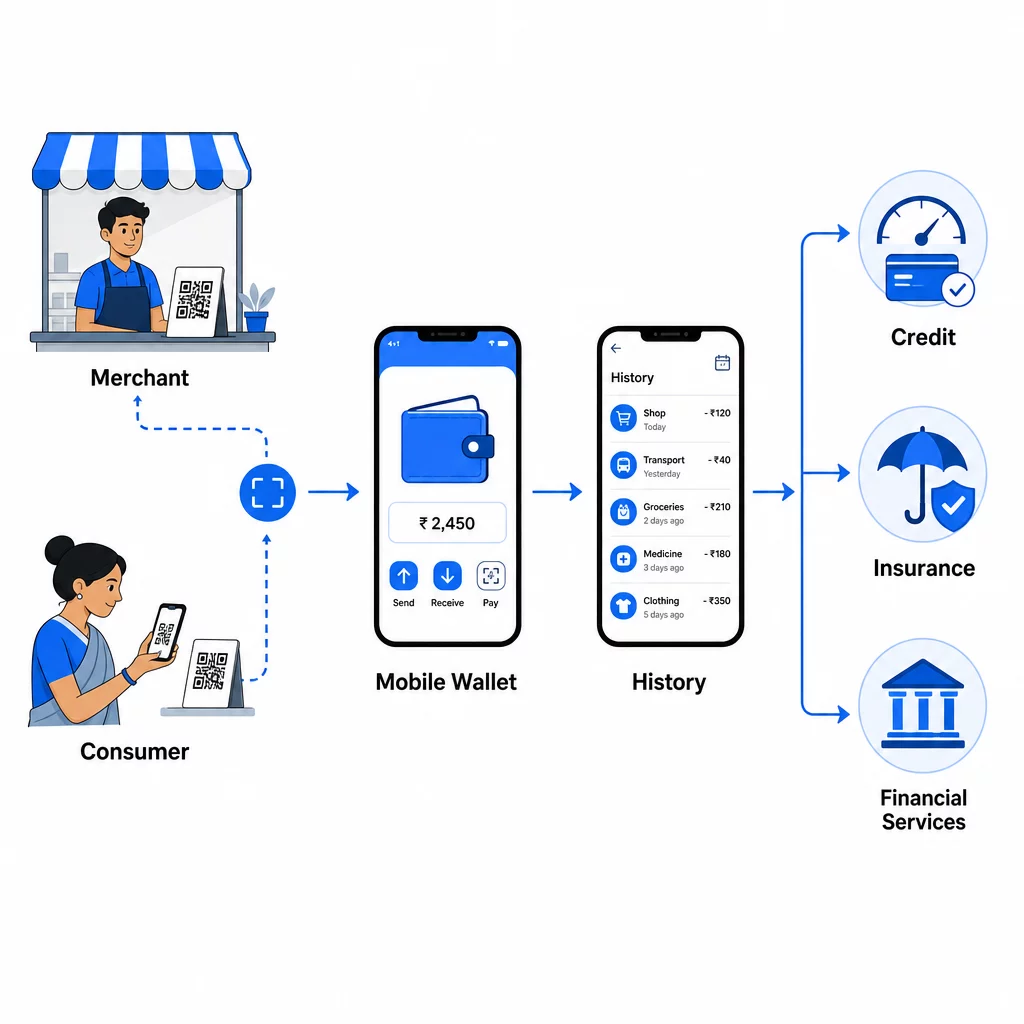
Beyond convenience, QR payments create something valuable over time: a transaction history. For previously unbanked individuals and merchants, this data trail can eventually unlock access to credit, insurance, and other formal financial services. As CGAP notes, easy and widespread digital payment opportunities “can bring lasting and profound behavior change among low-income customers and merchants, making formal payments a part of their everyday lives.”

Mobile wallet growth and digital ecosystems

The rise of mobile wallets – Alipay and WeChat Pay in China, Paytm in India, GoPay and OVO in Indonesia, M-Pesa derivatives across Africa – has created ready-made user bases for QR payments. Understanding how Alipay and WeChat Pay QR code integration works in practice gives you a useful reference point for how mature QR payment ecosystems function.

Social influence and trust

Research on QR payment adoption in Cambodia identified trust, service quality, social influence, and perceived risk as significant user-level drivers. In markets where cash remains culturally dominant, visible peer adoption and institutional credibility carry more weight than in markets where digital payments are already the norm.

Market Size and Growth Forecasts

The numbers behind QR payment growth are substantial enough to demand serious attention from investors and strategists.

  • The global QR code payment market was estimated at approximately USD 12.5 billion in 2024 and is projected to reach USD 61.7 billion by 2033, representing a compound annual growth rate of around 20%.
  • A separate forecast projects that total QR code payment spend will rise from USD 5.4 trillion in 2025 to USD 8 trillion in 2029 – a 48% increase over four years.
  • An earlier projection estimated growth from USD 8.07 billion in 2020 to USD 35.07 billion by 2030 at a 16.1% CAGR.

Asia-Pacific, which contains many of the world’s largest emerging economies, is expected to hold the largest share of global growth throughout the forecast period. China, India, and Southeast Asian nations are the primary contributors, supported by both market-driven mobile wallet expansion and deliberate government cashless initiatives.

While these figures are global rather than emerging-market-specific, the underlying drivers are concentrated in developing economies. Growth in mature markets like the United States has been comparatively slower. As more merchants adopt QR code payment options to make transactions faster, safer, and more accessible, that concentration is likely to deepen.

The Regulatory Landscape: Standards, Interoperability, and Oversight

Regulation in this space is not a barrier so much as an architecture. How central banks and governments structure QR payment schemes shapes who can participate, how costs are distributed, and how fast adoption can scale.

National QR standards and interoperability

The most significant regulatory development in emerging economies is the proliferation of interoperable national QR standards. These schemes – developed and often owned by central banks or national payment authorities – use EMVCo standards to ensure that a single QR code can accept payments from multiple providers. This matters enormously for merchant adoption: a small trader who accepts one QR scheme effectively accepts all participating wallets and banks.

국가 Scheme Operator
India BharatQR Reserve Bank of India / NPCI
Indonesia QRIS Bank Indonesia
Sri Lanka LankaQR Central Bank of Sri Lanka
Bangladesh Bangla QR Bangladesh Bank
Ghana GhQR Ghana Interbank Payment and Settlement Systems
Mexico CoDi Banco de México
Brazil Pix Banco Central do Brasil
Kyrgyzstan ELQR National Payment System

LankaQR, introduced in 2018, is explicitly required to comply with global EMV standards – a design choice that enables any bank or payment provider to accept payments through a unified code, without proprietary lock-in.

Cross-border interoperability

The ASEAN Integrated QR Code Payment System links national QR schemes across participating countries under the ASEAN Local Currency Transaction Framework. This policy initiative supports cross-border QR payments in local currencies, reducing dependence on foreign currency intermediaries for regional transactions. For businesses and investors with a regional rather than single-country focus, this integration significantly expands the addressable market.

Consumer protection and privacy

The OECD recommends that digital financial literacy initiatives run alongside financial consumer protection frameworks. In practice, regulations around QR payments should not only mandate technical security standards but also ensure consumers have access to transparent information and effective mechanisms to report fraud. For businesses operating across multiple jurisdictions, understanding how QR code privacy laws and key regulations apply to payment data is an important compliance consideration.

This is increasingly relevant because QR payment growth has produced new fraud patterns in some countries. Static merchant QR codes are particularly vulnerable to physical replacement attacks – where a fraudster places a fake code over a legitimate one. The guide on QR code risks in payments and how to mitigate them covers the main threat vectors businesses face.

The limits of available regulatory data

Public sources provide high-level descriptions of central bank roles and EMV standards, but granular, country-by-country statutory provisions specifically governing QR code payments are not well documented. Investors and strategists conducting due diligence in specific markets will need to supplement these frameworks with local legal analysis.

Financial Inclusion: The Long-Term Strategic Case

For investors and development-focused strategists, the financial inclusion dimension of QR payments is arguably the most consequential long-term trend.

QR codes create a low-cost entry point into the formal digital economy for two groups who have historically been excluded: small merchants and low-income consumers. As QR adoption spreads in these segments, it generates transaction histories that can serve as alternative credit data. Over time, this data trail creates pathways to credit, insurance, and other financial services – products that represent substantial addressable markets in their own right.

Financial inclusion pathway

CGAP frames this clearly: QR codes are “a promising way to digitize payments at low-income merchants and get customers to go digital,” and the transaction histories they generate “can bring access to credit and other formal financial services, creating a gateway to financial inclusion.”

Experience from East Asia reinforces this point. As QR-based mobile payments substitute for cash, banks can reduce costs associated with cash services – freeing capital for lending and other value-adding activities. The financial inclusion case is not purely theoretical; it is backed by observable behavior change at scale.

Risks and Barriers to Watch

The growth case is strong, but no honest market analysis ignores the headwinds.

Fraud and security vulnerabilities

Static QR codes can be physically tampered with, and the inability of most users to verify a code’s destination before scanning creates ongoing fraud risk. As adoption scales, fraud patterns tend to scale with it. The security and speed advantages of QR code payments are real, but they depend on implementation choices – particularly the use of dynamic codes over static ones – not the technology alone.

Trust and digital literacy gaps

Research from Cambodia and other emerging market contexts consistently identifies trust as a primary adoption barrier. Where consumers lack confidence in digital systems – or where prior fraud experiences have damaged trust – adoption stalls regardless of infrastructure quality. Government-backed digital literacy initiatives are part of the policy response, but progress is uneven.

Fragmentation risks

While interoperable national standards reduce fragmentation within countries, cross-border interoperability remains incomplete. Businesses operating across multiple emerging markets face the practical challenge of navigating different schemes, standards, and regulatory environments. The ASEAN integration effort is a meaningful step forward, but it covers a limited set of countries.

Infrastructure dependencies

QR payments require reliable mobile internet connectivity. In rural areas and lower-income urban zones – precisely the populations most relevant to financial inclusion goals – connectivity can be inconsistent. This constraint limits how quickly QR adoption can reach the most underserved segments.

What This Means for Businesses Operating in These Markets

For companies already accepting or planning to accept QR code payments across emerging economies, a few practical considerations follow from this analysis.

  • Design payment acceptance around the dominant local scheme. Merchant acceptance of QRIS in Indonesia or UPI-linked QR in India reaches a far wider customer base than accepting only one proprietary wallet. Interoperable standards exist precisely to eliminate that kind of lock-in.
  • Use dynamic QR codes rather than static ones. Dynamic codes let you update payment destinations, monitor scan activity for anomalies, and deactivate codes if fraud is detected – all without reprinting. For businesses managing payments across multiple locations, this centralized control is operationally significant. The guide to QR codes for mobile wallets explains the practical differences between dynamic and static approaches in a payment context.
  • Treat analytics as a core function, not an afterthought. Understanding when and where codes are being scanned – and flagging unusual patterns – is as relevant to fraud prevention as it is to marketing optimization. Businesses that use QR codes for peer payments effectively tend to monitor scan data actively rather than reactively.
  • Build for the interoperable future. Cross-border QR payment integration is expanding. Businesses that invest now in flexible, scheme-agnostic acceptance infrastructure are better positioned to scale as regional frameworks like the ASEAN system mature.

Start Accepting QR Payments Without the Complexity Need to create payment QR codes that work across your business locations? Use the Pageloot QR 코드 생성기 to build dynamic, trackable codes – or the PayPal QR 코드 생성기 to link directly to your payment account with no hardware required.

The Trajectory Is Clear, the Details Are Still Being Written

QR code payments in emerging economies are not a speculative trend – they are an infrastructure reality backed by central bank mandates, demonstrated adoption at scale, and a growth rate that outpaces most segments of the payments industry. The market is projected to grow at roughly 20% annually through 2033, with Asia-Pacific leading and Latin America, Africa, and South Asia contributing meaningfully.

The strategic question for investors and business leaders is not whether QR payments will dominate digital commerce in emerging economies, but how quickly fraud governance, cross-border interoperability, and digital literacy will mature to support that dominance. Those who understand the regulatory architecture – and position themselves within the interoperable national standards that central banks are actively promoting – are best placed to capture the opportunity.

For businesses building QR payment capabilities today, explore the QR code solutions available across industries to find the right approach for your sector.

자주 묻는 질문

Why are QR code payments growing faster in emerging economies than in developed markets?

Emerging markets have less existing card payment infrastructure, higher proportions of unbanked populations, and lower smartphone costs relative to POS terminal costs. QR codes remove the need for expensive hardware, allowing any merchant with a printed code or smartphone to accept digital payments. Government-backed cashless initiatives and interoperable national QR standards have also accelerated adoption in ways that have no direct equivalent in most developed markets.

What role do central banks play in shaping QR payment systems in developing countries?

Central banks in many emerging economies have taken a direct role in developing and mandating interoperable national QR schemes – examples include BharatQR in India, QRIS in Indonesia, LankaQR in Sri Lanka, and Pix in Brazil. These schemes use EMVCo standards to ensure that a single QR code can accept payments from multiple providers, reducing fragmentation and supporting adoption among small merchants and low-income consumers. This is a policy-driven infrastructure investment, not simply a market outcome.

What are the main security risks businesses should plan for when using QR payments in these markets?

The most common risks are physical QR code tampering (where fraudsters replace a legitimate code with a fake one redirecting payments to their own account) and phishing attacks that mimic legitimate payment pages. Using dynamic QR codes – which can be monitored for unusual scan activity and deactivated if compromised – significantly reduces these risks compared to static codes. For a full breakdown of threats and mitigation strategies, see the guide on QR code risks in payments.

작성자 정보

시임 코스타비는 페이지루트의 콘텐츠 책임자입니다. 그는 페이지루트의 혁신적인 QR 코드 생성 서비스에 대한 글을 쓰고 있습니다. 5년 이상 QR 코드 분야에서 쌓아온 깊이 있는 전문 지식을 바탕으로, 시임은 이 분야의 전문가로 인정받고 있습니다. 그는 QR 기술을 활용하여 디지털 상호작용을 간소화하고 향상시키는 데 크게 기여하고 있습니다.

범주
에 대해 자세히 알아보기

온라인으로 QR 코드를 생성해야하는 경우 QR 코드 만들기 무료로 여기!
Pageloot는 #1 Go-To 솔루션 QR 코드를 만들고 스캔합니다.

20,000개 이상의 브랜드로부터 신뢰를 받아 더 많은 매출, 리뷰, 팔로워를 확보했습니다.

클라이언트 로고
최고 브랜드의 신뢰
5 중 4.8 평가

4.86 / 5 별점

휴고 로랑
휴고 로랑
레스토랑 주인
가장 쉽고 안정적인 QR 코드 생성기. PDF 파일을 즉시 업로드할 수 있습니다. 이제 레스토랑 메뉴가 디지털화되었습니다.
루카스 얀센
루카스 얀센
부동산 개발사
이것은 훌륭한 도구이며 QR 코드를 사용하면 원하는 곳으로 이동할 수 있습니다. 우리는 위치 QR 코드만 사용하지만 유용한 기능이 너무 많습니다.
엠마 모레티
엠마 모레티
소매 제품
사용하기 쉽고 빠릅니다. 그것은 훌륭하게 작동하고 완벽한 이미지를 생성하므로 직원들이 내 vCard를 다운로드할 수 있습니다.
휴고 로랑
휴고 로랑
레스토랑 주인
가장 쉽고 안정적인 QR 코드 생성기. PDF 파일을 즉시 업로드할 수 있습니다. 이제 레스토랑 메뉴가 디지털화되었습니다.
루카스 얀센
루카스 얀센
부동산 개발사
이것은 훌륭한 도구이며 QR 코드를 사용하면 원하는 곳으로 이동할 수 있습니다. 우리는 위치 QR 코드만 사용하지만 유용한 기능이 너무 많습니다.
엠마 모레티
엠마 모레티
소매 제품
사용하기 쉽고 빠릅니다. 그것은 훌륭하게 작동하고 완벽한 이미지를 생성하므로 직원들이 내 vCard를 다운로드할 수 있습니다.
더 많은 QR 코드보기
포스터 QR 코드 스캔
QR 코드 사용 포스터
교회 QR 코드 스캔
QR 코드 교회에
무엇이든 디지털 경험으로 전환하세요 3분 이내에.

14일 무료 체험.

신용카드는 필요 없습니다.

첫 구매 시 30% 할인

코드를 사용하세요:

MP3 파일 공유

PDF QR 코드를 생성하려면 가입하세요

필요한 모든 것을 업로드하고 표시합니다.

  • 오디오 파일
  • 팟캐스트
  • 음악

가입 시 14일 무료 체험.
체험 기간 후 QR 코드 만료.

오디오 mp3 QR 코드를 생성하려면 가입하세요

프레임으로 더 많은 스캔 확보

QR 코드에 더 많은 프레임을 추가하려면 가입하세요

클릭 유도 문안 프레임은 고객이 QR 코드와 쉽게 상호 작용할 수 있도록 도와줍니다. 사용해 보세요!

가입 시 14일 무료 체험.
체험 기간 후 QR 코드 만료.

QR 코드에 더 많은 프레임을 추가하려면 가입하세요

도형으로 더 많은 스타일 추가

더 많은 도형을 만들려면 가입하세요

QR 코드는 정사각형일 필요가 없습니다. 브랜드 이미지에 맞게 전환해 보세요.

가입 시 14일 무료 체험.
체험 기간 후 QR 코드 만료.

더 많은 도형을 만들려면 가입하세요

QR 코드에 로고 추가

QR 코드에 로고를 추가하려면 가입하세요

로고와 브랜드를 추가하여 QR 코드를 돋보이게 만드세요.

가입 시 14일 무료 체험.
체험 기간 후 QR 코드 만료.

QR 코드에 로고를 추가하려면 가입하세요

스마트 앱 스토어 리디렉션

앱 스토어 QR 코드를 생성하려면 가입하세요

스마트 앱 스토어 QR 코드에 앱 링크를 추가하세요. 사용자는 장치에 따라 리디렉션됩니다.

가입 시 14일 무료 체험.
체험 기간 후 QR 코드 만료.

앱 스토어 QR 코드를 생성하려면 가입하세요

QR 코드에 이미지 업로드

이미지 QR 코드를 생성하려면 가입하세요

이미지를 쉽게 공유하세요. 몇 초 안에 동적으로 이미지를 변경하십시오.

가입 시 14일 무료 체험.
체험 기간 후 QR 코드 만료.

이미지 QR 코드를 생성하려면 가입하세요

PDF 파일 공유

PDF QR 코드를 생성하려면 가입하세요

필요한 모든 것을 업로드하고 표시합니다.

  • 메뉴 및 가격표
  • 명령
  • 모든 문서

가입 시 14일 무료 체험.
체험 기간 후 QR 코드 만료.

PDF QR 코드를 생성하려면 가입하세요

인쇄 없이 나중에 편집

다시 인쇄하지 않고 QR 코드를 편집하려면 가입하세요

동적 QR 코드를 사용하면 새 QR 코드를 인쇄하지 않고도 QR 코드의 내용을 변경할 수 있습니다.

가입 시 14일 무료 체험.
체험 기간 후 QR 코드 만료.

다시 인쇄하지 않고 QR 코드를 편집하려면 가입하세요

언제? 어디서? QR 코드 스캔 추적

QR 코드를 추적하려면 가입하세요

어떤 QR 코드가 가장 많이 스캔되고 무엇이 고객을 가장 흥분시키는지 알아보십시오.

가입 시 14일 무료 체험.
체험 기간 후 QR 코드 만료.

QR 코드를 추적하려면 가입하세요

인쇄 준비 파일 제공

PDF 및 SVG와 같은 벡터 QR 코드를 생성하려면 가입하세요.

.EPS, .PDF, .SVG

HD 해상도로 QR 코드를 다운로드하고 싶으신가요? 인쇄할 준비가 된 벡터 또는 픽셀 형식을 가져옵니다.

가입 시 14일 무료 체험.
체험 기간 후 QR 코드 만료.

PDF 및 SVG와 같은 벡터 QR 코드를 생성하려면 가입하세요.

기다리세요. 귀하의 QR 코드는 로드 중... 로드 중...

나만의 것으로 만들기

나중을 위해 QR 코드를 저장하려면 가입하세요.

다양한 색상, 로고 및 클릭 유도문안 프레임으로 멋진 QR 코드를 만들어 더 많은 스캔을 받으세요.

가입 시 14일 무료 체험.
체험 기간 후 QR 코드 만료.

나중을 위해 QR 코드를 저장하려면 가입하세요.