首页 > 博客 > Secure Patient Data Sharing with QR Codes
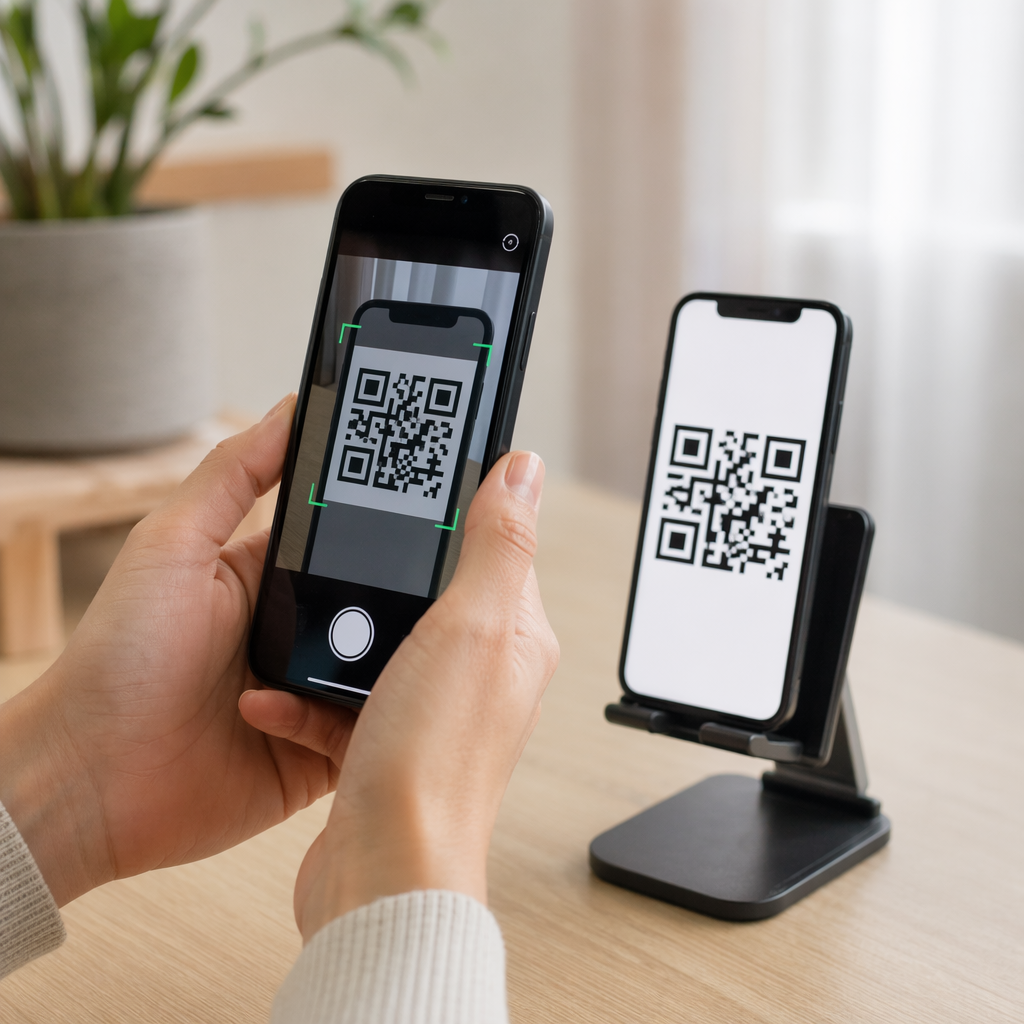
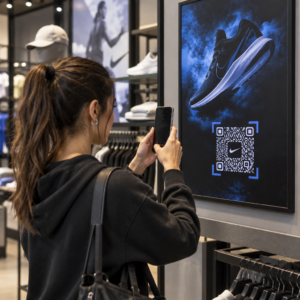
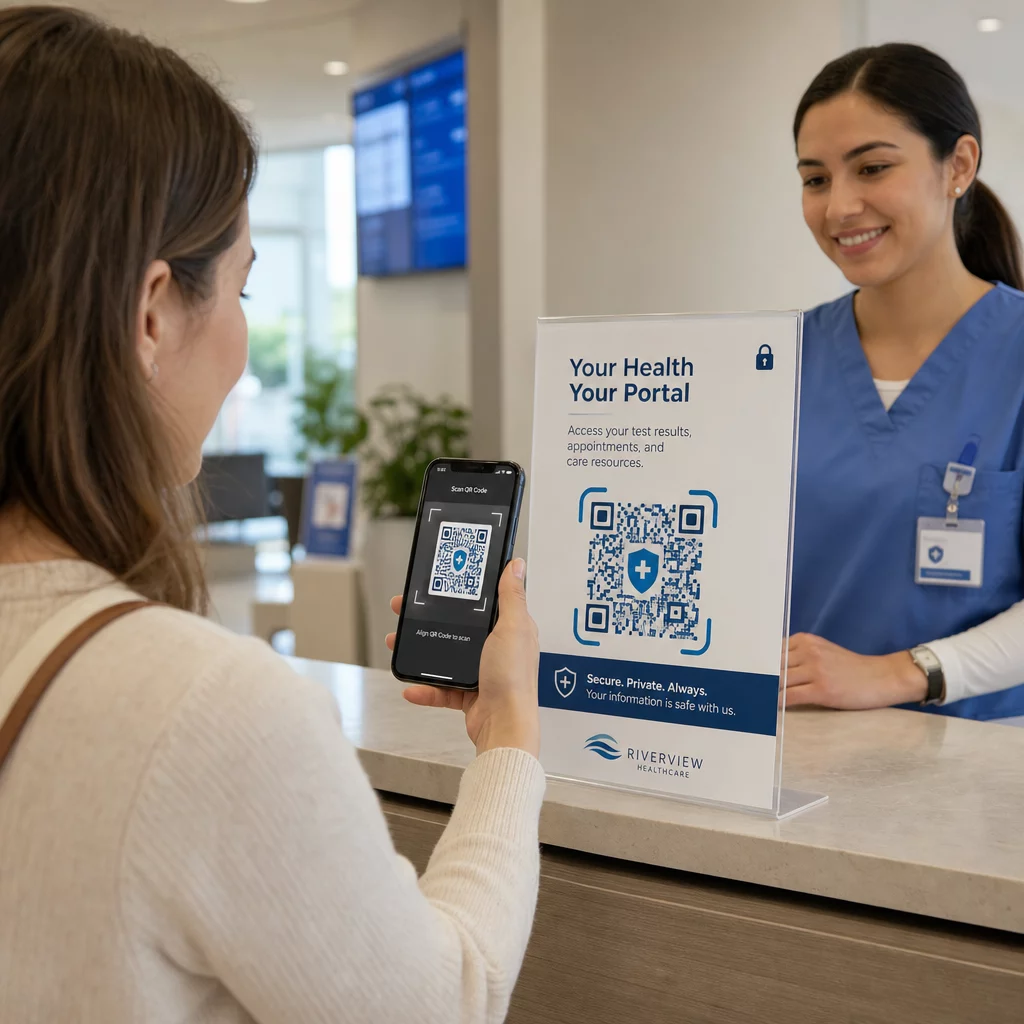
Secure healthcare QR scan

Secure Patient Data Sharing with QR Codes

Implement secure QR codes for patient data sharing and maintain HIPAA compliance. Learn about encryption, dynamic links, and technical safeguards for PHI.
Updated on 6 月 10, 2026
目录

Are you unsure whether QR codes are safe enough for sharing protected health information? Exposing patient data – even accidentally – can mean HIPAA violations, steep fines, and broken patient trust. This guide explains how to implement QR codes securely in healthcare settings, what compliance requirements apply, and which practices keep patient data protected at every step.

How QR Codes Work for Health Data Sharing

QR codes encode a link or token into a scannable pattern. When a staff member or patient scans the code, their device retrieves the associated content – a patient intake form, lab result, discharge instruction, or secure portal – without requiring manual data entry or specialized software.

In healthcare, this matters because the alternative is often a fragmented mix of phone calls, fax transmissions, printed forms, and unencrypted email. QR codes consolidate these touchpoints into a single, auditable interaction. The QR codes for healthcare and hospitals guide describes them as a way to improve patient access, streamline communication, and increase operational safety without requiring a dedicated tech team.

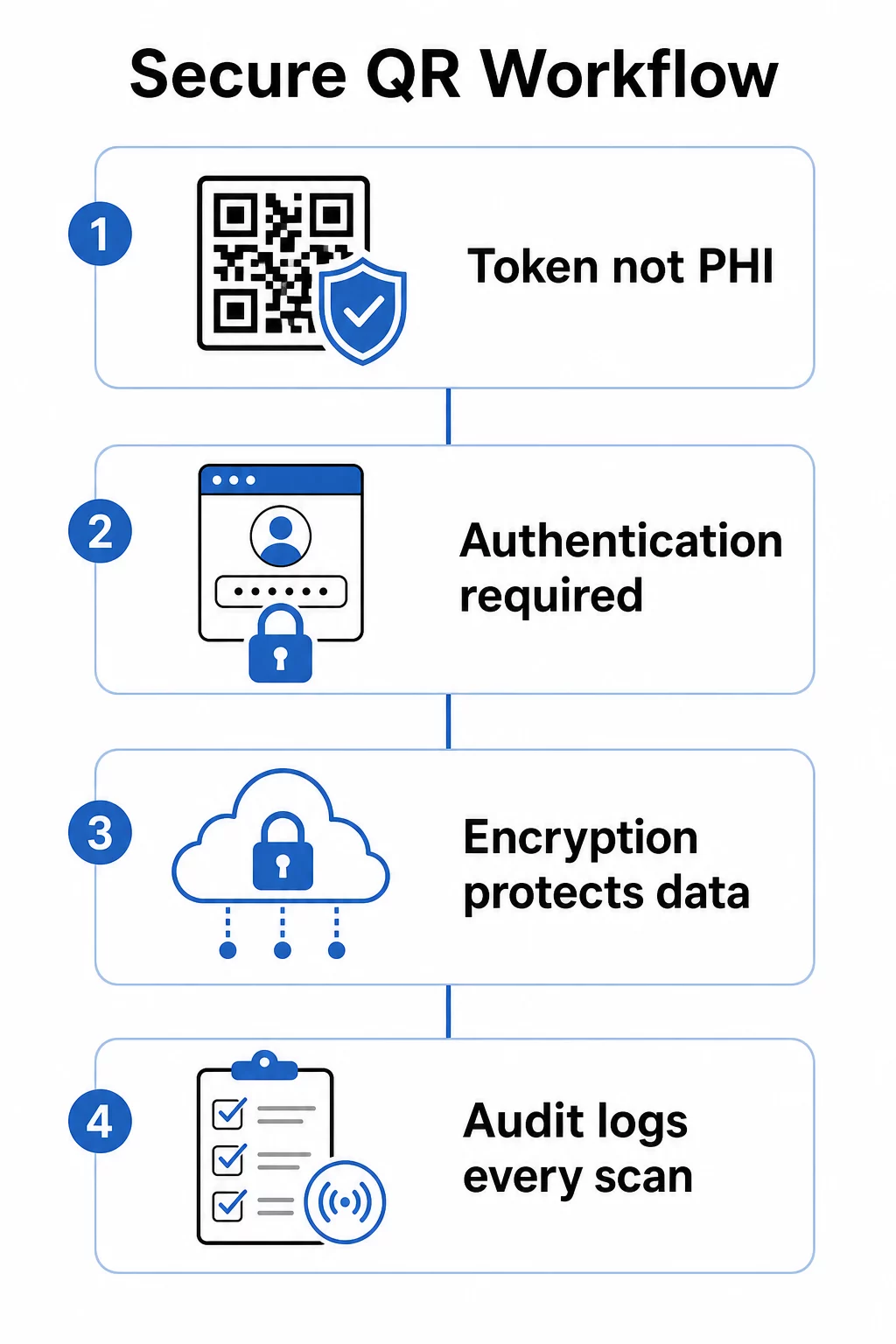
A critical distinction: the QR code itself should never contain protected health information (PHI). Instead, it should encode an opaque token or signed URL that points to a backend system where ePHI is stored and protected under proper safeguards. This keeps the physical code safe to print on wristbands, appointment cards, or discharge packets without exposing sensitive data if the code is photographed or intercepted.

HIPAA Requirements That Apply to QR Code Systems

The HIPAA Security Rule establishes national standards for protecting electronic protected health information (ePHI). Any QR code system that creates, receives, maintains, or transmits ePHI must meet these requirements – and so must any third-party vendor involved in that workflow.

The Security Rule’s technical safeguards cover four areas directly relevant to QR-based systems:

  • Access control: Only authorized persons or software programs may access systems containing ePHI. This means QR-linked resources must require authentication before displaying patient data.
  • Audit controls: Mechanisms must record and examine activity in systems that contain or use ePHI. Every scan, access attempt, and data retrieval needs to be logged with timestamps and user identifiers.
  • Transmission security: Technical measures must guard against unauthorized access to ePHI transmitted over electronic networks, including encryption and integrity controls.
  • Authentication: Systems must verify that users are who they claim to be before granting access.

The Privacy Rule adds the minimum necessary standard: only the information required for a specific purpose should be shared. Dynamic QR codes support this directly – you can configure a code to surface only the relevant portion of a patient record, not the entire file.

When you use a third-party QR code platform that handles ePHI, HIPAA requires a signed Business Associate Agreement (BAA). This agreement legally binds the vendor to the same data protection and breach notification standards that apply to your organization. Always verify that a vendor will sign a BAA and that their documented security controls – encryption standards, access logging, incident response procedures – meet HIPAA requirements before deploying their tools in a clinical workflow.

Share Medical Documents Securely Need to give patients instant access to consent forms, discharge instructions, or lab results? Use the PDF QR 码生成器 to upload files and generate trackable, secure QR codes without email attachments or paper handoffs.

Static vs. Dynamic QR Codes for Healthcare

Not all QR codes offer the same level of control, and for healthcare use, the difference matters significantly.

静态二维码 encode fixed data directly into the code. Once printed, they cannot be updated, revoked, or monitored. If a static code links to a resource that later becomes outdated or compromised, you have no way to disable it without reprinting. For healthcare applications involving any patient-specific information, static codes introduce unnecessary risk.

动态 QR 码 link to a server-side destination that you control. This means you can:

  • Update the linked content without reprinting the code
  • Set expiration dates or one-time access rules on the URL
  • Revoke access immediately if a code is lost, tampered with, or no longer needed
  • Monitor scan activity in real time – who accessed the resource, when, and from which device

For example, a physician sharing test results with a specialist for a single consultation can configure the link to expire automatically after the session. If a patient’s medication list changes, the QR code on their medical ID card continues to work while the linked content updates instantly. This flexibility is what makes dynamic codes the appropriate choice for sensitive healthcare workflows.

医疗保健QR码终极指南 recommends static codes only for permanent, non-sensitive information – hygiene instructions, Wi-Fi access in waiting rooms, or fixed contact details – and dynamic codes for anything requiring updates, tracking, or security controls.

Create Trackable, Editable Healthcare QR Codes Manage all your healthcare QR codes from one dashboard, update destinations without reprinting, and monitor scan activity in real time with the Pageloot healthcare QR code solution.

Security Controls to Implement

Meeting HIPAA’s technical safeguard requirements in a QR code workflow requires deliberate configuration. These are the controls that matter most:

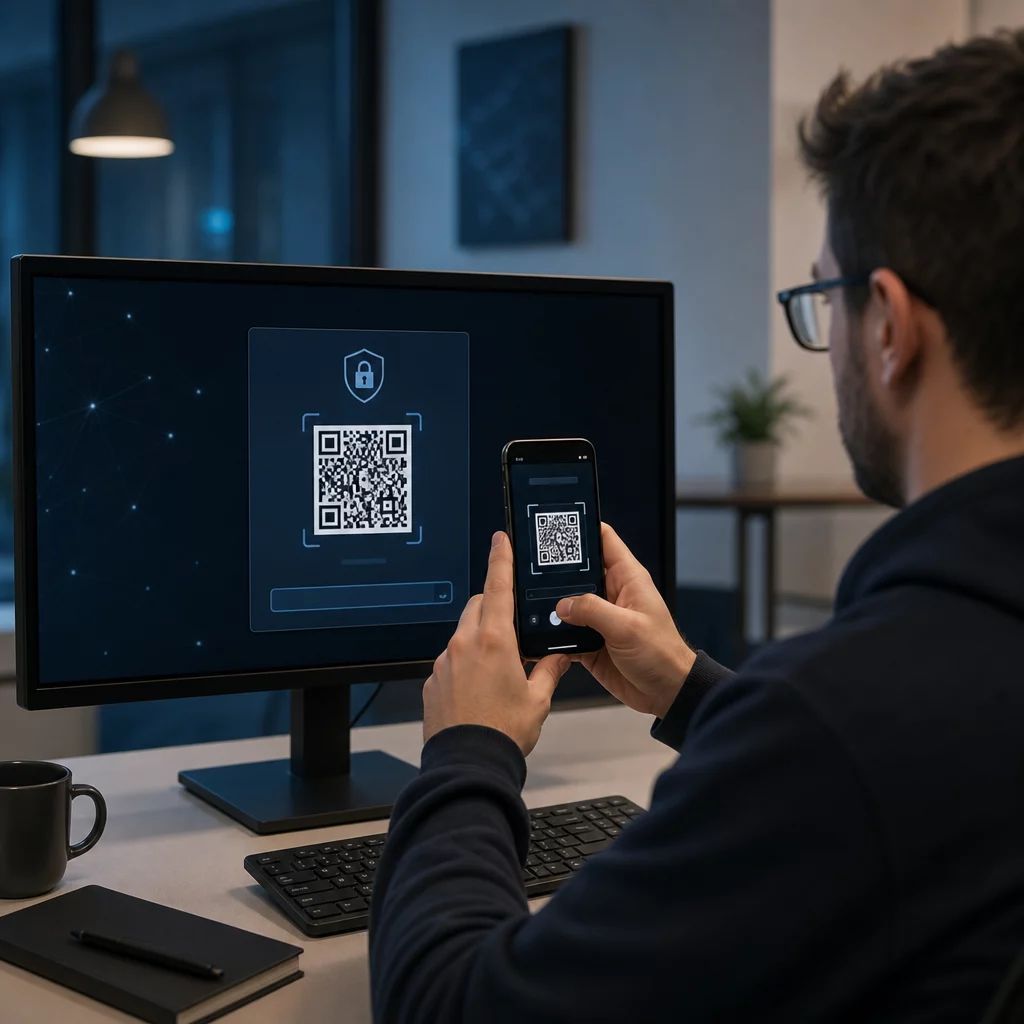
QR security controls

Encryption in transit and at rest

All QR-linked resources that handle ePHI must use TLS-only connections with valid certificates. The data stored on the server must also be encrypted at rest. AES-256 is the standard used by financial institutions and government agencies, and it satisfies HIPAA’s encryption implementation specifications. How encryption secures QR code data explains how symmetric encryption like AES works well for QR applications given the storage constraints of the code format itself.

Authentication and access control

Require users to verify their identity before viewing ePHI retrieved through a QR code. This can include single sign-on (SSO), multi-factor authentication (MFA), or time-based session tokens. Role-based access control ensures that a front desk administrator and an attending physician see only the data their role requires. Pageloot supports role-based access control for enterprise users, enabling organizations to prevent unauthorized edits and centralize governance across teams.

Password-protected codes

For QR codes shared in semi-public contexts – printed on discharge paperwork, affixed to equipment, or included in mailed materials – password protection adds a layer of defense. Even if someone photographs the code, they cannot access the linked resource without credentials.

Short-lived, signed URLs

Rather than issuing permanent links, generate tokens that expire after a set period or after a single use. This limits the exposure window if a code is intercepted or shared beyond its intended recipient.

Comprehensive audit logging

Every scan attempt, successful access, and data interaction should be logged automatically. Logs must capture timestamps, user identifiers, and the specific resources accessed. These records support both routine HIPAA compliance reviews and incident response if a breach is suspected.

Avoid public URL shorteners and third-party trackers

QR-linked ePHI pages should be hosted under trusted, first-party healthcare domains. Public URL shorteners obscure the destination and may route traffic through third-party infrastructure that does not meet HIPAA standards. Use privacy-preserving analytics rather than third-party tracking scripts that collect unnecessary metadata.

For a broader look at secure QR code generation practices, the secure QR code generation best practices guide 以及 QR code security in cyber defense guide cover encryption, tamper detection, and monitoring in detail.

Physical Security: Tamper and Phishing Risks

Digital controls protect data in transit, but QR codes in clinical environments also face physical threats. QR code phishing – sometimes called “quishing” – occurs when an attacker places a fraudulent QR code over a legitimate one, redirecting scans to a malicious site designed to harvest credentials or install malware. This risk is real in healthcare settings where QR codes appear on waiting room signage, equipment labels, and printed patient materials.

Mitigate physical tampering by:

  • Using tamper-evident materials for codes affixed to physical surfaces
  • Embedding your organization’s logo and branding directly in the QR code design so altered codes look visually inconsistent
  • Establishing a routine inspection schedule for all placed QR codes, with reference photos for comparison
  • Training staff to verify that QR code destinations match expected URLs before entering any credentials

Patient and staff education is equally important. Train your team to recognize suspicious QR distributions, use scanning apps that preview the destination URL before opening it, and never enter login credentials into a page reached by scanning an unfamiliar code. QR code privacy laws and key regulations outlines the regulatory context for these risks in more detail.

Healthcare Use Cases

The security controls above enable a range of practical applications across the care continuum:

Patient registration and check-in

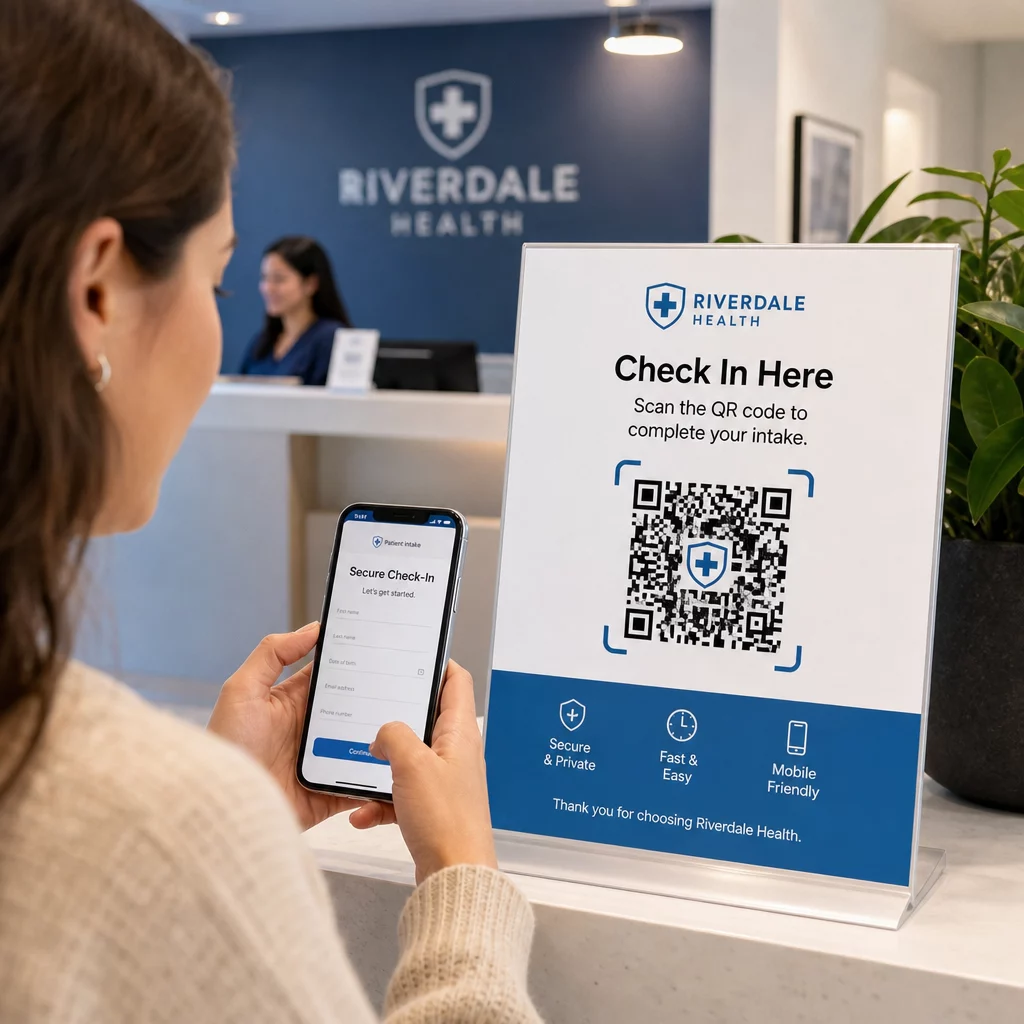
Patients scan a QR code on arrival to access a secure intake form, update insurance details, or complete consent documents on their own device. This eliminates paper forms, reduces front desk load, and creates a digital record of submissions. Contactless check-in workflows gained wide adoption during COVID-19 and continue to reduce wait times and infection risk.

Patient QR check-in

Secure document distribution

Lab results, imaging reports, treatment plans, and aftercare instructions can be distributed as PDF QR codes. Patients access documents directly on their devices without requiring a portal login or printed handout. When results are amended, the dynamic code reflects the updated content automatically. The file upload feature on Pageloot supports secure PDF hosting for exactly this use case.

Emergency access to critical health information

Patients can carry QR codes on medical alert cards or bracelets linking to critical details – allergies, current medications, implanted devices, emergency contacts. First responders scan the code to retrieve life-saving information when the patient cannot communicate. Dynamic codes ensure this data stays current without requiring a new card each time medications change.

Provider-to-provider data sharing

When transferring care between facilities or consulting specialists, a sending provider generates a time-limited QR code linked to the relevant portion of the patient’s record. The receiving provider scans to access the data securely. Access expires automatically after the consultation period, reducing the risk of unauthorized future access.

Medication management

QR codes on prescription packaging link patients to dosing instructions, multilingual resources, reminder tools, and support programs. For home-based care, QR codes can link to updated care plans and medication schedules that reflect the most current prescriptions without requiring a new printout.

Equipment tracking and maintenance

QR codes on medical devices give clinical staff instant access to device specifications, maintenance schedules, calibration records, and safety alerts – reducing administrative overhead and supporting compliance with equipment safety requirements.

Comparing QR Codes to Other Sharing Methods

方法 Privacy & Security Usability 实时更新 Audit Trail
动态二维码 High (encrypted, access-controlled) Excellent (instant scan) Yes (automatic logging)
静态二维码 Medium (no revocation) Excellent (instant scan) 没有 有限公司
Patient Portals High (MFA supported) Poor (login friction)
Email/Fax Low (often unencrypted) 没有 没有
Traditional Barcodes Medium (limited encryption) Good (requires scanner) 没有 没有

Dynamic QR codes occupy a practical middle ground: they offer the security controls of a patient portal without the login friction that discourages patient engagement. They outperform fax and email on every security dimension, and they provide the audit trails that HIPAA requires – without the infrastructure cost of building or maintaining a dedicated portal system.

Implementation Checklist

Before deploying QR codes in any workflow that involves patient data, verify these controls are in place:

  • QR codes encode opaque tokens, not PHI directly
  • All linked resources use HTTPS with valid certificates
  • ePHI is encrypted in transit and at rest
  • Authentication (MFA or SSO) is required before displaying patient data
  • Access is scoped by role using least-privilege principles
  • URLs are time-limited or single-use for sensitive exchanges
  • Every scan and access event is logged automatically
  • Logs are reviewed regularly and retained per your organization’s policies
  • A signed BAA is in place with your QR code platform vendor
  • Physical codes are branded, inspected regularly, and use tamper-evident materials
  • Staff have received training on quishing risks and safe scanning behavior
  • Patient-facing codes link only to minimum necessary information

For a deeper look at QR code applications across clinical environments, the QR codes for hospitals and healthcare page covers patient identification, equipment tracking, drug transparency, and more. You can also explore QR code solutions by industry to see how the same technology adapts across different operational contexts.

QR codes work in healthcare when the implementation treats them as a secure interface to properly protected systems – not as a storage mechanism for sensitive data. Get the architecture right, enforce authentication and logging, and QR codes become one of the lowest-friction ways to give patients and providers fast, compliant access to the information they need.

Build a HIPAA-Ready QR Code Workflow Generate dynamic, branded QR codes with built-in scan tracking, access controls, and real-time analytics. The Pageloot 链接二维码生成器 lets you create and manage every code from one dashboard – and update destinations anytime without reprinting.

常见问题

Should the QR code itself contain patient health information?

No. The QR code should encode only an opaque token or signed URL that points to a secure backend system. The PHI is stored and protected server-side under proper HIPAA safeguards. This way, photographing or intercepting the code does not expose any patient data – access still requires authentication at the linked destination.

What makes dynamic QR codes more appropriate than static codes for healthcare?

Dynamic QR codes allow you to update the linked content, set expiration dates, revoke access instantly, and monitor every scan attempt in real time. Static codes are permanent and unrevocable – if a linked resource changes or a security issue arises, you cannot disable the code without reprinting it. For any workflow involving patient-specific information or time-sensitive data, dynamic codes are the appropriate choice.

Do we need a Business Associate Agreement with a QR code platform vendor?

Yes, if the vendor’s platform creates, receives, maintains, or transmits ePHI as part of your workflow. HIPAA requires a signed BAA with any business associate involved in handling protected health information. Before selecting a platform, confirm that the vendor will sign a BAA and that their security controls – encryption standards, access logging, breach notification procedures – meet HIPAA requirements.

关于作者

Siim Kostabi 是 Pageloot 的内容主管,负责撰写关于我们创新型二维码生成器服务的文章。凭借五年多来在二维码领域积累的深厚专业知识,Siim 是该领域的专家。他致力于利用二维码技术简化和增强数字交互,并取得了显著的成果。.

类别
了解更多关于
QR QR码的#1解决方案

如果您需要在线创建QR码,则可以 制作二维码 就在这里免费!
Pageloot是 #1转到解决方案 创建和扫描QR码。

BL-0200

受到超过 20,000 个品牌的信赖,可获得更多销售、评论和关注者。

客户徽标
受到顶级品牌的信赖
评分为 4.8(共 5)

4.86 / 5 星评级

雨果·劳伦特
雨果·劳伦特
餐馆老板
有史以来最容易和最可靠的QR码生成器。PDF文件可以立即上传。我们的餐厅菜单现在是数字化的。
卢卡斯-詹森
卢卡斯-詹森
房地产开发商
这是一个很好的工具,二维码带你到你想要的地方。我们只使用位置二维码,但有许多有用的功能。
艾玛-莫雷蒂
艾玛-莫雷蒂
零售产品
易于使用和快速。它工作得很好,创造了一个完美的图像,所以员工可以下载我的vCard。
雨果·劳伦特
雨果·劳伦特
餐馆老板
有史以来最容易和最可靠的QR码生成器。PDF文件可以立即上传。我们的餐厅菜单现在是数字化的。
卢卡斯-詹森
卢卡斯-詹森
房地产开发商
这是一个很好的工具,二维码带你到你想要的地方。我们只使用位置二维码,但有许多有用的功能。
艾玛-莫雷蒂
艾玛-莫雷蒂
零售产品
易于使用和快速。它工作得很好,创造了一个完美的图像,所以员工可以下载我的vCard。
查看更多QR码
选择二维码类型
如何使用 动态二维码
将一切转化为数字体验 不到3分钟。

免费试用 14 天。

无需信用卡。

首次购买可享受 30% 折扣

使用代码:

分享您的 MP3 文件

注册以创建 PDF QR 码

上传和显示你需要的一切。

  • 音频文件
  • 播客
  • 音乐

注册即可享 14 天免费试用。.
试用期结束后,二维码将失效。.

注册以创建音频 mp3 二维码

使用边框获得更多扫描

注册以向您的二维码添加更多框架

呼叫行动框架帮助您的客户与QR码轻松互动。试试吧!

注册即可享 14 天免费试用。.
试用期结束后,二维码将失效。.

注册以向您的二维码添加更多框架

使用形状添加更多样式

注册以创建更多形状

二维码不一定是方形的。试着改变它以适应你的品牌形象。

注册即可享 14 天免费试用。.
试用期结束后,二维码将失效。.

注册以创建更多形状

为您的二维码添加徽标

注册以将您的徽标添加到二维码中

通过在二维码上添加你的标志和品牌,使你的二维码脱颖而出。

注册即可享 14 天免费试用。.
试用期结束后,二维码将失效。.

注册以将您的徽标添加到二维码中

智能应用商店重定向

注册以创建应用商店二维码

将您的应用程序链接添加到我们的智能应用程序商店QR码。用户会根据他们的设备被重新定向。

注册即可享 14 天免费试用。.
试用期结束后,二维码将失效。.

注册以创建应用商店二维码

将图片上传到二维码

注册以创建图像二维码

轻松分享你的图像。在几秒钟内动态地改变任何图像。

注册即可享 14 天免费试用。.
试用期结束后,二维码将失效。.

注册以创建图像二维码

分享您的 PDF 文件

注册以创建 PDF QR 码

上传和显示你需要的一切。

  • 菜单和价格表
  • 使用说明
  • 任何文件

注册即可享 14 天免费试用。.
试用期结束后,二维码将失效。.

注册以创建 PDF QR 码

稍后编辑,无需打印

注册即可编辑您的二维码,无需再次打印

动态QR码让你改变你的QR码的内容,而不需要打印新的QR码。

注册即可享 14 天免费试用。.
试用期结束后,二维码将失效。.

注册即可编辑您的二维码,无需再次打印

何时?何地?追踪您的二维码扫描

注册以追踪您的二维码

发现你的哪些二维码收到了最多的扫描,以及什么最能让你的客户兴奋。

注册即可享 14 天免费试用。.
试用期结束后,二维码将失效。.

注册以追踪您的二维码

提供可打印文件

注册以创建 PDF 和 SVG 等矢量二维码

.EPS, .PDF, .SVG

想下载高清分辨率的QR码吗?获得矢量或像素格式,可随时打印。

注册即可享 14 天免费试用。.
试用期结束后,二维码将失效。.

注册以创建 PDF 和 SVG 等矢量二维码

请等待。您的二维码是 正在加载... 正在加载...

打造专属

注册以保存您的二维码以供日后使用

通过创建具有不同颜色、标识和行动呼吁框架的出色的QR码,获得更多的扫描。

注册即可享 14 天免费试用。.
试用期结束后,二维码将失效。.

注册以保存您的二维码以供日后使用