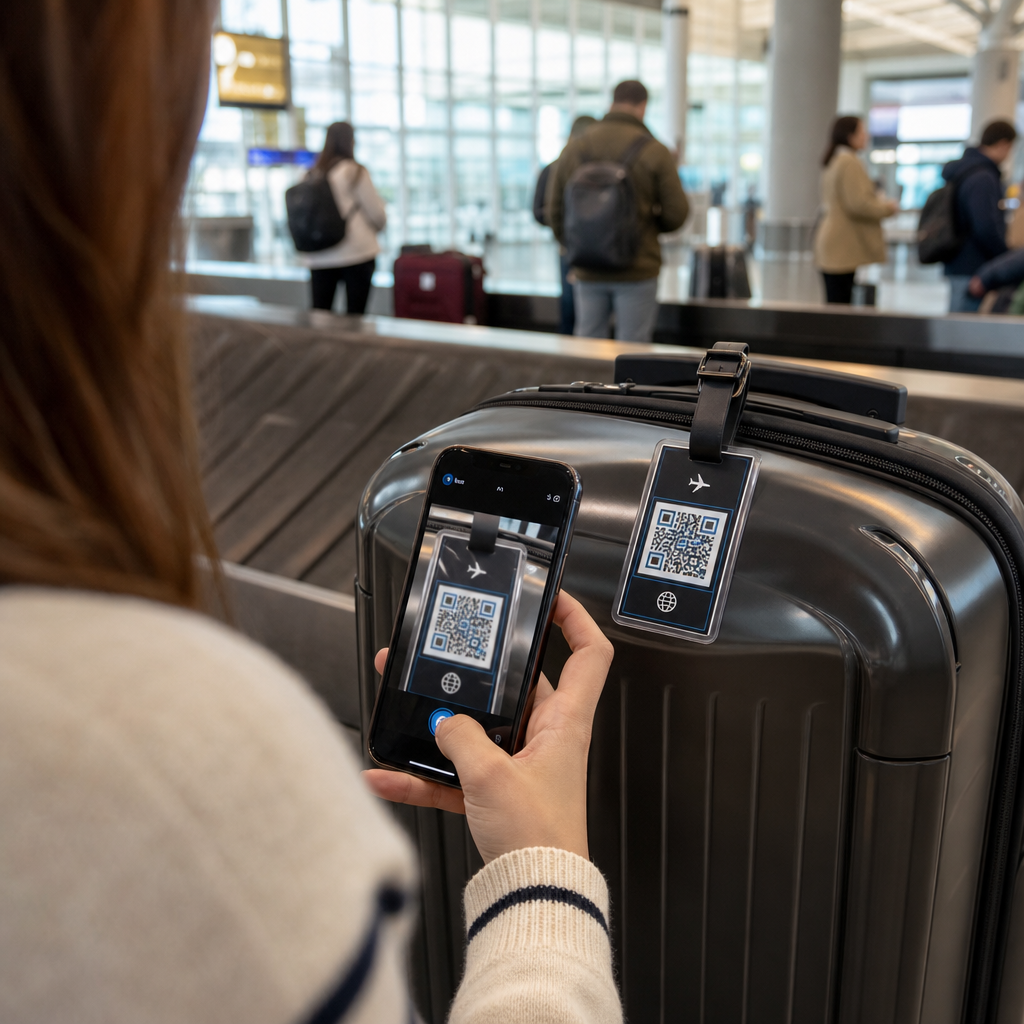
Ever wondered what happens to your bag if it gets separated from you at the airport? With a standard paper tag, a stranger has to read your personal details out loud just to return it. A QR code on your luggage tag changes that equation entirely, letting anyone with a smartphone contact you without exposing your private information to every passerby in the terminal.
Why Standard Luggage Tags Fall Short
U.S. reporting carriers posted a mishandled baggage rate of 0.55% in 2024, which sounds small until you consider the sheer volume of checked bags handled every day. Lost, delayed, or damaged bags are a routine travel headache, and the first line of defense is a legible, useful luggage tag.
The problem with traditional tags is the privacy tradeoff. Travel experts consistently advise against listing your home address on an external tag, since it signals to anyone watching that your house is empty. They also warn against including sensitive identifiers like passport numbers or driver’s license numbers. Yet the tag still needs enough detail that a finder or airline agent can actually reach you.
Most travelers end up with an uncomfortable compromise: too much information exposed, or not enough to be useful.
How a QR Code Solves the Problem
A QR code on a luggage tag works as a privacy layer between your contact details and the public. Instead of printing your phone number and email in large text for anyone to read while your bag rides a carousel, you encode that information into a scannable pattern. A finder scans the code, lands on a contact page or pre-filled message, and reaches you – without ever seeing your raw personal data displayed in the open.
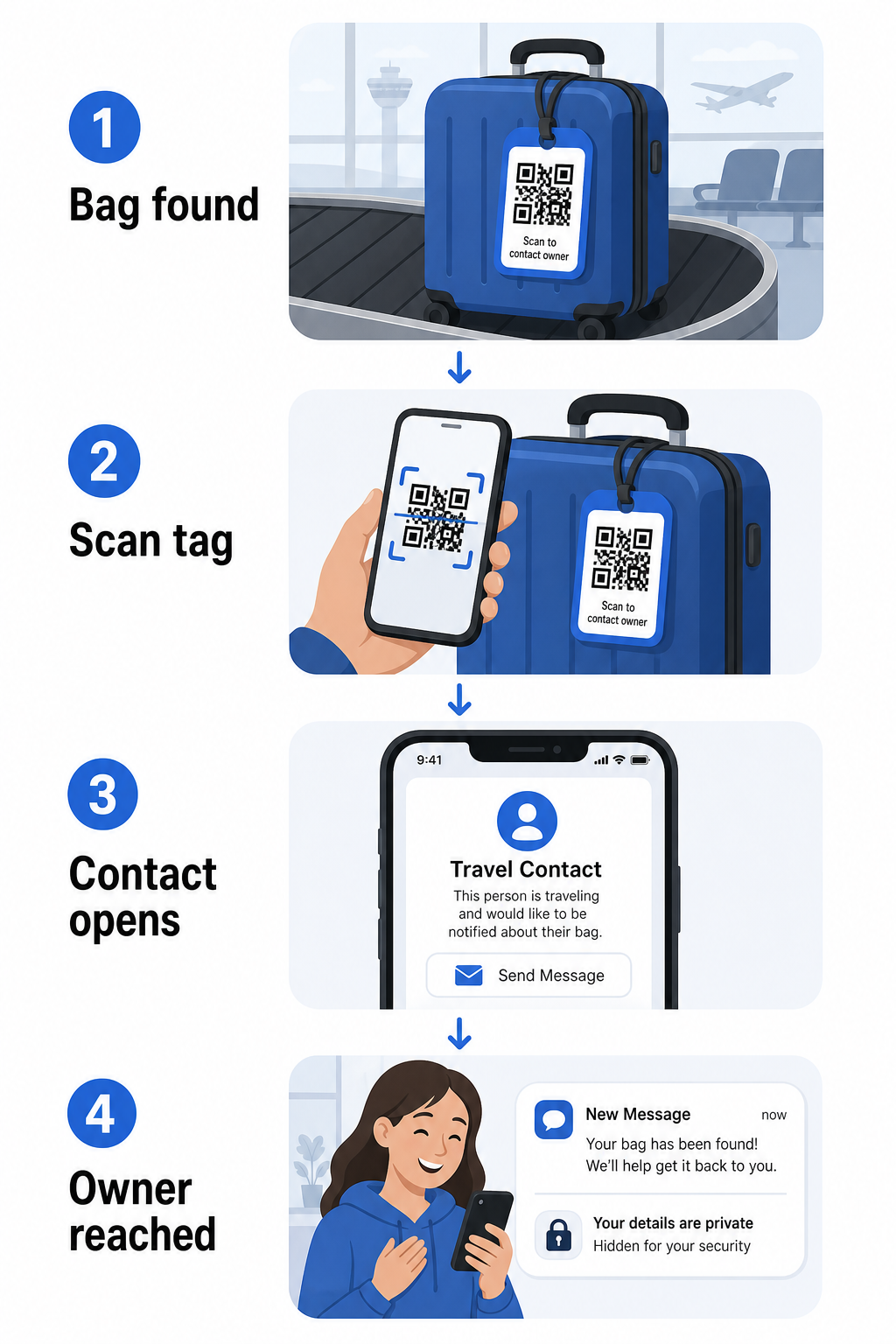
There are a few formats worth considering, depending on how much information you want to share:
- vCard QR-kode: Encodes your name, phone number, and email in vCard format. When scanned, the finder’s phone prompts them to save your contact details directly to their address book using the vCard QR-kodegenerator. No typing required, and no visible personal data on the tag itself.
- E-post QR-kode: Opens a pre-filled email addressed to you when scanned. The finder simply hits send. You can set this up with the e-post QR-kodegenerator and keep your actual address hidden from plain sight.
- Koble til QR-kode: Directs the finder to a webpage you control – a simple contact form or a page with your travel details. Use the lenke QR-kodegenerator to point the code at any URL you choose.
Each approach keeps your contact details functional for recovery purposes while reducing what any random observer can read off your tag in a busy terminal.
Create a Privacy-Friendly Luggage Tag QR Code Ready to set up a QR code that protects your details while keeping your bag findable? Use the QR-kodegenerator to get started – free, with no technical knowledge required.
What Information to Include (and What to Leave Out)
Travel experts recommend keeping luggage tag information minimal but effective. The practical consensus is:
- Inkludere: Your full name, a mobile phone number with country code if traveling internationally, and an email address
- Skip: Your home address (use a work address or PO box if an address feels necessary), passport numbers, government ID numbers, and home landline numbers
- Consider: A travel-specific email address rather than your primary personal account, so that any unwanted contact stays contained
A QR code approach makes this guidance easier to follow. You encode only what is necessary, and you control the contact method the finder uses – whether that’s an email form, a vCard save, or a contact page.
Multiple travel sources also recommend placing backup contact information inside your bag, so the bag can still be identified if the external tag is lost or damaged. A QR code tag combined with an internal paper card gives you the best coverage on both fronts.
Why a Dynamic QR Code Is Worth Using
EN dynamisk QR-kode has one significant advantage over a static one for luggage tag use: you can update the destination without reprinting the tag.
Dynamic QR codes work through a permanent short redirect URL. The QR code itself never changes, but the page it points to can be updated anytime from your dashboard. This means if your phone number changes, you get a new email address, or you want to swap a vCard for a contact form, you update the destination – and every scan of the same physical tag reaches the new information.
For a luggage tag you use year after year, this flexibility is practical. You print the tag once and maintain control of the contact details it surfaces indefinitely.
Dynamic codes also let you monitor scan activity. If your bag goes missing and someone scans your tag, you can see that a scan occurred, when, and in what location – useful context when coordinating with an airline. To understand the broader role QR codes play in air travel, the airlines and airports overview covers how carriers are using them across the passenger journey, including baggage tracking.
Keep Your Tag Current Without Reprinting Bruke Dynamisk QR-kodegenerator to create a luggage tag QR code you can update anytime – change your contact details or destination URL without touching the physical tag.
Printing Your QR Code Tag: Size and Format
A QR code that can’t be scanned defeats the purpose. A few practical guidelines apply when printing for a luggage tag:
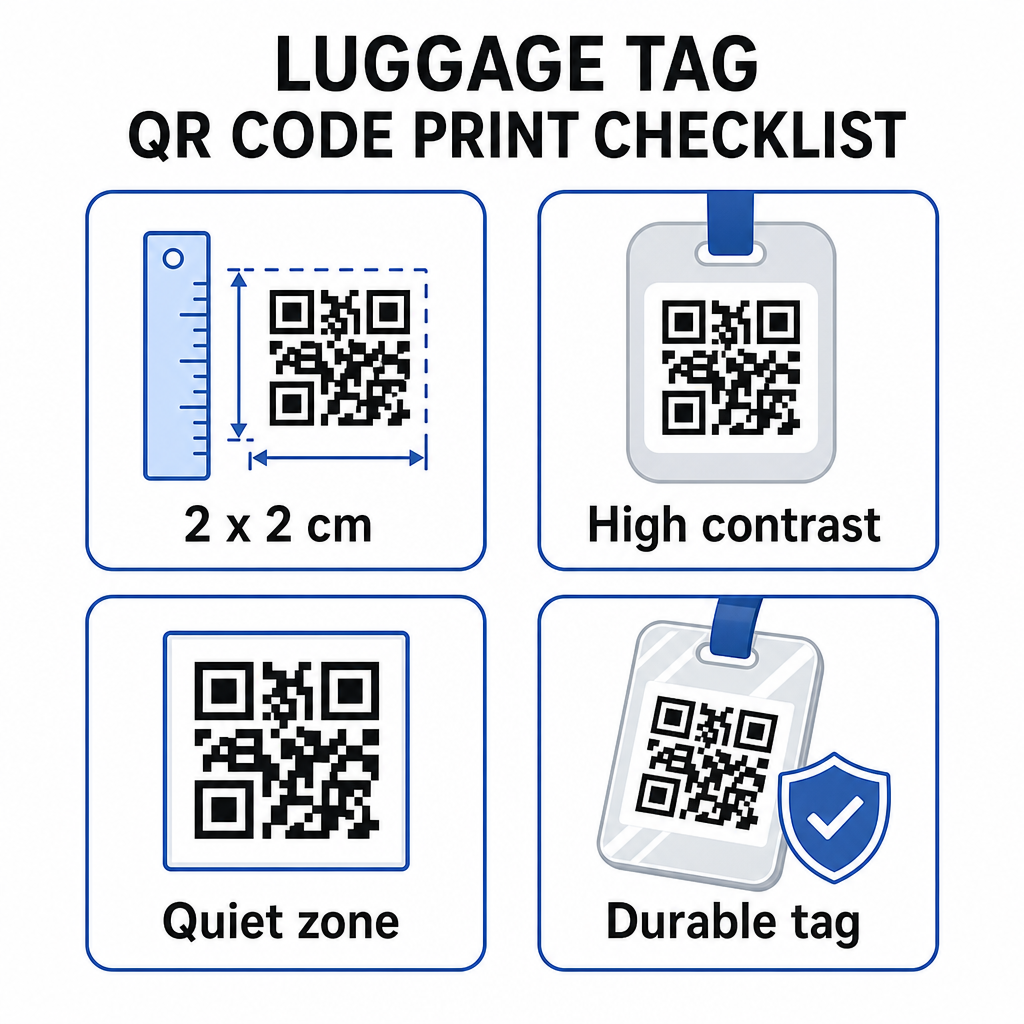
- Minimum size: Aim for at least 2 × 2 cm (roughly 0.8 × 0.8 inches). Smaller than this and scanning reliability drops, especially in poor lighting. See the størrelsesguide for QR-koder for trykt materiale for surface-specific recommendations.
- File format: PNG works well for small print sizes. For a laminated or professionally printed tag, SVG or PDF exports give sharper edges at any size.
- Kontrast: Use a dark pattern on a light background. Low contrast is one of the most common reasons QR codes fail to scan.
- Quiet zone: Leave a clear border around the code – at least four modules wide on all sides – so a scanner can distinguish the code from surrounding graphics or text.
- Error correction: Higher error correction levels allow the code to remain scannable even if part of it is scratched or worn, which matters for a tag that sees heavy use across multiple trips.
For step-by-step guidance on preparing a QR code for physical labels, the guide to printing QR codes on labels covers the process in detail.
Keeping Your Personal Data Private
Placing any contact information on a public-facing tag involves some privacy consideration. A few practices reduce that risk when using QR codes:
- Use a contact form or vCard rather than encoding a raw phone number as plain text, so the information isn’t immediately visible to anyone who inspects the code’s content
- Choose a travel-specific email address for the tag so your primary account stays separate from any luggage-related contact
- If using a dynamic code, you can deactivate or redirect the link if you want to retire a tag or change how finders reach you
- Encode only what is necessary for bag recovery – your name and one contact method is sufficient
For a deeper look at managing privacy when using QR codes, the QR code privacy risks guide og sikker QR-kodegenerering beste praksis cover the key considerations. For broader context on how QR codes are reshaping the travel experience overall, how QR codes improve travel experiences is a useful reference.
A QR code luggage tag is a straightforward upgrade over a printed tag: it keeps your contact information functional for anyone who needs to return your bag while shielding those details from casual observation. Use a dynamic code so you can keep the tag current across multiple trips, size it correctly for reliable scanning, and encode only the contact method you want finders to use.
Build Your Luggage Tag QR Code Today Set up a vCard, email, or link QR code for your luggage in minutes. Start with the Pageloot QR-kodegenerator – free trial, no credit card required.
Ofte stilte spørsmål
A vCard QR code is a practical choice because it lets the finder save your contact details directly to their phone with one tap. If you prefer more control over what information is shared, a link QR code pointing to a simple contact form works well too. Dynamic versions of either allow you to update the destination without reprinting the tag.
A well-configured QR code on a luggage tag shares only what you choose to encode – typically a name, phone number, or email address. Avoid encoding sensitive identifiers like passport or ID numbers. Using a contact form page rather than raw personal data adds another layer of separation, and following QR code privacy best practices ensures your setup limits unnecessary exposure.
Not if you use a dynamic QR code. Dynamic codes point to a redirect URL that you can update anytime from your Pageloot dashboard. The physical tag stays the same, but the contact information it surfaces can be changed whenever you need – making it a practical long-term solution for frequent travelers.