> 사용 사례 > How to Use QR Codes on Displays & Screens
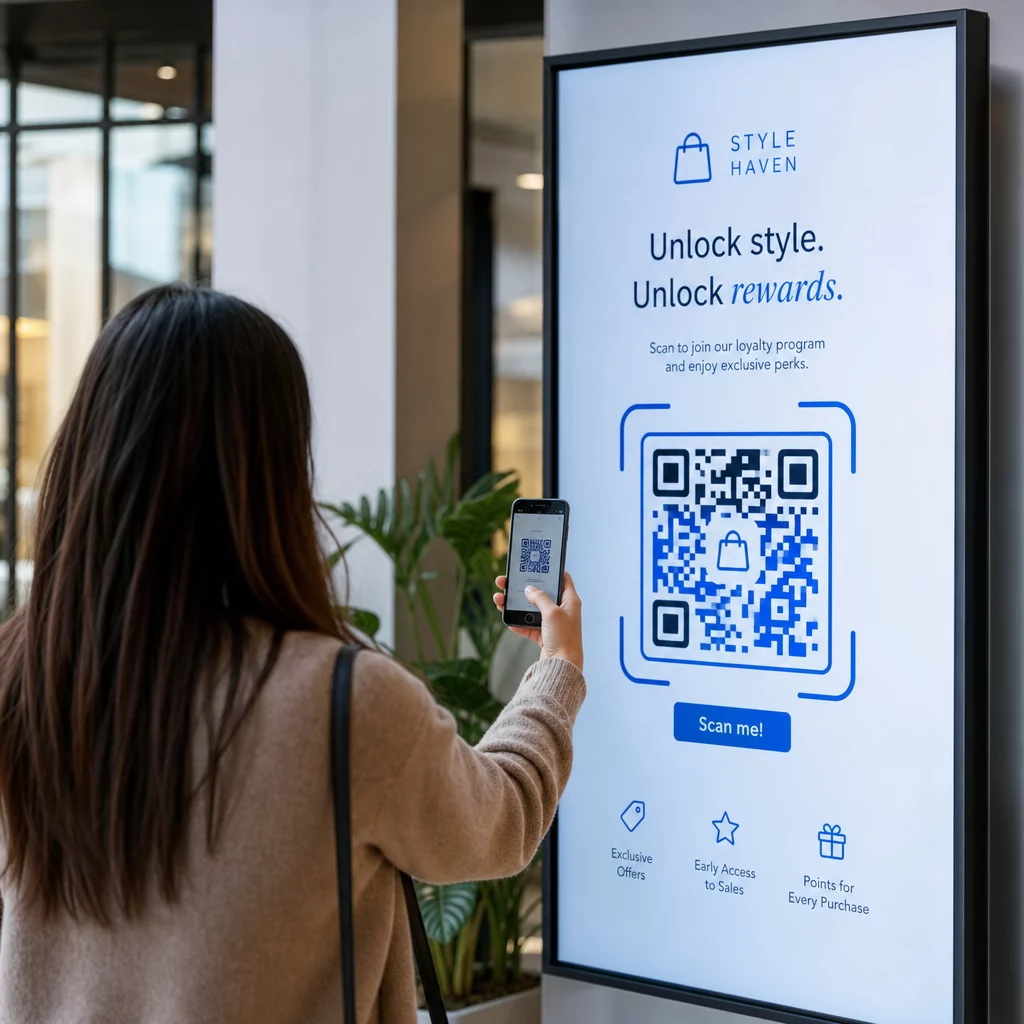
Scanning display QR code

How to Use QR Codes on Displays & Screens

Turn digital displays into interactive tools with QR codes. Learn the 10:1 sizing rule, placement strategies, and how to use dynamic codes to track engagement.
Updated on 6월 10, 2026
목차

Are your digital displays generating engagement, or just generating impressions? A QR code turns a passive screen into an interactive touchpoint – but only if it’s designed and placed correctly. This guide covers everything you need to know to make QR codes on screens actually work.

Why QR Codes Make Digital Displays More Effective

Digital signage and screens are already good at grabbing attention. What they struggle with is converting that attention into action. A viewer reads your message, feels interested, and then… moves on. There’s no mechanism to bridge the moment of interest with the next step.

A QR code closes that gap. When someone scans a code on your display, they’ve voluntarily chosen to engage further – they’ve signaled intent. That single scan can connect them to a product page, a promotional offer, a sign-up form, or a video, all from the screen they were already looking at.

This is especially useful in situations where your audience doesn’t have a pen handy or won’t remember to search later: trade shows, retail floors, transportation hubs, and public venues. The code does the work even when you’re not present.

Where QR Codes on Displays Work Best

Not every screen environment is equally suited to QR codes. The best placements share a common trait: the viewer has a natural moment to pause, take out their phone, and scan.

  • Display windows and storefronts give window shoppers access to product details, reviews, pricing, or online purchase options even when the store is closed
  • Trade show and exhibition displays are ideal for converting floor traffic into leads – codes can link to digital brochures, contest entries, social media follows, or exclusive show offers
  • In-store LED screens and kiosks reach high foot-traffic audiences and can drive impulse actions like scanning for a discount or viewing a new product launch
  • Point-of-sale and checkout displays are prime real estate for loyalty sign-ups, digital receipts, or next-purchase promotions
  • Transit and vehicle signage extends your reach to commuters and passersby – a QR code on a branded delivery van, for example, works entirely on its own once deployed

For a deeper look at how in-store placement strategy affects engagement, see 소매점을 위한 최고의 QR 코드 배치 and the comparison of QR codes on packaging versus store displays.

Getting the Size Right for Digital Screens

Size is the most common mistake with QR codes on screens. A code that looks large in a design file can become nearly unscannable when displayed on a monitor across a room.

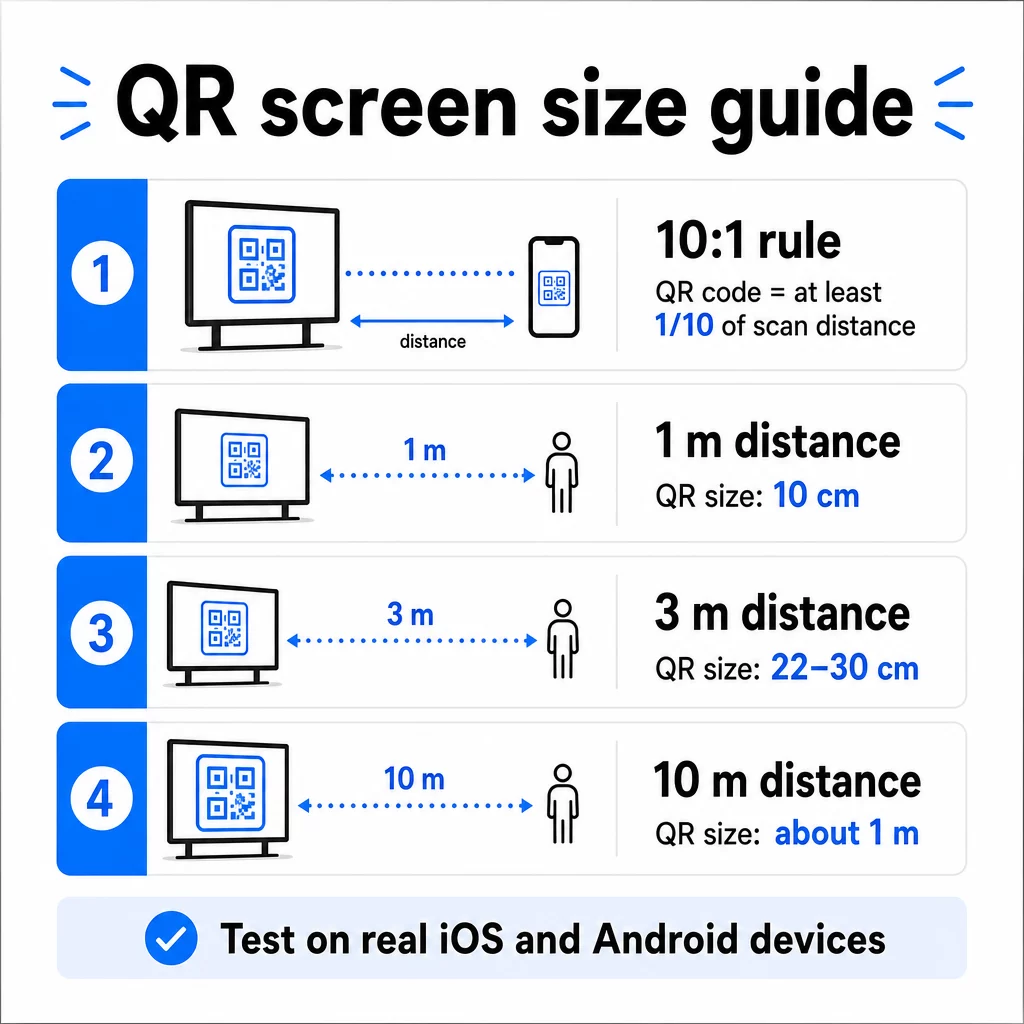
The standard guideline is the 10:1 rule: your QR code should be at least one-tenth of the intended scanning distance. If viewers will be standing 1 meter from the screen, the code needs to be at least 10 cm wide. From 3 meters, aim for 22–30 cm. From 10 meters, you’re looking at a code that needs to be roughly 1 meter on a side.

QR 코드 크기 가이드

For reference on 1080p displays, a minimum of 240 pixels at 72 dpi is a starting baseline for close-range scanning, but that minimum must increase significantly as viewing distance grows. For general digital signage, no QR code should be smaller than roughly 2 × 2 inches – and bigger is always safer when people are scanning from a distance.

Always validate size in real-world conditions. Test the code at the actual display size, from the intended scanning distance, on both iOS and Android devices, before finalizing your design. Consult the full guidance on QR code sizing for different materials and contexts when scaling across formats.

Contrast and Color: What Makes a Code Scannable

A smartphone camera reads a QR code by detecting the contrast between dark modules and a light background. If that contrast is weak, the camera struggles to distinguish the pattern – and the scan fails.

The reliable standard is 밝은 배경에 어두운 전경, with black on white being the most dependable combination. When using brand colors, keep the QR pattern in a dark color and the background light. Avoid reversed color schemes (white code on a black background), as many QR code readers cannot reliably process them.

For screens specifically, contrast becomes more complicated because ambient lighting, screen glare, and refresh rates all affect what the camera sees. Aim for a contrast ratio of at least 4.5:1 between your code and its background – this threshold also supports accessibility for users with low vision. Avoid gradients and shadows within the code area, as these create mid-tones that confuse scanners.

For a full breakdown of color pairings and their scannability outcomes, see the guide on QR 코드 색상 대비 모범 사례.

The Quiet Zone: The Space That Makes Scanning Possible

The quiet zone is the empty border surrounding a QR code on all four sides. It’s not decorative – it’s functional. Scanners use this blank space to identify where the code begins and ends, separating it from other visual elements like text, images, or background patterns.

The minimum quiet zone is 4모듈 너비여야 한다고 명시합니다. on every side, where a module is the width of the smallest square in the code. If you’re scaling the code, the quiet zone must scale proportionally. Cropping or trimming the border – even slightly – can cause consistent scan failures.

On digital displays, where designers are often working against crowded layouts and tight screen real estate, the quiet zone is frequently the first thing to get squeezed. Don’t let it. Keep the quiet zone clear of logos, text, and any design elements, and make sure it matches the background color so it visually separates the code from its surroundings.

More on quiet zone requirements and QR 코드 가독성 모범 사례 is available if you’re optimizing an existing design.

Placement and Layout on the Screen

Where the code sits within the display layout affects both visibility and scan rate. A few principles apply consistently:

  • Place at eye level. Positioning the code at roughly 3.5 to 4.5 feet from the floor keeps it accessible for both standing adults and users in wheelchairs – no crouching or stretching required
  • Put the code in the natural reading flow. Center-screen or bottom-center placements tend to perform well; avoid burying the code in a corner where it competes with other elements
  • Use one code per display when possible. Multiple codes confuse viewers about which to scan and can cause camera apps to focus on the wrong one
  • Keep the surrounding design clean. Too much competing content on screen reduces scan rates; give the code visual breathing room

For digital signage that rotates content, display the QR code for the full duration of its time slot. Viewers need enough time to notice the code, decide to scan, and complete the scan before the slide changes. For more context on placement strategies across environments, the 마케팅에서 QR 코드 배치에 대한 궁극적인 가이드 covers layout decisions across print and digital formats.

Writing a Call to Action That Drives Scans

A QR code without context gets ignored. Viewers need to know – before they reach for their phone – what they’ll get by scanning.

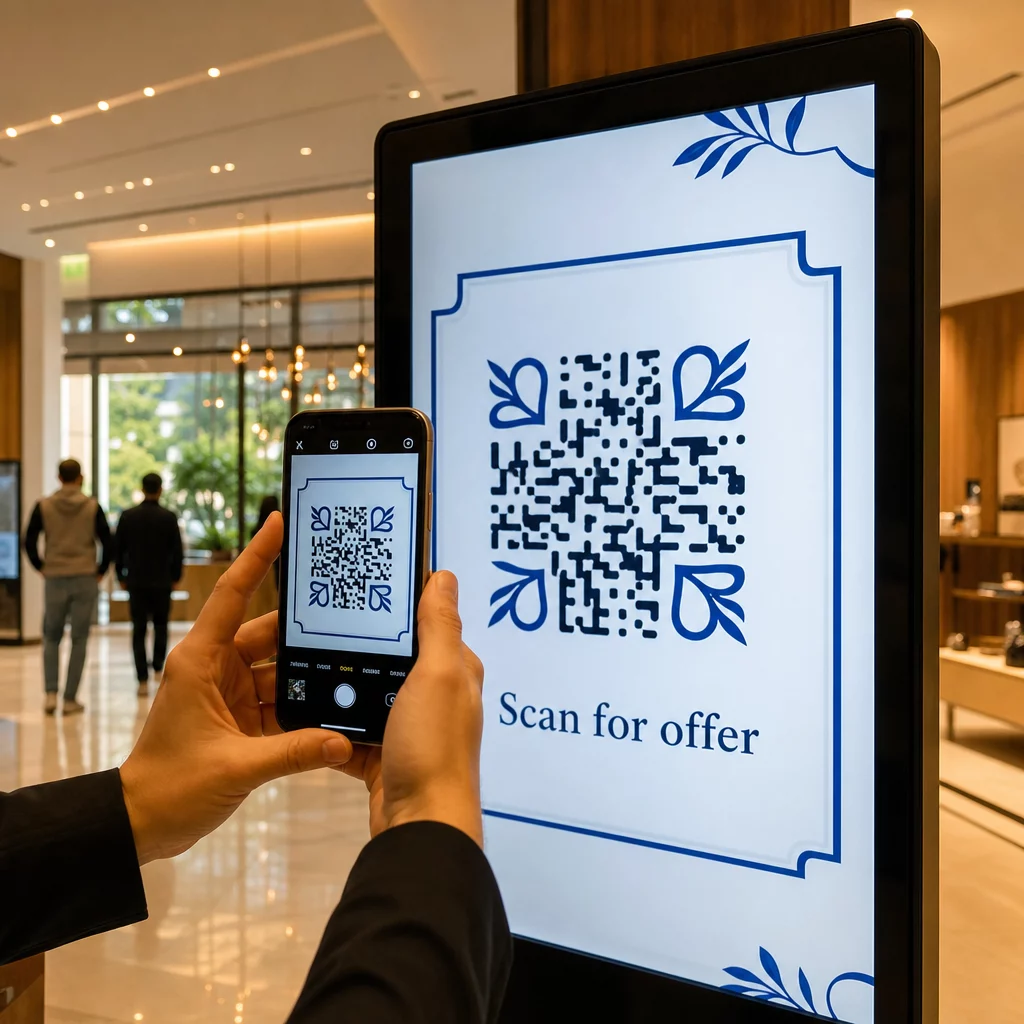
Place a short, specific call to action directly adjacent to the code. “Scan for today’s menu,” “Scan to enter the giveaway,” or “Scan for 20% off your next order” all work better than generic prompts like “Scan here.” The more concrete the benefit, the higher the scan rate.

Keep the text brief – two to five words is enough. Larger fonts and high contrast for the CTA text apply the same principles as the code itself: it needs to be readable from the viewer’s likely distance. See additional guidance on QR 코드 사용성 모범 사례 for more on effective framing.

Where the Scan Should Lead

Every scan that doesn’t immediately deliver value is a lost opportunity. Since viewers will arrive via smartphone, the destination needs to be a 모바일 최적화된 랜딩 페이지로 that loads quickly and delivers on the specific promise of the call to action.

Avoid sending users to your homepage or a generic product catalog. If the code is on a checkout display promoting a loyalty program, the landing page should be the loyalty sign-up form – nothing more. If it’s on a trade show display, the destination might be a lead capture form or a downloadable spec sheet.

Google Forms QR 코드 is a practical option for feedback collection, event registration, or surveys directly from a display. A QR 코드 링크 works for any URL-based destination and supports full customization and tracking.

Keep Your Display QR Codes Flexible Need to update what a code links to without changing the code itself? Use the QR 코드 생성기 to create dynamic codes that let you edit the destination anytime – no reprinting or redesigning required.

Using Dynamic QR Codes for Screens

Static QR codes encode a fixed URL or piece of data that can never change. For displays – especially digital signage that rotates campaigns or promotes time-sensitive offers – this creates a problem. If the linked content changes, you need to recreate and redeploy the code.

동적 QR 코드 solve this by encoding a short redirect URL. The actual destination can be updated at any time through your account dashboard, while the code itself stays the same. This means you can:

  • Update a promotional offer without redesigning the screen layout
  • Redirect a single code to different campaigns by season or event
  • Fix a broken link instantly without any display changes

Dynamic codes also unlock scan analytics – data on how many times a code was scanned, from which location, on which device, and at what time. This data helps you determine which display placements are generating real engagement versus which ones are being overlooked.

For screens with rotating content, dynamic codes are particularly valuable because the same visual asset can serve different campaigns over time.

Track Every Scan from Every Screen Want to know which displays are actually driving engagement? Use Pageloot’s dynamic QR code platform to monitor scan rates, locations, and device data in real time – and refine your display strategy based on what the data shows.

Testing Before You Go Live

Even a well-designed QR code can fail in practice due to display brightness, viewing angle, screen refresh rate, or ambient lighting. Before any display goes live:

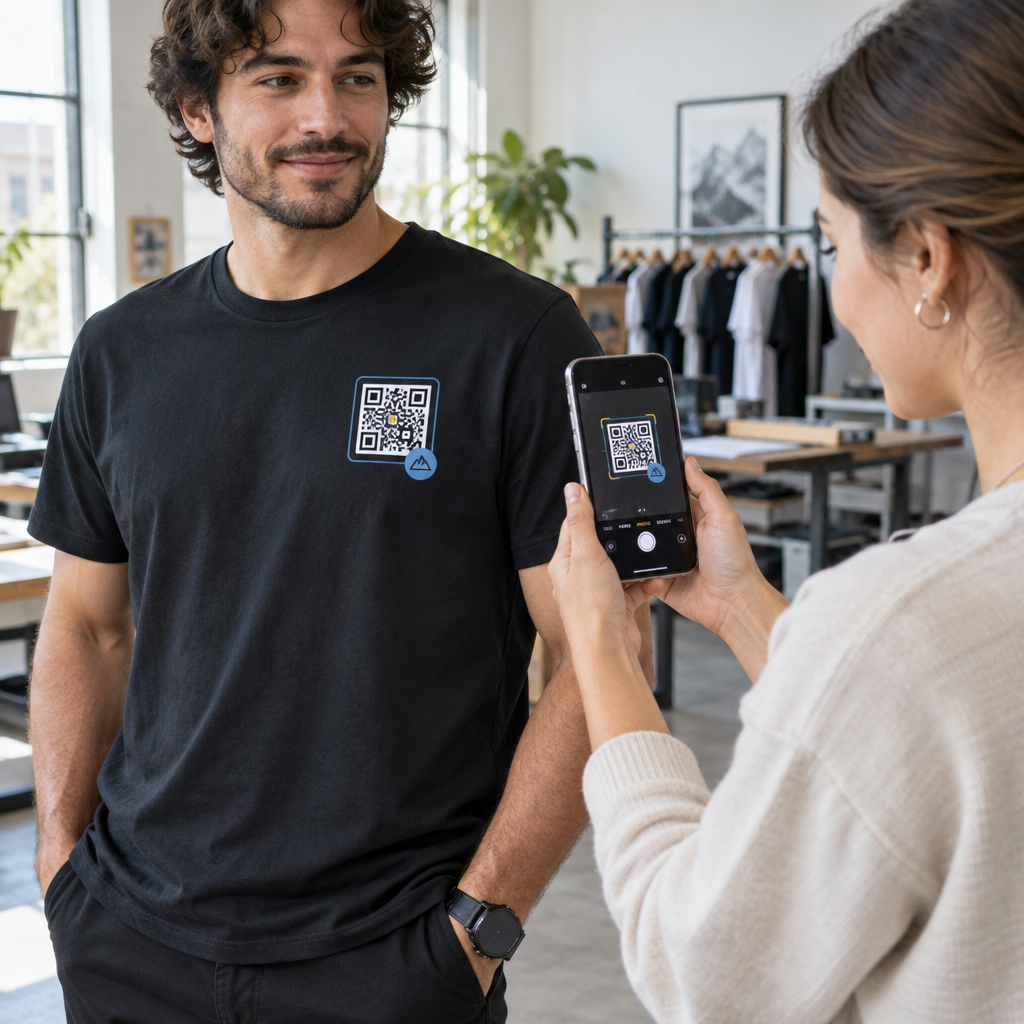
Testing display QR code
  • Test the code at the actual screen size and resolution it will be shown at
  • Scan from the intended minimum and maximum distances
  • Test on multiple devices – at minimum one iOS and one Android phone
  • Test at different times of day if the display is near natural light sources that shift throughout the day
  • Verify that the destination page loads correctly on mobile and delivers the expected experience

그만큼 QR 코드 스캐너 도구 can be used to verify a code’s content and confirm it resolves correctly before deployment.

Explore the Pageloot features overviewindustry solutions for more on how QR codes can be applied across different display contexts and business sectors. A well-placed, correctly sized QR code with a clear call to action can turn any screen into a conversion point. Get the contrast, quiet zone, size, and destination right – then use dynamic codes and analytics to keep improving. Start with the QR 코드 생성기 to create your first scannable display code today.

자주 묻는 질문

How large does a QR code need to be on a digital display?

Use the 10:1 rule: the code should be at least one-tenth of the expected scanning distance. For a display scanned from 1 meter, the code should be at least 10 cm wide. For general digital signage, a minimum of 2 × 2 inches is a reasonable starting point, with size increasing as viewing distance grows. Always test at the actual display size and distance before going live.

Can I change what a QR code on a screen links to without updating the design?

Yes, if you use a dynamic QR code. Dynamic codes use a redirect URL, so you can update the destination in your account dashboard at any time – the code itself stays the same. This is especially useful for digital signage that promotes rotating campaigns or time-sensitive offers, since you avoid redesigning or redeploying the display every time the linked content changes.

Why is my QR code on a screen not scanning reliably?

The most common causes are insufficient contrast between the code and its background, a quiet zone that has been cropped or crowded by surrounding design elements, and a code that is too small for the viewing distance. On screens, display brightness and glare can also interfere. Check that your code uses a dark pattern on a light background, maintains a clear four-module quiet zone on all sides, and meets the size requirements for your expected scanning distance. Test on multiple devices to confirm compatibility.

작성자 정보

시임 코스타비는 페이지루트의 콘텐츠 책임자입니다. 그는 페이지루트의 혁신적인 QR 코드 생성 서비스에 대한 글을 쓰고 있습니다. 5년 이상 QR 코드 분야에서 쌓아온 깊이 있는 전문 지식을 바탕으로, 시임은 이 분야의 전문가로 인정받고 있습니다. 그는 QR 기술을 활용하여 디지털 상호작용을 간소화하고 향상시키는 데 크게 기여하고 있습니다.

범주
에 대해 자세히 알아보기
웹사이트 QR 코드 스캔
QR 코드 사용 웹 사이트
QR 티켓 이벤트 입장
QR 코드 사용 티켓 및 페스티벌 패스
Scanning display QR code
QR 코드 사용 디스플레이 및 화면

온라인으로 QR 코드를 생성해야하는 경우 QR 코드 만들기 무료로 여기!
Pageloot는 #1 Go-To 솔루션 QR 코드를 만들고 스캔합니다.

QO-08

블로그 세대

20,000개 이상의 브랜드로부터 신뢰를 받아 더 많은 매출, 리뷰, 팔로워를 확보했습니다.

클라이언트 로고
최고 브랜드의 신뢰
5 중 4.8 평가

4.86 / 5 별점

휴고 로랑
휴고 로랑
레스토랑 주인
가장 쉽고 안정적인 QR 코드 생성기. PDF 파일을 즉시 업로드할 수 있습니다. 이제 레스토랑 메뉴가 디지털화되었습니다.
루카스 얀센
루카스 얀센
부동산 개발사
이것은 훌륭한 도구이며 QR 코드를 사용하면 원하는 곳으로 이동할 수 있습니다. 우리는 위치 QR 코드만 사용하지만 유용한 기능이 너무 많습니다.
엠마 모레티
엠마 모레티
소매 제품
사용하기 쉽고 빠릅니다. 그것은 훌륭하게 작동하고 완벽한 이미지를 생성하므로 직원들이 내 vCard를 다운로드할 수 있습니다.
휴고 로랑
휴고 로랑
레스토랑 주인
가장 쉽고 안정적인 QR 코드 생성기. PDF 파일을 즉시 업로드할 수 있습니다. 이제 레스토랑 메뉴가 디지털화되었습니다.
루카스 얀센
루카스 얀센
부동산 개발사
이것은 훌륭한 도구이며 QR 코드를 사용하면 원하는 곳으로 이동할 수 있습니다. 우리는 위치 QR 코드만 사용하지만 유용한 기능이 너무 많습니다.
엠마 모레티
엠마 모레티
소매 제품
사용하기 쉽고 빠릅니다. 그것은 훌륭하게 작동하고 완벽한 이미지를 생성하므로 직원들이 내 vCard를 다운로드할 수 있습니다.
더 많은 QR 코드보기
음악 QR 포스터 스캔하기
QR 코드 Apple 음악
무엇이든 디지털 경험으로 전환하세요 3분 이내에.

14일 무료 체험.

신용카드는 필요 없습니다.

첫 구매 시 30% 할인

코드를 사용하세요:

MP3 파일 공유

PDF QR 코드를 생성하려면 가입하세요

필요한 모든 것을 업로드하고 표시합니다.

  • 오디오 파일
  • 팟캐스트
  • 음악

가입 시 14일 무료 체험.
체험 기간 후 QR 코드 만료.

오디오 mp3 QR 코드를 생성하려면 가입하세요

프레임으로 더 많은 스캔 확보

QR 코드에 더 많은 프레임을 추가하려면 가입하세요

클릭 유도 문안 프레임은 고객이 QR 코드와 쉽게 상호 작용할 수 있도록 도와줍니다. 사용해 보세요!

가입 시 14일 무료 체험.
체험 기간 후 QR 코드 만료.

QR 코드에 더 많은 프레임을 추가하려면 가입하세요

도형으로 더 많은 스타일 추가

더 많은 도형을 만들려면 가입하세요

QR 코드는 정사각형일 필요가 없습니다. 브랜드 이미지에 맞게 전환해 보세요.

가입 시 14일 무료 체험.
체험 기간 후 QR 코드 만료.

더 많은 도형을 만들려면 가입하세요

QR 코드에 로고 추가

QR 코드에 로고를 추가하려면 가입하세요

로고와 브랜드를 추가하여 QR 코드를 돋보이게 만드세요.

가입 시 14일 무료 체험.
체험 기간 후 QR 코드 만료.

QR 코드에 로고를 추가하려면 가입하세요

스마트 앱 스토어 리디렉션

앱 스토어 QR 코드를 생성하려면 가입하세요

스마트 앱 스토어 QR 코드에 앱 링크를 추가하세요. 사용자는 장치에 따라 리디렉션됩니다.

가입 시 14일 무료 체험.
체험 기간 후 QR 코드 만료.

앱 스토어 QR 코드를 생성하려면 가입하세요

QR 코드에 이미지 업로드

이미지 QR 코드를 생성하려면 가입하세요

이미지를 쉽게 공유하세요. 몇 초 안에 동적으로 이미지를 변경하십시오.

가입 시 14일 무료 체험.
체험 기간 후 QR 코드 만료.

이미지 QR 코드를 생성하려면 가입하세요

PDF 파일 공유

PDF QR 코드를 생성하려면 가입하세요

필요한 모든 것을 업로드하고 표시합니다.

  • 메뉴 및 가격표
  • 명령
  • 모든 문서

가입 시 14일 무료 체험.
체험 기간 후 QR 코드 만료.

PDF QR 코드를 생성하려면 가입하세요

인쇄 없이 나중에 편집

다시 인쇄하지 않고 QR 코드를 편집하려면 가입하세요

동적 QR 코드를 사용하면 새 QR 코드를 인쇄하지 않고도 QR 코드의 내용을 변경할 수 있습니다.

가입 시 14일 무료 체험.
체험 기간 후 QR 코드 만료.

다시 인쇄하지 않고 QR 코드를 편집하려면 가입하세요

언제? 어디서? QR 코드 스캔 추적

QR 코드를 추적하려면 가입하세요

어떤 QR 코드가 가장 많이 스캔되고 무엇이 고객을 가장 흥분시키는지 알아보십시오.

가입 시 14일 무료 체험.
체험 기간 후 QR 코드 만료.

QR 코드를 추적하려면 가입하세요

인쇄 준비 파일 제공

PDF 및 SVG와 같은 벡터 QR 코드를 생성하려면 가입하세요.

.EPS, .PDF, .SVG

HD 해상도로 QR 코드를 다운로드하고 싶으신가요? 인쇄할 준비가 된 벡터 또는 픽셀 형식을 가져옵니다.

가입 시 14일 무료 체험.
체험 기간 후 QR 코드 만료.

PDF 및 SVG와 같은 벡터 QR 코드를 생성하려면 가입하세요.

기다리세요. 귀하의 QR 코드는 로드 중... 로드 중...

나만의 것으로 만들기

나중을 위해 QR 코드를 저장하려면 가입하세요.

다양한 색상, 로고 및 클릭 유도문안 프레임으로 멋진 QR 코드를 만들어 더 많은 스캔을 받으세요.

가입 시 14일 무료 체험.
체험 기간 후 QR 코드 만료.

나중을 위해 QR 코드를 저장하려면 가입하세요.