首页 > 博客 > QR Codes for Public Art: How to Connect Viewers to Digital Content
Scanning public art

QR Codes for Public Art: How to Connect Viewers to Digital Content

Connect viewers to murals and public art with QR codes for audio guides, artist bios, and AR. Learn best practices for design, placement, and tracking.
Updated on 6 月 10, 2026
目录

How do you give viewers more than what fits on a placard – without cluttering the artwork itself? Static labels can’t carry artist interviews, oral histories, or augmented reality experiences, and that gap leaves audiences disconnected from the full story behind the work. This guide covers practical strategies for integrating QR codes into public art and murals, from design and placement to content types and analytics.

Why QR Codes Work in Public Art Settings

A QR code placed next to – or woven into – a mural acts as a bridge between the physical piece and a wealth of digital content. Viewers with smartphones can scan instantly, without downloading a separate app, and be taken to audio guides, video interviews, donation pages, or interactive AR experiences.

Several public art programs have demonstrated the model:

  • In Raleigh, North Carolina, the Q-Art Code Project placed QR smart codes with public artworks throughout the city so community members could instantly access information about each piece and its creator.
  • In Miami’s Wynwood neighborhood, artist Ruben Ubiera embedded a QR code directly into a mural depicting eight immigrants, linking each face to a recorded oral history – including accounts of family separation and deportation.
  • In downtown Syracuse, the S.Alt City mural is built entirely from QR code tiles, with each tile linking to a different contemporary arts organization in the region, effectively turning the wall into a scannable directory.
  • In Punta Gorda, Florida, a local mural society mounted QR code signs on historic mural walls so visitors can self-guide through the collection off-season, accessing brief history lessons from their phones.

These projects share a common principle: the QR code does not replace the art – it extends it.

Connect Your Public Art to Digital Content 使用 链接二维码生成器 to create a scannable code that points viewers to artist bios, audio guides, video interviews, or any web destination you choose.

The value of a scan depends entirely on what it delivers. Choosing the right content format for the context makes the difference between a curious tap and a meaningful interaction.

Public art QR content

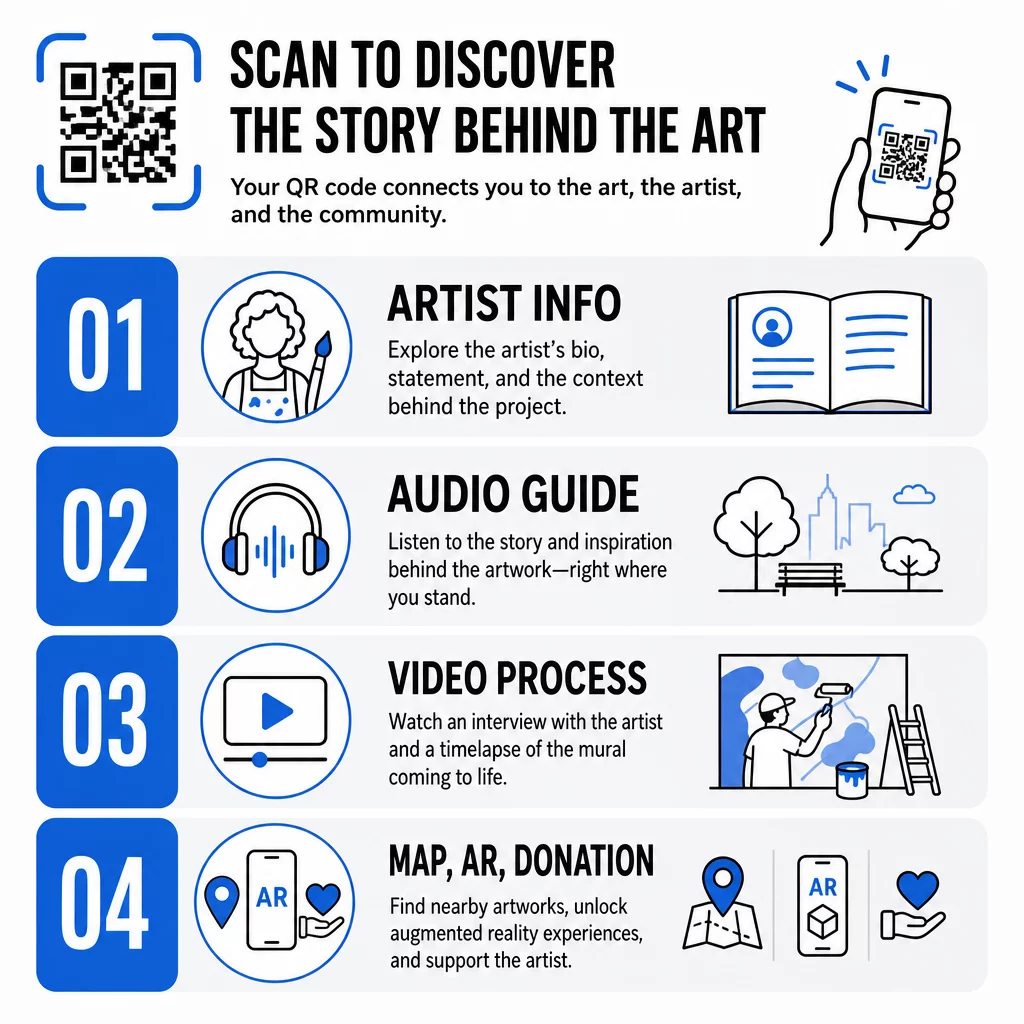
Artist information and context

Link to a short biography, a statement about the work, or a timeline showing the project’s development. This is especially valuable for temporary installations where wall space is limited.

Audio guides

Spoken narration works well outdoors, where visitors may be moving or in noisy environments. You can host audio files directly using an MP3 QR code that plays back on any smartphone.

Video interviews and process documentation

Linking to an artist interview or a time-lapse of the mural being painted gives viewers a behind-the-scenes perspective that deepens appreciation of the finished work.

PDF guides and tour maps

For installations that are part of a larger trail or district, a PDF QR 码 can deliver a downloadable walking tour map or printed guide equivalent – without printing costs.

Location and wayfinding

For multi-site public art collections, a 谷歌地图二维码 lets visitors navigate from one piece to the next without having to search manually.

Augmented reality experiences

AR-linked QR codes allow viewers to unlock animations, 3D overlays, or evolving narratives layered on top of the physical work. Museums like the Smithsonian and interactive venues such as Meow Wolf’s Convergence Station in Denver have used this approach to turn static displays into participatory experiences. For a deeper look at how AR changes storytelling in art spaces, see how AR QR codes transform museum storytelling.

Donation and support links

French street artist Pascal “PBOY” Boyart embedded Bitcoin QR codes into his murals, allowing viewers to send cryptocurrency donations by scanning. The codes were designed as integral elements of the artwork, not afterthoughts, and resulted in direct community support for his practice.

Designing QR Codes That Belong in the Art

A QR code that clashes visually with the surrounding work breaks the viewer’s immersion. Thoughtful design keeps the code functional while respecting the artistic context.

Contrast is non-negotiable

Dark patterns on a light background scan reliably. Inverted color schemes – light on dark – are harder for most readers to detect. Whatever color palette you choose, prioritize sufficient contrast between the code’s foreground and background.

Keep the quiet zone clear

Leave at least four modules of blank space around the outer edge of the code. Text, imagery, and decorative elements that encroach on this border interfere with scanning.

Use high error correction when adding logos

Embedding a logo or symbol in the center of a QR code is a common way to integrate branding or the artist’s signature. Set error correction to Level H before adding any overlay – this level can recover up to 30% of damaged data, which compensates for the portion of the code obscured by the logo.

Size for the viewing distance

The general rule is that the code should be roughly one-tenth the width of the expected scanning distance. A visitor standing 10 feet from a mural needs a code at least 12 inches wide to scan comfortably. For close-range signage, a minimum of 1 × 1 inch applies. For large-scale murals, plan for codes 1 to 1.5 feet wide.

Choose durable materials for outdoor use

UV-resistant inks, engraved metal or plastic, and weatherproof laminates all extend the functional life of outdoor codes. Glossy finishes create glare; matte substrates perform better in varied lighting. Test the code at different times of day and under the lighting conditions the installation will actually face.

Export in vector format for print

Download your QR code as an SVG, EPS, or PDF file rather than a low-resolution raster image. Vector formats scale cleanly to any size without pixelation, which is essential for large outdoor applications.

For a complete breakdown of contrast ratios, quiet zones, and error correction levels, see 二维码可用性最佳实践二维码可读性的最佳实践.

Where to Place QR Codes on Murals and Installations

Even a perfectly designed code will go unscanned if it’s in the wrong location. Placement decisions affect both discoverability and ease of use.

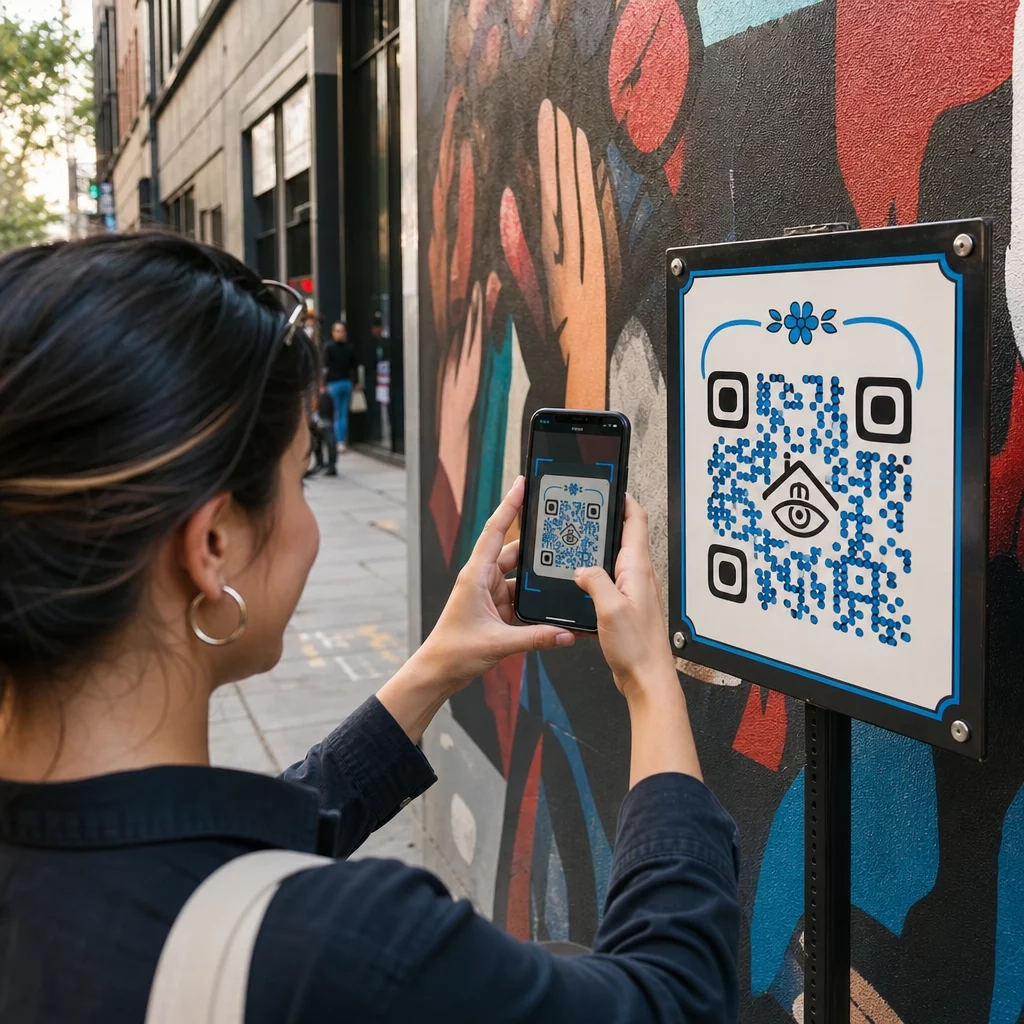
Scanning mural QR code

Eye level and reachable

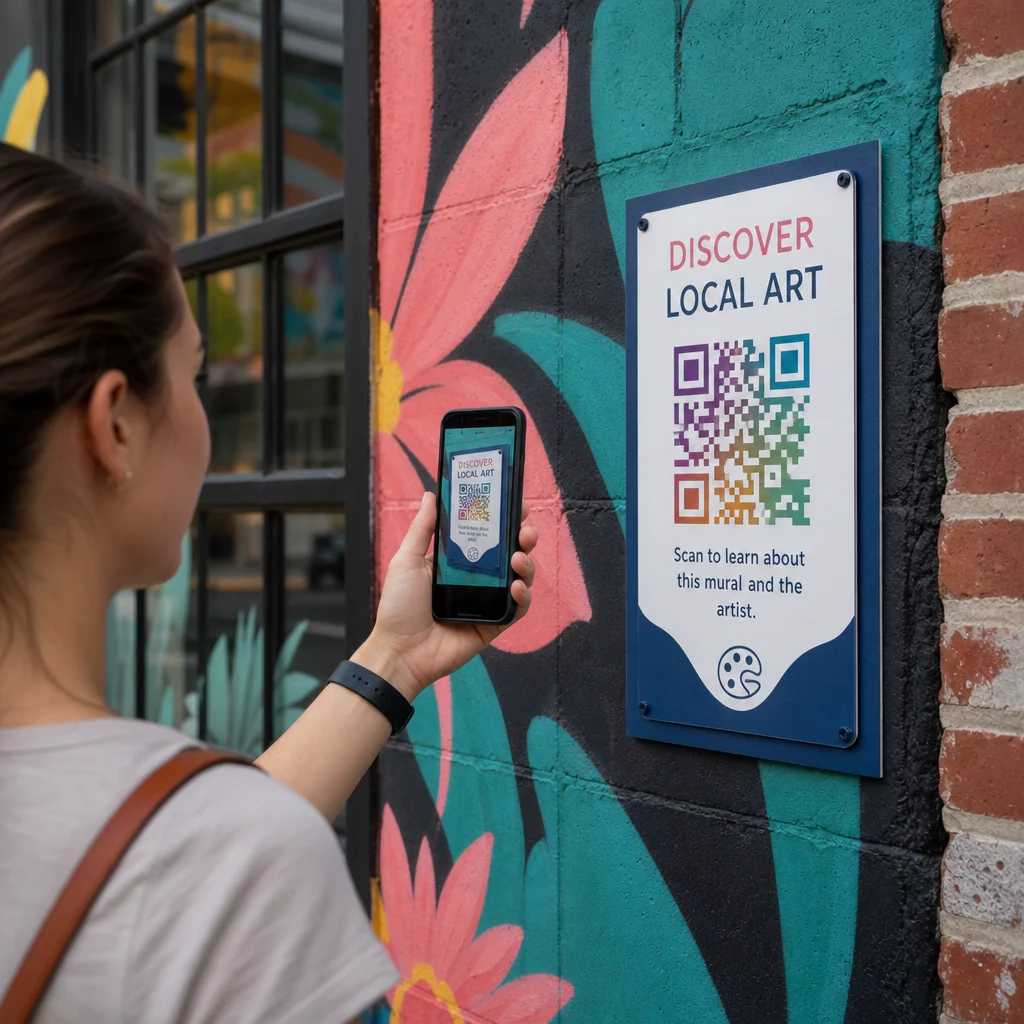
Position codes at roughly 4 to 5 feet from the ground – the natural scanning position for most adults. Codes placed too high require viewers to raise their phones awkwardly; codes placed at ground level are easy to miss.

Where people already pause

Viewers who are stationary are far more likely to scan than viewers walking past. Identify natural stopping points – seating areas, shaded spots, corners where people cluster – and place codes there rather than at mid-stride positions along a busy walkway.

Flat, stable surfaces

Flat surfaces give scanners a clean, undistorted read. Slightly curved or textured surfaces can work if the code is large enough, but they increase the chance of scanning failure. Avoid highly reflective surfaces that generate glare.

Clear signage cues

Add a short call-to-action near the code: “Scan to hear the artist’s story” or “Scan for the full guide.” Viewers who don’t immediately recognize what the code does are less likely to try. For guidance on writing effective CTAs, see QR code placement best practices.

Using Dynamic QR Codes to Manage and Track Public Art

Static QR codes encode a fixed destination. Once printed or installed, the linked content cannot be changed without replacing the physical code. For long-term public art installations – or projects where content evolves – this creates a real maintenance problem.

动态 QR 码 solve this by pointing to a short redirect URL that you control. The physical code stays the same, but you can update the destination anytime from a dashboard. If an artist’s website changes, a video is re-hosted, or a seasonal tour guide replaces an older one, the update happens in the platform without touching the installed code.

Dynamic codes also provide analytics. You can track how many times a code has been scanned, when scans happen, and where in the world scanners are located. For curators and exhibition organizers, this data reveals which pieces in a collection are generating the most engagement, what times of day see peak activity, and whether certain locations outperform others. Those insights support better placement decisions and more relevant content updates over time.

For artists managing temporary installations or evolving projects, the ability to layer content – providing basic information on the first scan and unlocking deeper material with repeat visits – encourages ongoing engagement with the same piece.

Track Every Scan Across Your Public Art Collection动态二维码生成器 lets you update linked content without reprinting and provides a full analytics dashboard to monitor engagement across every installation.

QR Codes in Museums and Cultural Institutions

Indoor cultural venues operate under different constraints than outdoor murals, but the same principles apply. Museums have adopted QR codes to extend what exhibit labels can communicate, offer multilingual content to international visitors, and replace printed brochures with updateable digital alternatives.

Use cases in museum settings include:

  • Interactive audio guides and self-directed tours
  • Digital maps of the exhibition space
  • AR experiences that animate artifacts or reveal hidden layers of paintings
  • Workshop schedules, lecture sign-ups, and event promotions
  • Visitor feedback forms linked at exits or throughout the gallery

The M+ museum in Hong Kong recorded 148,000 visitor interactions via QR codes, demonstrating strong audience readiness for smartphone-based engagement in art spaces. Musea Brugge has used Pageloot QR codes specifically to enrich visitor engagement and streamline access to exhibition information.

For a broader look at how institutions are applying this technology, see QR codes for museums, QR codes for art galleries: best practices,以及 case studies on QR codes in modern art installations.

Security, Privacy, and Long-Term Maintenance

Public QR codes are accessible at all hours and to all audiences, which makes ongoing maintenance essential. A broken link or outdated destination undermines viewer trust and wastes the opportunity the scan created.

Key practices for responsible long-term deployment:

  • Test regularly across multiple devices and under different lighting conditions to confirm codes remain scannable and links are live.
  • Use HTTPS destinations to signal legitimacy and protect visitors from insecure redirects.
  • Post clear signage about what data, if any, is collected when viewers scan, and comply with applicable privacy regulations.
  • Use durable physical materials appropriate to the outdoor environment – UV-resistant inks, weatherproof laminates, or protected digital screens for permanent installations.
  • Audit linked content periodically to ensure videos, PDFs, and artist pages remain current and accessible.

Dynamic QR codes reduce maintenance burden significantly, since content updates and link changes happen in the platform rather than requiring physical replacement of installed codes. When QR codes are designed with the same care as the artwork they accompany – right-sized, properly contrasted, thoughtfully placed, and linked to genuinely valuable content – they extend the life and reach of public art well beyond what a single viewing can offer. Whether you’re documenting a street mural, building an interactive sculpture trail, or digitizing a museum collection, the QR code tools for art available through Pageloot give you a straightforward path from physical installation to measurable digital engagement.

常见问题

How large should a QR code be on an outdoor mural?

Size depends on scanning distance. A practical rule is to make the code at least one-tenth as wide as the distance from which you expect viewers to scan. For someone standing 10 feet away, the code should be at least 12 inches wide. For close-range signage, a minimum of 1 × 1 inch is sufficient. Large-scale murals typically require codes between 1 and 1.5 feet wide to remain scannable from a comfortable distance.

What types of content can a public art QR code link to?

QR codes in public art can link to almost any digital content: artist biographies, audio guides, video interviews, AR experiences, PDF walking tour guides, donation pages, Google Maps navigation, social media profiles, or feedback forms. The right content type depends on the artwork’s context – outdoor murals often benefit from audio or short video, while museum installations may support more detailed multimedia guides.

What is the difference between a static and dynamic QR code for public art?

A static QR code encodes a fixed destination that cannot be changed after the code is printed or installed. A dynamic QR code points to a redirect URL that you can update anytime from a management dashboard, so the physical code stays in place while the linked content evolves. Dynamic codes also provide analytics – scan counts, timing, and geographic data – which help curators understand which installations are generating the most engagement and refine their approach over time.

关于作者

Siim Kostabi 是 Pageloot 的内容主管,负责撰写关于我们创新型二维码生成器服务的文章。凭借五年多来在二维码领域积累的深厚专业知识,Siim 是该领域的专家。他致力于利用二维码技术简化和增强数字交互,并取得了显著的成果。.

类别
了解更多关于
三星扫描二维码
使用扫描二维码 三星Galaxy
QR QR码的#1解决方案

如果您需要在线创建QR码,则可以 制作二维码 就在这里免费!
Pageloot是 #1转到解决方案 创建和扫描QR码。

受到超过 20,000 个品牌的信赖,可获得更多销售、评论和关注者。

客户徽标
受到顶级品牌的信赖
评分为 4.8(共 5)

4.86 / 5 星评级

雨果·劳伦特
雨果·劳伦特
餐馆老板
有史以来最容易和最可靠的QR码生成器。PDF文件可以立即上传。我们的餐厅菜单现在是数字化的。
卢卡斯-詹森
卢卡斯-詹森
房地产开发商
这是一个很好的工具,二维码带你到你想要的地方。我们只使用位置二维码,但有许多有用的功能。
艾玛-莫雷蒂
艾玛-莫雷蒂
零售产品
易于使用和快速。它工作得很好,创造了一个完美的图像,所以员工可以下载我的vCard。
雨果·劳伦特
雨果·劳伦特
餐馆老板
有史以来最容易和最可靠的QR码生成器。PDF文件可以立即上传。我们的餐厅菜单现在是数字化的。
卢卡斯-詹森
卢卡斯-詹森
房地产开发商
这是一个很好的工具,二维码带你到你想要的地方。我们只使用位置二维码,但有许多有用的功能。
艾玛-莫雷蒂
艾玛-莫雷蒂
零售产品
易于使用和快速。它工作得很好,创造了一个完美的图像,所以员工可以下载我的vCard。
查看更多QR码
将一切转化为数字体验 不到3分钟。

免费试用 14 天。

无需信用卡。

首次购买可享受 30% 折扣

使用代码:

分享您的 MP3 文件

注册以创建 PDF QR 码

上传和显示你需要的一切。

  • 音频文件
  • 播客
  • 音乐

注册即可享 14 天免费试用。.
试用期结束后,二维码将失效。.

注册以创建音频 mp3 二维码

使用边框获得更多扫描

注册以向您的二维码添加更多框架

呼叫行动框架帮助您的客户与QR码轻松互动。试试吧!

注册即可享 14 天免费试用。.
试用期结束后,二维码将失效。.

注册以向您的二维码添加更多框架

使用形状添加更多样式

注册以创建更多形状

二维码不一定是方形的。试着改变它以适应你的品牌形象。

注册即可享 14 天免费试用。.
试用期结束后,二维码将失效。.

注册以创建更多形状

为您的二维码添加徽标

注册以将您的徽标添加到二维码中

通过在二维码上添加你的标志和品牌,使你的二维码脱颖而出。

注册即可享 14 天免费试用。.
试用期结束后,二维码将失效。.

注册以将您的徽标添加到二维码中

智能应用商店重定向

注册以创建应用商店二维码

将您的应用程序链接添加到我们的智能应用程序商店QR码。用户会根据他们的设备被重新定向。

注册即可享 14 天免费试用。.
试用期结束后,二维码将失效。.

注册以创建应用商店二维码

将图片上传到二维码

注册以创建图像二维码

轻松分享你的图像。在几秒钟内动态地改变任何图像。

注册即可享 14 天免费试用。.
试用期结束后,二维码将失效。.

注册以创建图像二维码

分享您的 PDF 文件

注册以创建 PDF QR 码

上传和显示你需要的一切。

  • 菜单和价格表
  • 使用说明
  • 任何文件

注册即可享 14 天免费试用。.
试用期结束后,二维码将失效。.

注册以创建 PDF QR 码

稍后编辑,无需打印

注册即可编辑您的二维码,无需再次打印

动态QR码让你改变你的QR码的内容,而不需要打印新的QR码。

注册即可享 14 天免费试用。.
试用期结束后,二维码将失效。.

注册即可编辑您的二维码,无需再次打印

何时?何地?追踪您的二维码扫描

注册以追踪您的二维码

发现你的哪些二维码收到了最多的扫描,以及什么最能让你的客户兴奋。

注册即可享 14 天免费试用。.
试用期结束后,二维码将失效。.

注册以追踪您的二维码

提供可打印文件

注册以创建 PDF 和 SVG 等矢量二维码

.EPS, .PDF, .SVG

想下载高清分辨率的QR码吗?获得矢量或像素格式,可随时打印。

注册即可享 14 天免费试用。.
试用期结束后,二维码将失效。.

注册以创建 PDF 和 SVG 等矢量二维码

请等待。您的二维码是 正在加载... 正在加载...

打造专属

注册以保存您的二维码以供日后使用

通过创建具有不同颜色、标识和行动呼吁框架的出色的QR码,获得更多的扫描。

注册即可享 14 天免费试用。.
试用期结束后,二维码将失效。.

注册以保存您的二维码以供日后使用