Comment ajouter un contexte numérique riche à une œuvre d'art physique sans encombrer le mur de la galerie ni rompre le charme de la pièce ? Cette tension – entre information et immersion – est exactement ce que les codes QR dans les installations artistiques sont conçus pour résoudre. Ce guide couvre des exemples concrets, des principes de conception et des étapes pratiques pour les conservateurs et les artistes qui souhaitent intégrer des couches numériques scannables dans leurs expositions.
Études de cas : Comment les musées et les artistes utilisent les codes QR
Installation artistique de codes QR Mehendi
Ce projet temporaire a fusionné la tradition de l'art du henné avec la praticité des codes QR. Les visiteurs pouvaient scanner les motifs à base de henné pour effectuer des transactions numériques ou faire des dons. Parce que le henné s'estompe naturellement, l'installation est devenue une méditation sur l'impermanence tout en démontrant comment les codes QR peuvent relier les traditions culturelles aux interactions numériques modernes.
Intégration spatiale de codes QR à la Collection Pinault
À la Collection Pinault à Rennes, en France, les conservateurs ont intégré des codes QR dans les sols des musées et les espaces de transition plutôt que d'encombrer les murs des galeries avec des panneaux de texte. Utilisant la plateforme MySmartJourney, les codes ont fourni du contenu ludique – des tutoriels de pop-art et des puzzles visuels – pendant des moments qui seraient autrement inactifs, comme les temps d'attente. Le résultat a été un engagement accru sans perturber le flux visuel de la galerie, un modèle à étudier pour toute institution conciliant la diffusion d'informations et l'intégrité esthétique.
L'expérience visiteur étendue du musée Erarta
Le musée Erarta a utilisé des codes QR pour étendre la visite au-delà de la galerie elle-même. Des codes placés près des œuvres d'art ont permis aux visiteurs d'explorer des informations détaillées sur l'exposition, d'en apprendre davantage sur les artistes et d'acheter des reproductions de haute qualité. Plutôt que de forcer chaque visiteur à traverser la même expérience linéaire, cette approche a donné aux gens la liberté d'aller aussi loin que leur curiosité les mènerait – une interaction plus personnalisée que n'importe quelle étiquette murale fixe ne peut offrir.
Codes QR d'inspiration Bauhaus du collectif d'artistes Elkoy
Le collectif d'artistes Elkoy a réinventé les codes QR à travers le prisme des principes du Bauhaus. En incorporant des formes géométriques, des couleurs vives et un design minimaliste, ils ont transformé les codes noir et blanc standard en éléments de composition. Chaque code renvoyait à des essais expliquant la relation entre les mouvements de design historiques et la technologie moderne. Leur travail est une démonstration claire qu'un code QR peut faire partie de l'œuvre d'art plutôt qu'une annotation sur celle-ci.
Leçons de l'adoption précoce du Brooklyn Museum
Le Brooklyn Museum a été l'un des premiers à adopter les codes QR, mais leurs efforts initiaux ont rencontré de réelles difficultés – les visiteurs avaient besoin d'applications tierces pour scanner, ce que la plupart des gens n'avaient pas. L'engagement n'a augmenté qu'après qu'Apple et Android ont intégré des lecteurs QR directement dans les appareils photo des smartphones. La leçon est pratique : même une idée bien conçue peut échouer sans la bonne infrastructure en place. Le timing et l'accessibilité technique comptent autant que la vision créative.
Avantages des codes QR dans les installations artistiques
Engagement plus profond des visiteurs
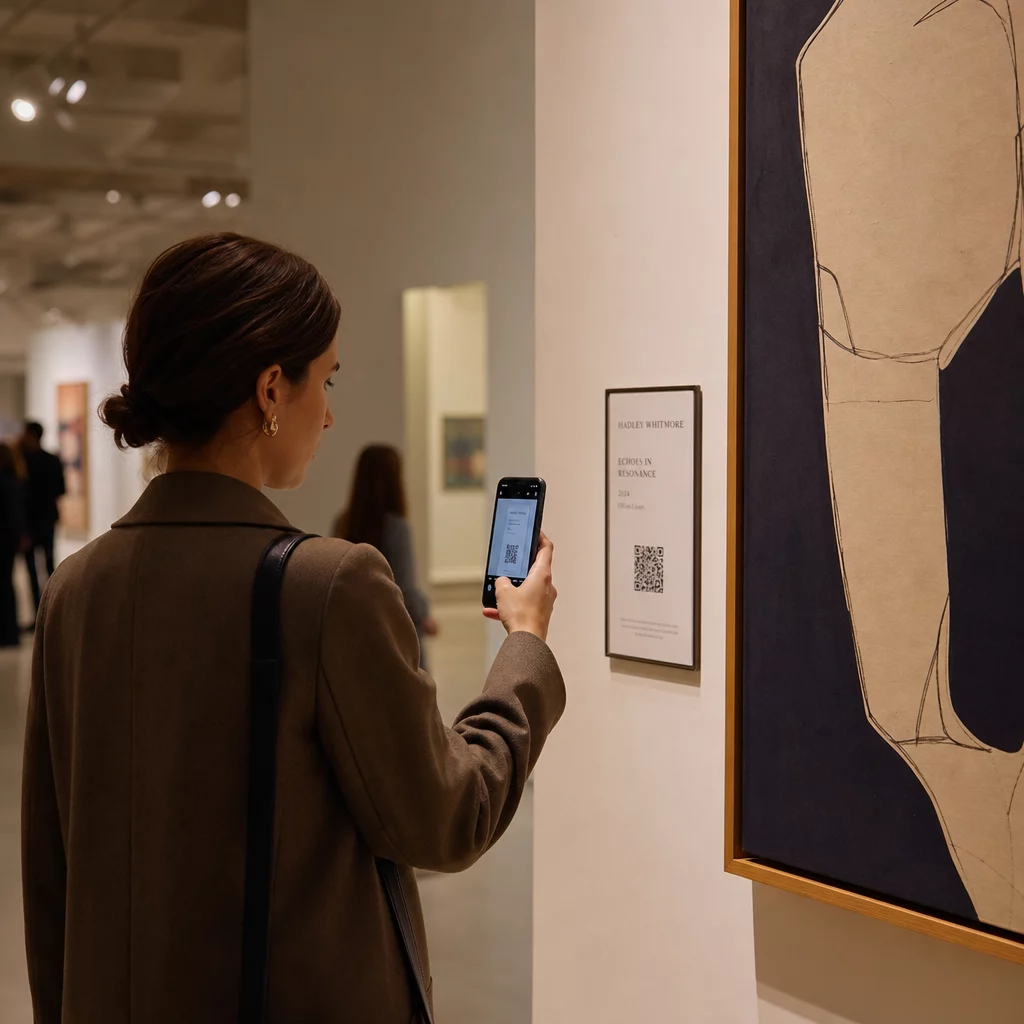
Les codes QR transforment les visiteurs d'observateurs passifs en participants actifs. Au lieu d'absorber ce qui tient sur une étiquette murale, un visiteur peut scanner et accéder à des interviews d'artistes, des vidéos des coulisses, des audioguides ou des superpositions de réalité augmentée qui animent une œuvre statique. Les musées peuvent également utiliser des codes pour déclencher des chasses au trésor numériques ou des quiz, particulièrement efficaces pour les familles et les jeunes publics.
Codes QR pour les musées ouvrent également la voie à des améliorations significatives en matière d'accessibilité. Des audioguides multilingues, des sous-titres codés et des vidéos à lecture répétée pour les visiteurs ayant des troubles d'apprentissage deviennent tous possibles grâce à un simple scan sur l'appareil du visiteur. La recherche confirme que les visiteurs ayant des troubles d'apprentissage apprécient particulièrement la possibilité de regarder ou d'écouter du contenu plusieurs fois à leur propre rythme.
Une mise en garde pratique : tous les visiteurs ne possèdent pas de smartphone – les groupes scolaires en sont un exemple fréquemment cité. Les codes QR doivent être traités comme une couche d'amélioration, et non comme le seul chemin d'accès à l'information. Proposez toujours un moyen alternatif d'accéder au même contenu, qu'il s'agisse d'une URL à proximité, d'un dépliant imprimé ou d'une option assistée par le personnel.
Ajoutez une couche numérique à votre prochaine exposition Le Générateur de QR code dynamique vous permet de mettre à jour le contenu lié à tout moment – aucune réimpression n'est requise – afin que vos codes restent à jour tout au long de l'installation.
Flexibilité de conception et intégration artistique
Les codes QR n'ont plus besoin de ressembler à des codes QR au sens traditionnel. Couleurs, formes, logos intégrés et motifs personnalisés peuvent tous être appliqués tout en préservant la scannabilité, à condition que le contraste et les zones de silence soient respectés (plus de détails ci-dessous). Les codes d'inspiration Bauhaus du collectif Elkoy et les codes intégrés au sol de la Collection Pinault montrent tous deux qu'un placement réfléchi et un design visuel peuvent faire en sorte qu'un code semble natif à une installation plutôt que greffé sur celle-ci.
Un principe directeur utile issu de la pratique curatoriale : “ Le code QR doit être conçu pour être discret et élégant, complétant l'exposition plutôt que de la distraire. ” Cette norme s'applique que le code apparaisse sur une petite étiquette à côté d'une peinture ou qu'il soit intégré directement à la surface d'une œuvre sculpturale.
Analyses et informations en temps réel sur les visiteurs
L'un des arguments les plus pratiques en faveur des codes QR dans les expositions est les données qu'ils génèrent. Chaque scan est un signal : quelles œuvres suscitent un intérêt soutenu, quand l'engagement maximal se produit, dans quelles zones de la galerie les visiteurs s'attardent, et quels formats de contenu – vidéo, audio, texte – sont les plus consommés.
| Point de Donnée | Informations fournies |
|---|---|
| TOTAL DES SCANS | Mesure l'intérêt global pour une œuvre ou une zone spécifique |
| Scans uniques | Suit l'engagement individuel des visiteurs |
| Heure de scan | Identifie les heures de pointe et les schémas de flux des visiteurs |
| Système d'exploitation | Offre des informations techniques pour l'optimisation mobile |
| Lieu de Scan | Évalue l'efficacité du placement des codes QR |
Les codes QR dynamiques rendent ces données encore plus exploitables. Parce que l'URL de destination peut être modifiée sans réimprimer le code physique, un conservateur peut réagir aux données de scan en temps réel – en remplaçant une vidéo qui ne résonne pas par une autre qui le fait, ou en ajoutant du contenu d'accessibilité en cours d'exposition basé sur les retours des visiteurs. Pour une image plus complète de la façon dont Les codes QR RA transforment la narration muséale, des couches de réalité augmentée peuvent être ajoutées ou mises à jour de la même manière.
Que lier : Contenu qui ajoute de la valeur
Le contenu derrière le code est aussi important que le code lui-même. Les musées et les artistes ont trouvé les types de contenu suivants constamment utiles :
- Déclarations d'artistes et interviews – entendre un artiste décrire son processus avec ses propres mots crée une connexion qu'aucun texte mural ne peut reproduire ; un Code QR YouTube gère cela proprement
- Guides audio – descriptions narrées ou paysages sonores liés via un code QR MP3 fonctionnent particulièrement bien pour les œuvres où l'expérience visuelle doit rester intacte
- Contenu de catalogue étendu – provenance détaillée, essais savants ou catalogues d'exposition livrés sous forme de PDF Code QR
- Galeries d'images – traiter les photographies, les vues d'installation ou les œuvres comparatives accessibles via une galerie d'images code QR
- Visites virtuelles – pour les visiteurs qui souhaitent explorer des œuvres connexes ou des institutions sœurs, un code QR menant à une visite virtuelle étend l'expérience au-delà de l'espace physique
- Formulaires de commentaires des visiteurs – placés aux points de sortie ou près des œuvres principales pour recueillir des réponses qualitatives
Gardez la destination liée simple. Les URL plus courtes s'encodent en motifs moins denses, ce qui permet une numérisation plus rapide et plus fiable. Les codes QR dynamiques résolvent ce problème systématiquement en n'encodant qu'un court lien de redirection, quelle que soit la complexité de la destination.
Conception et placement : Rendre les codes scannables et discrets
Réussir l'exécution visuelle et physique est là où de nombreuses installations trébuchent. Les principes ci-dessous sont tirés des directives d'accessibilité et de la recherche sur la lisibilité des codes QR.
Contraste et couleur
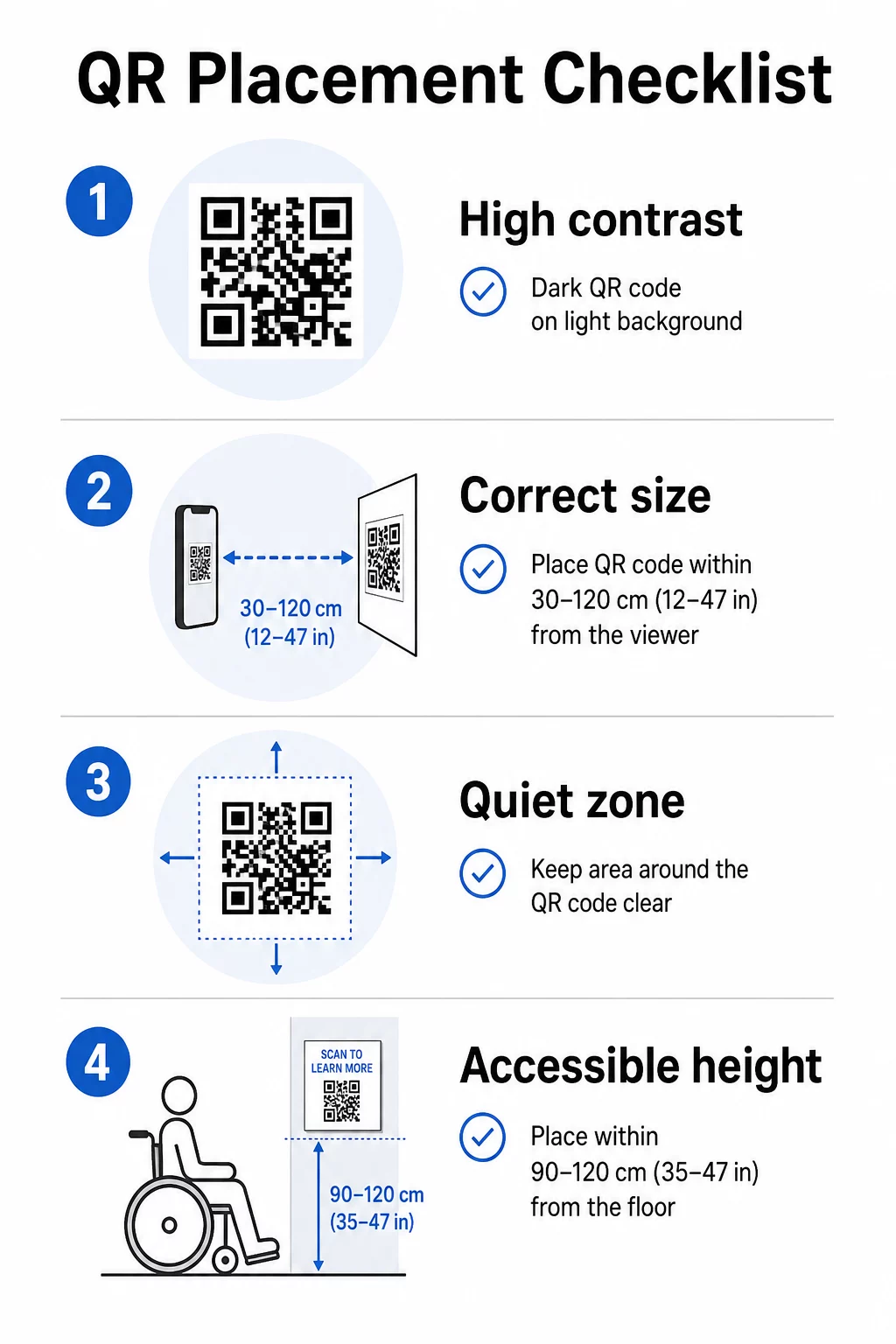
Le premier plan du code doit être sombre et l'arrière-plan clair – et non l'inverse. Les codes inversés (motif clair sur fond sombre) échouent sur une partie significative des appareils photo de smartphones. Pour les codes de couleur personnalisée, visez un rapport de contraste d'au moins 3:1 entre les modules du code et la surface d'arrière-plan. Une ventilation complète des règles de contraste est disponible dans le guide des meilleures pratiques de contraste des couleurs des codes QR.
Les dégradés et les ombres introduisent des demi-teintes qui perturbent les scanners. Si vous souhaitez un code stylisé qui correspond à la palette de l'installation, utilisez des couleurs unies et testez-le minutieusement.
Taille et distance de numérisation
Une règle fiable : le code doit avoir environ un dixième de la taille de la distance de numérisation prévue. Un code destiné à être scanné à bout de bras (environ 25 cm) doit mesurer au moins 2,5 cm de côté. Pour la signalisation d'installation vue de plus loin, adaptez la taille en conséquence. Le minimum absolu pour une numérisation à courte portée est de 2 × 2 cm (environ 0,8 × 0,8 pouces). Plus de détails sur le dimensionnement sont disponibles dans le Guide de placement du code QR.
Zones de silence
Chaque code QR nécessite une marge claire – appelée zone de silence – d'au moins quatre modules de tous les côtés. Aucun texte, motif ou élément décoratif ne doit empiéter sur cet espace. Si vous intégrez un code dans une surface à motifs ou le bord d'une œuvre d'art, c'est la contrainte la plus susceptible de provoquer des échecs de numérisation.
Accessibilité physique
La hauteur et l'emplacement déterminent qui peut réellement utiliser le code. Le placement doit être accessible aux visiteurs en fauteuil roulant ou aux personnes de petite taille – environ 75 à 120 cm du sol pour un accès confortable. Évitez de placer les codes sur des surfaces courbes, du verre réfléchissant ou des matériaux qui créent des reflets sous l'éclairage de la galerie.
Texte de l'étiquette
Une étiquette près du code doit expliquer clairement ce que le visiteur trouvera après le scan et comment le scanner. Tous les visiteurs ne sont pas familiers avec le processus, et même les scanneurs expérimentés bénéficient de savoir s'ils sont sur le point de voir une vidéo de trois minutes ou un essai de catalogue de 12 pages. Un langage simple, des phrases courtes et une taille de police adéquate contribuent tous à la convivialité. Gardez les étiquettes concises – les visiteurs parcourent rapidement, et les informations les plus essentielles doivent apparaître en premier.
Maintenir le contenu de l'exposition à jour sans réimpression Les galeries d'art peuvent utiliser le Générateur de QR code dynamique pour mettre à jour les biographies d'artistes, échanger des audioguides ou ajouter de nouveaux contenus même après l'ouverture d'une exposition – sans toucher à la signalétique physique.
Tester avant d'installer
Imprimez le code à sa taille finale et scannez-le avec au moins deux appareils – un iPhone et un téléphone Android – dans les conditions d'éclairage que l'installation utilisera réellement. L'éclairage des galeries est souvent chaud et directionnel, ce qui peut affecter le contraste différemment de la lumière de bureau standard. Les finitions mates réduisent l'éblouissement et sont généralement plus performantes que les surfaces brillantes pour un scan fiable. Plus de conseils de test se trouvent dans le guide des meilleures pratiques de lisibilité des codes QR.
Utilisation de codes QR dynamiques pour les expositions évolutives
Un code QR statique encode une destination fixe. Une fois imprimé, la seule façon de changer sa destination est de le réimprimer. Les codes QR dynamiques fonctionnent différemment : le code lui-même pointe vers une courte redirection, et vous pouvez changer la destination de la redirection à tout moment depuis un tableau de bord.
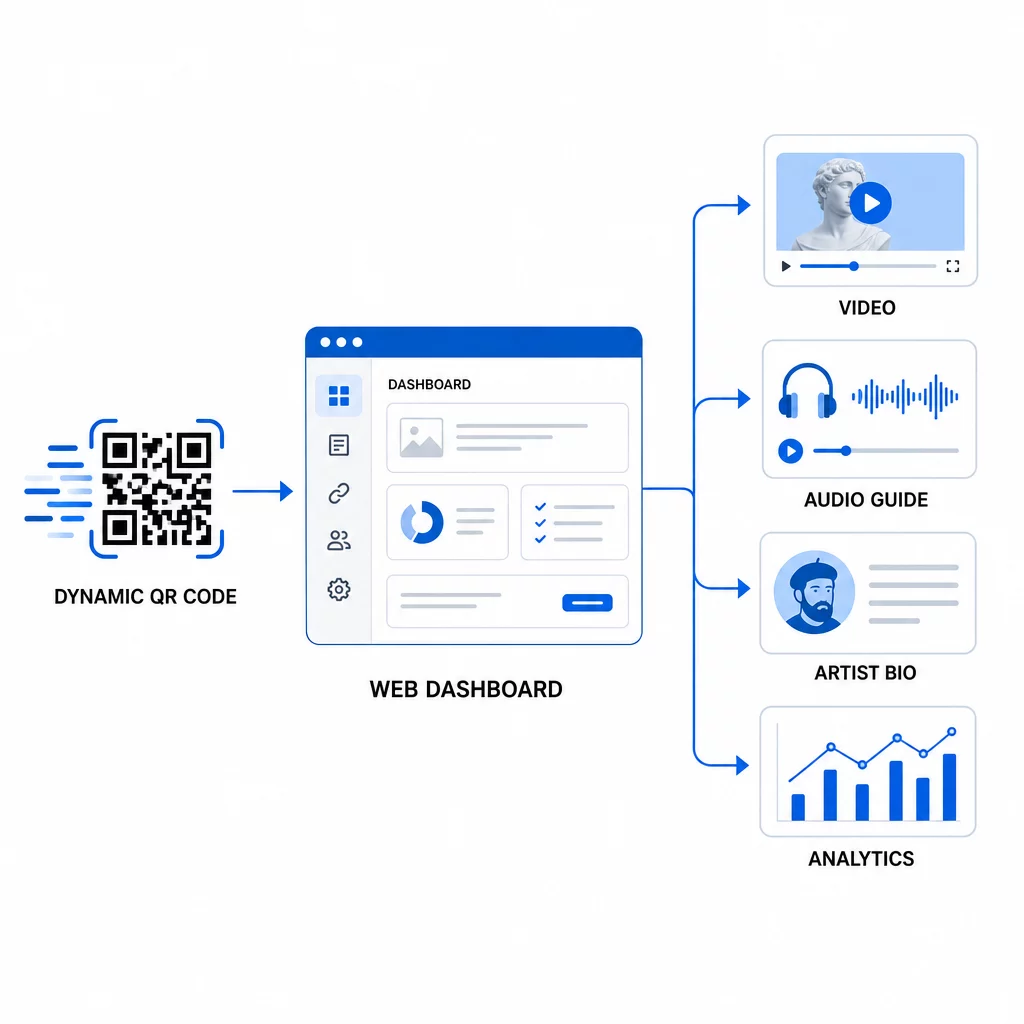
Pour les installations artistiques, cette distinction est significative :
- Une exposition qui dure plusieurs mois peut modifier son contenu lié à mesure que le spectacle évolue – ajoutant de nouveaux commentaires d'artistes, échangeant une vidéo d'accroche contre un documentaire complet, ou mettant à jour les détails de provenance à mesure que la recherche progresse
- Les installations temporaires peuvent réutiliser le même code physique pour plusieurs événements en mettant simplement à jour la destination
- Les analyses restent liées au même code, offrant un enregistrement de performance continu plutôt que des données fragmentées sur plusieurs réimpressions
Le Smithsonian a utilisé cette approche pour gérer efficacement l'accès à de vastes collections numériques, réduisant à la fois les coûts et le gaspillage environnemental lié aux matériaux réimprimés. Pour les conservateurs gérant des expositions multi-sites ou itinérantes, la capacité de configurer une visite d'art virtuelle avec des codes QR et de la mettre à jour de manière centralisée est un avantage opérationnel significatif.
Questions fréquentes
Concevez le code en utilisant des couleurs tirées de la palette de l'œuvre d'art, mais maintenez un premier plan sombre sur un arrière-plan clair et visez un rapport de contraste d'au moins 3:1. Gardez la zone de silence dégagée de tous les côtés et testez la version imprimée avec plusieurs appareils avant l'installation. Des niveaux de correction d'erreur plus élevés (Q ou H) permettent une personnalisation visuelle accrue – y compris des logos intégrés – tout en préservant la fiabilité de la numérisation.
Les types de contenu les plus efficaces sont les entretiens d'artistes ou les déclarations vidéo, les guides audio, les essais de catalogue approfondis ou les documents de provenance, les images de processus et les formulaires de commentaires des visiteurs. Adaptez le format au public et à l'œuvre : la vidéo convient aux œuvres axées sur le processus ou basées sur la performance, tandis que l'audio fonctionne bien avec les œuvres où l'expérience visuelle doit rester ininterrompue.
Les codes QR dynamiques avec analyses intégrées enregistrent des données agrégées – nombre total de scans, scans uniques, heure de scan, type d'appareil et emplacement géographique – sans capturer d'informations personnelles des visiteurs individuels. Des plateformes comme le générateur de codes QR dynamiques de Pageloot fournissent ces données dans une vue de tableau de bord, offrant aux conservateurs des informations exploitables tout en respectant la confidentialité des visiteurs.