> 블로그 > 대규모로 편집 가능한 QR 코드를 관리하는 방법
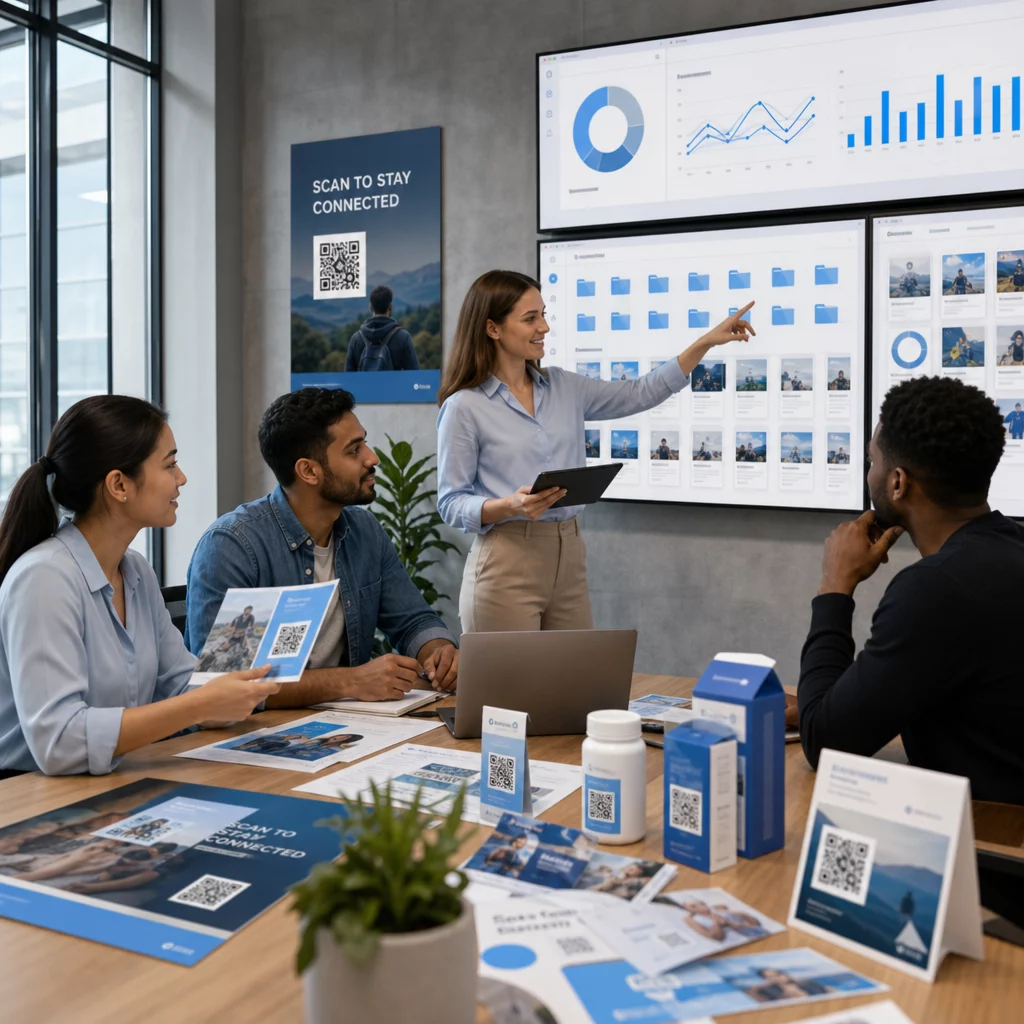
Team managing QR codes

대규모로 편집 가능한 QR 코드를 관리하는 방법

Manage thousands of QR codes efficiently with this guide to dynamic links, bulk generation, naming conventions, and UTM tracking for large-scale campaigns.
Updated on 6월 10, 2026
목차

Managing hundreds – or thousands – of QR codes across campaigns, locations, and product lines is harder than it looks. Without a clear system, teams end up with broken links, inconsistent branding, and no real visibility into what’s working. This guide covers the practical strategies and tools that keep large-scale QR code deployments organized, trackable, and easy to update.

Choose the Right QR Code Type Before You Scale

The most important decision you’ll make before scaling any QR code program is choosing between dynamic and static codes – because that choice determines what you can change, track, and automate later.

동적 QR 코드 use a short redirect URL that you control. Because the printed code only points to that redirect, you can update the destination, swap content, or change tracking parameters at any time without reprinting anything. They also unlock tracking capabilities including scan counts, timestamps, geographic location, device type, and operating system. This makes them the right choice for marketing campaigns, promotions, restaurant menus, event materials, and any use case where content changes or performance data matters.

정적 QR 코드 encode a destination directly into the pattern itself. Once printed, that data is permanent – you cannot update the link or track scans without generating a new code. They’re well-suited for information that genuinely never changes: a fixed Wi-Fi password, a permanent regulatory document, or a museum exhibit with stable content.

기능 동적 QR 코드 정적 QR 코드
Editable after printing ✅ 예 ❌ 아니요
스캔 추적 ✅ 예 ❌ 아니요
Geographic analytics ✅ 예 ❌ 아니요
실시간 분석 ✅ 예 ❌ 아니요
비용 구독 필요 비어 있는
가장 적합한 대상 Campaigns, menus, promotions Fixed, permanent content

For a deeper look at how these two options compare, see the full static vs. dynamic QR code breakdown.

Start Managing Dynamic QR Codes Today Need editable codes with built-in tracking and a centralized dashboard? The 동적 QR 코드 생성기 lets you create, update, and monitor all your codes in one place.

Build a Naming and Organization System That Scales

When you’re managing dozens of codes, loose naming conventions are an inconvenience. At hundreds or thousands, they become a serious operational problem. A consistent naming structure, combined with a logical folder hierarchy, keeps your team aligned and your codes findable at any stage of a campaign.

Use a Standardized Naming Convention

A reliable naming format captures everything you need to identify a code without opening it. One practical structure:

`Dept-CampaignChannel-GeoObjective-AssetType버전Status`

For example: `MKT-Summer25OOH-USPromo-Posterv2ACTIVE`

Set dates in YYYY-MM format, use version numbers (v1, v2) to distinguish iterations, and always include a status indicator (ACTIVE, PAUSED, ARCHIVED). This prevents confusion when multiple versions of the same campaign are live simultaneously.

Record Structured Metadata for Every Code

Beyond the name, each QR code should carry structured metadata that anyone on your team can reference. Fields to include:

  • Owner (person or team responsible)
  • Business unit or product line
  • Target URL and backup URL
  • Code type (dynamic or static)
  • Start date and end date
  • Call-to-action copy
  • Access or security level

End dates and backup URLs are especially important at scale – they prevent dead-end scans after a campaign closes, and a backup URL ensures users still land somewhere useful if the primary destination goes down.

Organize with Folders and Tags

A two-tier folder structure works well for most teams: top-level folders for business units or product lines, and subfolders for individual campaigns or locations. Tags add a second layer of filtering – mark codes by region (US, EU), channel (email, out-of-home, packaging), placement type (poster, bottle, screen), and status (active, archived).

페이지루트의 QR code folders feature supports team-based folder sharing with role-based permissions, so you can give new team members read access to analytics while restricting who can edit or delete codes. This is especially useful for agencies managing multiple clients or enterprises running codes across departments.

Generate Codes in Bulk Without Losing Control

Once your naming and folder structure is in place, bulk creation becomes straightforward – provided your input data is clean and your process includes a validation step before generating at volume.

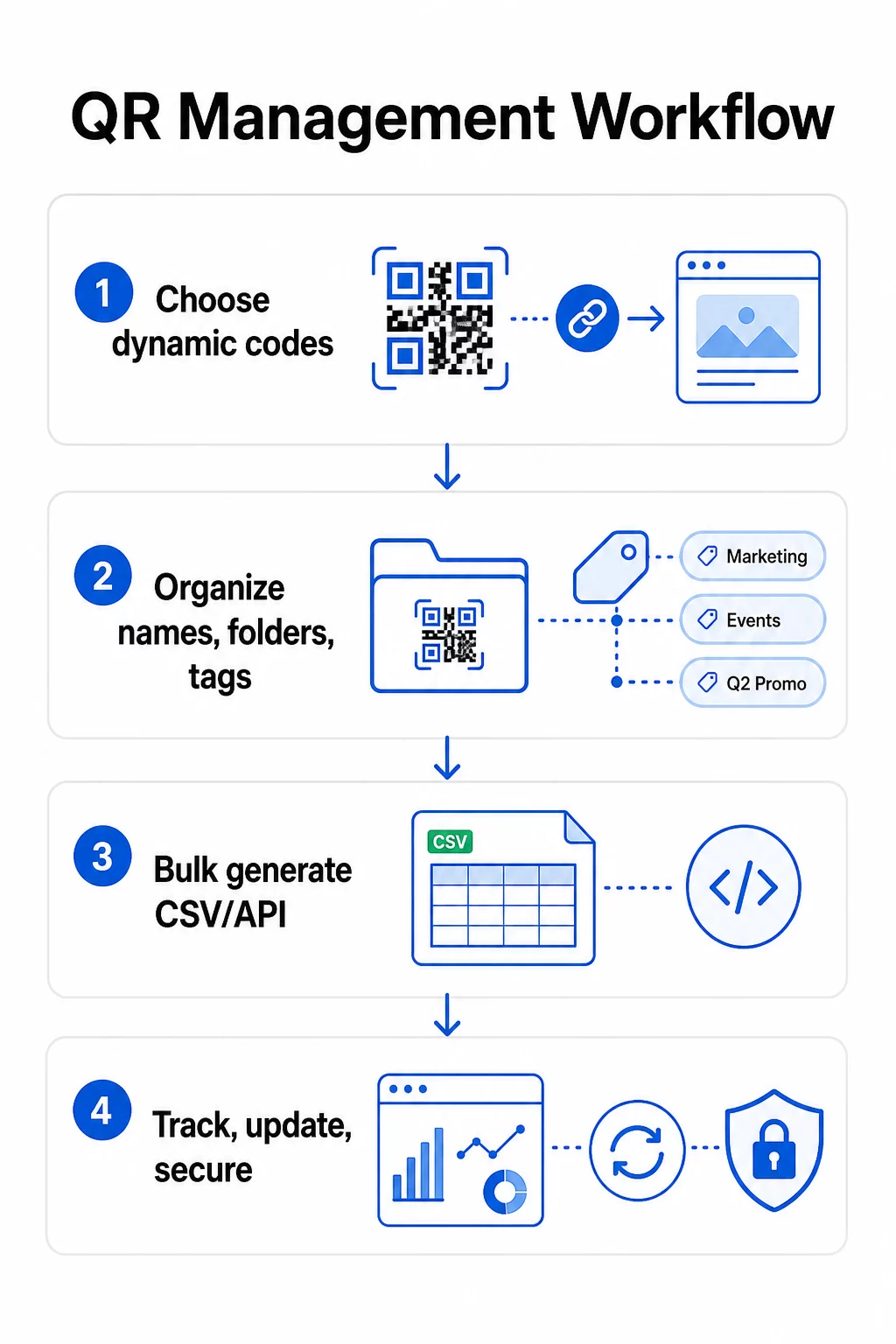
QR management workflow

Use CSV Files for Batch Generation

CSV-based bulk generation is the most practical method for creating large volumes of codes efficiently. A well-structured CSV file for QR code generation should include:

  • `unique_id` – your internal identifier
  • `qr_type` – URL, PDF, vCard, form, etc.
  • `destination_url` – the target destination
  • `campaign_name` – for reporting and filtering
  • `folder` – where the code should live in your dashboard
  • `template_name` – the branded design to apply
  • `utm_parameters` – source, medium, campaign, content
  • `startdate` / `enddate` – campaign window
  • `status` – active or paused
  • `owner` – responsible team member

Before uploading, validate the CSV: confirm all required fields are populated, check that URLs are live and correctly formatted, and run a test batch of five to ten codes across different devices to catch errors before they propagate through the full run.

For automated bulk generation at enterprise scale, API-based QR code management allows you to pass parameters programmatically, trigger batch creation from your own systems, and update destination URLs across thousands of codes simultaneously using PATCH or PUT requests.

Add UTM Parameters Consistently

UTM parameters are what connect QR code scans to your broader analytics stack. Without them, you can see that someone scanned a code, but you can’t easily attribute that scan to a specific campaign, channel, or placement in Google Analytics.

Follow these conventions to keep your data clean:

  • Use lowercase throughout – UTM tracking is case-sensitive, and mixed capitalization creates fragmented reporting
  • Keep parameter values descriptive but concise: `utmsource=storedisplay`, `utm매체=qrcode`, `utmcampaign=summersale_2025`
  • Use `utmcontent` to distinguish between placements within the same campaign (e.g., `windowposter` vs. `checkout_counter`)
  • Document your naming taxonomy in a shared reference document so every team member follows the same rules

For a full walkthrough of UTM setup and Google Analytics 4 reporting, see QR 코드용 UTM 매개변수.

Connect Your QR Scans to Campaign Analytics 페이지루트의 agency and team platform supports automatic UTM appending, role-based access control, and shareable client reports – making attribution tracking significantly easier across large deployments.

Keep Branding Consistent Across Every Code

At scale, visual consistency matters for two reasons: it builds recognition and trust with the people scanning your codes, and it prevents a patchwork of mismatched designs from diluting your brand identity.

Before generating a large batch, define and lock your design standards:

  • Logo placement and minimum size
  • Brand color palette (dark foreground on light background remains the most reliable pattern for scanning)
  • Corner and module style
  • Quiet zone requirements (at minimum four modules of clear space on all sides)
  • Minimum print size (at least 2 × 2 cm for close-range scanning; scale up using the 10:1 rule – code width should be at least one-tenth the expected scanning distance)
  • File formats: SVG or PDF for print materials (300+ DPI), PNG for digital use

Dynamic QR codes offer a practical advantage here: because they encode a short redirect URL rather than a long destination, the underlying pattern is less dense. That leaves more room to incorporate logos and custom colors without compromising scannability.

Save these standards as reusable branded templates in your QR code platform. Pageloot allows you to create templates for different contexts – a compact format for business cards, a bolder version for large-format signage – and apply them consistently across every bulk generation run.

Before committing to a large print run, test a sample of physical prints across multiple devices and lighting conditions. If any codes fail to scan reliably, increase the physical size, strengthen the color contrast, or widen the quiet zone.

Track Performance With the Right Metrics

Generating codes efficiently is only half the job. Understanding how they perform – and acting on that data – is what drives continuous improvement.

The key metrics to monitor for large-scale deployments are:

  • Total scans and unique scans: Total scans show overall engagement; unique scans reveal your actual reach. A high ratio of total to unique scans may indicate strong repeat engagement or, in some cases, a poorly optimized landing page driving users to scan multiple times.
  • Geographic distribution: Pageloot’s analytics provide location-based scan data, accurate to approximately the city level. Use this to identify which regions or placements outperform others and reallocate resources accordingly.
  • Device and operating system: If the majority of your scans come from a specific device type, prioritize testing your landing pages on that platform. Mobile-first optimization is essential for most QR-driven campaigns.
  • Time-based trends: Scan data over time reveals peak engagement windows. For time-sensitive campaigns – retail promotions, events – this data helps you schedule content changes at the right moment.
  • Conversion tracking: Scan volume alone doesn’t indicate campaign success. Set clear downstream goals (form submissions, purchases, app downloads) and use UTM data plus your analytics platform to measure whether scans lead to the actions you want.

For a detailed approach to building reporting views around these metrics, see the guide to using a QR code analytics dashboard.

Build Dashboards That Surface Actionable Insights

Raw scan data across hundreds of codes becomes unwieldy without structured views. Organize your reporting into:

  • Campaign-level dashboards: Compare performance across active campaigns, filtered by time period. Track cost-per-scan, conversion rate, and ROI against campaign benchmarks.
  • Location-based views: Map scan distribution geographically to identify high-performing placements and inform future deployment decisions.
  • Audience segmentation: Group users by device type, scan frequency, or behavior patterns to tailor follow-up content.

Set up automated alerts for significant deviations – a sudden spike in scans from an unusual geographic source could indicate a broken redirect or fraudulent activity, while a sharp drop might signal a broken link that needs immediate attention.

Update and Maintain Codes Without Reprinting

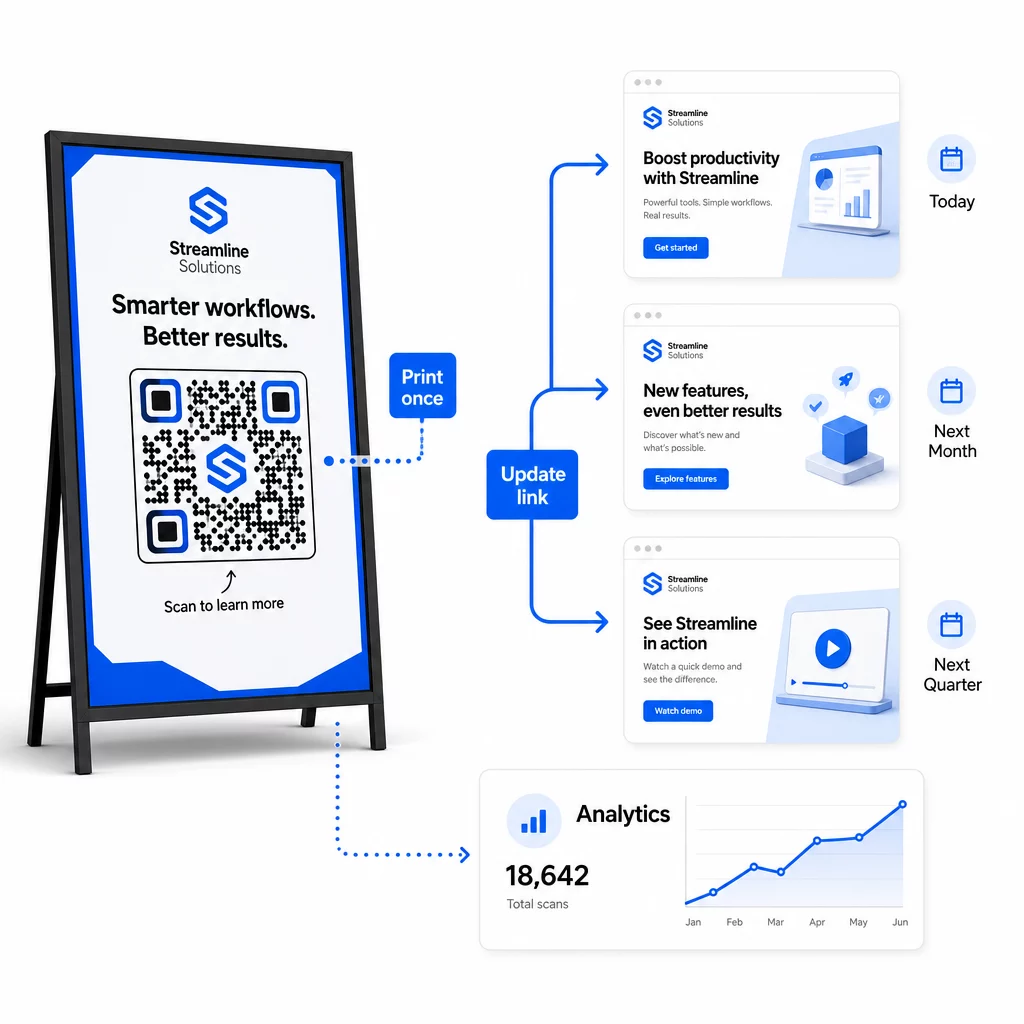
One of the core operational advantages of dynamic QR codes is the ability to edit destination URLs after printing – no new codes, no new print runs, no interruption to active materials. At scale, this capability becomes essential.

Editable QR redirects

Implement Version Control for Destination Changes

Every time you update a dynamic QR code’s destination, log the change with:

  • Date and time of update
  • Previous destination URL
  • New destination URL
  • Reason for the change
  • Who authorized it

Use a versioning scheme – v1.0 for initial launch, v1.1 for minor adjustments, v2.0 for a significant destination change – so your team always knows which version is live and can roll back if something breaks. For teams with multiple contributors, role-based permissions ensure that only authorized users can make changes to active codes.

Automate Time-Based Redirects

For campaigns with predictable content schedules, timed redirects remove the need for manual intervention. A restaurant can serve breakfast, lunch, and dinner menus from a single printed QR code by scheduling destination changes at set times. A retailer can configure a code to redirect to a promotional page during a sale window and return to the standard product page automatically when the promotion ends.

This approach is particularly valuable when QR codes are printed on materials with long lead times. You can finalize the physical production well in advance, confident that the code will serve the right content when the campaign goes live.

Monitor Links Automatically

At scale, manually checking whether every destination URL is live is not practical. Set up automated link monitoring to alert your team when a destination returns an error, so you can redirect scans to a backup URL before users encounter a broken experience. Documenting backup URLs in your metadata – as described in the naming convention section above – means your team always has a fallback ready.

Secure Your QR Code Program as It Grows

Operational efficiency at scale requires governance – clear ownership, appropriate access controls, and proactive monitoring to protect your data and your users.

Role-based access control is the foundation of a secure, well-governed QR code program. Assign permissions that match each team member’s responsibilities: analytics viewers can see scan data but not edit codes; campaign managers can update destinations but not delete codes; administrators have full access. This structure prevents accidental or unauthorized changes while enabling collaboration across large teams.

For enterprises managing QR codes across multiple departments, Pageloot supports workspace-level access controls and team folder sharing, allowing decentralized teams to manage their own codes without visibility into other groups’ campaigns.

Beyond access control, watch for anomalous scan patterns – unexpected volume spikes, high concentrations of scans from a single IP range, or geographic distributions inconsistent with your campaign placements. These patterns can indicate bot activity or other fraudulent scanning that would corrupt your analytics data. Automated monitoring that flags these patterns early protects both your data integrity and your campaign performance insights.

Maintain an audit log of all changes to active codes: who changed what, when, and why. When a campaign issue surfaces, this record is the fastest path to diagnosis and resolution.

자주 묻는 질문

What is the main advantage of using dynamic QR codes when managing codes at scale?

Dynamic QR codes let you update the destination URL or content after the code has been printed, without generating or reprinting anything. At scale, this means you can correct broken links, update seasonal promotions, or redirect users to new content across thousands of deployed codes from a single dashboard – eliminating reprinting costs and operational downtime.

How should I structure UTM parameters for QR codes used across multiple campaigns?

Use lowercase throughout, keep values descriptive and concise, and standardize your parameter structure in a shared reference document. A reliable pattern is: `utmsource` for the specific placement (e.g., `storedisplay`), `utmmedium=qrcode` consistently across all codes, `utmcampaign` for the campaign name with date (e.g., `summersale2025`), and `utmcontent` to distinguish individual placements within the same campaign. Avoid internal UTM links, and run pre-launch QA checks to confirm all parameters are passing correctly to your analytics platform.

How do I keep branding consistent when generating QR codes in large batches?

Define your design standards – logo placement, brand colors, quiet zone size, minimum print dimensions, and file formats – before generating any batch, then save these as reusable branded templates in your QR code platform. Apply the same template across every code in a batch run. Dynamic QR codes make this easier because their shorter encoded data produces less dense patterns, leaving more room for logos and custom colors without compromising scannability.

작성자 정보

시임 코스타비는 페이지루트의 콘텐츠 책임자입니다. 그는 페이지루트의 혁신적인 QR 코드 생성 서비스에 대한 글을 쓰고 있습니다. 5년 이상 QR 코드 분야에서 쌓아온 깊이 있는 전문 지식을 바탕으로, 시임은 이 분야의 전문가로 인정받고 있습니다. 그는 QR 기술을 활용하여 디지털 상호작용을 간소화하고 향상시키는 데 크게 기여하고 있습니다.

범주
에 대해 자세히 알아보기
후원자가 도서관 QR 스캔
QR 코드 도서관
미용 제품 용 QR 코드 메이커
QR 코드 화장품
갤러리 QR 코드 스캔
QR 코드 이미지 갤러리

온라인으로 QR 코드를 생성해야하는 경우 QR 코드 만들기 무료로 여기!
Pageloot는 #1 Go-To 솔루션 QR 코드를 만들고 스캔합니다.

BL-0095

20,000개 이상의 브랜드로부터 신뢰를 받아 더 많은 매출, 리뷰, 팔로워를 확보했습니다.

클라이언트 로고
최고 브랜드의 신뢰
5 중 4.8 평가

4.86 / 5 별점

휴고 로랑
휴고 로랑
레스토랑 주인
가장 쉽고 안정적인 QR 코드 생성기. PDF 파일을 즉시 업로드할 수 있습니다. 이제 레스토랑 메뉴가 디지털화되었습니다.
루카스 얀센
루카스 얀센
부동산 개발사
이것은 훌륭한 도구이며 QR 코드를 사용하면 원하는 곳으로 이동할 수 있습니다. 우리는 위치 QR 코드만 사용하지만 유용한 기능이 너무 많습니다.
엠마 모레티
엠마 모레티
소매 제품
사용하기 쉽고 빠릅니다. 그것은 훌륭하게 작동하고 완벽한 이미지를 생성하므로 직원들이 내 vCard를 다운로드할 수 있습니다.
휴고 로랑
휴고 로랑
레스토랑 주인
가장 쉽고 안정적인 QR 코드 생성기. PDF 파일을 즉시 업로드할 수 있습니다. 이제 레스토랑 메뉴가 디지털화되었습니다.
루카스 얀센
루카스 얀센
부동산 개발사
이것은 훌륭한 도구이며 QR 코드를 사용하면 원하는 곳으로 이동할 수 있습니다. 우리는 위치 QR 코드만 사용하지만 유용한 기능이 너무 많습니다.
엠마 모레티
엠마 모레티
소매 제품
사용하기 쉽고 빠릅니다. 그것은 훌륭하게 작동하고 완벽한 이미지를 생성하므로 직원들이 내 vCard를 다운로드할 수 있습니다.
더 많은 QR 코드보기
무엇이든 디지털 경험으로 전환하세요 3분 이내에.

14일 무료 체험.

신용카드는 필요 없습니다.

첫 구매 시 30% 할인

코드를 사용하세요:

MP3 파일 공유

PDF QR 코드를 생성하려면 가입하세요

필요한 모든 것을 업로드하고 표시합니다.

  • 오디오 파일
  • 팟캐스트
  • 음악

가입 시 14일 무료 체험.
체험 기간 후 QR 코드 만료.

오디오 mp3 QR 코드를 생성하려면 가입하세요

프레임으로 더 많은 스캔 확보

QR 코드에 더 많은 프레임을 추가하려면 가입하세요

클릭 유도 문안 프레임은 고객이 QR 코드와 쉽게 상호 작용할 수 있도록 도와줍니다. 사용해 보세요!

가입 시 14일 무료 체험.
체험 기간 후 QR 코드 만료.

QR 코드에 더 많은 프레임을 추가하려면 가입하세요

도형으로 더 많은 스타일 추가

더 많은 도형을 만들려면 가입하세요

QR 코드는 정사각형일 필요가 없습니다. 브랜드 이미지에 맞게 전환해 보세요.

가입 시 14일 무료 체험.
체험 기간 후 QR 코드 만료.

더 많은 도형을 만들려면 가입하세요

QR 코드에 로고 추가

QR 코드에 로고를 추가하려면 가입하세요

로고와 브랜드를 추가하여 QR 코드를 돋보이게 만드세요.

가입 시 14일 무료 체험.
체험 기간 후 QR 코드 만료.

QR 코드에 로고를 추가하려면 가입하세요

스마트 앱 스토어 리디렉션

앱 스토어 QR 코드를 생성하려면 가입하세요

스마트 앱 스토어 QR 코드에 앱 링크를 추가하세요. 사용자는 장치에 따라 리디렉션됩니다.

가입 시 14일 무료 체험.
체험 기간 후 QR 코드 만료.

앱 스토어 QR 코드를 생성하려면 가입하세요

QR 코드에 이미지 업로드

이미지 QR 코드를 생성하려면 가입하세요

이미지를 쉽게 공유하세요. 몇 초 안에 동적으로 이미지를 변경하십시오.

가입 시 14일 무료 체험.
체험 기간 후 QR 코드 만료.

이미지 QR 코드를 생성하려면 가입하세요

PDF 파일 공유

PDF QR 코드를 생성하려면 가입하세요

필요한 모든 것을 업로드하고 표시합니다.

  • 메뉴 및 가격표
  • 명령
  • 모든 문서

가입 시 14일 무료 체험.
체험 기간 후 QR 코드 만료.

PDF QR 코드를 생성하려면 가입하세요

인쇄 없이 나중에 편집

다시 인쇄하지 않고 QR 코드를 편집하려면 가입하세요

동적 QR 코드를 사용하면 새 QR 코드를 인쇄하지 않고도 QR 코드의 내용을 변경할 수 있습니다.

가입 시 14일 무료 체험.
체험 기간 후 QR 코드 만료.

다시 인쇄하지 않고 QR 코드를 편집하려면 가입하세요

언제? 어디서? QR 코드 스캔 추적

QR 코드를 추적하려면 가입하세요

어떤 QR 코드가 가장 많이 스캔되고 무엇이 고객을 가장 흥분시키는지 알아보십시오.

가입 시 14일 무료 체험.
체험 기간 후 QR 코드 만료.

QR 코드를 추적하려면 가입하세요

인쇄 준비 파일 제공

PDF 및 SVG와 같은 벡터 QR 코드를 생성하려면 가입하세요.

.EPS, .PDF, .SVG

HD 해상도로 QR 코드를 다운로드하고 싶으신가요? 인쇄할 준비가 된 벡터 또는 픽셀 형식을 가져옵니다.

가입 시 14일 무료 체험.
체험 기간 후 QR 코드 만료.

PDF 및 SVG와 같은 벡터 QR 코드를 생성하려면 가입하세요.

기다리세요. 귀하의 QR 코드는 로드 중... 로드 중...

나만의 것으로 만들기

나중을 위해 QR 코드를 저장하려면 가입하세요.

다양한 색상, 로고 및 클릭 유도문안 프레임으로 멋진 QR 코드를 만들어 더 많은 스캔을 받으세요.

가입 시 14일 무료 체험.
체험 기간 후 QR 코드 만료.

나중을 위해 QR 코드를 저장하려면 가입하세요.