Are your lot visitors leaving without engaging with your inventory or sharing their contact information? Car shoppers are increasingly mobile-first, and QR codes give you a direct bridge between your physical lot and your digital tools. This guide covers practical ways to implement QR codes across your dealership’s sales and marketing operations, from vehicle window stickers to service scheduling.
Why QR Codes Make Sense for Dealerships Right Now
According to CarGurus’ 2025 U.S. consumer study, 54% of car shoppers use their phones more than desktops when researching vehicles, with another 31% using both equally. At the same time, 83% of consumers prefer to complete more of the buying process from home before visiting in person. That combination means your customers are already on their phones – on the lot, in your showroom, and before they ever arrive.
A QR code on a window sticker, a service bay sign, or a direct mail piece gives those phone-first shoppers an instant connection to the information they want, without requiring a salesperson to be available at that exact moment.
Kode QR dinamis – codes whose destination URL can be updated without reprinting the physical code – are particularly well-suited to dealership environments where inventory changes frequently, promotions rotate, and pricing updates regularly.
Start Creating Dealership QR Codes Ready to connect your lot to your digital content? Use the Generator Kode QR to create your first code in minutes, with no technical knowledge required.
Vehicle Window Stickers and Inventory Pages
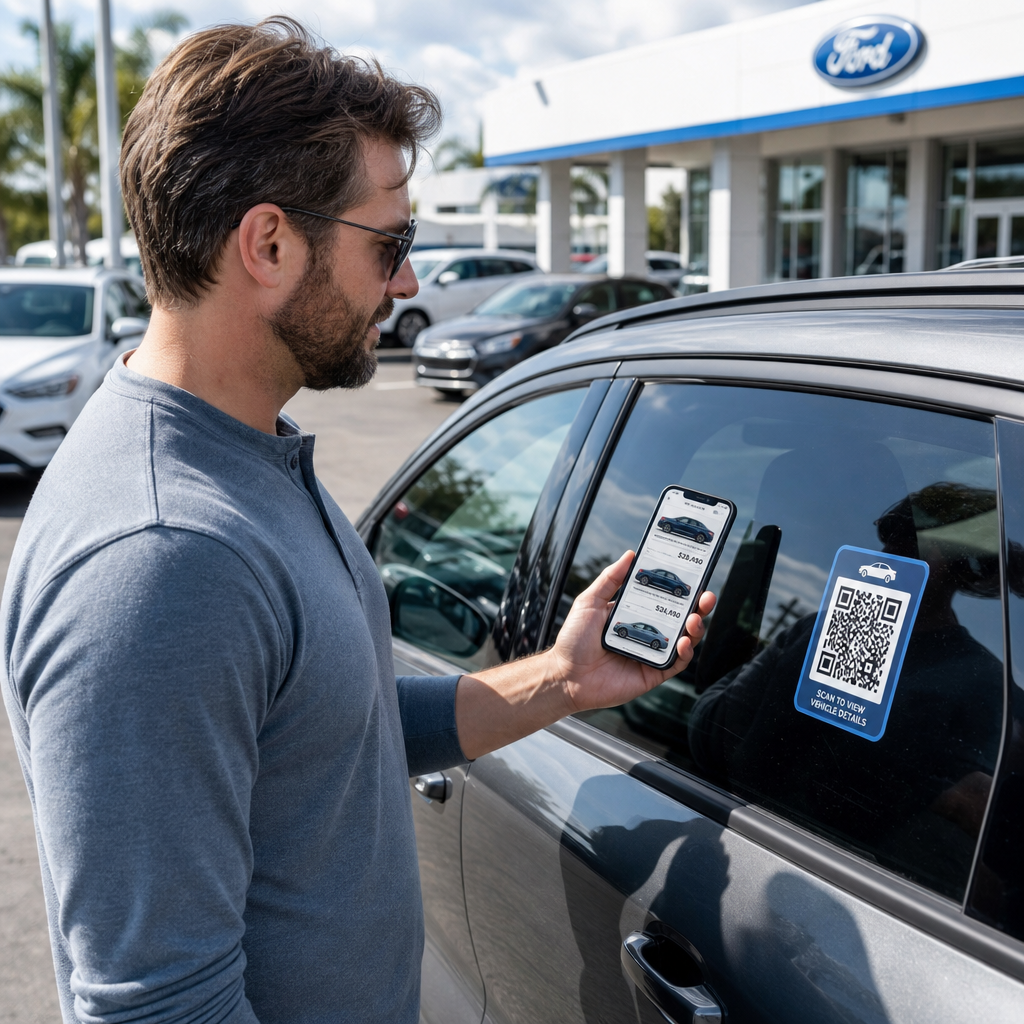
The most direct application for a dealership is placing a QR code on each vehicle’s window sticker. When a shopper walks the lot after hours, or while your sales team is occupied, a scan can immediately pull up a dedicated vehicle page showing specs, trim details, current pricing, financing options, photos, and a lead capture form.
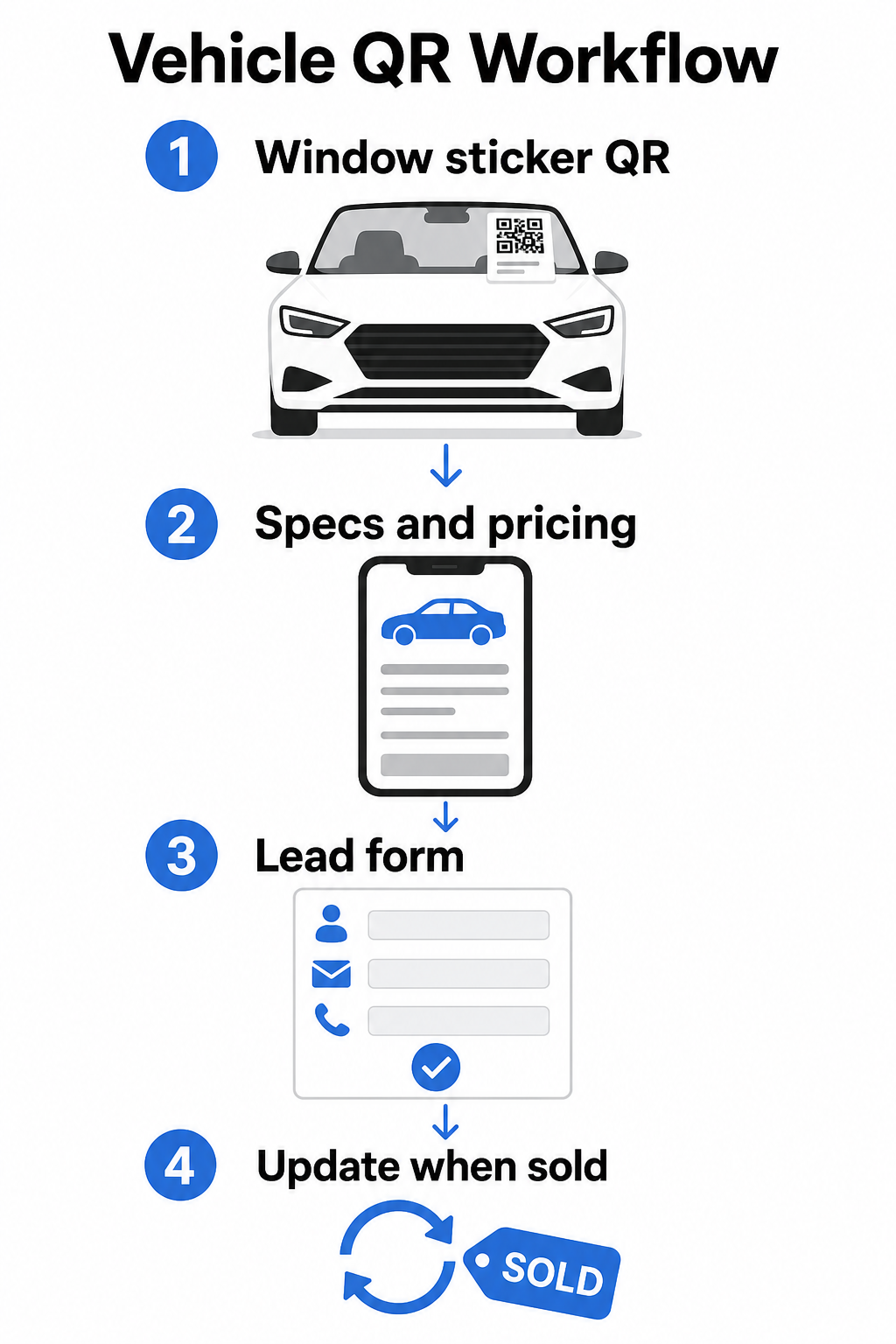
Because inventory moves fast, dynamic QR codes are the practical choice here. When a vehicle sells, you can redirect that code to a similar model or a general inventory page without touching the physical sticker. As the vehicle QR code guide notes, dynamic codes are ideal for dealership applications where campaigns and inventory are constantly changing.
For placement, the back window and side panels offer the best visibility to customers walking the lot. Make sure the code is large enough to scan comfortably from a standing position – a minimum of 1.2 inches is a reliable starting point for printed materials at close range, though larger is better when the code competes with other elements on a sticker. Always follow high-contrast design principles, using a dark code on a light background, so the code scans reliably under varying outdoor lighting conditions. Pageloot’s guide on praktik terbaik kontras warna kode QR covers this in detail.
Keep Inventory Links Current Without Reprinting Menggunakan Generator Kode QR Dinamis to create codes for window stickers that you can redirect any time a vehicle sells or a promotion changes.
Showroom Signage and Sales Floor Engagement
Inside the showroom, QR codes can handle the informational load that salespeople can’t always deliver instantly. Place codes near display vehicles, financing desks, or trade-in appraisal areas to link customers to relevant content – detailed spec sheets or comparison pages, current financing offers and payment calculators, trade-in valuation tools, video walkarounds, or customer testimonials and review pages.
SEBUAH kode QR halaman arahan works especially well here because you can surface multiple links from a single scan. For example, a vehicle landing page can include a video, a spec PDF, a financing inquiry form, and a contact option – all in one mobile-friendly layout that looks consistent with your brand.
For customers who are deeper in the consideration process, a QR code linking directly to a lead form can capture their name, contact information, and vehicle interest while they’re still engaged on the floor. The Generator Kode QR Formulir Google makes it straightforward to create and display inquiry codes on signage, counter cards, or desk displays, with the added ability to track responses directly.
Service Department Scheduling
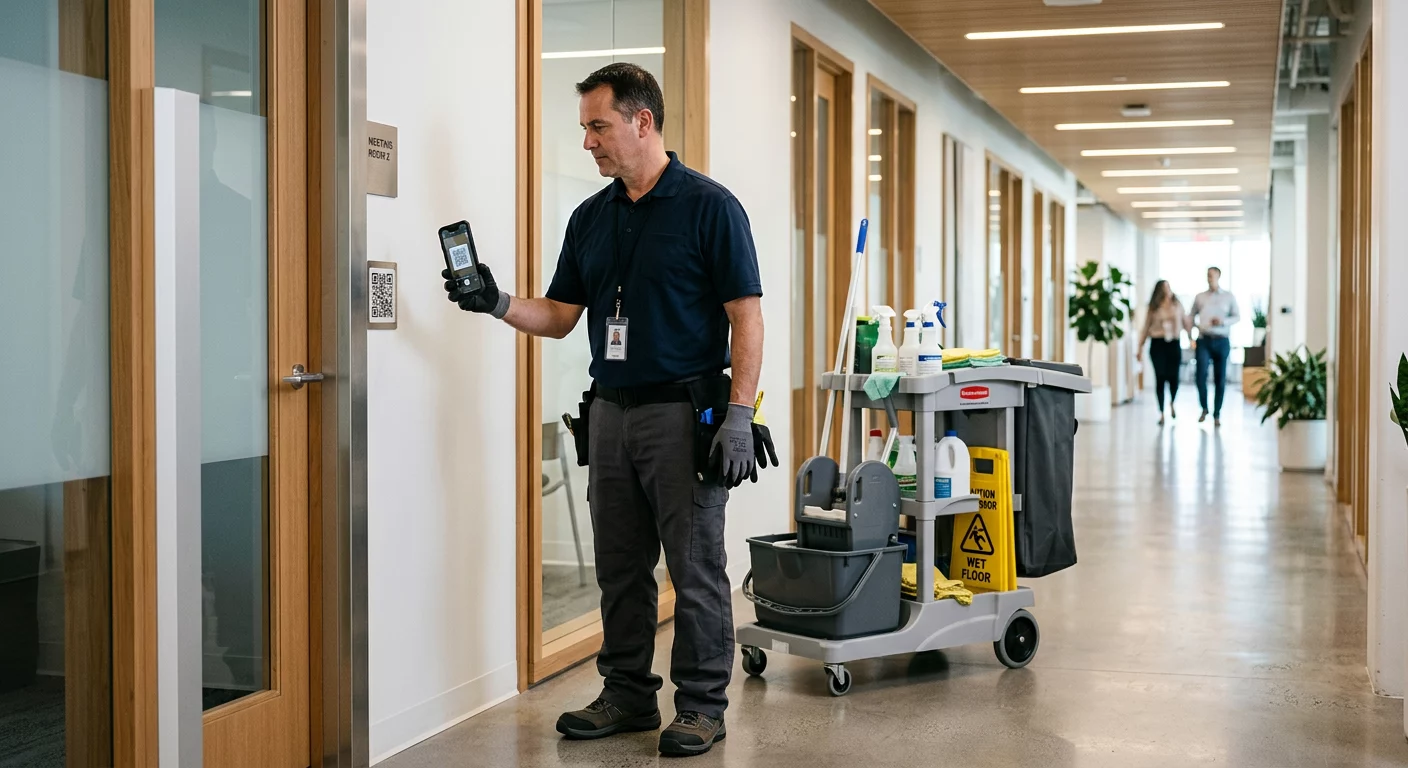
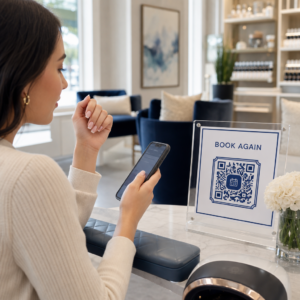
Service customers increasingly expect self-service booking options. Online scheduling is growing steadily each year as customers seek the convenience of choosing their own appointment times without a phone call. QR codes in your service drive, waiting area, and on past-due service reminder mailers give customers a one-scan path to your online booking tool.
Practical placement points include:
- Service drive entry: A sign or decal at the pull-in lane with a scan-to-schedule code for customers returning for repeat services
- Waiting room signage: A code linking to your service menu, service status page, or scheduling tool
- Service reminder postcards: A printed code on direct mail that lets customers book an oil change, tire rotation, or recall service without calling in
- On courtesy loaners or fleet vehicles: A QR code magnet or decal can link drivers to service contact information or scheduling options
Since service promotions rotate – seasonal tire deals, free multi-point inspections, and similar offers – dynamic QR codes in the service department let you update the destination to match the current promotion without replacing signage.
Direct Mail and Print Advertising Campaigns
Dealership direct mail campaigns – conquest mailers, service retention pieces, lease-end notifications – typically ask customers to call or visit a URL. A QR code on the same piece gives recipients a faster path to the relevant landing page, and more importantly, gives you a way to measure exactly how many people engaged with that mailer.
Dengan dynamic QR codes and scan analytics, you can see total scans, unique scans, scan times, geographic locations, and device types – all tied to that specific campaign piece. This level of measurement is significantly more actionable than tracking a phone number or a generic URL.
For A/B testing, you can create two versions of a mailer with different QR code destinations – one linking to a specific offer page and one to a general inventory page, for example – and compare scan and conversion rates to inform future campaigns. Adding UTM parameters to your destination URLs extends this tracking into your broader web analytics, connecting QR scan data to form completions, time on site, and other downstream actions.
Track Which Campaigns Are Driving Engagement Create trackable QR codes for every print campaign with the Generator Kode QR Tautan and monitor scan performance from a single dashboard.
Collecting Reviews and Customer Feedback
Cox Automotive’s 2025 Car Buyer Journey Study found that buyers who complete more steps digitally report higher satisfaction – which means post-purchase follow-through matters as much as the sale itself. QR codes placed at delivery handoff, on thank-you cards, or in service waiting areas can funnel satisfied customers directly to your Google Business review page.
SEBUAH kode QR Ulasan Google removes all friction from the review process: one scan takes the customer directly to the review submission screen, without requiring them to search for your dealership or navigate Google Maps. Effective placement includes:
- The delivery desk or F&I office
- Service cashier counters
- Inside a branded thank-you card included with new vehicle deliveries
- Service follow-up mailers sent after a completed appointment
Design and Placement Principles for Dealership QR Codes
A few practical standards apply across all dealership QR code applications:
- Kontras: Use a dark module color on a light background. Black on white is the most reliable combination. Avoid reversed codes (light on dark), as some scanner apps struggle with them.
- Ukuran: For window stickers and lot signage, err larger rather than smaller. At a scanning distance of one to two feet, a 1.5-inch code works reliably on smooth surfaces. For larger format signage, scale up proportionally – the panduan ukuran kode QR untuk bahan cetak covers these ratios in detail.
- Quiet zone: Leave clear space around the code, free of text or design elements, so scanners can locate the code boundaries accurately.
- CTA text: Always pair the code with a short call to action – “Scan for Pricing,” “Book Service Online,” “See Full Specs” – so customers know what they’ll get before scanning.
- Testing: Test every code in actual conditions before deploying – outdoors on the lot, under showroom lighting, in direct sunlight – on both iOS and Android devices. The QR code readability best practices guide provides a full checklist.
Tracking and Measuring QR Code Performance
One of the strongest reasons to use dynamic QR codes over static ones is built-in scan analytics. For a dealership with active codes across the lot, showroom, service drive, and print campaigns, a centralized dashboard lets you compare which placements and campaigns are generating the most engagement.
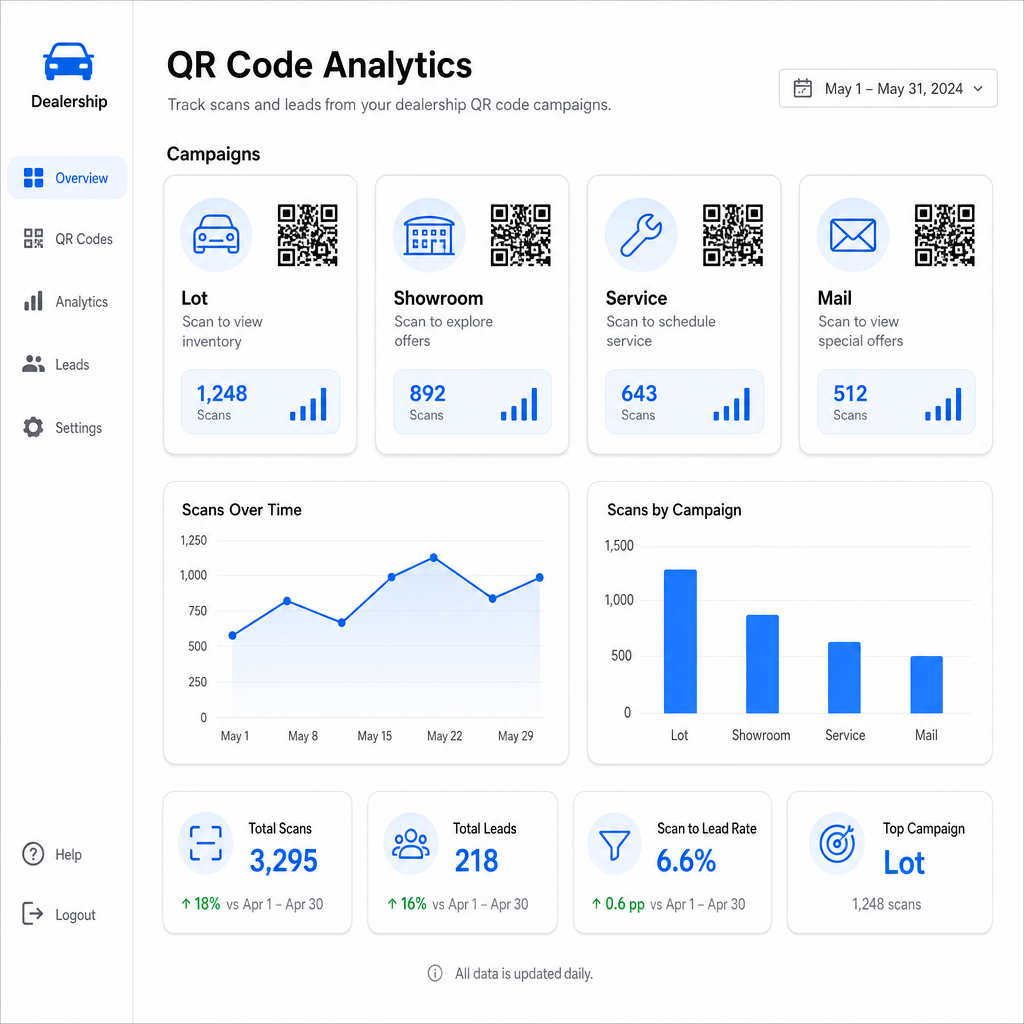
Key metrics available through Pageloot’s tracking include:
- Total and unique scan counts per code
- Scan times and dates, useful for understanding lot traffic patterns
- Geographic location data, relevant for direct mail campaigns across zip codes
- Device types and operating systems
- Scan trends over time
This data feeds directly back into decisions about where to place codes, which offers to promote, and which vehicles to feature. Pageloot’s QR code tracking guide explains how to connect scan data with UTM parameters and external analytics tools for full-funnel visibility.
Pageloot’s platform also covers QR code solutions across industries, so if your dealership group operates across multiple business types or locations, the same tools and tracking infrastructure apply consistently.
Monitor All Your Codes from One Dashboard Manage every dealership QR code – lot, service, mailers, showroom – with the Generator Kode QR Dinamis and access real-time scan data across all your campaigns.
QR codes give your dealership a measurable, flexible way to bridge your physical locations with digital engagement – whether a customer is walking your lot at midnight or sitting in your service waiting room. Start with your highest-traffic touchpoints, use dynamic codes so you can update destinations without reprinting, and let scan analytics guide where you expand from there.
Pertanyaan yang Sering Diajukan
Yes, if you use a dynamic QR code. Dynamic codes point to a short redirect link that you can update at any time from your dashboard, so the physical sticker stays the same while the destination reflects current pricing or availability. If a vehicle sells, you can redirect that code to a similar model without reprinting anything.
Dynamic QR codes include scan analytics that show you how many people scanned each code, when, from what location, and on what device. By pairing QR code destinations with UTM parameters, you can track which scans resulted in form completions, appointment bookings, or inventory page views inside your broader web analytics platform.
For a window sticker scanned at arm’s length – roughly one to two feet – a minimum of 1.2 inches is a reasonable starting point on a smooth, high-contrast surface. Larger codes scan more reliably, especially outdoors in varying light. If the sticker includes your dealership logo inside the code, increase the size by 20–30% to maintain scannability. Always test the final printed version in real conditions before full deployment.