Er du usikker på hvilke personopplysninger QR-kodene dine faktisk avslører – og hva du kan gjøre med det? Hvert skann går gjennom sporingsservere som logger IP-adresser, enhetstyper, tidsstempler og posisjonsdata, ofte uten at brukere er klar over det. Denne guiden forklarer fem velprøvde anonymiseringsmetoder som reduserer personvernrisikoen samtidig som analysene dine forblir nyttige.
Hva QR-kodeskanning faktisk avslører
Før du velger en anonymiseringsstrategi, er det nyttig å forstå hvilke data som samles inn i utgangspunktet.
Når noen skanner en dynamisk QR-kode, går forespørselen deres først gjennom plattformens omdirigeringsserver før den lander på destinasjons-URL-en din. Det omdirigeringsøyeblikket er når skannedata logges. Avhengig av plattform og konfigurasjon kan dette inkludere:
- IP-adresse (brukes til å estimere geografisk plassering)
- Enhetstype, operativsystem og nettleser
- Tidsstempel for skanningen
- Antall skanninger (totalt og unikt)
Destinasjonsnettstedet kan samle inn enda mer – informasjonskapsler, henvisningsdata og all informasjon brukere legger inn. Statiske QR-koder omgår denne omdirigeringen fullstendig og videresender brukere direkte til den endelige URL-en uten å logge noe, men de tilbyr heller ingen analyser.
Å forstå disse dataflytene er utgangspunktet for å anvende riktig anonymiseringsmetode. Du kan også se gjennom hvilke data dynamiske QR-koder samler inn for en dypere gjennomgang før du bestemmer deg for en tilnærming.
Se nøyaktig hva QR-kodene dine sporer Bruk Pageloot’s analysepanel for å gjennomgå hvilke skannedata som samles inn og konfigurere sporingen din for å matche personvernkravene dine.
5 metoder for å anonymisere QR-kodedata
1. Maskering
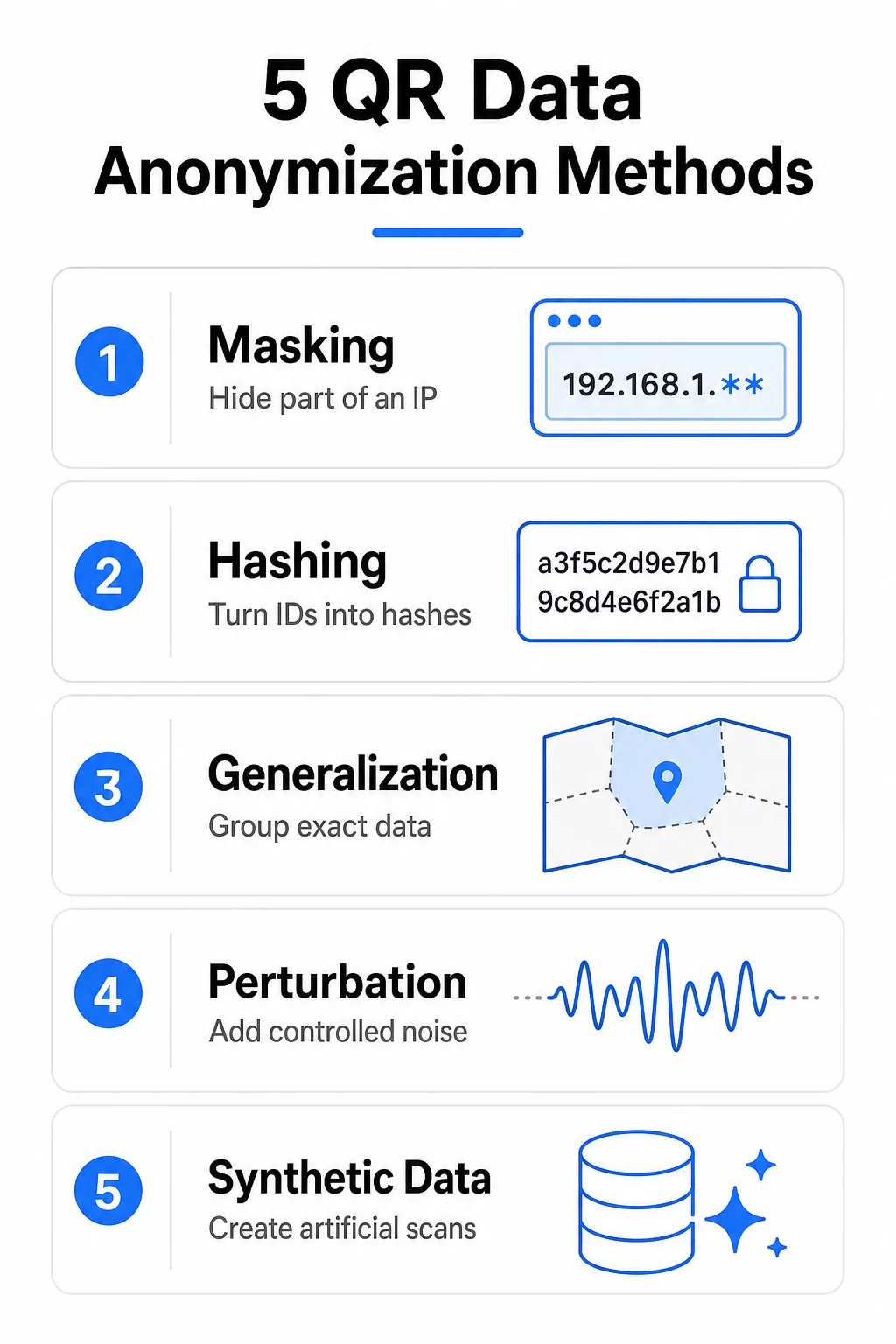
Maskering skjuler eller erstatter sensitive datafelt slik at de underliggende verdiene ikke kan leses, samtidig som dataene i seg selv forblir strukturelt brukbare. I en QR-kodekontekst gjelder dette vanligvis data samlet inn på omdirigeringsserveren eller lagret i analysesystemer – for eksempel å erstatte den siste oktetten av en IP-adresse med en null før den skrives til en database.
Personvernstyrke: Maskering gir moderat beskyttelse. Det forhindrer tilfeldig eksponering, men forblir sårbart for inferensangrep hvis tilstrekkelig kontekst er tilgjengelig. Det brukes best som ett lag i en bredere personvernstrategi snarere enn en frittstående løsning.
Datanytte: Fordi maskering bevarer datastrukturen, forblir aggregert analyse fullt funksjonell. Du kan fortsatt måle skannevolum, regionale trender og enhetsdistribusjon uten å få tilgang til individuelle identiteter.
Implementeringskompleksitet: Maskering er blant de enkleste teknikkene å implementere. Det innebærer å identifisere hvilke felt som trenger beskyttelse og konsekvent anvende substitusjonsregler. Moderne QR-kodeplattformer kan automatisk anvende IP-maskering ved innsamlingspunktet, før noen verdi lagres.
Regulatorisk samsvar: Maskering alene tilfredsstiller ikke GDPRs anonymiseringskrav, fordi regulatorer behandler maskerte data som potensielt fortsatt knyttbare til enkeltpersoner. Det støtter imidlertid samsvar ved å redusere eksponering og demonstrere god tro dataminimering – et av kjerneprinsippene under både GDPR og CCPA.
2. Hashing
Hashing konverterer sensitive verdier til strenger med fast lengde ved hjelp av en kryptografisk algoritme, noe som gjør det umulig å gjenopprette den opprinnelige inndataen fra utdataene. En brukers e-postadresse eller enhetsidentifikator blir for eksempel en kryptert streng som fortsatt kan brukes til matching eller deduplisering innenfor et system.
Personvernstyrke: Sterk i prinsippet, men ikke absolutt. Lav-entropi-verdier – de med et begrenset sett av mulige inndata – kan være sårbare for brute-force-angrep. Å legge til et salt (en tilfeldig streng lagt til før hashing) og rotere nøkler regelmessig gjør angrep betydelig vanskeligere.
Datanytte: Hashing er godt egnet for deduplisering og konsistenskontroller, for eksempel å identifisere gjentatte skannere uten å lagre deres identifikatorer. Det er mindre nyttig for detaljert atferdsanalyse eller integrasjoner som krever de opprinnelige verdiene.
Implementeringskompleksitet: Grunnleggende hashing er enkelt og bredt støttet i de fleste utviklingsmiljøer. De ekstra trinnene med salting og nøkkelhåndtering legger til kompleksitet og krever et sikkert system for lagring og rotasjon av disse verdiene.
Regulatorisk samsvar: Federal Trade Commission har uttalt at hashing alene ikke utgjør anonymisering. Artikkel 29-arbeidsgruppen (nå European Data Protection Board) har på lignende måte bemerket at “hashing er et nyttig sikkerhetstiltak, men er ikke en metode for anonymisering.” Under GDPR behandles hashet personopplysninger fortsatt som personopplysninger. Under CCPA kan hashet data kvalifisere som deidentifisert hvis passende tekniske kontroller og interne retningslinjer er på plass, men bedrifter må håndheve disse retningslinjene konsekvent og dokumentere sine risikovurderinger.
3. Generalisering
Generalisering erstatter spesifikke dataverdier med bredere kategorier eller områder. I stedet for å lagre et presist tidsstempel, lagrer du timen eller dagen. I stedet for å lagre en by, lagrer du en region. I stedet for en eksakt alder, lagrer du et aldersintervall.
For QR-kodeanalyse kan dette bety å registrere at en skanning skjedde “på ettermiddagen på en ukedag” i stedet for kl. 14:17 på en tirsdag, eller å tilskrive en skanning til “Stillehavsnordvesten” i stedet for et spesifikt postnummer.
Personvernstyrke: Moderat, og avhengig av hvor bredt verdier er gruppert. Risikoen for re-identifisering øker når flere generaliserte felt kombineres. En sak fra 2007 som involverte et Netflix-datasett viste at forskere kunne re-identifisere brukere ved å kryssreferere generaliserte vurderingsdata med eksterne kilder – en advarsel om at selv aggregerte data krever nøye design.
Datanytte: Generalisering bevarer nok detaljer for trendanalyse og kampanjemåling. Bedrifter som bruker QR-koder i detaljhandel eller gjestfrihet kan fortsatt identifisere toppperioder, populære regioner og enhetspreferanser uten å avsløre individuell atferd.
Implementeringskompleksitet: Generalisering kan implementeres manuelt ved å sette kategorigrenser, eller automatisk ved hjelp av algoritmer som balanserer personvern og dataoppløsning. Begge tilnærmingene krever definering av klare retningslinjer for hvilket detaljnivå som er passende for hvert datafelt.
Regulatorisk samsvar: Generalisering er i tråd med dataminimeringsprinsippene i GDPR og CCPA, som krever innsamling av kun det som er nødvendig for et spesifisert formål. Det tilfredsstiller ikke automatisk anonymiseringsstandarder alene, men bidrar meningsfullt til en lagdelt tilnærming. Dokumentering av generaliseringsbeslutningene dine og regelmessig gjennomgang av dem støtter revisjonsberedskap.
4. Dataperturbasjon
Dataperturbasjon introduserer små, kontrollerte mengder støy i numeriske eller geografiske data. I stedet for å registrere en eksakt verdi, lagrer systemet en litt modifisert versjon – et tidsstempel forskjøvet med noen minutter, koordinater avrundet til et bredere område, eller et antall justert innenfor et definert område.
Denne tilnærmingen er vanlig i felt der statistisk nøyaktighet betyr mer enn presisjon for individuelle poster. Sykehus har brukt det til å dele pasientdata med forskere samtidig som private medisinske detaljer beskyttes; finansinstitusjoner bruker det på transaksjonsdata for å forhindre eksponering av sensitive mønstre.
Personvernstyrke: Perturbasjon skaper en balanse mellom å maskere spesifikke detaljer og bevare analytiske mønstre. Nivået av personvern det gir, avhenger direkte av hvor mye støy som introduseres. For lite, og individuelle poster forblir identifiserbare. For mye, og dataene mister mening.
Datanytte: I motsetning til teknikker som fullstendig fjerner originale verdier, beholder perturbasjon de statistiske forholdene innenfor et datasett. Trendanalyse, toppidentifikasjon og geografisk klynging forblir alle gyldige – bare uten evnen til å identifisere eksakte individer.
Implementeringskompleksitet: Perturbasjon krever mer teknisk vurdering enn maskering eller generalisering. Valget av transformasjonsmetode – tilfeldig støy, verdibytte eller matematiske transformasjoner som wavelet- eller Fourier-metoder – påvirker både ytelse og personvernresultater. Wavelet-transformasjoner, for eksempel, opererer med O(n) tidskompleksitet, noe som gjør dem raskere enn noen alternativer. Nøye kalibrering er nødvendig for å unngå å introdusere systematisk skjevhet.
Regulatorisk samsvar: Perturbasjon støtter GDPRs krav til dataminimering og gir en forsvarlig teknisk sikkerhet. Det garanterer ikke full anonymisering, men demonstrerer en meningsfull innsats for å begrense identifiserbarhet, noe regulatorer generelt ser positivt på når det kombineres med andre kontroller.
5. Syntetisk datagenerering
Syntetisk datagenerering skaper helt kunstige datasett som speiler de statistiske egenskapene til reelle data uten å inneholde faktisk brukerinformasjon. I stedet for å endre det som ble samlet inn, erstatter det de originale dataene med fabrikkerte poster som oppfører seg som ekte for analytiske formål.
For QR-kodeanalyse betyr dette å generere realistiske skanningstidspunkter, sannsynlige geografiske distribusjoner og representative enhetsmikser – uten at noen av disse postene tilsvarer faktiske skanninger utført av ekte mennesker.
Personvernstyrke: Syntetiske data tilbyr den sterkeste personvern-beskyttelsen av de fem metodene. Fordi det ikke inneholder ekte personlig informasjon, er det ingen risiko for re-identifisering selv om datasettet blir eksponert. Et brudd på et syntetisk datasett har ingen personvernkonsekvenser for enkeltpersoner.
Datanytte: Når det er godt generert, bevarer syntetiske data de statistiske forholdene som trengs for trendanalyse, modelltrening og funksjonstesting. Det gjør det også mulig å simulere scenarier som er sjeldne i virkelige data – nyttig for stresstesting av analysesystemer eller trening av maskinlæringsmodeller på grensetilfeller.
Implementeringskompleksitet: Dette er den mest ressurskrevende metoden. Generering av syntetiske data av høy kvalitet krever spesialiserte verktøy, betydelige beregningsressurser og valideringsprosesser for å bekrefte at det syntetiske datasettet nøyaktig representerer originalen. Organisasjoner trenger vanligvis dedikert ekspertise eller tredjepartsplattformer for å implementere det pålitelig.
Regulatorisk samsvar: Fordi syntetiske data ikke inneholder personlig informasjon, faller det i seg selv utenfor omfanget av GDPR, CCPA og de fleste andre personvernforskrifter. Dette gjør det spesielt verdifullt for bransjer med strenge samsvarskrav, som helsevesenet og utdanning. Det eliminerer risikoen for re-identifisering som andre metoder aktivt må håndtere.
Begynn å samle inn Personvernvennlig QR-analyse Pageloots Dynamisk QR-kode generator aggregerer skannedata på land- og bynivå, grupperer enheter i generelle kategorier, og avslører aldri individuelle identiteter i sin analyse. Prøv det gratis i 14 dager.
Metodesammenligning
| Metode | Personvernstyrke | Datanytte | Implementeringskompleksitet | Regulatorisk samsvar |
|---|---|---|---|---|
| Maskering | Moderat | Høy | Lav | Delvis – støtter minimering, ikke full anonymisering |
| Hashing | Moderat–Høy | Medium | Medium | Delvis – fortsatt personopplysninger under GDPR |
| Generalisering | Moderat | Middels–Høy | Lav–Middels | Delvis – støtter minimeringsprinsipper |
| Dataperturbasjon | Moderat | Middels–Høy | Høy | Bra – fleksibel, forsvarlig beskyttelse |
| Syntetiske data | Veldig høy | Høy | Veldig høy | Utmerket – ligger i sin natur utenfor GDPR/CCPA-omfanget |
Den rette metoden avhenger av ditt bruksområde. Maskering og generalisering er praktiske utgangspunkt for de fleste QR-kodeanalyseplattformer. Hashing fungerer bra for dedupliseringsoppgaver der eksakte verdier ikke er nødvendig senere. Perturbasjon passer for scenarier der statistisk nøyaktighet er kritisk. Syntetiske data er det sterkeste alternativet når samsvarsrisikoen er høy, eller når du trenger å dele datasett eksternt.
Mange organisasjoner bruker disse metodene i kombinasjon i stedet for å velge bare én – for eksempel ved å bruke IP-maskering ved innsamlingstidspunktet, generalisere stedsdata til bynivå, og generere syntetiske datasett for eventuelle eksterne analysepartnere.
Hvordan Pageloot Tilnærmer Seg QR-kode Datapersonvern
Pageloots analyser er bygget rundt aggregerte, ikke-personlig identifiserbare data. Stedsdata vises på land- eller bynivå, enhetsinformasjon er gruppert i generelle kategorier som iOS eller Android, og IP-adresser lagres ikke i en form som identifiserer enkeltpersoner. Plattformen tilbyr fleksible alternativer for datalagring, og bedriftsbrukere har tilgang til CSV-eksporter som støtter ytterligere anonymisering senere.

For bedrifter som kjører kampanjer på tvers av flere regioner, vil analysefunksjonene tillate deg å måle ytelse uten å bygge profiler på individuelle brukere. Pageloot støtter også GDPR-kompatibel QR-kodeanalyse gjennom samtykke-pop-ups, datahåndteringsverktøy og kryptert lagring med regelmessige sikkerhetsgjennomganger.
For kontekst om hvilke personvernlover for QR-koder gjelder for din spesifikke situasjon – inkludert GDPR, CCPA, HIPAA og andre – og hvordan du implementerer passende regler for datalagring for QR-kodeanalyse, Pageloots kunnskapsbase dekker hver forskrift med praktisk veiledning.
Velge riktig tilnærming for din bedrift
Ingen enkelt anonymiseringsmetode fungerer for enhver situasjon. FTCs veiledning er tydelig: samle kun inn det du trenger, behold det bare så lenge det er nødvendig, og kast det på riktig måte når det har tjent sitt formål. Dette prinsippet gjelder uavhengig av hvilken teknisk metode du bruker.
For de fleste bedrifter som bruker QR-koder i markedsføring eller drift, er et praktisk utgangspunkt å aktivere IP-maskering og lokasjonsgeneralisering på plattformnivå, gjennomgå hvilke data din analyseintegrasjon samler inn, og sette definerte lagringsgrenser. For organisasjoner i regulerte bransjer eller de som deler data med tredjeparter, kan sterkere metoder – perturbasjon eller syntetiske data – være verdt den ekstra implementeringsinvesteringen.
Målet er ikke perfekt anonymisering på bekostning av all innsikt. Det handler om å finne det nivået av personvern som er passende for sensitiviteten til dataene du samler inn, forskriftene som gjelder for din virksomhet, og tilliten du ønsker å bygge med brukerne dine.
Utforsk Pageloots fulle utvalg av QR-kodefunksjoner for å se hvordan personvernkontroller passer inn i den bredere plattformen, eller se gjennom personvernrisikoene med QR-koder og hvordan du unngår dem for et bredere blikk på trusselbildet.
Ofte stilte spørsmål
Nei. Artikkel 29-arbeidsgruppen har uttalt at hashing er et sikkerhetstiltak, ikke en anonymiseringsmetode. Under GDPR er hashet personopplysninger fortsatt klassifisert som personopplysninger og underlagt de samme beskyttelsene som originalen. For å kvalifisere som anonymt under GDPR, må data være irreversibelt fratatt enhver forbindelse til en identifiserbar enkeltperson.
Maskering erstatter eller tilslører spesifikke feltverdier – for eksempel å erstatte deler av en IP-adresse med nuller – samtidig som strukturen beholdes intakt. Generalisering erstatter presise verdier med bredere kategorier, som for eksempel å konvertere et eksakt tidsstempel til et tidsintervall på dagen eller en by til en region. Maskering er bedre for å beskytte spesifikke identifikatorer; generalisering er bedre for å redusere oppløsningen av data på tvers av flere felt samtidig.
Generering av syntetiske data gir den sterkeste samsvarsposisjonen fordi det ikke inneholder ekte personlig informasjon og faller utenfor omfanget av de fleste personvernforskrifter. For virksomheter som trenger å beholde ekte skannedata, gir en kombinasjon av IP-maskering, lokasjonsgeneralisering og definerte oppbevaringsgrenser et forsvarlig grunnlag. Den rette metoden avhenger av datens følsomhet, hvordan du bruker analysene, og om du deler data med tredjeparter.