¿Están quedando obsoletos los códigos de barras tradicionales? Con la industria minorista planeando activamente reemplazarlos, muchas empresas necesitan entender qué está cambiando y qué significa para sus operaciones. Este artículo desglosa el cambio de códigos de barras 1D a códigos 2D, qué lo impulsa y cuál es la situación actual.
La Respuesta Corta: Los Códigos de Barras Aún No Han Muerto
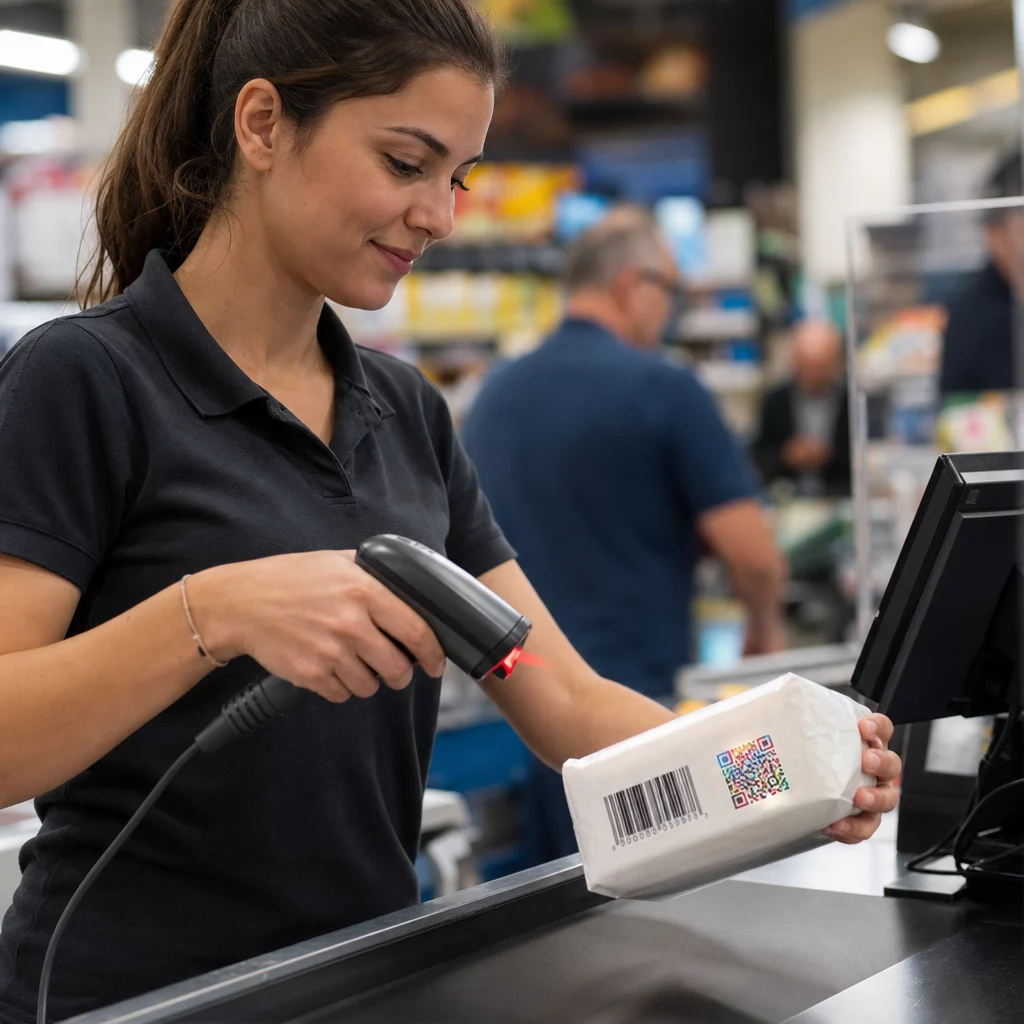
El clásico código de barras 1D –el tipo que ves en cada caja de cereal y producto de supermercado– ha estado en uso desde principios de la década de 1970. Permanece profundamente arraigado en la infraestructura global de venta minorista y cadena de suministro. Decenas de miles de millones de productos llevan códigos UPC o EAN, y la mayoría de los sistemas de punto de venta (POS) minoristas están construidos para escanearlos.
Pero “no muerto” no es lo mismo que “aquí para quedarse sin cambios”. La industria se está alejando activamente de los códigos de barras 1D, con una fecha límite clara a la vista.
¿Qué es GS1 Sunrise 2027?
GS1 –el organismo internacional de estándares que rige los códigos de barras y la identificación de productos– ha establecido una iniciativa global llamada Sunrise 2027. El objetivo es sencillo: para finales de 2027, cada sistema POS minorista en todo el mundo debería ser capaz de escanear y procesar códigos de barras 2D.
GS1 US describe el cambio como un esfuerzo para dar a los minoristas mayor transparencia, una trazabilidad más sólida y datos más ricos en toda la cadena de suministro. Esto no es un movimiento marginal. Según GS1 UK, el 82% de los minoristas y el 92% de los propietarios de marcas apoyan la transición de códigos de barras lineales a códigos 2D en los próximos cinco años.
Durante la transición, se espera que los códigos de barras 1D y 2D coexistan en el empaque del producto. La guía de GS1 recomienda específicamente que los propietarios de marcas coloquen códigos 2D junto a sus códigos de barras lineales existentes para asegurar una opción de escaneo de respaldo confiable en los sistemas POS que aún no han sido actualizados.
Para una mirada más profunda sobre cómo funcionan los códigos QR GS1 Digital Link en la práctica, vea cómo implementar códigos QR GS1 Digital Link de manera efectiva.
Por Qué los Códigos de Barras 2D Están Reemplazando a los Códigos 1D
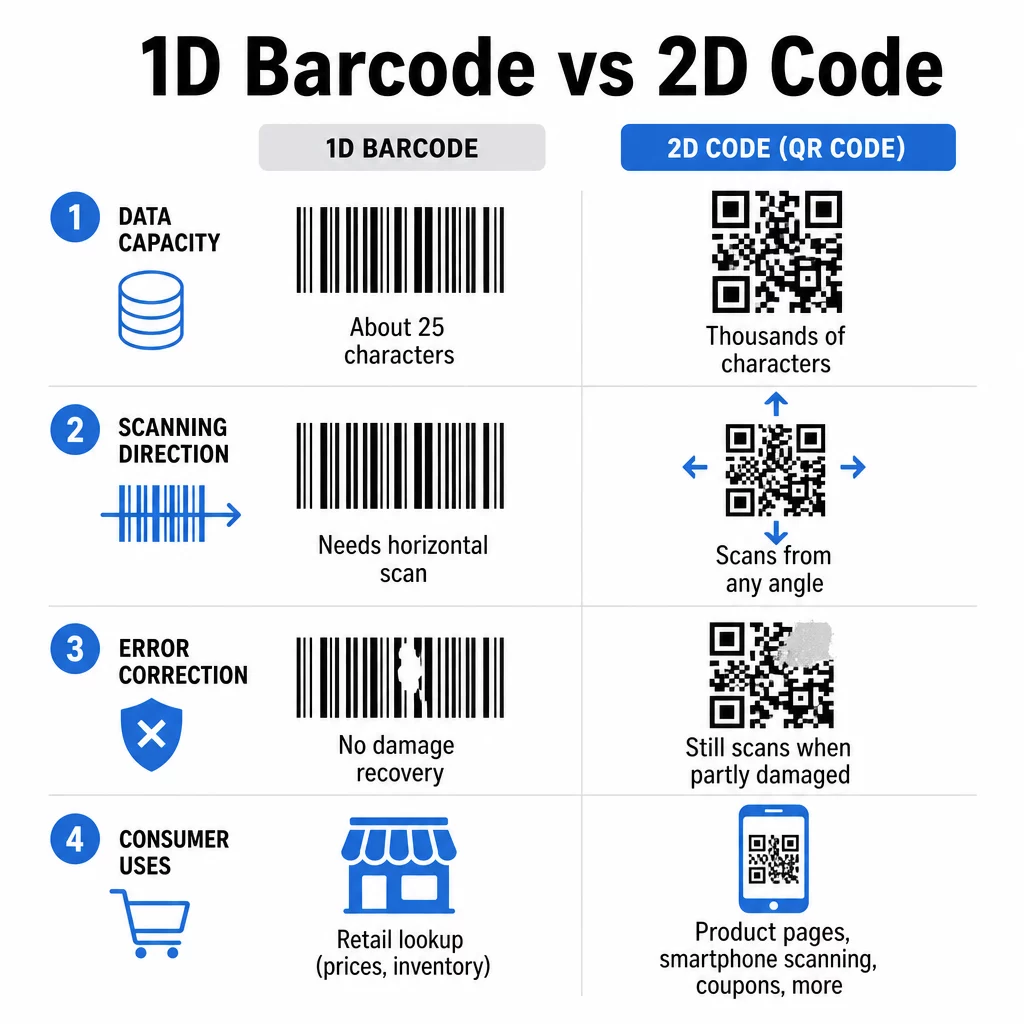
La limitación principal de un código de barras 1D tradicional es su capacidad de datos. Un código UPC o EAN estándar puede contener aproximadamente 20-25 caracteres, justo lo suficiente para codificar un número de identificador de producto. Todo lo demás, como el precio, la descripción y los datos de inventario, debe recuperarse de una base de datos conectada.
Un código de barras 2D cambia esa ecuación por completo. Esto es lo que un código 2D puede codificar directamente en el propio símbolo:
- Número Global de Artículo Comercial (GTIN)
- Números de lote y partida
- Números de serie
- Fechas de caducidad
- Peso y precio
- URL que enlazan a páginas de información del producto
Esto tiene consecuencias prácticas en toda la cadena de suministro. Debido a que los códigos de barras 2D llevan datos detallados del producto y la producción dentro del propio símbolo, reducen la dependencia de una conectividad constante a la base de datos. Esto hace que la trazabilidad, la auditoría y las retiradas de productos sean más rápidas y fiables: no es necesario consultar un registro de la base de datos para conocer el número de lote o la fecha de caducidad de un producto.
Los códigos de barras 2D también admiten escaneo omnidireccional, lo que significa que pueden leerse desde cualquier ángulo. Incluyen corrección de errores incorporada, por lo que siguen siendo escaneables incluso si el código está parcialmente dañado o impreso en superficies irregulares. Un escáner láser estándar solo puede leer códigos de barras 1D en una única pasada horizontal; la lectura de un código 2D requiere un escáner basado en imágenes, lo cual es parte de la razón por la que las actualizaciones del sistema POS son un paso necesario en la transición de Sunrise 2027.
Tipos Comunes de Códigos de Barras 2D
No todos los códigos de barras 2D son iguales. Los dos formatos más utilizados son los códigos QR y los códigos Data Matrix, y sirven para diferentes propósitos.
Códigos QR fueron diseñados para una lectura rápida y la interacción con el consumidor. Admiten una gran capacidad de datos y son fácilmente escaneados por cámaras de teléfonos inteligentes, lo que los hace populares para marketing, pagos e información de productos. En el contexto de GS1, los códigos QR impulsados por GS1 Digital Link pueden servir simultáneamente para el pago en tiendas y la interacción con el consumidor desde un único código en el paquete.
Códigos Data Matrix están optimizados para el marcado de artículos pequeños con una densidad de datos muy alta. Se utilizan comúnmente en las industrias aeroespacial, electrónica, de atención médica y farmacéutica, donde el espacio es limitado y los escáneres industriales son la norma. Para una comparación detallada, consulte Data Matrix vs Código QR – cuál es la diferencia.
Donde los códigos de barras 1D todavía tienen sentido
A pesar del impulso detrás de los códigos 2D, los códigos de barras tradicionales no desaparecerán de la noche a la mañana. Varias realidades prácticas los mantienen en uso:
- Infraestructura heredada: La mayoría de los sistemas POS minoristas actuales todavía leen códigos de barras 1D. La fecha límite de Sunrise 2027 existe precisamente porque la actualización de esos sistemas requiere tiempo e inversión.
- Simplicidad para casos de uso básicos: Para el seguimiento interno de activos o la gestión simple de inventario donde la capacidad de datos no es una limitación, los códigos de barras 1D siguen siendo una opción rentable.
- Coexistencia durante el período de transición: La guía de GS1 reconoce explícitamente que para diciembre de 2027, no todos los minoristas podrán leer códigos de barras 2D, razón por la cual se recomienda la co-ubicación de ambos tipos de códigos durante la transición.
Los tres tipos de códigos de barras más utilizados en el comercio minorista hoy en día siguen siendo el UPC (utilizado principalmente en EE. UU., Reino Unido, Australia y Nueva Zelanda), el EAN (utilizado en Europa e internacionalmente) y el ITF (utilizado para envíos globales en embalajes de cartón, con hasta 14 dígitos numéricos y mayor tolerancia a errores). Estos no desaparecerán de inmediato, sino que están siendo complementados y eventualmente reemplazados.
Puedes aprender más sobre tipos de códigos de barras y cómo crear códigos escaneables para tu caso de uso específico.
Códigos de barras vs. Códigos QR: Una comparación práctica
| FUNCIÓN | Código de barras 1D (UPC/EAN) | Código de barras 2D / Código QR |
|---|---|---|
| Capacidad de datos | ~20–25 caracteres | Hasta 7,000+ caracteres |
| Dirección de escaneo | Paso horizontal único | Omnidireccional |
| Corrección de errores | Ninguno | Sí (hasta ~30% de tolerancia a daños) |
| Escaneo por el consumidor | Requiere escáner dedicado | Funciona con cámaras de smartphone |
| Dinámico/editable | No | Sí (con códigos QR dinámicos) |
| Interacción con el consumidor | Limitado | URLs, páginas de productos, promociones |
| Preparación para POS (2025) | Universal | Expandiendo con Sunrise 2027 |
Para un desglose completo de las ventajas y desventajas, consulte código de barras vs código QR – qué es mejor para su negocio.
Qué Significa Esto para Su Negocio
Si actualmente utiliza códigos de barras 1D para productos minoristas, el cronograma de Sunrise 2027 es relevante. Añadir un código 2D – específicamente un código QR GS1 Digital Link – junto a su código de barras existente prepara su empaque para un mundo donde los sistemas POS pueden leer y procesar los datos más ricos que proporcionan los códigos 2D.
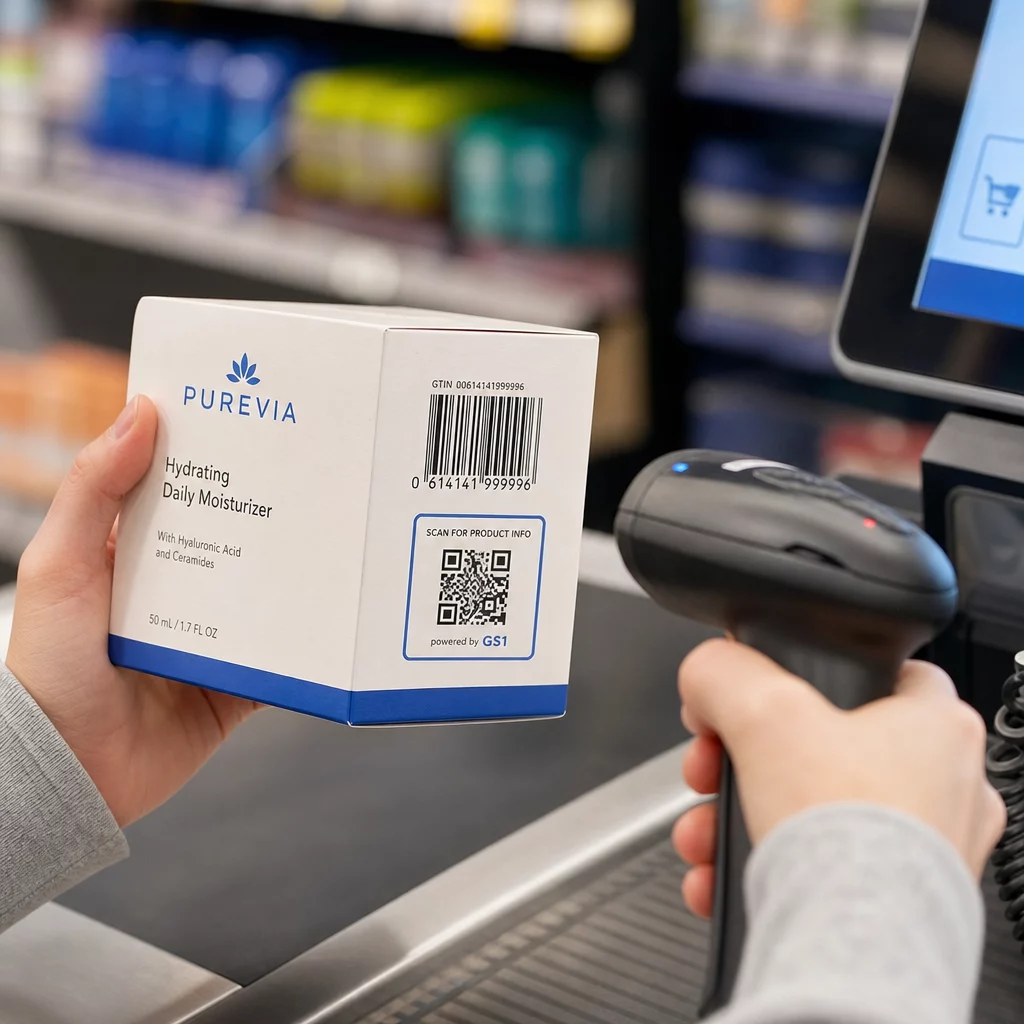
Si utiliza códigos de barras para la interacción con el consumidor – dirigiendo a las personas a páginas de productos, manuales o promociones – los códigos QR ya son la opción más capaz. A diferencia de un código de barras 1D estático, un código QR dinámico le permite actualizar la URL de destino después de la impresión, para que pueda apuntar el mismo código en el empaque existente a contenido nuevo sin una reimpresión.
Los códigos QR en el empaque pueden vincular a los clientes a información nutricional, videos instructivos, reseñas, promociones y opciones de suscripción. Para obtener orientación práctica sobre la ubicación y el diseño, consulte Cómo usar códigos QR en el envase de tus productos.
También puede escanear códigos de barras y códigos QR en línea usando una cámara o una imagen cargada si necesita verificar cómo se leen sus códigos antes de imprimir.
Actualice Sus Códigos de Producto Sin Reimprimir Si necesita apuntar el empaque existente a contenido nuevo, el Generador de códigos QR dinámicos le permite cambiar el destino vinculado en cualquier momento y rastrear el rendimiento de escaneo desde un panel central.
Preguntas frecuentes
No inmediatamente. GS1 Sunrise 2027 establece un objetivo para que todos los sistemas de punto de venta (POS) minoristas sean capaces de escanear códigos de barras 2D, no una fecha límite para eliminar los códigos 1D. Durante el período de transición, se espera que ambos tipos de códigos coexistan en el empaque de los productos. Sin embargo, la dirección a largo plazo es clara: los códigos 2D se convertirán en el estándar.
Sí, cuando están estructurados como códigos QR GS1 Digital Link, pueden ser escaneados en el punto de venta minorista de la misma manera que hoy se escanea un código de barras UPC o EAN – extrayendo el GTIN para la búsqueda de precios – mientras que también llevan datos adicionales como números de lote y fechas de caducidad. Los minoristas necesitan escáneres de imagen con soporte para GS1 Digital Link para aprovechar esto.
Un código QR estático tiene su destino codificado permanentemente – no puede cambiar a dónde apunta después de ser generado. Un código QR dinámico apunta a una URL de redirección corta que puede actualizarse en cualquier momento, permitiéndole cambiar el contenido vinculado sin reimprimir el código. Los códigos dinámicos también admiten el seguimiento de escaneos y análisis.