Have a QR code on your screen or desk but no phone handy? Your laptop can decode it in seconds – using built-in tools, your browser, or a lightweight web scanner. This guide walks through every practical method for Windows and macOS, so you can pick the one that fits your situation.
Scanning QR Codes on Windows
Windows 10 and 11 offer several built-in options for decoding QR codes, so you often won’t need to install anything extra.
Using the Windows Camera App
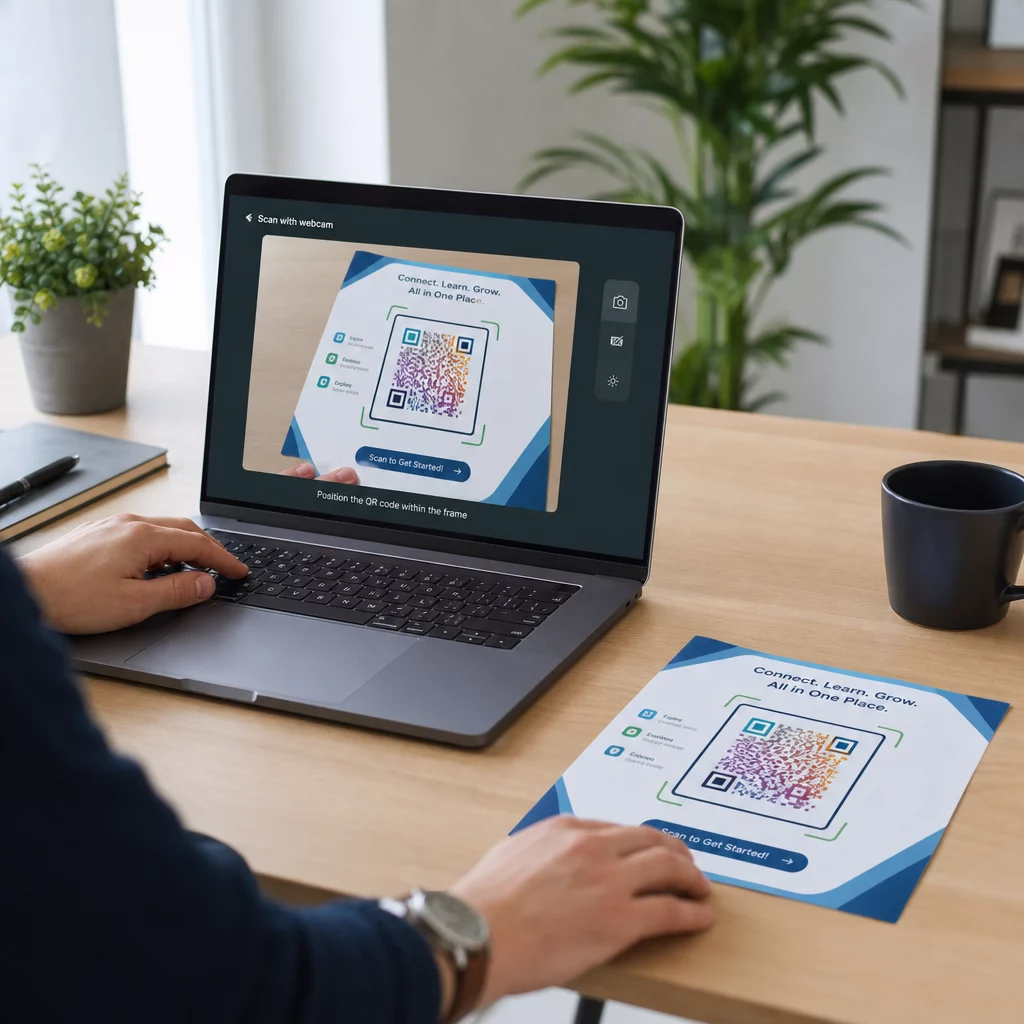
On many Windows laptops, the Camera app includes a Barcode mode that scans QR codes directly through your webcam. Here’s how to use it:
- Open the Camera app from the Start menu.
- Look for a Mã vạch or barcode icon in the toolbar. On some versions, you may need to go to Settings (the gear icon), enable Experimental Features, and restart the app before this option appears.
- Click the barcode icon, then hold your physical QR code in front of the webcam.
- The app detects the code automatically and displays a clickable URL that opens in your default browser.
For best results, make sure the code is well-lit, the webcam lens is clean, and the code fills most of the frame. Keep in mind that availability of this feature can vary depending on your laptop manufacturer and Camera app version – if you don’t see the Barcode option, the browser-based methods below are a reliable fallback.
Using Microsoft Edge’s Built-In Tools
Microsoft Edge gives you two useful options for QR codes you encounter while browsing:
- Right-click any QR code image on a webpage and select Search images with Google. Google Lens will decode the code and display the link or content.
- Đối với two-factor authentication (2FA) codes, Edge integrates with the iCloud Passwords extension. Right-click a 2FA QR code and select Set Up Verification Code to sync it without needing a camera.
- For QR codes saved as image files, drag the file into an Edge tab, right-click the image, select Inspect, press `Ctrl + Shift + P`, type “QR”, and choose Show QR Code reader from the DevTools command palette.
Using the Snipping Tool (Windows 11)
If a QR code is displayed on your screen – inside a document, email, or webpage – the Snipping Tool offers a quick, camera-free solution:
- Press `Win + Shift + S` to open the snipping overlay.
- Select the area containing the QR code.
- In the Snipping Tool window, click Text Actions to extract and decode the content.
This keeps everything local on your device without uploading anything to a third-party service.
Windows Methods at a Glance
| Phương pháp | Trường hợp sử dụng tốt nhất | Key Requirement |
|---|---|---|
| Camera App (Barcode mode) | Physical or printed QR codes | Feature availability varies by device |
| Microsoft Edge DevTools | Saved image files | No extra software needed |
| Edge + Google Lens | QR codes on webpages | Right-click the image |
| Snipping Tool | On-screen QR codes | Windows 11 with Text Actions |
Scanning QR Codes on macOS
macOS does not include native QR scanning in any of its built-in apps – you’ll need a browser tool, third-party app, or the Pageloot web scanner to decode codes on a Mac.
Using a Browser and Google Lens
For QR codes you encounter in Chrome or Edge on a Mac:
- Right-click the QR code image on the webpage and select Search image with Google.
- Google Lens opens and decodes the code, showing the URL or content with an option to open or copy it.
For QR codes saved as image files, drag the file into a Chrome tab, then right-click the image and follow the same steps.
Using Third-Party Mac Apps
Apps available from the Mac App Store – such as QR Capture, QR Journal, hoặc Code Reader – QR Scanner – use your Mac’s built-in camera or a USB webcam to scan codes in real time. Open the app, align the code within the on-screen frame, and it decodes automatically. Most apps also support dragging an image file into the window for file-based scanning.
For professional workflows, QR Journal integrates with AppleScript for automation and stores a local scan history – useful if you’re regularly processing codes as part of a business workflow.
Using Continuity with an iPhone
If you have an iPhone linked to the same Apple ID and on the same Wi-Fi network:
- Open the Camera app on your iPhone and scan the QR code.
- A Safari icon appears in your Mac’s Dock showing the decoded link.
- Click it to open the URL directly on your Mac.
This is often the fastest option for occasional use without downloading any additional software.
Enabling Camera Permissions on macOS
Before any app or browser tool can use your webcam, you may need to grant permission:
- Đi đến System Settings → Privacy & Security → Camera.
- Enable access for the browser or app you’re using.
Scanning QR Codes Without a Webcam
If you have a QR code saved as an image, a screenshot, or embedded in a PDF, you don’t need a camera at all.
Using an Online QR Code Scanner
Các Máy quét mã QR Pageloot works directly in your browser on any platform – no installation required. You can either:
- Upload an image file: Drag and drop a PNG, JPG, or screenshot of the QR code into the scanner.
- Use your webcam: Click the camera option, grant browser permission when prompted, and hold the QR code in front of your laptop’s webcam.
Other browser-based tools like scanqr.org work similarly and support both upload and webcam input.
Scan QR Codes Directly in Your Browser Need to decode a QR code on your laptop right now? The Máy quét mã QR Pageloot works with both file uploads and your webcam – no app download needed.
Granting Camera Access in Your Browser
Different browsers handle camera permissions slightly differently:
- Chrome: Click the site control icon to the left of the URL bar, set Camera đến Allowed, and reload the page.
- Safari: Click Allow when prompted, or go to Safari → Settings for [site] → Camera and set it to Allow, then refresh.
- Edge: Click Allow in the prompt, or open the lock icon → Permission for this site, set Camera to Allow, and reload.
Scanning from Screenshots or PDFs
Most PDF viewers don’t include QR code recognition. The simplest workaround:
- Take a screenshot of the QR code section using `Shift + Command + 4` (Mac) or the Snipping Tool (Windows 11).
- Upload the screenshot to the Pageloot scanner or another browser-based tool.
- On Windows 11, you can also use the Snipping Tool’s Text Actions feature directly on the captured image.
Tips for Better Image Quality
A blurry or poorly cropped image is the most common reason a file-based scan fails. Keep these points in mind:
- Zoom in before screenshotting if the QR code appears small – use `Ctrl + +` (Windows) or `Command + +` (Mac) to enlarge it in your browser.
- Crop tightly around the QR code, but keep the white border (called the “quiet zone”) intact – removing it prevents the scanner from detecting the code boundaries.
- Increase screen brightness when screenshotting a code displayed on a monitor, to improve contrast.
- If the image is still too blurry, try opening it in a photo editor and adjusting the contrast before uploading.
Choosing the Right Method for Your Situation
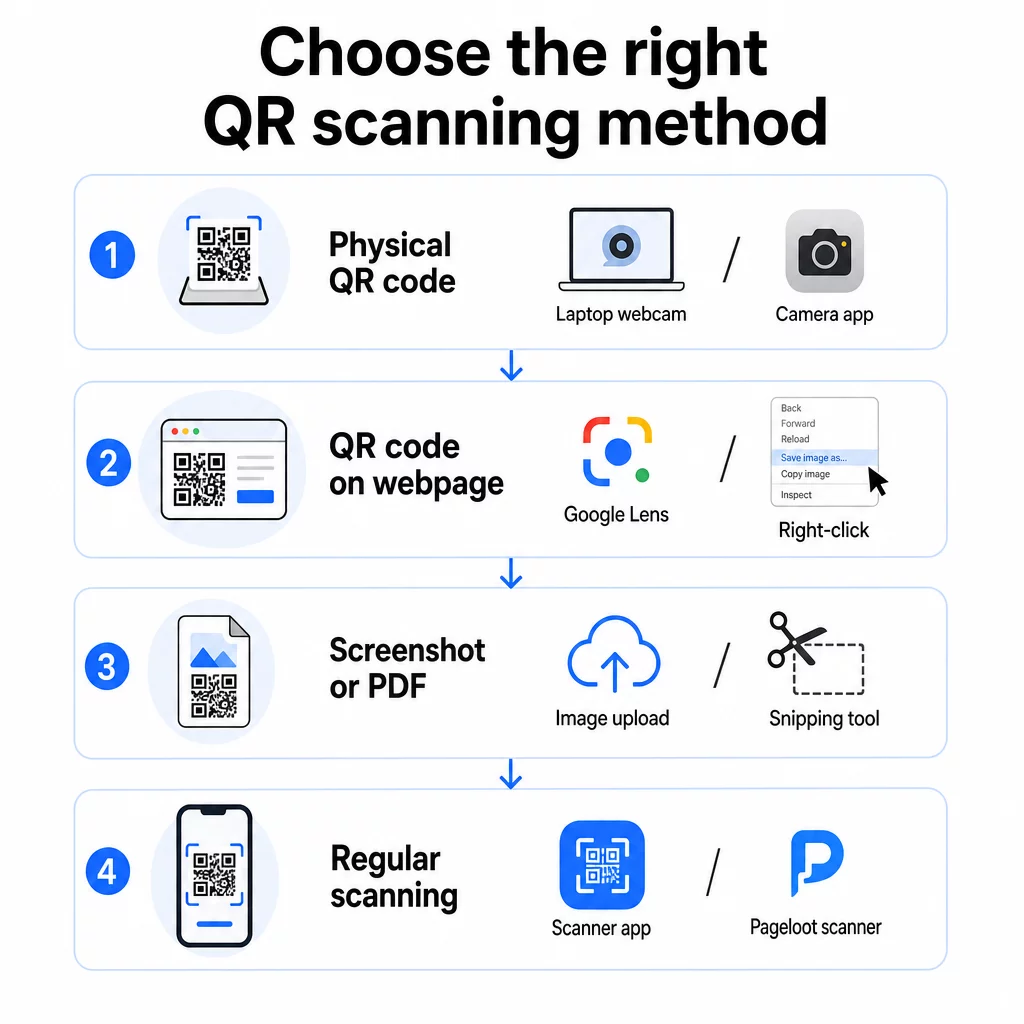
| Situation | các cửa sổ | macOS |
|---|---|---|
| Physical or printed QR code | Camera App (Barcode mode) | Browser-based scanner or third-party app |
| QR code on a webpage | Right-click → Google Lens in Chrome/Edge | Right-click → Google Lens in Chrome |
| Saved image or screenshot | Snipping Tool or online scanner | Online scanner or QR Capture |
| Regular or professional use | CodeTwo QR Code Desktop Reader | QR Journal or QR Capture |
| No webcam, no install | Upload to Pageloot QR Scanner | Upload to Pageloot QR Scanner |
For a deeper comparison of dedicated scanner apps – including security features and analytics – see the best QR code scanning apps comparison.
Staying Safe When Scanning QR Codes
Scanning a QR code on a laptop is generally safe, but the link it contains might not be. Before opening anything a scanned code returns, take a moment to:

- Review the URL before clicking. Check for misspellings, unrelated domains, or anything that doesn’t match the expected source.
- Consider the context. Did you receive this code in an unsolicited email? Was it a sticker placed over another code? Treat unfamiliar codes with the same caution you’d apply to unknown links.
- Use a scanner that shows the URL first, rather than opening it automatically. This gives you a chance to evaluate the link before committing.
- Close the browser if a decoded link leads to an unexpected login page, payment form, or request for personal data. Verify the site independently before returning.
If a QR code simply won’t scan despite good lighting and a clear image, the problem may be with the code itself. Common causes include a broken destination URL, low contrast, or a code that’s too small – see the QR code not working guide for a full breakdown of fixes.11The method you choose will depend on how often you scan, whether you’re working with physical codes or digital files, and which platform you’re on. For one-off situations, a browser upload or the Windows Snipping Tool handles most cases without any setup. For regular use, a dedicated desktop app or the Máy quét mã QR Pageloot gives you more control, including webcam scanning and a scan history.
If you’re also creating QR codes from your laptop – for campaigns, documents, or business cards – learn how to scan QR codes across different devices to make sure your codes work before you distribute them.
Các câu hỏi thường gặp
The most common reasons are poor lighting, an out-of-focus webcam, or a camera app that doesn’t support QR scanning on your specific device. Try cleaning the webcam lens, improving the lighting, and ensuring the QR code fills most of the frame. If the Camera app still doesn’t detect the code, switch to a browser-based tool or upload a screenshot to the Pageloot QR Code Scanner instead.
Take a screenshot of the QR code – use `Win + Shift + S` on Windows 11 or `Shift + Command + 4` on macOS – then upload the image to a browser-based scanner like the Pageloot QR Code Scanner. On Windows 11, the Snipping Tool’s Text Actions feature can also decode on-screen codes directly without any upload.
It can be, as long as you use a reputable tool that doesn’t store your images or require unnecessary account sign-ups. More importantly, always review the URL the scanner returns before clicking it – check for misspellings, unexpected domains, or anything that doesn’t match the source you expect. Treat QR codes from unsolicited emails or unfamiliar public locations as potentially suspicious until verified.