Are you looking for a modern way to streamline client intake and payments without compromising your law firm’s professional reputation? Paper-based administrative workflows slow down initial consultations, delay bill collection, and create friction for prospective clients. Implementing scannable QR codes across your legal practice connects physical print touchpoints directly to secure digital portals, accelerating firm efficiency while maintaining complete ethical compliance.
Why Legal Practices Are Adopting Scannable Touchpoints
Traditional legal marketing and administrative processes often suffer from friction when prospective clients attempt to transition from printed materials – such as business cards, event signage, or direct mailers – to digital contact forms and consultation scheduling.
American Bar Association (ABA) Model Rule 7.2(a) permits attorney advertising through any media, provided that all communications remain accurate and non-misleading under ABA Model Rule 7.1. Modern legal practices utilize scannable matrix barcodes (commonly known as QR codes) to bridge physical media with encrypted online landing pages.
When implementing these touchpoints, law firms must choose between static and dynamic codes:
- קודי QR סטטיים: Store fixed data directly inside the matrix pattern, meaning you cannot alter the destination or track scan metrics after printing.
- קודי QR דינמיים: Direct scanners through a short redirect link, allowing you to update destination URLs anytime and analyze scan engagement.
Dynamic technology also records non-personally identifiable scan metrics – such as time of scan, operating system, and geographical region – enabling firms to evaluate marketing campaign performance. To learn more about selecting the appropriate technical structure, review our breakdown of קודי QR סטטיים לעומת דינמיים or explore broader legal practice tools across different industry solutions.
Enhancing Attorney Business Cards with Dynamic vCards
Standard legal business cards frequently suffer from limited physical space, forcing attorneys to omit important practice details or print illegibly small text. Using a מחולל קוד QR של כרטיס ביקור allows you to embed a complete virtual contact file (vCard) directly onto paper cardstock.
When a prospective client or colleague scans the code with a smartphone camera, their device prompts them to save your full legal profile instantly – including primary phone numbers, direct extensions, office addresses, direct email, and firm web portals. For step-by-step guidance on setting up virtual contact cards, consult our tutorial on generating a QR code for contact info.
| FRONT OF CARD | BACK OF CARD |
|---|---|
| JANE DOE, ESQ. | QR CODE |
| Partner, Litigation | 0.8 x 0.8 אינץ' |
| Smith & Doe LLP | – |
| [email protected] | Scan to Save Contact |
To maintain an uncluttered and highly professional aesthetic:
- Reserve the front of the card for essential typography, such as the attorney’s name, title, firm name, and primary telephone number.
- Position the scannable code cleanly on the back panel accompanied by a subtle action phrase like “Scan to save contact details.”
- Maintain a printed size of at least 0.8 x 0.8 inches (2 x 2 cm) to guarantee fast and reliable scanning.
For deeper design recommendations, read our guides on עיצוב כרטיס ביקור עם קוד QR and the exact print standards for גדלי קוד QR הטובים ביותר לכרטיסי ביקור.
Upgrade Your Firm’s Networking Tools Streamline how prospective clients save your attorney contact details directly to their mobile devices. Use the מחולל קוד QR של כרטיסי ביקור to create customized, scannable legal vCards today.
Modernizing Client Intake Forms while Safeguarding Confidentiality
Paper intake forms in waiting rooms prolong client onboarding and introduce data transcription errors. Deploying online intake forms via a מחולל קוד QR של Google Form or a general מחולל קוד QR לקישור allows prospective clients to fill out preliminary consultation questionnaires directly on their personal mobile devices.
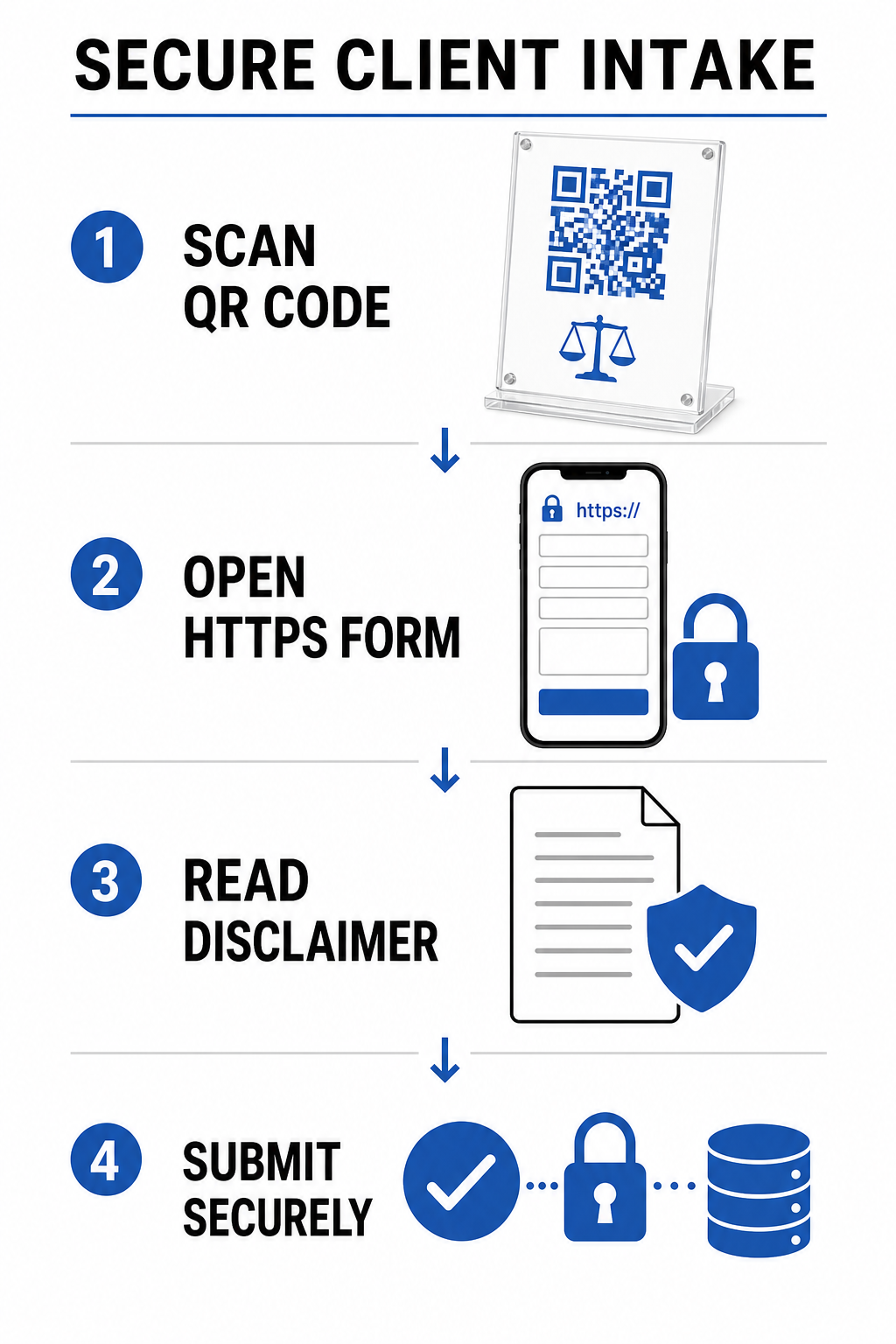
Because legal intake involves sensitive personal data, digital intake systems must adhere strictly to ethics standards:
- Duty of Confidentiality (ABA Model Rule 1.6): Requires reasonable efforts to prevent unauthorized access by transmitting all prospective client intake data over encrypted HTTPS channels.
- Technology Competence (ABA Model Rule 1.1, Comment 8): Demands that legal professionals stay informed about cybersecurity risks and protective measures when deploying client-facing digital tools.
- Attorney-Client Relationship Disclaimers: Obligates firms to display prominent notices stating that preliminary form submissions do not establish a formal attorney-client relationship.
Firms handling prospective client information must also implement strict data retention and privacy policies. Review international and regional data protection frameworks in our guide to QR code privacy laws and key regulations.
Accelerating Invoice and Retainer Payments Securely
Paper invoices often suffer from delayed processing because clients put off typing long account numbers or visiting web portals manually. Adding payment links using a מחולל קודי QR של PayPal directly onto billing statements or retainer agreements lets clients open secure payment portals in seconds.
When deploying digital payment workflows, law firms must strictly observe legal accounting ethics:
| Ethics Requirement | Implementation Guidance |
|---|---|
| Separation of Trust & Operating Funds | Payment QR codes for unearned retainer deposits must route exclusively to designated client trust accounts (e.g., IOLTA), never directly to operating accounts. |
| Handling Processing Fees | Unless agreed upon in writing, merchant transaction fees must be paid by the law firm and cannot be deducted directly from client trust funds. |
| Chargeback Safeguards | Web payment gateways must be configured so that disputed charges or chargebacks are drawn against operating accounts rather than client trust accounts. |
For detailed information on configuring scannable payment gateways, explore our legal resource on קודי QR לתשלומים.
Design Standards and Print Specifications for Law Firms
Maintaining scannability and visual authority requires following precise technical print standards when outputting legal marketing materials:
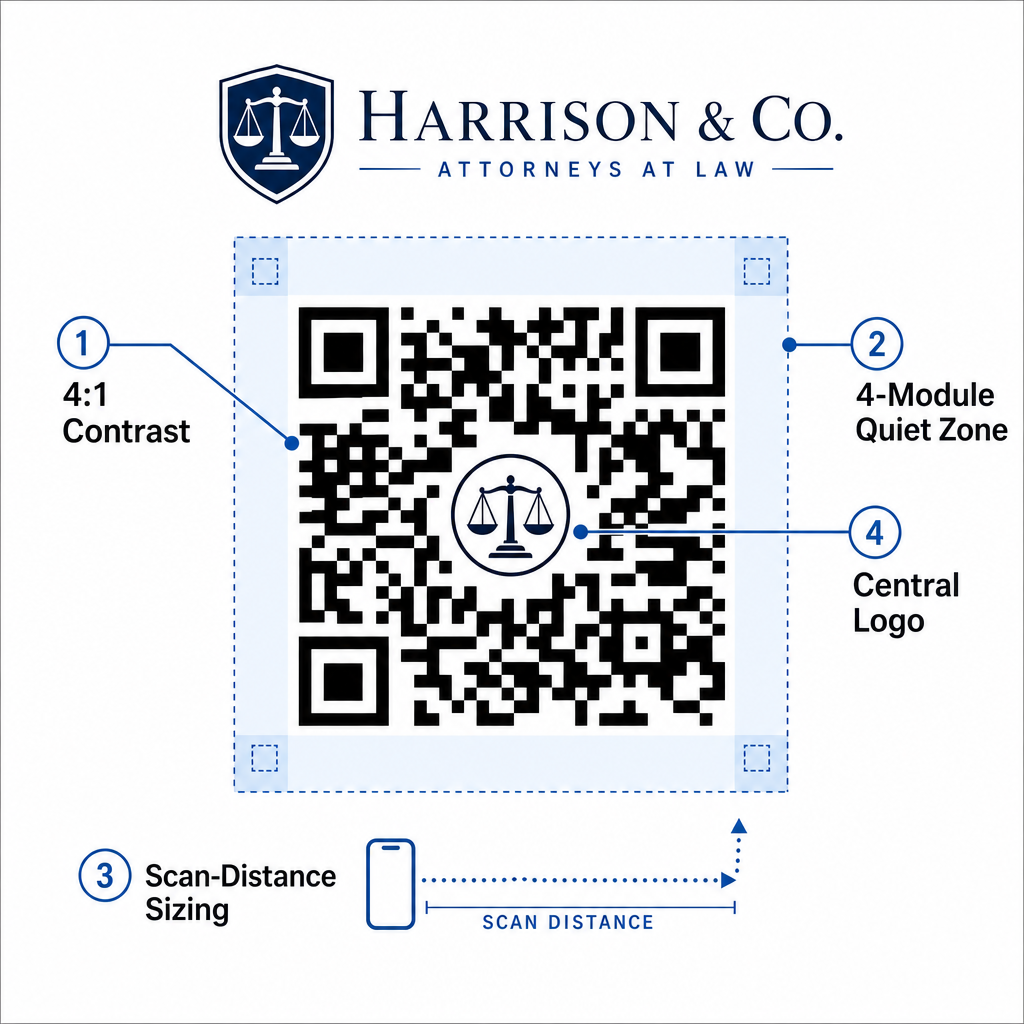
- יחס ניגודיות: Maintain a minimum contrast ratio of 4:1 between the foreground modules and the background. Always print dark modules on a lighter, uniform background. Avoid inverted designs (light codes on dark backgrounds), as legacy mobile camera sensors frequently struggle to decode inverted patterns.
- Quiet Zone Border: Reserve an unobstructed margin – the quiet zone – around all four sides of the code pattern. This quiet zone must equal at least four module widths (the size of one individual data square) to isolate the code from surrounding graphics or text.
- The 10:1 Distance-to-Size Rule: Determine code dimensions based on scanning distance. The width of the printed code should equal at least one-tenth of the distance between the camera and the target. For example, a poster designed to be scanned from 5 feet away requires a QR code width of at least 6 inches (15 cm).
- Branding Elements: When embedding law firm logos via a מחולל קודי QR מקצועי עם לוגו, keep the logo central and sized so it does not obstruct the corner positioning pattern targets.
- Vector Export Formats: Always export final graphics in vector formats (such as SVG, EPS, or high-resolution PDF) at 300 to 600 DPI to avoid pixelation blur during professional commercial printing.
For complete placement rules across print collateral, see our מדריך אולטימטיבי למיקום קוד QR בשיווק, learn how to monitor performance through מעקב אחר קודי QR, and explore all available platform תכונות.
Streamline Your Legal Practice with Scannable Workflows
Integrating scannable matrix codes into law firm operations transforms static paper touchpoints into secure, measurable digital access points. By implementing dynamic vCards on business cards, establishing encrypted intake form links, enforcing strict trust-account payment safeguards, and adhering to professional print standards, your practice can streamline client onboarding while upholding ethics compliance.
Start creating branded, dynamic digital touchpoints for your law firm today using Pageloot’s professional management platform.
שאלות נפוצות
Yes. Under ABA Model Rules 7.1 and 7.2, lawyers may market services through digital tools including QR codes, provided that all information conveyed is accurate, truthful, and non-misleading.
A QR code printed on a business card should be at least 0.8 x 0.8 inches (2 x 2 cm) with a 4-module quiet zone border to guarantee fast and reliable scanning across all smartphone devices.
Intake forms linked via QR codes should use encrypted HTTPS connections and display a clear disclaimer instructing users not to send highly sensitive confidential facts prior to establishing formal representation.