首页 > 博客 > 地理定位二维码与标准二维码
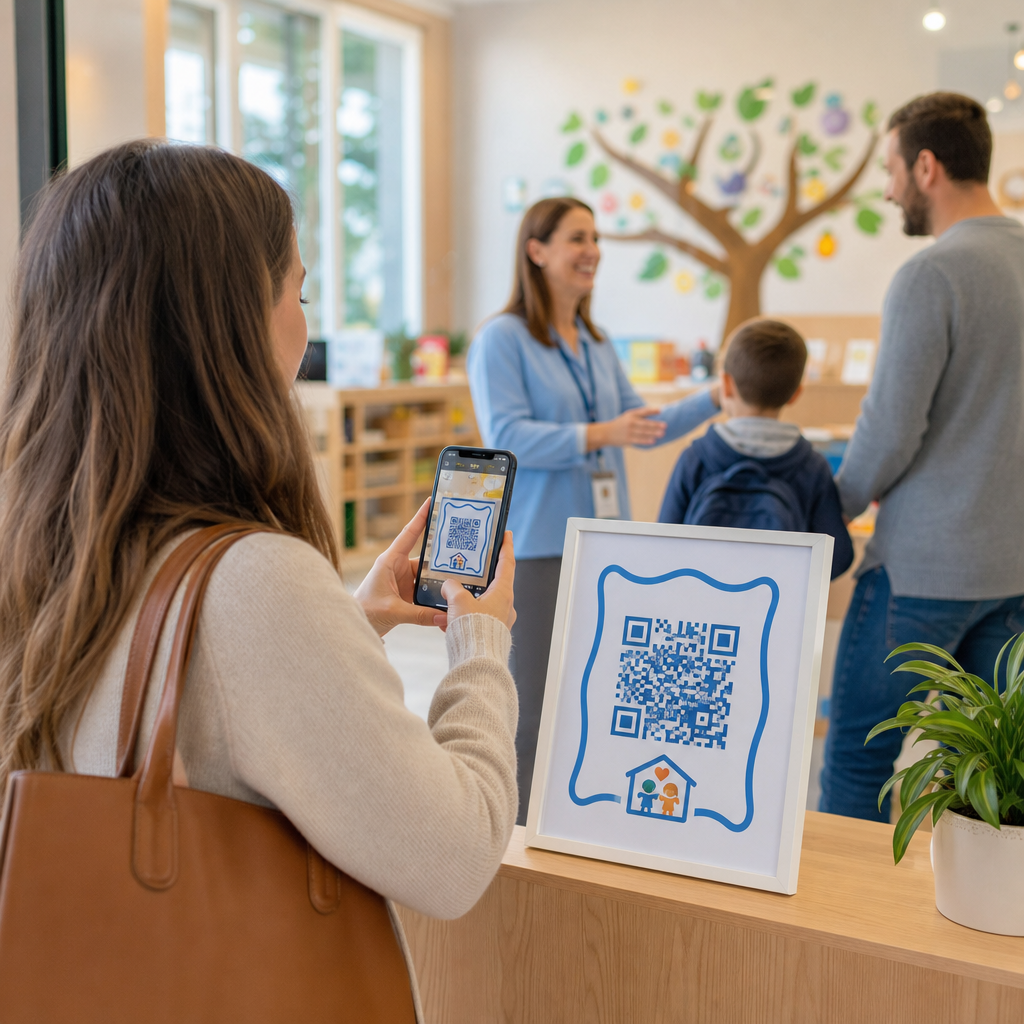
Scanning local QR code

地理定位二维码与标准二维码

Compare standard and geotargeted QR codes to find the right fit for your campaign. Learn how location-based redirects work and where they differ technically.
Updated on 6 月 10, 2026
目录

Not sure whether you need a standard or geotargeted QR code? The wrong choice can mean delivering the same generic content to every customer, regardless of where they are – wasting campaign budget and missing personalization opportunities. This guide explains how both types work, where they differ technically, and which fits your situation.

What Standard QR Codes Actually Do

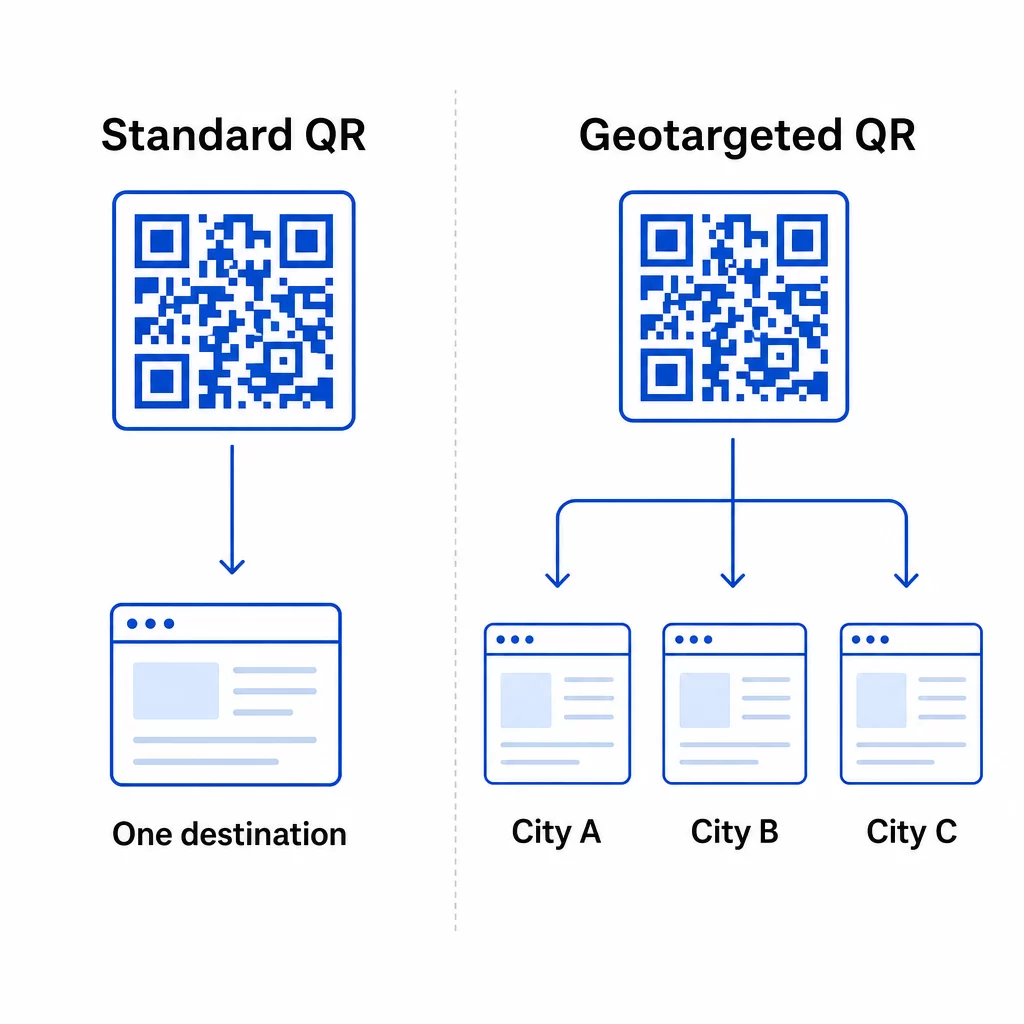
Standard QR codes encode data – a URL, contact information, Wi-Fi credentials, plain text – directly into the code’s pattern. When someone scans the code, their device reads that encoded data and acts on it. The destination is fixed; every scan from every location goes to the same place.

Standard QR codes come in two forms: 静态动态的.

A static QR code permanently embeds its data into the pattern itself. Once printed, the destination cannot be changed without generating and reprinting an entirely new code. A dynamic QR code, by contrast, encodes a short redirect URL that points to your actual destination. Because the final URL lives on a server rather than inside the code’s pattern, you can update where the code redirects at any time – without touching the printed code.

This distinction matters more than it first appears. Static codes also produce denser, more complex patterns when they store long URLs or detailed contact data, which can make them harder to scan reliably. Dynamic codes stay clean and simple because they only need to encode a short redirect link.

What standard QR codes do well

  • Universal accessibility: Any smartphone with a camera can scan them – no special app or permissions required.
  • Low cost: Static codes are free to generate and have no ongoing fees, making them a practical choice for simple, one-off uses.
  • Reliable and consistent: The same code works across all devices, operating systems, and scanning apps.
  • Offline functionality: Static codes don’t depend on a server, so they work for offline information like Wi-Fi passwords or plain text.

Where standard QR codes fall short

The core limitation is that standard QR codes treat every user identically. A retail chain can’t show store-specific hours or local promotions. A hospitality brand can’t surface location-relevant recommendations. One code, one destination, for everyone.

Static QR codes also produce no tracking data at all. Because they don’t route through a redirect server, there’s no mechanism to log a scan event. Dynamic QR codes enable tracking; static QR codes do not. Even with dynamic standard codes, analytics are limited to basic metrics like total scans, timestamps, and device types – there’s no mechanism to serve different content to different users based on where they are.

How Geotargeted QR Codes Work Differently

A geotargeted QR code is a specialized type of dynamic QR code. Visually, it looks the same as any other QR code. What’s different is what happens between the scan and the destination.

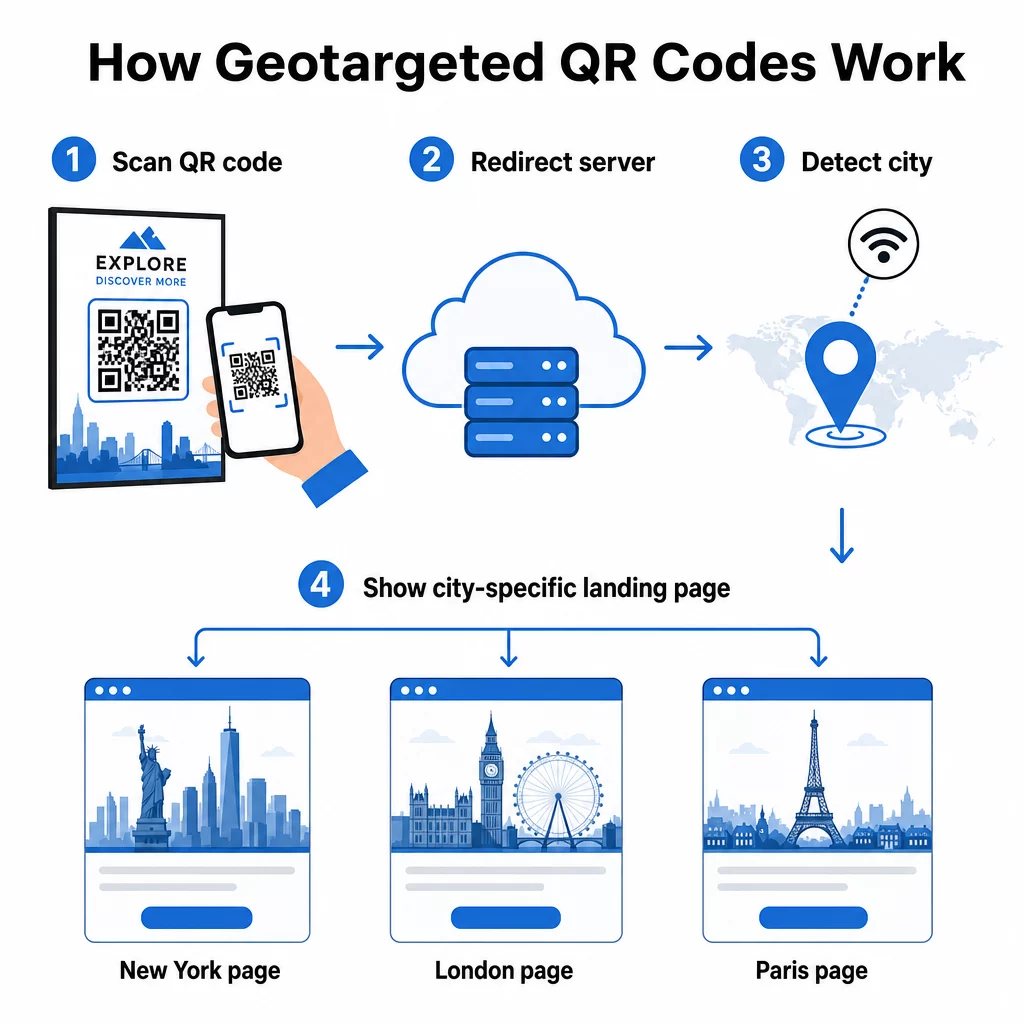
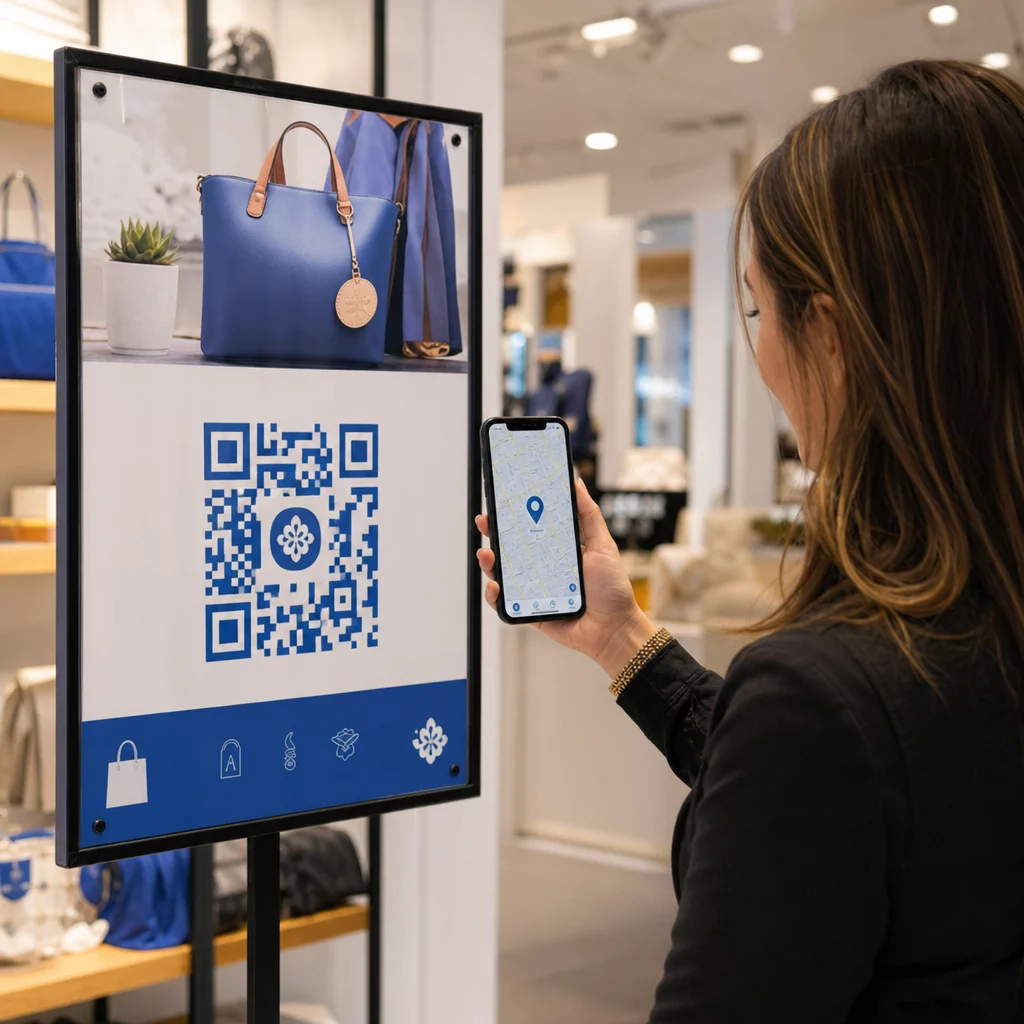
When someone scans a geotargeted code, the redirect server intercepts the request before sending the user anywhere. The server determines the user’s approximate location – typically through IP geolocation, which can resolve location to the city level – and then routes the user to content configured for that location. One physical code can deliver a completely different experience depending on where it’s scanned.

Geotargeted QR code flow

It’s worth understanding how location detection works in practice. IP-based geolocation is the most common method: the server looks up the scanner’s IP address against a geolocation database and infers their city or region. This approach works without any action from the user, but accuracy varies. City-level accuracy typically ranges from roughly 50% to 75%, with better results in large urban areas and on residential networks. Mobile networks, VPNs, and proxy servers can all shift the apparent location.

Browser-based GPS tracking offers more precise location data but requires the user to explicitly grant location access when prompted by their device. This method is more accurate but less automatic – users can decline the prompt.

See Location-Based Redirects in Action Want to deliver different content to customers in different cities using a single code? Use the 动态二维码生成器 to build location-aware QR codes with full scan analytics.

What geotargeted QR codes add

Beyond location-based redirects, geotargeted QR codes unlock capabilities that standard dynamic codes can’t provide on their own:

  • Location-specific content delivery: A single code can show different promotions, languages, prices, or landing pages depending on where the scan occurs.
  • Advanced analytics: In addition to scan counts and device types, you get geographic engagement data – which cities or regions are generating the most scans, and how behavior differs across locations.
  • Centralized campaign management: One code covers all locations, simplifying logistics for multi-location businesses that would otherwise need separate codes for each site.
  • Dynamic updates: Because geotargeted codes are a form of dynamic QR code, you can update the rules, destinations, or content at any time – no reprinting needed.

For a deeper look at how tracking QR code scans and analytics works, including what data is actually captured at the moment of a scan, that guide covers the technical mechanics in full.

Side-by-Side Comparison

功能 Standard QR Codes Geotargeted QR Codes
Content delivery Static – same for every scan Dynamic – varies by location
Editable after printing Only with dynamic codes Yes (always dynamic)
跟踪 None (static) / Basic (dynamic) Advanced, including location data
Location-based redirects
Setup complexity 简单 Moderate – requires location mapping
费用 Low to free Higher – needs a dynamic platform
最适合 Simple, consistent messaging Multi-location and regional campaigns
Analytics depth Scan counts, timestamps, device type Geographic breakdowns, regional trends
Campaign management Manual, per-code Centralized, one code for all locations

Choosing the Right Type for Your Situation

The honest answer is that most businesses don’t start with geotargeted QR codes – and don’t need to. If you’re sharing a menu, a landing page, or contact information, a standard dynamic QR code gives you the flexibility to update content and track scans without the added complexity.

Standard versus geotargeted QR

Geotargeted QR codes make the most sense when location is a meaningful variable in your campaign. Practical situations where this matters:

  • Multi-location retail or hospitality: Show store-specific hours, inventory, or promotions without printing separate codes for each location.
  • Regional marketing campaigns: Adapt messaging, language, or offers for different cities or markets from a single code placed on national materials.
  • Event management: Direct attendees to venue maps, session schedules, or nearby services based on which part of a large venue they’re in.
  • Franchise or partner networks: Maintain brand consistency at the code level while allowing location-specific content underneath.

If you’re running campaigns that span multiple regions and want to measure engagement by geography, pairing geotargeted codes with 二维码的UTM参数 in Google Analytics creates a complete picture of where traffic originates and how it converts.

For businesses new to location-based QR campaigns, the geofencing QR code campaigns guide covers practical setup steps, placement strategy, and how to measure results.

安全和隐私注意事项

Geotargeted QR codes collect more sensitive data than standard codes – location information and IP addresses in addition to basic scan metrics. This creates responsibilities that standard codes don’t.

Transparency matters. Users should know, through a clear privacy notice, that location data is being collected and how it will be used. Explicit consent is required before collecting precise GPS data. Implicit IP-based geolocation sits in a grayer area, but clear disclosure is still best practice.

A few technical safeguards are worth implementing regardless of code type, but they’re especially important for location-aware campaigns:

  • Scan limits: Cap how many times a code can be used to prevent misuse of location-based offers.
  • Expiry dates: Automatically disable codes after a campaign ends so outdated materials don’t become security risks.
  • Password protection: For codes linking to sensitive or exclusive content, require authentication before access is granted.
  • Real-time monitoring: Watch for scan anomalies – unusual spikes in volume or unexpected geographic patterns – so you can respond quickly.

Industry Applications

The practical value of geotargeted QR codes shows up differently across sectors:

  • Retail and e-commerce: A fashion brand can use one QR code on national packaging but surface region-specific promotions, seasonal inventory, or localized pricing depending on where the scan happens.
  • 酒店业: Hotels can direct guests to local attraction recommendations, weather-appropriate activity suggestions, or branch-specific services – all through a single code in the lobby.
  • 医疗保健: A hospital network can route patients to the nearest facility’s booking system, complete with location-specific services and availability.
  • Education: Universities can place codes on printed materials that direct students to building-specific resources, class schedules, or campus navigation based on where they scan.
  • 房地产: Property listings can surface neighborhood-specific data – school ratings, local amenities, commute information – for prospective buyers scanning from different areas.

Standard dynamic QR codes serve these same industries well for content that doesn’t need to change by location. The full list of QR code features covers additional use cases across content types and industries.

Start Tracking Where Your Scans Come From Whether you need a standard dynamic code or location-based redirects, the 二维码生成器 lets you build, customize, and analyze QR code performance from one dashboard. The right choice comes down to whether location is a variable that matters for your campaign. If every customer should see the same content, a standard dynamic QR code gives you flexibility and tracking without added complexity. If where someone scans changes what they should see, geotargeted QR codes solve that problem efficiently – one code, intelligently routed, with the analytics to understand how different regions are engaging.

Start with whichever type matches your current needs, and build toward location-based targeting as your campaigns grow and your audience data matures.

常见问题

Can a geotargeted QR code replace multiple location-specific QR codes?

Yes. A single geotargeted QR code can redirect users to different content depending on where they scan. For a business with ten locations, this means one code instead of ten – with centralized analytics showing how each region performs.

How accurate is the location detection in geotargeted QR codes?

Most geotargeted systems use IP-based geolocation, which typically identifies a user’s city with roughly 50–75% accuracy. Accuracy is better in large cities and on residential networks, and lower when users are on mobile networks, VPNs, or proxy connections. Browser-based GPS offers more precision but requires the user to grant explicit location permission.

Do standard QR codes support any form of tracking?

Static QR codes support no tracking at all – they don’t route through a redirect server, so there’s no mechanism to log a scan. Dynamic QR codes (including geotargeted ones) do support tracking, capturing metrics like total scans, timestamps, device types, and geographic location data.

关于作者

Siim Kostabi 是 Pageloot 的内容主管,负责撰写关于我们创新型二维码生成器服务的文章。凭借五年多来在二维码领域积累的深厚专业知识,Siim 是该领域的专家。他致力于利用二维码技术简化和增强数字交互,并取得了显著的成果。.

类别
了解更多关于
扫描电子邮件签名二维码
制作二维码 电子邮件签名
手机扫描二维码
如何 扫描二维码
QR QR码的#1解决方案

如果您需要在线创建QR码,则可以 制作二维码 就在这里免费!
Pageloot是 #1转到解决方案 创建和扫描QR码。

BL-0110

受到超过 20,000 个品牌的信赖,可获得更多销售、评论和关注者。

客户徽标
受到顶级品牌的信赖
评分为 4.8(共 5)

4.86 / 5 星评级

雨果·劳伦特
雨果·劳伦特
餐馆老板
有史以来最容易和最可靠的QR码生成器。PDF文件可以立即上传。我们的餐厅菜单现在是数字化的。
卢卡斯-詹森
卢卡斯-詹森
房地产开发商
这是一个很好的工具,二维码带你到你想要的地方。我们只使用位置二维码,但有许多有用的功能。
艾玛-莫雷蒂
艾玛-莫雷蒂
零售产品
易于使用和快速。它工作得很好,创造了一个完美的图像,所以员工可以下载我的vCard。
雨果·劳伦特
雨果·劳伦特
餐馆老板
有史以来最容易和最可靠的QR码生成器。PDF文件可以立即上传。我们的餐厅菜单现在是数字化的。
卢卡斯-詹森
卢卡斯-詹森
房地产开发商
这是一个很好的工具,二维码带你到你想要的地方。我们只使用位置二维码,但有许多有用的功能。
艾玛-莫雷蒂
艾玛-莫雷蒂
零售产品
易于使用和快速。它工作得很好,创造了一个完美的图像,所以员工可以下载我的vCard。
查看更多QR码
扫描二维码
将 URL 转换为 二维码
将一切转化为数字体验 不到3分钟。

免费试用 14 天。

无需信用卡。

首次购买可享受 30% 折扣

使用代码:

分享您的 MP3 文件

注册以创建 PDF QR 码

上传和显示你需要的一切。

  • 音频文件
  • 播客
  • 音乐

注册即可享 14 天免费试用。.
试用期结束后,二维码将失效。.

注册以创建音频 mp3 二维码

使用边框获得更多扫描

注册以向您的二维码添加更多框架

呼叫行动框架帮助您的客户与QR码轻松互动。试试吧!

注册即可享 14 天免费试用。.
试用期结束后,二维码将失效。.

注册以向您的二维码添加更多框架

使用形状添加更多样式

注册以创建更多形状

二维码不一定是方形的。试着改变它以适应你的品牌形象。

注册即可享 14 天免费试用。.
试用期结束后,二维码将失效。.

注册以创建更多形状

为您的二维码添加徽标

注册以将您的徽标添加到二维码中

通过在二维码上添加你的标志和品牌,使你的二维码脱颖而出。

注册即可享 14 天免费试用。.
试用期结束后,二维码将失效。.

注册以将您的徽标添加到二维码中

智能应用商店重定向

注册以创建应用商店二维码

将您的应用程序链接添加到我们的智能应用程序商店QR码。用户会根据他们的设备被重新定向。

注册即可享 14 天免费试用。.
试用期结束后,二维码将失效。.

注册以创建应用商店二维码

将图片上传到二维码

注册以创建图像二维码

轻松分享你的图像。在几秒钟内动态地改变任何图像。

注册即可享 14 天免费试用。.
试用期结束后,二维码将失效。.

注册以创建图像二维码

分享您的 PDF 文件

注册以创建 PDF QR 码

上传和显示你需要的一切。

  • 菜单和价格表
  • 使用说明
  • 任何文件

注册即可享 14 天免费试用。.
试用期结束后,二维码将失效。.

注册以创建 PDF QR 码

稍后编辑,无需打印

注册即可编辑您的二维码,无需再次打印

动态QR码让你改变你的QR码的内容,而不需要打印新的QR码。

注册即可享 14 天免费试用。.
试用期结束后,二维码将失效。.

注册即可编辑您的二维码,无需再次打印

何时?何地?追踪您的二维码扫描

注册以追踪您的二维码

发现你的哪些二维码收到了最多的扫描,以及什么最能让你的客户兴奋。

注册即可享 14 天免费试用。.
试用期结束后,二维码将失效。.

注册以追踪您的二维码

提供可打印文件

注册以创建 PDF 和 SVG 等矢量二维码

.EPS, .PDF, .SVG

想下载高清分辨率的QR码吗?获得矢量或像素格式,可随时打印。

注册即可享 14 天免费试用。.
试用期结束后,二维码将失效。.

注册以创建 PDF 和 SVG 等矢量二维码

请等待。您的二维码是 正在加载... 正在加载...

打造专属

注册以保存您的二维码以供日后使用

通过创建具有不同颜色、标识和行动呼吁框架的出色的QR码,获得更多的扫描。

注册即可享 14 天免费试用。.
试用期结束后,二维码将失效。.

注册以保存您的二维码以供日后使用