Not sure whether you need a standard or geotargeted QR code? The wrong choice can mean delivering the same generic content to every customer, regardless of where they are – wasting campaign budget and missing personalization opportunities. This guide explains how both types work, where they differ technically, and which fits your situation.
What Standard QR Codes Actually Do
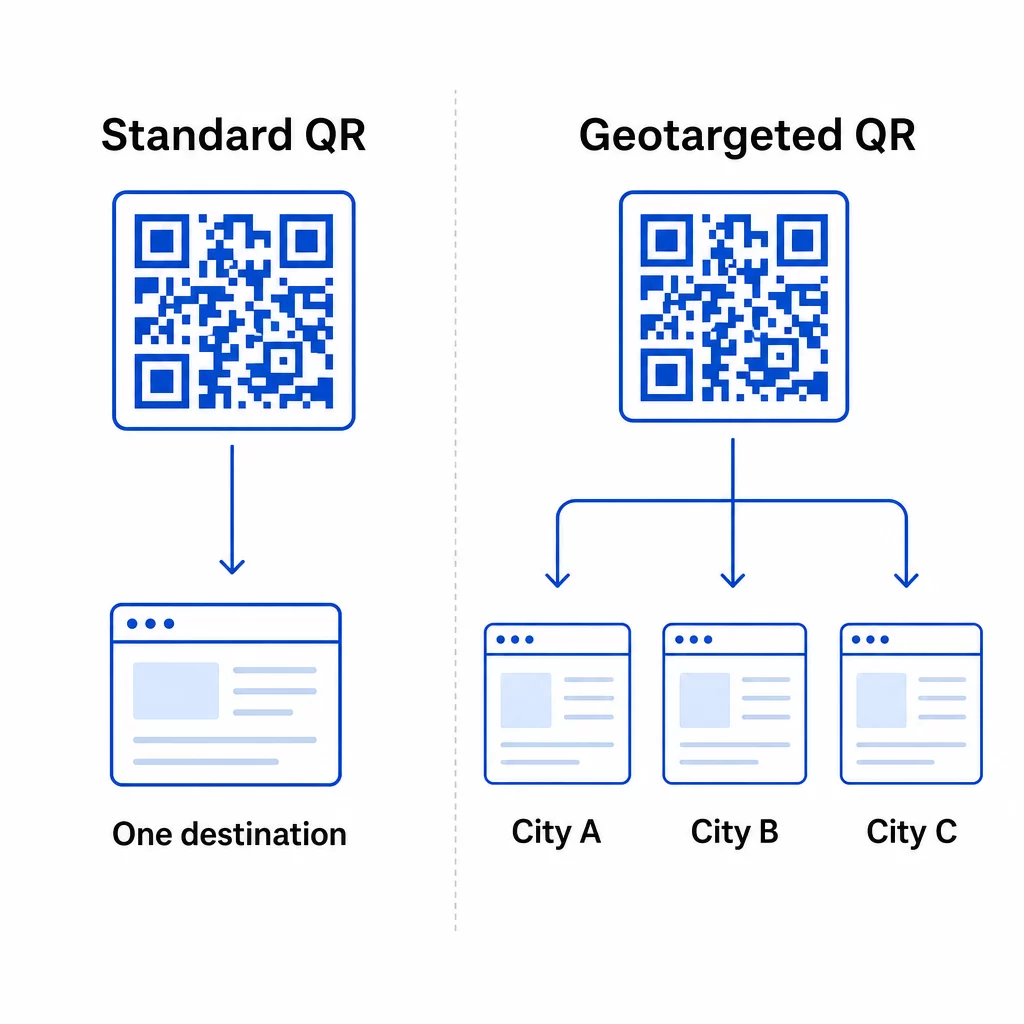
Standard QR codes encode data – a URL, contact information, Wi-Fi credentials, plain text – directly into the code’s pattern. When someone scans the code, their device reads that encoded data and acts on it. The destination is fixed; every scan from every location goes to the same place.
Standard QR codes come in two forms: statisch und dynamisch.
A static QR code permanently embeds its data into the pattern itself. Once printed, the destination cannot be changed without generating and reprinting an entirely new code. A dynamic QR code, by contrast, encodes a short redirect URL that points to your actual destination. Because the final URL lives on a server rather than inside the code’s pattern, you can update where the code redirects at any time – without touching the printed code.
This distinction matters more than it first appears. Static codes also produce denser, more complex patterns when they store long URLs or detailed contact data, which can make them harder to scan reliably. Dynamic codes stay clean and simple because they only need to encode a short redirect link.
What standard QR codes do well
- Universal accessibility: Any smartphone with a camera can scan them – no special app or permissions required.
- Low cost: Static codes are free to generate and have no ongoing fees, making them a practical choice for simple, one-off uses.
- Reliable and consistent: The same code works across all devices, operating systems, and scanning apps.
- Offline functionality: Static codes don’t depend on a server, so they work for offline information like Wi-Fi passwords or plain text.
Where standard QR codes fall short
The core limitation is that standard QR codes treat every user identically. A retail chain can’t show store-specific hours or local promotions. A hospitality brand can’t surface location-relevant recommendations. One code, one destination, for everyone.
Static QR codes also produce no tracking data at all. Because they don’t route through a redirect server, there’s no mechanism to log a scan event. Dynamic QR codes enable tracking; static QR codes do not. Even with dynamic standard codes, analytics are limited to basic metrics like total scans, timestamps, and device types – there’s no mechanism to serve different content to different users based on where they are.
How Geotargeted QR Codes Work Differently
A geotargeted QR code is a specialized type of dynamic QR code. Visually, it looks the same as any other QR code. What’s different is what happens between the scan and the destination.
When someone scans a geotargeted code, the redirect server intercepts the request before sending the user anywhere. The server determines the user’s approximate location – typically through IP geolocation, which can resolve location to the city level – and then routes the user to content configured for that location. One physical code can deliver a completely different experience depending on where it’s scanned.
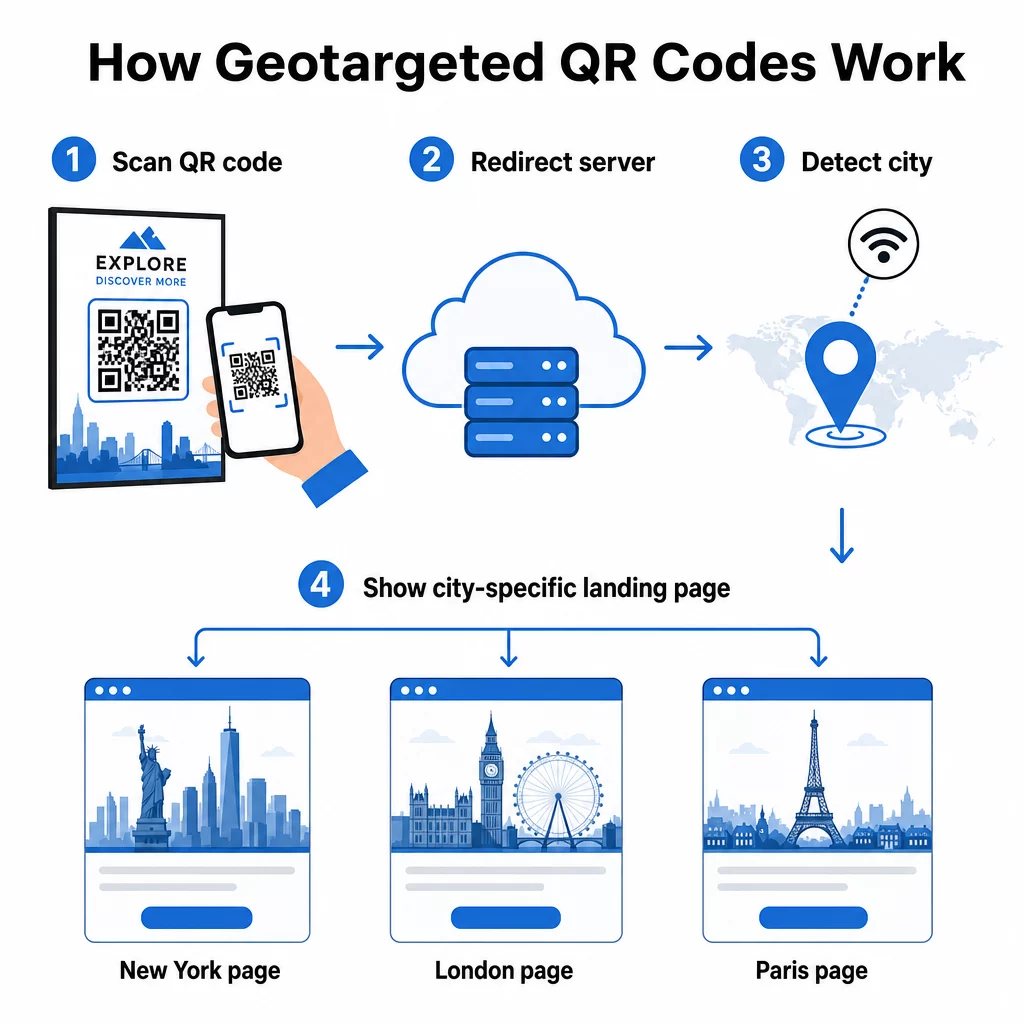
It’s worth understanding how location detection works in practice. IP-based geolocation is the most common method: the server looks up the scanner’s IP address against a geolocation database and infers their city or region. This approach works without any action from the user, but accuracy varies. City-level accuracy typically ranges from roughly 50% to 75%, with better results in large urban areas and on residential networks. Mobile networks, VPNs, and proxy servers can all shift the apparent location.
Browser-based GPS tracking offers more precise location data but requires the user to explicitly grant location access when prompted by their device. This method is more accurate but less automatic – users can decline the prompt.
See Location-Based Redirects in Action Want to deliver different content to customers in different cities using a single code? Use the Dynamischen QR-Code-Generator to build location-aware QR codes with full scan analytics.
What geotargeted QR codes add
Beyond location-based redirects, geotargeted QR codes unlock capabilities that standard dynamic codes can’t provide on their own:
- Location-specific content delivery: A single code can show different promotions, languages, prices, or landing pages depending on where the scan occurs.
- Advanced analytics: In addition to scan counts and device types, you get geographic engagement data – which cities or regions are generating the most scans, and how behavior differs across locations.
- Centralized campaign management: One code covers all locations, simplifying logistics for multi-location businesses that would otherwise need separate codes for each site.
- Dynamic updates: Because geotargeted codes are a form of dynamic QR code, you can update the rules, destinations, or content at any time – no reprinting needed.
For a deeper look at how tracking QR code scans and analytics works, including what data is actually captured at the moment of a scan, that guide covers the technical mechanics in full.
Side-by-Side Comparison
| Funktion | Standard QR Codes | Geotargeted QR Codes |
|---|---|---|
| Content delivery | Static – same for every scan | Dynamic – varies by location |
| Editable after printing | Only with dynamic codes | Yes (always dynamic) |
| Tracking | None (static) / Basic (dynamic) | Advanced, including location data |
| Location-based redirects | ❌ | ✅ |
| Setup complexity | Einfach | Moderate – requires location mapping |
| Kosten | Low to free | Higher – needs a dynamic platform |
| Am besten für | Simple, consistent messaging | Multi-location and regional campaigns |
| Analytics depth | Scan counts, timestamps, device type | Geographic breakdowns, regional trends |
| Campaign management | Manual, per-code | Centralized, one code for all locations |
Choosing the Right Type for Your Situation
The honest answer is that most businesses don’t start with geotargeted QR codes – and don’t need to. If you’re sharing a menu, a landing page, or contact information, a standard dynamic QR code gives you the flexibility to update content and track scans without the added complexity.
Geotargeted QR codes make the most sense when location is a meaningful variable in your campaign. Practical situations where this matters:
- Multi-location retail or hospitality: Show store-specific hours, inventory, or promotions without printing separate codes for each location.
- Regional marketing campaigns: Adapt messaging, language, or offers for different cities or markets from a single code placed on national materials.
- Event management: Direct attendees to venue maps, session schedules, or nearby services based on which part of a large venue they’re in.
- Franchise or partner networks: Maintain brand consistency at the code level while allowing location-specific content underneath.
If you’re running campaigns that span multiple regions and want to measure engagement by geography, pairing geotargeted codes with UTM-Parametern für QR-Codes in Google Analytics creates a complete picture of where traffic originates and how it converts.
For businesses new to location-based QR campaigns, the geofencing QR code campaigns guide covers practical setup steps, placement strategy, and how to measure results.
Sicherheits- und Datenschutzüberlegungen
Geotargeted QR codes collect more sensitive data than standard codes – location information and IP addresses in addition to basic scan metrics. This creates responsibilities that standard codes don’t.
Transparency matters. Users should know, through a clear privacy notice, that location data is being collected and how it will be used. Explicit consent is required before collecting precise GPS data. Implicit IP-based geolocation sits in a grayer area, but clear disclosure is still best practice.
A few technical safeguards are worth implementing regardless of code type, but they’re especially important for location-aware campaigns:
- Scan limits: Cap how many times a code can be used to prevent misuse of location-based offers.
- Expiry dates: Automatically disable codes after a campaign ends so outdated materials don’t become security risks.
- Password protection: For codes linking to sensitive or exclusive content, require authentication before access is granted.
- Real-time monitoring: Watch for scan anomalies – unusual spikes in volume or unexpected geographic patterns – so you can respond quickly.
Industry Applications
The practical value of geotargeted QR codes shows up differently across sectors:
- Retail and e-commerce: A fashion brand can use one QR code on national packaging but surface region-specific promotions, seasonal inventory, or localized pricing depending on where the scan happens.
- Gastgewerbe: Hotels can direct guests to local attraction recommendations, weather-appropriate activity suggestions, or branch-specific services – all through a single code in the lobby.
- Gesundheitswesen: A hospital network can route patients to the nearest facility’s booking system, complete with location-specific services and availability.
- Education: Universities can place codes on printed materials that direct students to building-specific resources, class schedules, or campus navigation based on where they scan.
- Immobilien: Property listings can surface neighborhood-specific data – school ratings, local amenities, commute information – for prospective buyers scanning from different areas.
Standard dynamic QR codes serve these same industries well for content that doesn’t need to change by location. The full list of QR code features covers additional use cases across content types and industries.
Start Tracking Where Your Scans Come From Whether you need a standard dynamic code or location-based redirects, the QR-Code-Generator lets you build, customize, and analyze QR code performance from one dashboard. The right choice comes down to whether location is a variable that matters for your campaign. If every customer should see the same content, a standard dynamic QR code gives you flexibility and tracking without added complexity. If where someone scans changes what they should see, geotargeted QR codes solve that problem efficiently – one code, intelligently routed, with the analytics to understand how different regions are engaging.
Start with whichever type matches your current needs, and build toward location-based targeting as your campaigns grow and your audience data matures.
Häufig gestellte Fragen
Yes. A single geotargeted QR code can redirect users to different content depending on where they scan. For a business with ten locations, this means one code instead of ten – with centralized analytics showing how each region performs.
Most geotargeted systems use IP-based geolocation, which typically identifies a user’s city with roughly 50–75% accuracy. Accuracy is better in large cities and on residential networks, and lower when users are on mobile networks, VPNs, or proxy connections. Browser-based GPS offers more precision but requires the user to grant explicit location permission.
Static QR codes support no tracking at all – they don’t route through a redirect server, so there’s no mechanism to log a scan. Dynamic QR codes (including geotargeted ones) do support tracking, capturing metrics like total scans, timestamps, device types, and geographic location data.