Kode QR Bertarget Geografis vs. Kode QR Standar

Kode QR Bertarget Geografis vs. Kode QR Standar

Explore the differences between standard and geotargeted QR codes, including their features, benefits, and best use cases for businesses.
Diperbarui pada 12 Desember 2025
Daftar isi

Looking to choose between standard and kode QR yang ditargetkan secara geografis? Here’s the quick answer:

Key Takeaways:

  • Standard QR Codes: Consistent content, low cost, limited features.
  • Geotargeted QR Codes: Location-specific content, advanced analytics, higher cost.

Quick Comparison:

Fitur Standard QR Codes Geotargeted QR Codes
Content Static, same for all Dynamic, location-based
Biaya Rendah Lebih Tinggi
Setup Sederhana Moderate complexity
Analitik Dasar Advanced (location data)
Terbaik untuk Simple tasks Multi-location campaigns

If you’re a small business with straightforward needs, standard QR codes work well. For businesses targeting multiple locations or running personalized campaigns, geotargeted QR codes are a smarter choice.

How to Reach Your Target Audience with Geotargeting

What are standard QR codes?

Standard QR codes are the classic, square-shaped barcodes that direct every user to the same destination. They come in two forms: statis dan dinamis. Static QR codes permanently embed data, meaning the information can’t be updated once printed. Kode QR dinamis, on the other hand, allow you to update the destination without needing to reprint the code.

At their core, standard QR codes are all about simplicity. Whether you’re scanning a business card or a poster, the content remains the same for everyone, everywhere. This straightforward approach has made them a popular tool for sharing basic information, but it also highlights their biggest limitation: they can’t adapt to personalized or location-specific needs.

These codes work by encoding data like URLs, contact details, Wi-Fi credentials, or text. When scanned, a smartphone decodes this data and performs actions such as opening a website or saving a contact.

Key features of standard QR codes

Standard QR codes are a go-to choice when simplicity and consistency are the main goals. Here are their standout features:

  • Universal accessibility: Anyone with a smartphone can scan these codes without needing special apps or permissions. This makes them perfect for product labels where all users need access to the same information.
  • Budget-friendly: Static QR codes are a one-time investment. You can generate a QR code for free and use it for basic tasks like linking to a website or sharing contact details, without worrying about ongoing fees.
  • Reliable performance: These codes work seamlessly across different devices, operating systems, and scanning apps. Their consistency is ideal for printed materials like flyers that need to function over extended periods.
  • Offline functionality: Static QR codes don’t rely on internet access, making them useful for sharing information like contact details, Wi-Fi passwords, or text-based messages in offline scenarios.
  • Ease of use: Generating and deploying standard QR codes is straightforward and doesn’t require technical expertise. For instance, a restaurant can quickly create a QR code for their menu and start using it right away.

While these benefits make standard QR codes appealing, they also come with certain limitations that can restrict their use in more advanced applications.

Limitations of standard QR codes

Despite their simplicity, standard QR codes have several drawbacks that can pose challenges for businesses aiming for more targeted or dynamic marketing strategies:

  • No location-specific customization: These codes can’t adapt to different locations. For example, a retail chain using QR codes on window displays can’t provide store-specific details like local hours or inventory.
  • Lack of analytics: Standard QR codes don’t offer insights into user behavior. Businesses can’t melacak data pemindaian, such as the number of scans, user demographics, or geographic trends, without implementing complex tracking systems.
  • No personalized content: Unlike dynamic QR codes, standard codes can’t adjust their content based on factors like user preferences, time of day, or seasonal campaigns. This limits their effectiveness for personalized marketing.
  • Inflexibility with printed materials: Once a static QR code is printed on items like tickets or clothing, its destination can’t be changed. Updating the content would require reprinting, which can be costly for businesses running time-sensitive promotions.
  • Security limitations: Standard QR codes don’t support advanced security features like user verification, encrypted connections, or access controls. This makes them less suitable for applications requiring heightened security.
  • Limited campaign optimization: Without detailed analytics or tools like A/B testing, businesses miss out on opportunities to fine-tune their campaigns or adjust content based on user behavior.

These limitations highlight the need for more advanced QR code solutions, such as geotargeted QR codes, which offer customization based on location and address many of these shortcomings.

What are geotargeted QR codes?

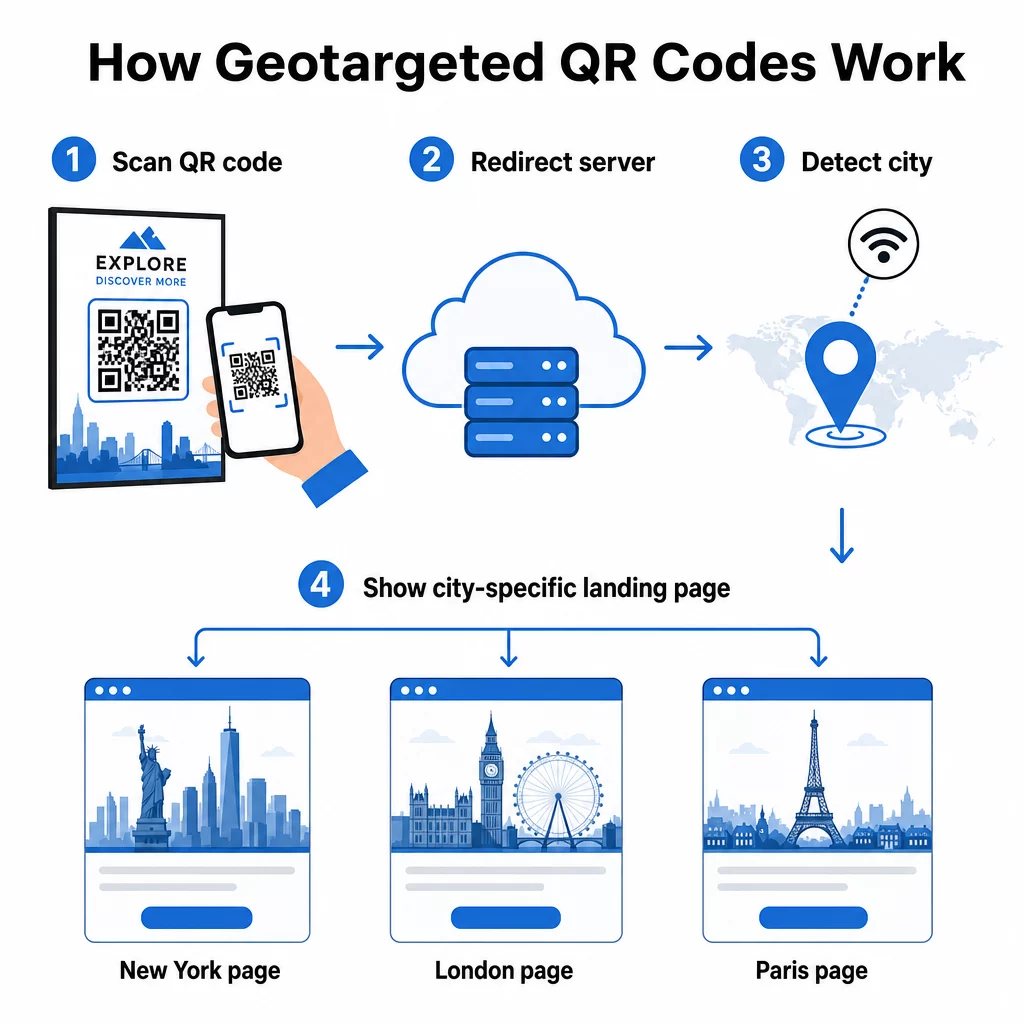
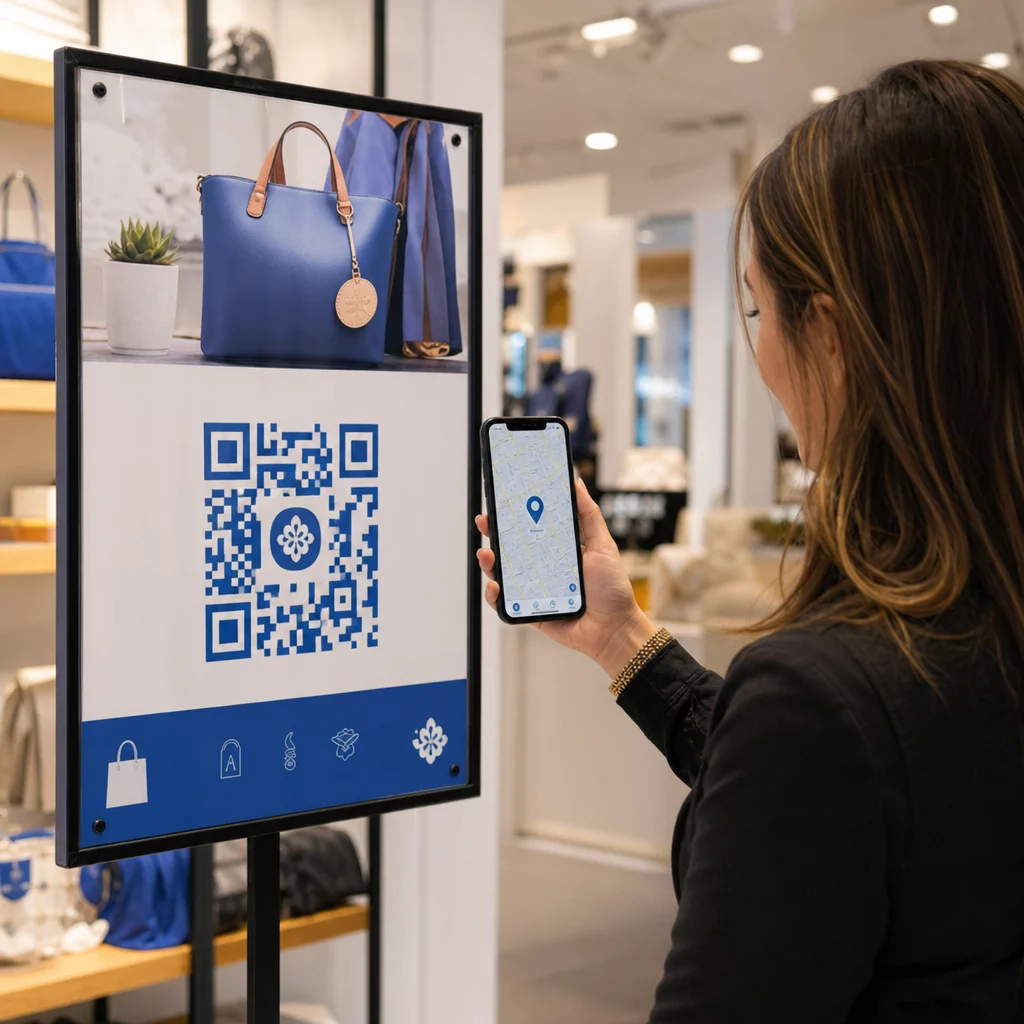
Geotargeted QR codes use location data – like GPS or IP addresses – to deliver content that’s tailored to where the user is physically located. This means a single QR code can show different information depending on where it’s scanned. For example, it might display store-specific deals or event details based on the user’s location. Unlike standard QR codes, which always lead to the same content, geotargeted codes adapt dynamically to the user’s surroundings.

Take a retail chain, for instance. They could use the same QR code across all their stores, but customers would see different promotions, store hours, or inventory details depending on the specific location. This bridges the gap between offline and online experiences, offering users digital content relevant to their immediate environment.

These codes rely on dynamic QR code generators that process location data and redirect users to the appropriate content. The system detects the location upon scanning and serves customized information instantly.

Key features of geotargeted QR codes

Geotargeted QR codes come packed with features that can elevate marketing efforts. One standout is their ability to create personalized campaigns, offering content tailored to local preferences, languages, or even regional trends. For example, a restaurant chain can showcase different menu items or pricing based on the tastes and conditions of a particular region.

Hyperlocal promotions are another key feature. Businesses can target customers with offers specific to their immediate surroundings. Imagine a shopping mall using these codes on displays and screens to promote discounts available only near certain retailers. This could help drive traffic to underperforming stores or manage inventory more effectively.

Itu analitik real-time provided by geotargeted QR codes are invaluable. They don’t just track how many people scan the code but also when, where, and on what devices the scans happen. This gives businesses insights into geographic engagement trends, peak scanning times, and device preferences – helping them make smarter marketing decisions.

Combining location data with scanning behavior also provides deeper audience insights. Marketers can pinpoint high-engagement areas, analyze seasonal trends, and even track how customers move between scanning points. For retail businesses, this kind of data is gold for planning store layouts or expansion strategies.

Additionally, these codes support A/B testing and retargeting, allowing businesses to refine their content based on location and follow up with targeted campaigns. They also ensure device-specific content delivery, customizing the user experience whether they’re scanning from a smartphone, tablet, or another device.

These capabilities open up countless possibilities across various industries, which we’ll explore next.

Use cases for geotargeted QR codes

Geotargeted QR codes shine in situations where location-specific content enhances the user experience. Here are a few examples:

  • Store-specific offers: Retailers can use a single QR code to provide discounts tailored to local inventory, competitor pricing, or regional preferences. For instance, a clothing store might promote winter coats in colder regions and swimwear in warmer ones, all through the same QR code placed on clothing tags.
  • Event check-ins: These codes are a game-changer for event organizers. A music festival, for example, could use them to provide attendees with location-specific information – like food vendor details near dining areas, restroom locations in high-traffic zones, or emergency instructions. This is especially helpful for managing large crowds and enhancing attendee experiences in the events industry.
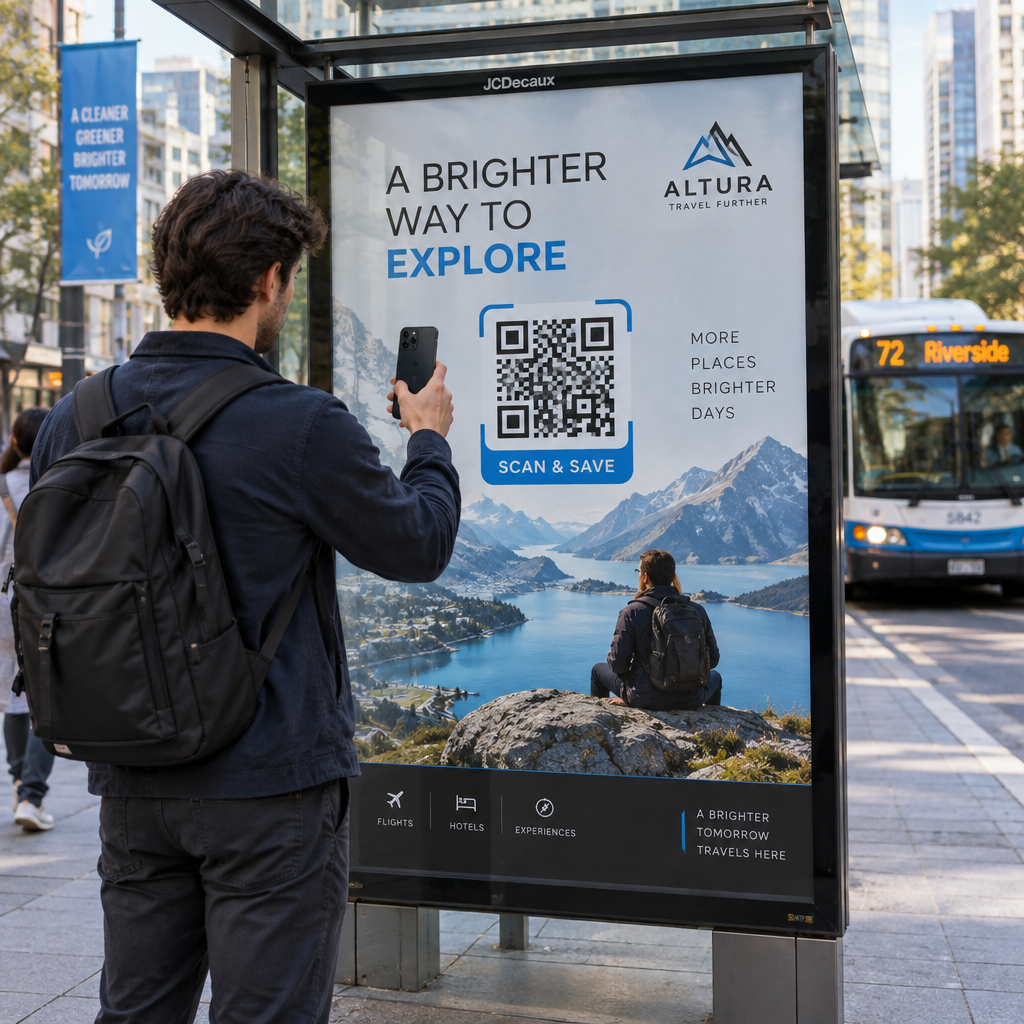
  • Region-based marketing campaigns: Businesses can adapt their messaging for local audiences without needing separate materials for each area. A tourism company might place the same QR code on nationwide posters but deliver region-specific travel packages, local attractions, or weather-based activity suggestions depending on where the code is scanned.
  • Multi-location businesses: These codes are perfect for businesses with multiple locations. A healthcare network, for example, could use them on business cards to direct patients to the nearest facility’s booking system, complete with location-specific services and availability.
  • Educational institutions: Universities can use geotargeted QR codes to enhance campus navigation and information access. Codes placed on books or campus materials could provide building-specific details, class schedules, or local resources, offering a more seamless experience for students while reducing the need for excessive printed materials.

Restaurants and other hospitality businesses also benefit from geotargeted QR codes. For instance, they can use them for contactless payments and menu systems, displaying location-specific menu options based on local ingredients, seasonal availability, or regional specialties. This approach maintains brand consistency while catering to local preferences and operational needs.

Geotargeted vs Standard QR Codes Comparison

Building on the earlier definitions, let’s dive into the practical differences between geotargeted and standard QR codes. Understanding these differences helps marketers make smarter decisions when planning campaigns. While both types bridge the gap between physical and digital interactions, they vary in functionality, flexibility, and overall value.

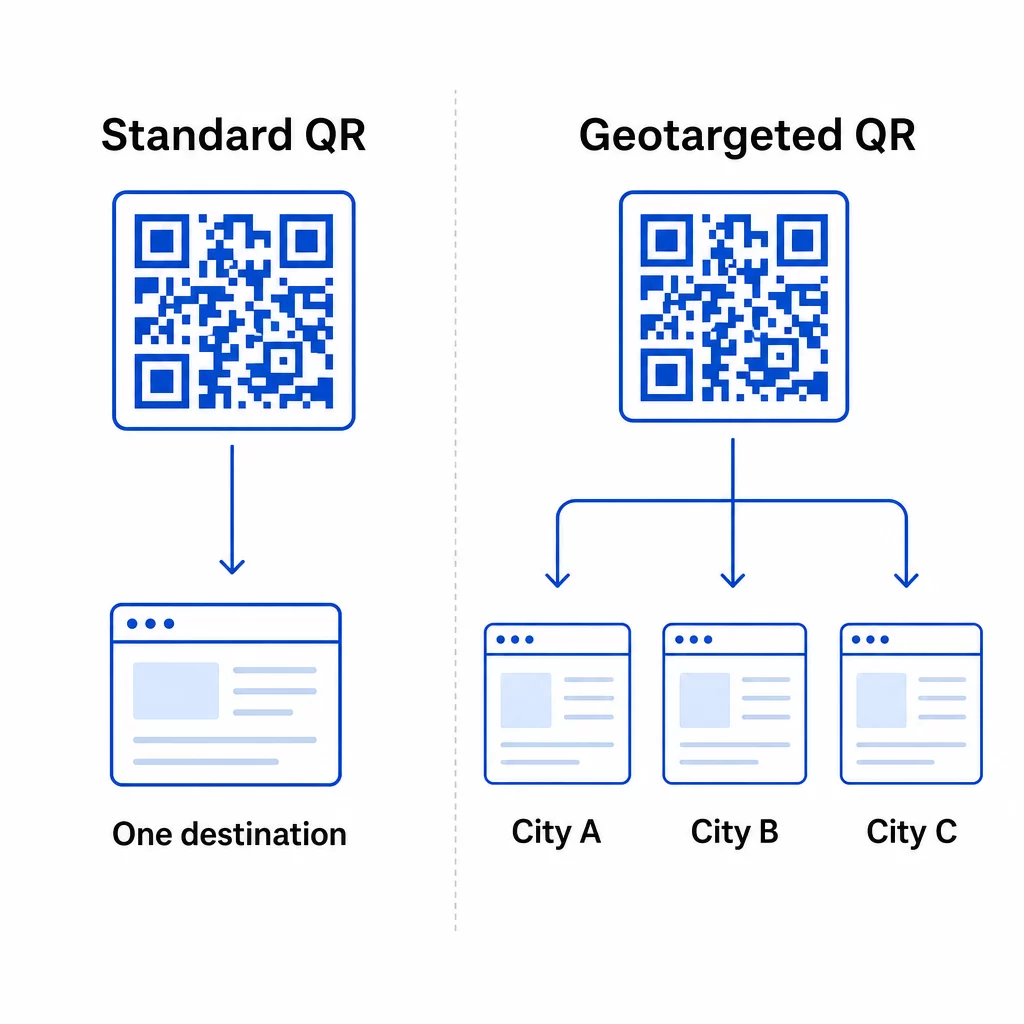
Standard QR codes are straightforward. They link directly to a fixed piece of content – like a website, contact details, or a PDF. This simplicity makes them perfect for consistent messaging across all users.

On the other hand, kode QR yang ditargetkan secara geografis adapt based on the user’s location. A single code can deliver different content depending on where it’s scanned. This dynamic feature is great for offering location-specific promotions. For instance, using a Google Maps QR Code Generator can provide local directions or highlight nearby deals, boosting engagement with a tailored approach.

The choice between these two types depends on your marketing goals, budget, and business needs. Here’s how they compare:

Comparison Table

Fitur Standard QR Codes Geotargeted QR Codes
Content delivery Static – same content for everyone Dynamic – location-based content
Setup complexity Simple – create once and deploy Moderate – requires location mapping
Biaya Low – often free for basic codes Higher – needs dynamic QR platforms
Analytics depth Basic – scan counts and timestamps Advanced – includes location data
Personalisasi ❌ One-size-fits-all ✅ Hyperlocal customization
Multi-location use ❌ Separate codes for each location ✅ One code works everywhere
Pembaruan waktu nyata ❌ Fixed content after creation ✅ Automatically updates content
Campaign management Manual – separate tracking needed Automated – centralized control
Pengalaman pengguna Generic – same for all users Tailored – location-relevant content
Security features Basic – standard encryption Enhanced – location-based access
Integration capabilities Limited – standalone functionality Advanced – integrates with CRM tools
Skalabilitas ❌ Requires multiple codes for growth ✅ Grows with your business

Which Should You Choose?

Geotargeted QR codes are particularly beneficial for multi-location businesses. They simplify campaign management by using a single code to deliver localized content, cutting down on printing and logistical costs. This also makes them ideal for campaigns that span different regions or markets. Plus, their advanced analytics provide insights like where and how users interact with your content, helping you fine-tune strategies.

For industries like finance or government, geotargeted QR codes offer added security by limiting access to content based on geographic location. This feature can help meet compliance requirements and protect sensitive information.

Meanwhile, standard QR codes are perfect for simpler needs. Whether you’re sharing contact details, directing users to a website, or offering access to a digital menu, their ease of use and low cost make them a go-to option for small businesses and budget-friendly campaigns.

Ultimately, the right choice depends on your goals and resources. With Pageloot, you can create both types of QR codes, complete with customization options, dynamic updates, and actionable insights to maximize your marketing impact.

Benefits for Marketers and Small Businesses

QR codes have become an essential tool for tackling key marketing challenges, offering solutions that range from simple, cost-effective options to advanced, personalized strategies. Standard QR codes are great for straightforward uses like linking to a website or sharing contact details on something as compact as a business card. On the other hand, kode QR yang ditargetkan secara geografis take things a step further by enabling dynamic and highly personalized campaigns, giving marketers the flexibility to adapt and refine their strategies.

One standout feature of kode QR yang ditargetkan secara geografis is their ability to be updated even after printing, thanks to platforms like Pageloot. These editable dynamic QR codes allow businesses to adjust campaigns on the fly – whether it’s tweaking offers for A/B testing, adapting time-sensitive promotions, or tailoring experiences based on the user’s device – all without the hassle and expense of reprinting materials.

Customization options are another game-changer. With over 25 QR code types available, businesses can create branded, logo-enhanced QR codes for a variety of purposes. Whether it’s sharing PDFs, linking to social media profiles through tools like the Generator kode QR Instagram, or integrating with marketing automation and CRM platforms, the possibilities are vast. These integrations also enable automated campaigns and seamless tracking of customer interactions, making it easier to manage the customer journey. Add to that robust analytics – tracking scans, locations, and device types – and marketers gain the insights they need to make smarter, data-driven decisions.

The practical applications are endless. For instance, restaurants can use Kode QR pada brosur to direct customers to a digital menu that updates in real time with the nearest location’s specials. This not only cuts down on printing costs but also delivers a seamless experience for the customer. Similarly, QR codes on product labels can link to instructional videos, warranty details, or customer support, reducing service calls and boosting satisfaction.

QR codes are proving their versatility across industries. In healthcare, they streamline patient check-ins, while in education, they offer instant access to learning materials, enhancing the overall experience. By combining flexibility, data insights, and ease of use, dynamic and geotargeted QR codes empower marketers and small businesses to create campaigns that are both cost-effective and highly engaging.

Use cases and industry applications

QR codes have found a home in countless industries, offering solutions for both general and location-specific needs. While standard QR codes are great for sharing straightforward information, geotargeted QR codes take things further by adding a location-based twist, creating new ways for businesses to connect with their audiences. The following examples highlight how different sectors are putting QR codes to work.

Industries using QR codes

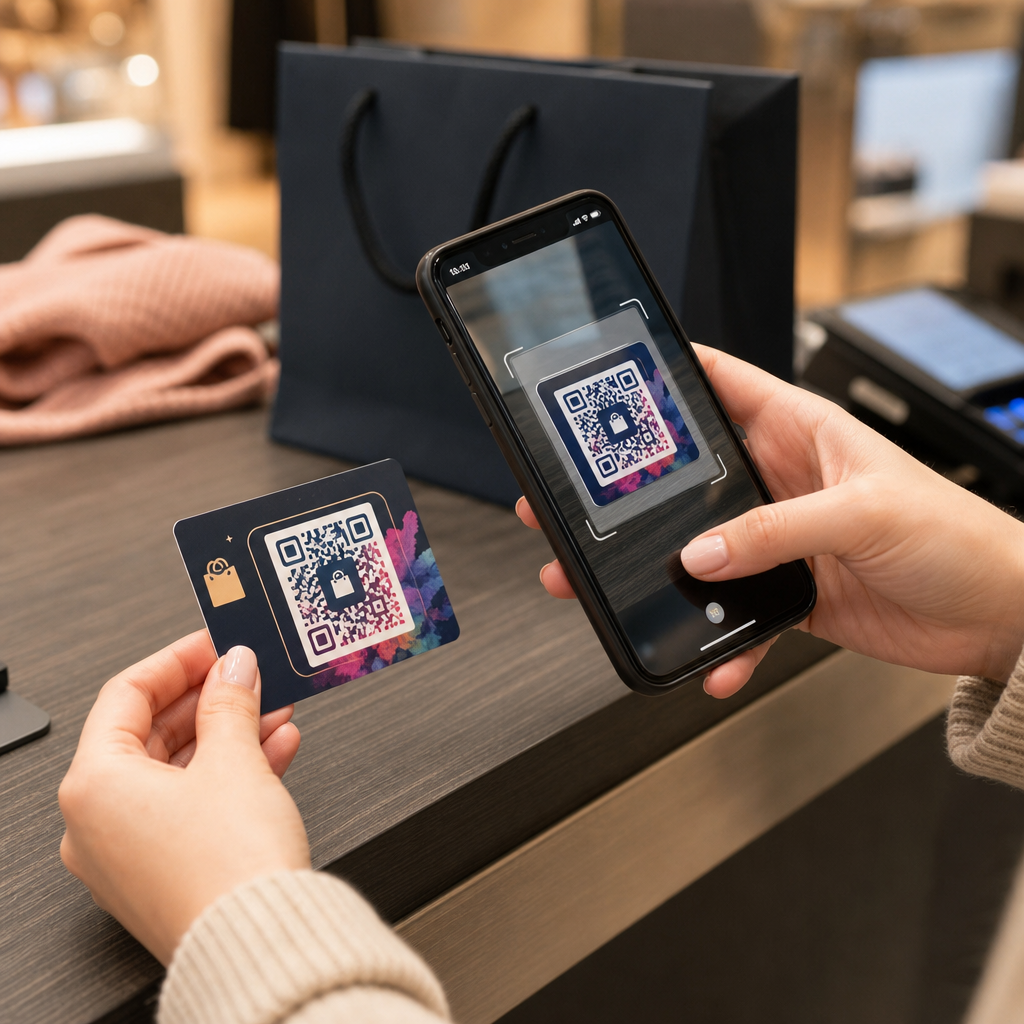
In retail and e-commerce, QR codes bridge the gap between online and offline experiences. Standard QR codes on product packaging might link to detailed specifications or warranty information, while geotargeted codes deliver location-based perks like local promotions, inventory availability, or regional pricing. Fashion brands, for instance, often include QR codes on clothing tags, directing customers to styling tips, care instructions, or even complementary items tailored to their geographic location.

Itu hospitality and events sector has embraced QR codes to streamline operations and enhance guest experiences. Hotels use standard QR codes for essentials like room service menus or Wi-Fi details, while geotargeted codes help guests discover nearby attractions, weather-appropriate activities, or personalized recommendations. Event organizers also use QR codes on tickets, enabling entry verification and offering attendees tailored schedules or venue-specific guidance.

In manufacturing, QR codes play a key role in supply chain management and customer support. Standard QR codes on equipment link to manuals, maintenance schedules, or troubleshooting guides. Meanwhile, geotargeted codes direct users to region-specific service centers, local distributors, or compliance details that vary by jurisdiction. This dual approach is especially useful for companies operating across multiple regions with differing regulations.

For the restaurant and food service industry, QR codes have transformed how businesses interact with customers. Standard QR codes on menus make it easy to access the menu digitally, while geotargeted codes can display location-specific pricing, seasonal dishes, or branch-specific offerings. Many restaurants combine both, using standard codes for core menus and geotargeted ones to highlight daily specials or regional favorites.

In perawatan kesehatan, QR codes enhance patient management and information sharing. Standard QR codes can provide access to general health resources, appointment booking tools, and patient portals. Geotargeted codes, on the other hand, direct patients to services in their area, regional health alerts, or location-specific emergency protocols. This combination ensures both broad access to information and tailored communication for specific needs.

Itu pendidikan sector uses QR codes for both learning and administrative purposes. Standard QR codes in textbooks or study materials link to extra resources, while geotargeted codes guide students to campus maps, location-specific services, or regional educational opportunities. Universities often place QR codes on posters around campus, helping students easily access building-specific resources or navigate campus facilities.

In real estate, QR codes are a powerful tool for property marketing. Standard QR codes on property signs might link to virtual tours or detailed listings, while geotargeted codes provide neighborhood-specific insights like school information, local amenities, or area demographics. This approach gives potential buyers a comprehensive view of both the property and its surroundings in one scan.

Itu automotive industry integrates QR codes for customer service and promotional efforts. Standard QR codes on vehicles often link to owner’s manuals or maintenance schedules, while geotargeted codes provide location-specific updates, such as recall notices or service discounts. This approach ensures customers receive both general product information and location-relevant services.

In tourism and travel, QR codes have become indispensable. Standard codes provide general destination details or booking links, while geotargeted codes adapt content based on the traveler’s current location, offering real-time recommendations, weather updates, or nearby attractions. Tour operators frequently use QR codes to deliver location-specific content, enhancing the visitor experience.

Pertimbangan Keamanan dan Privasi

When using QR codes in marketing, security takes on even greater importance, especially with geotargeted codes that require additional safeguards. While standard QR codes come with risks like malicious redirects or phishing attempts, geotargeted codes introduce new concerns, particularly around location tracking and managing user data.

The key difference lies in the type of data collected. Standard QR codes typically gather basic details like timestamps and device types. In contrast, geotargeted codes collect more sensitive information, such as location data and IP addresses. These added risks demand robust, multi-layered security measures.

Dynamic QR codes provide a critical advantage here, as they can be disabled, redirected, or updated in real time. Unlike static codes, which remain fixed once printed, dynamic codes allow businesses to respond quickly to security concerns or campaign adjustments.

To enhance security, multiple measures can be combined. Features like scan limits, password protection, dan expiry dates help prevent misuse, add authentication steps, and deactivate codes automatically after a campaign ends. For location-based campaigns, building trust through transparency is essential. Clearly communicating how data is collected and used not only ensures compliance with privacy regulations but also maintains customer confidence. The table below highlights key security features and how Pageloot integrates them.

Fitur Keamanan Standard QR Codes Geotargeted QR Codes Pageloot Implementation
Batas Pemindaian Tidak tersedia Essential for location campaigns Customizable per code
Password Protection Basic options Critical for sensitive data Integrated password protection
Expiry Dates Manual management Automated security Flexible scheduling
Real-time Monitoring Limited tracking Location-aware analytics Comprehensive dashboard
Data Privacy Controls Minimal options Regulatory compliance Full transparency tools

Protecting User Data Privacy

Beyond these security features, safeguarding user privacy is paramount. For example, scan limits are an effective way to control how often a QR code can be used. A restaurant running a geotargeted campaign for a special discount might set a scan limit of 100 uses per location. This prevents misuse while ensuring genuine customers benefit from the offer.

Password protection adds another layer of security, particularly for sensitive or exclusive content. When users scan a password-protected code, they must enter credentials to access the linked material. This feature is ideal for business cards containing confidential contact details or internal documents meant to remain private.

Expiry dates are another essential tool, automatically disabling QR codes after a set period. This ensures outdated campaigns don’t become security risks. For instance, a marketing agency might set expiry dates for client campaign codes to prevent old promotional materials from being exploited. This is especially useful for time-sensitive offers.

A geotargeted campaign for a real estate company could combine these features: password protection for exclusive property details, scan limits to control the number of views, and expiry dates aligned with property listing periods.

Pageloot’s analytics dashboard enhances these efforts by offering real-time monitoring. Businesses can track QR code scans as they happen, quickly identify irregularities, and maintain compliance with data protection regulations through detailed usage reports.

For small businesses and marketers, implementing these security features is straightforward. Pageloot’s intuitive interface makes it easy to enable password protection, set scan limits, and configure expiry dates during the QR code creation process. Even without a dedicated IT team, businesses can launch secure QR code campaigns while prioritizing customer privacy.

The key to effective QR code security is tailoring the right combination of features to each campaign. For example, a Google Maps QR code for a public business might only need basic expiry settings, while a geotargeted campaign collecting location data would require more advanced protections, like password authentication and strict scan limits.

Kesimpulan

Deciding between geotargeted and standard QR codes depends on your campaign goals and whether location-specific targeting is necessary. Standard QR codes are perfect for straightforward uses like linking to websites, sharing contact details, or displaying menus. They’re affordable, simple to use, and work well for businesses that don’t require location-based features.

On the other hand, geotargeted QR codes shine when you want to deliver personalized, location-based experiences. These are especially useful for businesses with multiple locations, event organizers, or marketers running regional promotions. For instance, showing tailored content to users in New York versus Los Angeles can significantly improve engagement and conversions.

If you’re just starting out, it’s smart to begin small. A small business could start by using a basic QR code for menus to get familiar with the technology. As your needs grow, you can explore geotargeted campaigns. Just remember, when collecting location data, prioritize strong security measures to safeguard user privacy.

The shift from static to dynamic, location-aware solutions reflects the changing landscape of modern marketing. With Pageloot’s QR code generator, you can create both standard and geotargeted codes featuring advanced customization, real-time analytics, and top-notch security. For those focusing on location-based marketing, the Google Maps QR code generator offers a creative way to provide localized content.

Start by addressing your immediate needs and scale up as your marketing strategy grows. Businesses that see the most success with QR codes often begin with simple applications and gradually adopt advanced features like geotargeting as their campaigns evolve.

Pertanyaan Umum

What makes geotargeted QR codes more effective at engaging customers than standard QR codes?

Geotargeted QR codes take personalization to the next level by offering content tailored to specific locations. Imagine scanning a QR code at a local coffee shop and instantly receiving a discount exclusive to that spot. This kind of targeted interaction not only grabs attention but also encourages users to act immediately, creating a more engaging experience.

Beyond enhancing user interaction, these QR codes provide businesses with a treasure trove of data. They can reveal patterns like foot traffic trends or preferences unique to certain areas. Armed with this information, companies can fine-tune their marketing strategies to better connect with local audiences. Unlike standard QR codes, geotargeted ones are more adaptable, helping businesses build stronger relationships with their customers while achieving better outcomes.

What privacy concerns should businesses consider with geotargeted QR codes, and how can they address them?

Geotargeted QR codes have the potential to spark privacy concerns, as they can gather sensitive details like location, device specifics, and IP addresses – sometimes without users being fully informed. To tackle this issue, businesses must prioritize clear and transparent data collection practices, ensuring users know exactly what information is being collected and the purpose behind it.

Securing explicit user consent before collecting location data is a key step. Beyond that, robust security measures, such as data encryption dan anonymization, are essential to safeguard user information. Offering users the ability to opt out of data tracking or geotargeting not only strengthens trust but also aligns with privacy regulations and standards.

When should a small business choose geotargeted QR codes over standard QR codes?

Small businesses looking to boost location-specific engagement should consider using kode QR yang ditargetkan secara geografis. These codes enable businesses to share personalized content – like store promotions, event updates, or regional offers – based on where the user is located. This approach not only makes the content more relevant but also encourages visits to local stores or events.

Geotargeted QR codes shine in local campaigns. Whether it’s promoting nearby events, providing store directions, or offering discounts tied to a specific location, these codes adapt dynamically to the user’s whereabouts. Unlike traditional QR codes that need manual updates, geotargeted ones automatically adjust their content, saving time while improving the user experience.

For businesses aiming to boost local visibility and deliver tailored marketing, geotargeted QR codes create meaningful, context-aware connections that resonate with their audience.

Posting Blog Terkait

Tentang penulis

Siim Kostabi adalah Content Lead di Pageloot. Ia menulis tentang layanan generator kode QR inovatif kami. Dengan keahlian mendalam selama lebih dari setengah dekade di bidang kode QR, Siim adalah pakar di bidang ini. Ia membuat kemajuan signifikan dalam memanfaatkan teknologi QR untuk menyederhanakan dan meningkatkan interaksi digital.

Kategori
Belajar lebih tentang
Buat Kode QR untuk Sekolah dan lembaga pendidikan pembelajaran
Kode QR untuk Pendidikan sekolah
✅ Solusi #1 untuk Kode QR

Jika Anda perlu membuat Kode QR online, Anda bisa Buat kode QR di sini gratis!
Pageloot adalah #1 Solusi Masuk untuk membuat dan memindai Kode QR.

BL-0110

Dipercaya oleh lebih dari 20.000 merek untuk mendapatkan lebih banyak penjualan, ulasan & pengikut.

Logo klien
Dipercaya oleh merek ternama
Dinilai 4.8 dari 5

4.86 / peringkat 5 bintang

Hugo Laurent
Hugo Laurent
Pemilik restoran
Generator kode QR paling mudah dan andal yang pernah ada. File PDF dapat diunggah secara instan. Menu restoran kami sekarang sudah digital.
Lucas Jansen
Lucas Jansen
Pengembang real estat
Ini adalah alat yang sangat baik dan kode QR membawa Anda ke tempat yang Anda inginkan. Kami hanya menggunakan kode QR lokasi tetapi ada begitu banyak fitur yang berguna.
Emma Moretti
Emma Moretti
Produk Ritel
Mudah digunakan dan cepat. Ini berfungsi dengan baik dan menghasilkan gambar yang sempurna, sehingga karyawan dapat mengunduh vCard saya.
Hugo Laurent
Hugo Laurent
Pemilik restoran
Generator kode QR paling mudah dan andal yang pernah ada. File PDF dapat diunggah secara instan. Menu restoran kami sekarang sudah digital.
Lucas Jansen
Lucas Jansen
Pengembang real estat
Ini adalah alat yang sangat baik dan kode QR membawa Anda ke tempat yang Anda inginkan. Kami hanya menggunakan kode QR lokasi tetapi ada begitu banyak fitur yang berguna.
Emma Moretti
Emma Moretti
Produk Ritel
Mudah digunakan dan cepat. Ini berfungsi dengan baik dan menghasilkan gambar yang sempurna, sehingga karyawan dapat mengunduh vCard saya.
Lihat Lebih Banyak Kode QR
Kode QR pada Tenda Tabel
Kode QR aktif Tenda Meja
Ubah apa pun menjadi pengalaman digital dalam waktu kurang dari 3 menit.

Uji coba gratis 14 hari.

Tidak diperlukan kartu kredit.

Dapatkan diskon 30% untuk pembelian pertama Anda

Gunakan kode:

Bagikan file MP3 Anda

Daftar untuk membuat kode QR PDF

Unggah dan tampilkan semua yang Anda butuhkan:

  • File audio
  • Podcast
  • Musik

Uji coba gratis 14 hari dengan pendaftaran.
Kode QR kedaluwarsa setelah uji coba.

mendaftar untuk membuat kode QR audio mp3

Dapatkan lebih banyak pemindaian dengan bingkai

Daftar untuk menambahkan lebih banyak bingkai ke kode QR Anda

Bingkai ajakan bertindak membantu pelanggan Anda berinteraksi dengan Kode QR dengan mudah. Cobalah mereka!

Uji coba gratis 14 hari dengan pendaftaran.
Kode QR kedaluwarsa setelah uji coba.

Daftar untuk menambahkan lebih banyak bingkai ke kode QR Anda

Tambahkan lebih banyak gaya dengan bentuk

Daftar untuk membuat lebih banyak bentuk

Kode QR tidak harus persegi. Cobalah mengubahnya agar sesuai dengan citra merek Anda.

Uji coba gratis 14 hari dengan pendaftaran.
Kode QR kedaluwarsa setelah uji coba.

Daftar untuk membuat lebih banyak bentuk

Tambahkan logo ke Kode QR Anda

Daftar untuk menambahkan logo Anda ke kode QR

Jadikan kode QR Anda menonjol dengan menambahkan logo dan merek Anda ke dalamnya.

Uji coba gratis 14 hari dengan pendaftaran.
Kode QR kedaluwarsa setelah uji coba.

Daftar untuk menambahkan logo Anda ke kode QR

Pengalihan Toko Aplikasi Cerdas

Daftar untuk membuat kode QR toko aplikasi

Tambahkan tautan Aplikasi Anda ke Kode QR App Store pintar kami. Pengguna dialihkan berdasarkan perangkat mereka.

Uji coba gratis 14 hari dengan pendaftaran.
Kode QR kedaluwarsa setelah uji coba.

Daftar untuk membuat kode QR toko aplikasi

Unggah gambar ke Kode QR

Daftar untuk membuat kode QR gambar

Bagikan gambar Anda dengan mudah. Ubah gambar apapun secara dinamis dalam hitungan detik.

Uji coba gratis 14 hari dengan pendaftaran.
Kode QR kedaluwarsa setelah uji coba.

Daftar untuk membuat kode QR gambar

Bagikan file PDF Anda

Daftar untuk membuat kode QR PDF

Unggah dan tampilkan semua yang Anda butuhkan:

  • Menu & daftar harga
  • Instruksi
  • Dokumen apa saja

Uji coba gratis 14 hari dengan pendaftaran.
Kode QR kedaluwarsa setelah uji coba.

Daftar untuk membuat kode QR PDF

Edit nanti tanpa mencetak

Daftar untuk mengedit kode QR Anda tanpa mencetak lagi

Kode QR Dinamis memungkinkan Anda mengubah konten Kode QR Anda tanpa harus mencetak yang baru.

Uji coba gratis 14 hari dengan pendaftaran.
Kode QR kedaluwarsa setelah uji coba.

Daftar untuk mengedit kode QR Anda tanpa mencetak lagi

Kapan? Di mana? Lacak pemindaian Kode QR Anda

Daftar untuk melacak kode QR Anda

Temukan Kode QR mana yang paling banyak dipindai dan apa yang paling menggairahkan klien Anda.

Uji coba gratis 14 hari dengan pendaftaran.
Kode QR kedaluwarsa setelah uji coba.

Daftar untuk melacak kode QR Anda

File siap cetak tersedia

Daftar untuk membuat kode QR vektor seperti PDF dan SVG

.EPS, .PDF, .SVG

Ingin mengunduh Kode QR Anda dalam resolusi HD? Dapatkan format vektor atau piksel yang siap dicetak.

Uji coba gratis 14 hari dengan pendaftaran.
Kode QR kedaluwarsa setelah uji coba.

Daftar untuk membuat kode QR vektor seperti PDF dan SVG

Mohon tunggu. Kode QR Anda adalah Memuat... Memuat...

Jadikan milik Anda sendiri

Daftar untuk menyimpan kode QR Anda untuk nanti

Dapatkan lebih banyak pindaian dengan membuat Kode QR keren dengan berbagai warna, logo, dan bingkai ajakan bertindak.

Uji coba gratis 14 hari dengan pendaftaran.
Kode QR kedaluwarsa setelah uji coba.

Daftar untuk menyimpan kode QR Anda untuk nanti