> 블로그 > QR 코드가 전자상거래 배송을 개선하는 방법
Printerless QR return

QR 코드가 전자상거래 배송을 개선하는 방법

Learn how QR codes improve e-commerce deliveries by enabling real-time tracking, automated notifications, and printerless returns to reduce support requests.
Updated on 6월 10, 2026
목차

Are your customers constantly asking “Where is my order?” while your support team drowns in tracking requests? Delivery communication gaps cost you time, money, and customer trust. This guide explains how QR codes solve those problems at every stage of the delivery process – from shipping labels to returns to post-purchase engagement.

What Delivery Problems Do QR Codes Actually Solve?

Before exploring the solutions, it helps to understand the specific breakdowns that QR codes address.

Lack of real-time tracking is one of the most common frustrations in e-commerce logistics. Traditional 1D barcodes store minimal data and require precise alignment to scan. When damaged, they can block updates entirely. Research shows that 88% of consumers consider real-time delivery tracking critical for a positive experience, yet many businesses still rely on systems that can’t provide it. Without live visibility, customers feel left in the dark – and their anxiety shows up directly in your support queue.

Poor notification systems compound the problem. When communication between warehouses, couriers, and customers is inconsistent, shoppers are left with vague delivery windows that can span several hours. They don’t know when to be home, whether to contact support, or whether their order is even moving. IKEA addressed a version of this problem by sending QR codes via email or SMS after customers register returns, allowing staff to process them without manual follow-ups.

Last-mile delivery failures represent the highest-risk stage of the journey. Incorrect addresses, missed delivery attempts, and missing proof of delivery can turn a smooth process into a frustrating ordeal – and one that directly affects repurchase decisions.

Difficult returns are a final pain point that grows each year. In 2024, the average U.S. e-commerce return rate reached 20.4%, representing approximately $362 billion in online returns. Processing a return can cost three to four times the refund amount alone when you factor in shipping, labor, fees, and lost customer value. When the returns process is unclear or printer-dependent, it adds friction that discourages both returns and repurchases.

How QR Codes Enable Real-Time Tracking and Automated Notifications

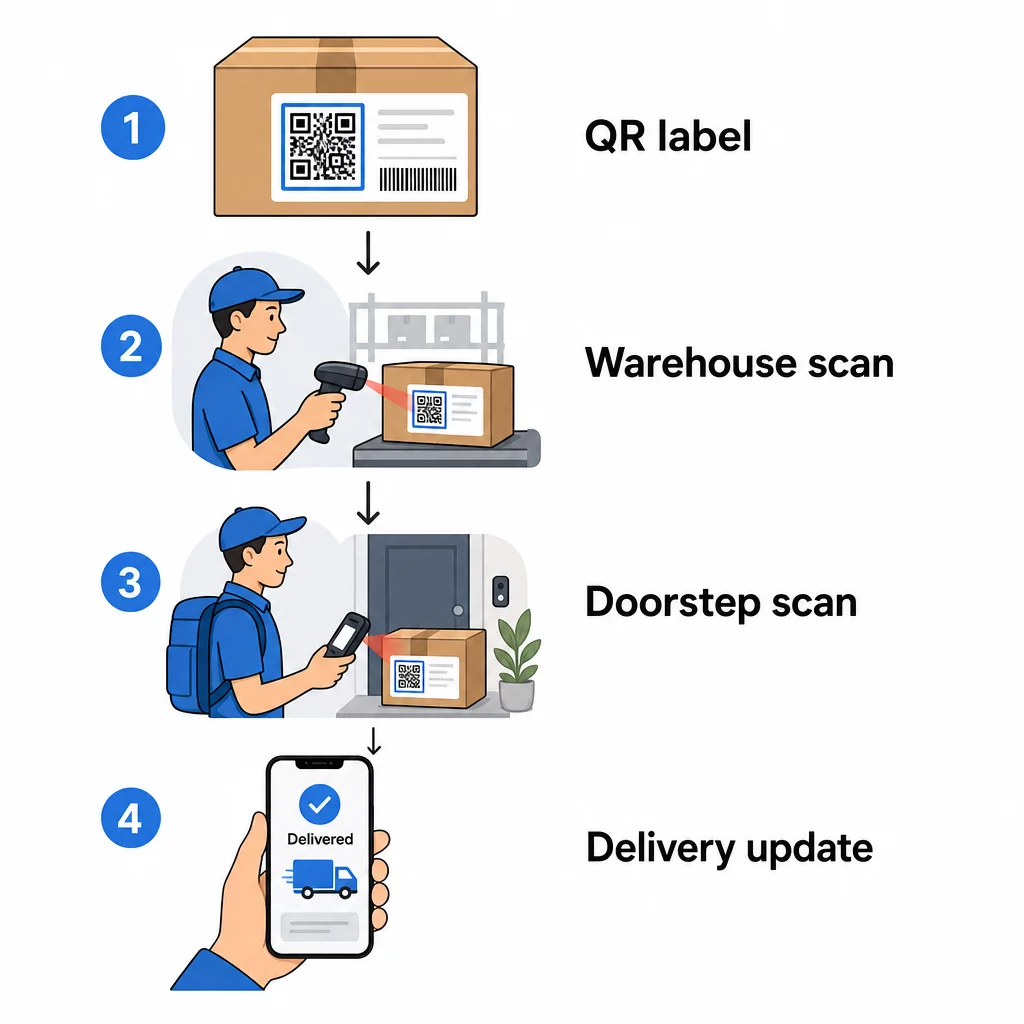
QR codes solve the tracking gap by turning shipping labels into dynamic data sources. Unlike traditional barcodes, QR codes carry detailed tracking information that updates at every scan point – warehouse intake, sorting facility, out for delivery, and final handoff. This creates a direct, real-time link between customers, couriers, and your logistics system.

QR delivery tracking flow

Self-Service Tracking for Customers

When you print a QR code on a shipping label or include one in a confirmation email, customers can scan it to access a live tracking page showing their package’s current location and status. This self-service model significantly reduces “Where is my order?” support tickets because customers get the answer themselves, instantly.

동적 QR 코드 make this even more powerful. Because the destination URL can be updated without reprinting the label, customers always see current information – whether the package is in transit, delayed, or delivered. You don’t need to reissue labels if a route changes or a delay occurs.

Keep Every Scan Current Without Reprinting 사용 동적 QR 코드 생성기 to create shipping label codes that you can update anytime – so customers always see accurate delivery status with a single scan.

Scan-Triggered Updates for Couriers and Warehouse Staff

For logistics teams, QR codes automate the data entry that slows down manual workflows. When a courier or warehouse worker scans a QR code on a shipping label, the system logs a timestamped update – picked, packed, shipped, received – without any manual input. A final scan before loading updates the order status to “shipped” automatically.

This also applies at scale. The European Pallet Association (EPAL) added QR codes to its 650 million pallets, enabling real-time tracking and unique identification for each unit. That level of precision reduces bottlenecks and improves delivery accuracy across high-volume operations.

Automated Delivery Alerts

When integrated into tracking systems, each QR scan can trigger automated customer notifications. When a courier scans the code at your customer’s doorstep, the system records GPS and timestamp data and instantly updates the order status to “Delivered” in the customer’s account. This confirms delivery, resolves disputes, and reduces support inquiries without requiring manual intervention.

Research supports how much this matters: 83% of buyers expect updates throughout their order’s journey, and nearly four in ten shoppers say frequent tracking updates directly reduce their post-purchase anxiety. Automating those updates through QR scans means you meet those expectations without adding workload to your team.

QR Code Applications Across the Delivery Lifecycle

Reducing Support Ticket Volume

QR codes placed on shipping confirmations and package labels give customers instant access to a real-time tracking portal. Because 동적 QR 코드 update automatically, the link on a printed label remains useful even when delivery routes change or delays occur. For e-commerce businesses, this translates directly into fewer support tickets and faster resolution for the inquiries that do come in.

Improving Last-Mile Delivery Accuracy

When delivery drivers scan a QR code on a shipping label, they instantly access recipient details, delivery instructions, and route updates. QR codes also provide seamless proof of delivery by capturing GPS coordinates and a timestamp the moment the code is scanned at the customer’s location. This creates clear documentation for resolving disputes.

An additional practical advantage: QR codes include built-in error correction. Even if up to 30% of the code is physically damaged – from moisture, abrasion, or handling – the code remains scannable. That resilience matters in real-world freight and last-mile environments. You can read more about this capability in the guide to how QR codes improve freight tracking.

Simplifying Returns with Printerless QR Labels

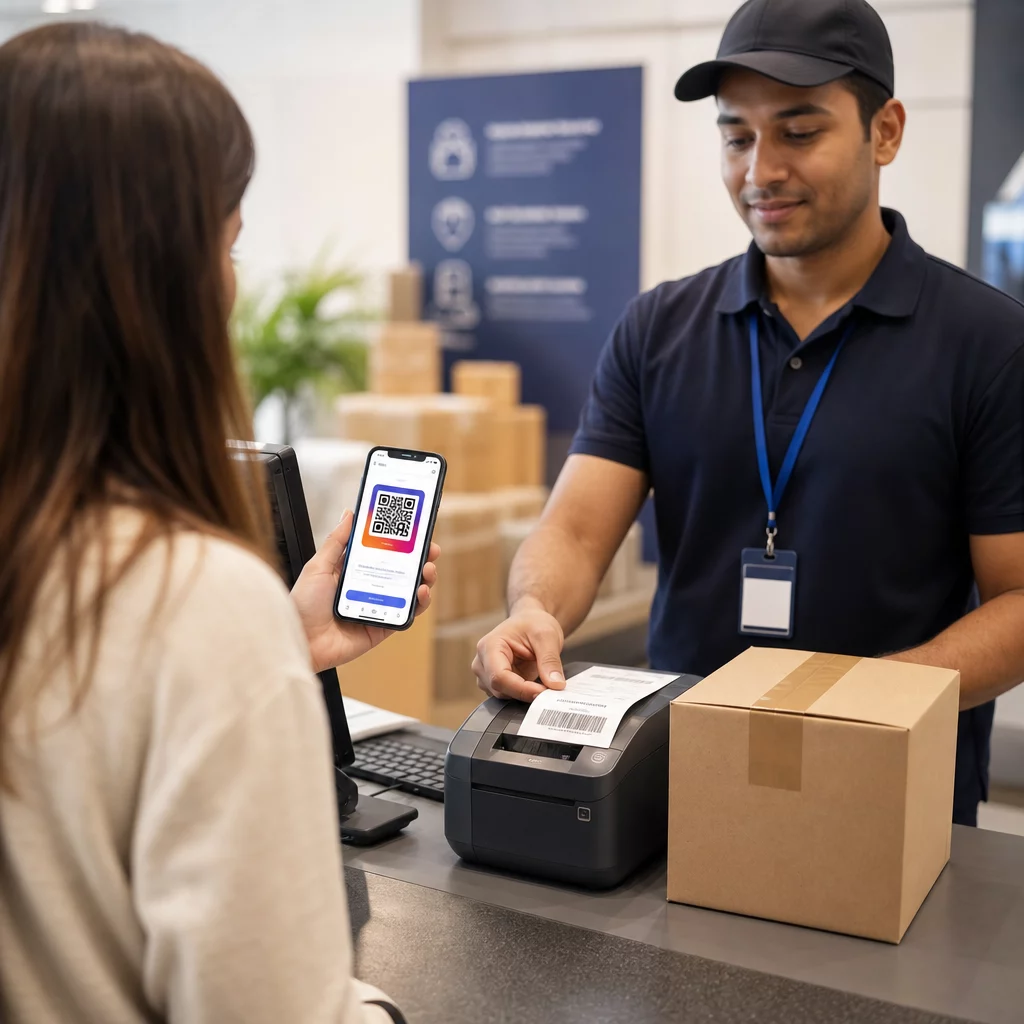
Returns are where QR codes may have their biggest operational impact. Instead of requiring customers to print labels, businesses can send a QR code by email or SMS that the customer presents at a drop-off point like USPS or a local carrier location. The carrier scans the code and generates the physical label on-site.

This “printerless return” approach reduces friction at every step. Customers don’t need a printer, don’t need to manually enter return addresses, and can initiate returns from their phones. Data shows that 96% of customers are more likely to repurchase from brands that make returns easy, and 30% of customers who use paperless returns ship on the same day they initiate the process.

와 함께 QR 코드 생성기 linked to a pre-filled return portal, you can also automate inventory updates the moment a return is initiated – removing the manual reconciliation that drives up reverse logistics costs.

Post-Delivery Customer Engagement

Delivery doesn’t have to end the customer relationship. A QR code inside the box or printed on the packaging can direct customers to product tutorials, setup guides, care instructions, or review forms. This reduces post-purchase confusion, cuts down on support requests for common questions, and opens a channel for ongoing engagement.

You can also use these packaging QR codes to share exclusive coupons or reorder links. A coupon QR code linked directly from the package insert is a straightforward way to drive repeat purchases without any additional outreach. For ideas on extending this approach, 제품 라벨용 QR 코드 covers implementation across packaging touchpoints.

How to Implement QR Codes in Your Delivery Operations

Map Your Key Touchpoints First

Start by identifying every point in your delivery workflow where information needs to move – shipping labels, return labels, packing slips, and product packaging. Each of these is a potential QR code placement. Shipping labels are scanned multiple times by warehouse staff, couriers, and customers, making them the highest-value location. Return labels benefit most from the printerless approach. Product packaging is best suited for post-delivery engagement content.

For a detailed walkthrough of how QR codes fit into the picking, packing, and shipping sequence, the guide to how QR codes streamline order fulfillment covers each stage with practical specifics.

Design QR Codes for Physical Durability

Logistics QR codes get handled roughly. When designing codes for shipping labels, ensure they meet minimum size requirements – at least 0.8 inches square – and maintain a high contrast ratio between the dark code and a light background. Use thermal-transfer or UV-resistant label materials that can withstand moisture and temperature changes during transit. Adding a brief instruction like “Scan to track your order” removes any ambiguity for customers who may be unfamiliar with the process.

If you’re transitioning from traditional barcodes, the guide to 배송 라벨 바코드 explains the differences between 1D and 2D formats and helps you understand what to replace.

Use Dynamic QR Codes for Flexibility

Static QR codes encode a fixed destination that cannot be changed after printing. For delivery applications, this creates problems whenever a tracking URL changes, delivery instructions are updated, or a return portal is modified. 동적 QR 코드 solve this by encoding a short redirect URL that you can update at any time from a central dashboard – without reprinting a single label.

This flexibility is particularly valuable for businesses with high label volumes. You print once, and retain the ability to redirect customers to current, accurate information indefinitely.

Update Delivery Information Without Touching a Printer 그만큼 동적 QR 코드 생성기 lets you edit the destination URL on any printed label. Trusted by over 20,000 companies across 110 countries – start with a free 14-day trial, no credit card required.

Track Performance with Scan Analytics

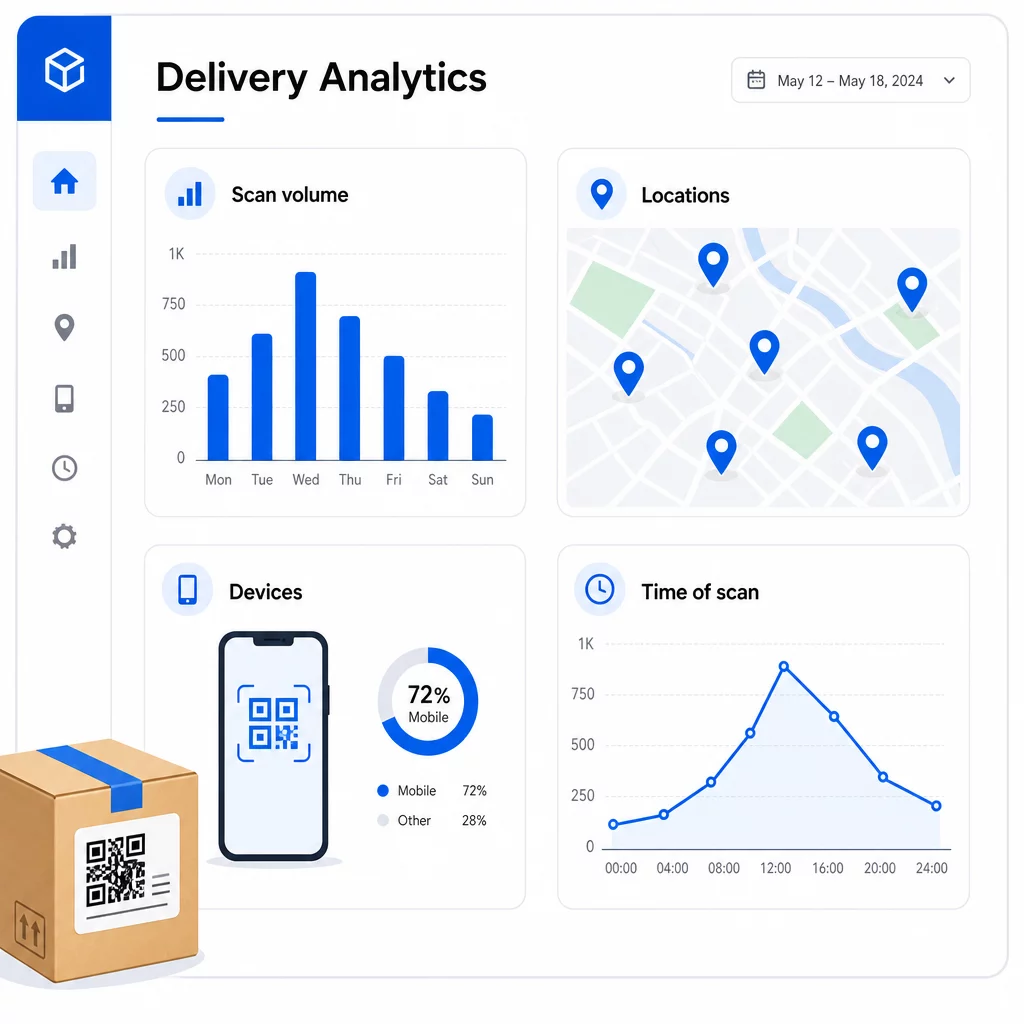
Once your codes are deployed, scan analytics tell you how and where they’re being used. Metrics like scan volume, geographic location, device type, and time of scan help you identify where customers are engaging most – and where they’re not. If QR codes on post-delivery packaging show low scan rates, that’s a signal to adjust placement or add a clearer call-to-action.

QR 스캔 분석

For e-commerce businesses running multiple SKUs or delivery regions, QR 코드 추적 lets you compare performance across campaigns and optimize your logistics communication based on real data rather than assumptions. You can explore how brands have applied this data in case studies on QR codes transforming e-commerce.

자주 묻는 질문

How do QR codes improve delivery accuracy in e-commerce?

QR codes on shipping labels give couriers instant access to recipient details, delivery instructions, and route updates with a single scan. At the moment of delivery, scanning the code logs GPS coordinates and a timestamp, creating verifiable proof of delivery and updating the order status automatically. This eliminates manual data entry errors and provides clear documentation for resolving delivery disputes.

What is the advantage of dynamic QR codes over static ones for logistics?

Static QR codes encode a fixed destination that cannot be changed after printing. Dynamic QR codes point to a redirect URL that you can update at any time from a central dashboard. For delivery operations, this means you can update tracking links, delivery instructions, or return portals without reprinting any labels. Dynamic codes also support scan analytics – including scan volume, location, device type, and timing – which static codes cannot provide.

How do QR codes make the returns process easier for customers?

QR codes enable printerless returns. Instead of printing a label at home, customers receive a QR code by email or SMS and present it at a carrier drop-off location, where the physical label is generated automatically. This removes the printer requirement entirely, reduces friction in the returns process, and speeds up package drop-off. Businesses benefit from automated inventory updates when a return is initiated through the linked return portal.

작성자 정보

시임 코스타비는 페이지루트의 콘텐츠 책임자입니다. 그는 페이지루트의 혁신적인 QR 코드 생성 서비스에 대한 글을 쓰고 있습니다. 5년 이상 QR 코드 분야에서 쌓아온 깊이 있는 전문 지식을 바탕으로, 시임은 이 분야의 전문가로 인정받고 있습니다. 그는 QR 기술을 활용하여 디지털 상호작용을 간소화하고 향상시키는 데 크게 기여하고 있습니다.

범주
에 대해 자세히 알아보기
WhatsApp QR 코드 스캔
QR 코드 스캔 WhatsApp

온라인으로 QR 코드를 생성해야하는 경우 QR 코드 만들기 무료로 여기!
Pageloot는 #1 Go-To 솔루션 QR 코드를 만들고 스캔합니다.

20,000개 이상의 브랜드로부터 신뢰를 받아 더 많은 매출, 리뷰, 팔로워를 확보했습니다.

클라이언트 로고
최고 브랜드의 신뢰
5 중 4.8 평가

4.86 / 5 별점

휴고 로랑
휴고 로랑
레스토랑 주인
가장 쉽고 안정적인 QR 코드 생성기. PDF 파일을 즉시 업로드할 수 있습니다. 이제 레스토랑 메뉴가 디지털화되었습니다.
루카스 얀센
루카스 얀센
부동산 개발사
이것은 훌륭한 도구이며 QR 코드를 사용하면 원하는 곳으로 이동할 수 있습니다. 우리는 위치 QR 코드만 사용하지만 유용한 기능이 너무 많습니다.
엠마 모레티
엠마 모레티
소매 제품
사용하기 쉽고 빠릅니다. 그것은 훌륭하게 작동하고 완벽한 이미지를 생성하므로 직원들이 내 vCard를 다운로드할 수 있습니다.
휴고 로랑
휴고 로랑
레스토랑 주인
가장 쉽고 안정적인 QR 코드 생성기. PDF 파일을 즉시 업로드할 수 있습니다. 이제 레스토랑 메뉴가 디지털화되었습니다.
루카스 얀센
루카스 얀센
부동산 개발사
이것은 훌륭한 도구이며 QR 코드를 사용하면 원하는 곳으로 이동할 수 있습니다. 우리는 위치 QR 코드만 사용하지만 유용한 기능이 너무 많습니다.
엠마 모레티
엠마 모레티
소매 제품
사용하기 쉽고 빠릅니다. 그것은 훌륭하게 작동하고 완벽한 이미지를 생성하므로 직원들이 내 vCard를 다운로드할 수 있습니다.
더 많은 QR 코드보기
Marketing QR code scan
QR 코드 방법 마케팅 강화
Scanning food package QR
QR 코드 사용 식품 포장
무엇이든 디지털 경험으로 전환하세요 3분 이내에.

14일 무료 체험.

신용카드는 필요 없습니다.

첫 구매 시 30% 할인

코드를 사용하세요:

MP3 파일 공유

PDF QR 코드를 생성하려면 가입하세요

필요한 모든 것을 업로드하고 표시합니다.

  • 오디오 파일
  • 팟캐스트
  • 음악

가입 시 14일 무료 체험.
체험 기간 후 QR 코드 만료.

오디오 mp3 QR 코드를 생성하려면 가입하세요

프레임으로 더 많은 스캔 확보

QR 코드에 더 많은 프레임을 추가하려면 가입하세요

클릭 유도 문안 프레임은 고객이 QR 코드와 쉽게 상호 작용할 수 있도록 도와줍니다. 사용해 보세요!

가입 시 14일 무료 체험.
체험 기간 후 QR 코드 만료.

QR 코드에 더 많은 프레임을 추가하려면 가입하세요

도형으로 더 많은 스타일 추가

더 많은 도형을 만들려면 가입하세요

QR 코드는 정사각형일 필요가 없습니다. 브랜드 이미지에 맞게 전환해 보세요.

가입 시 14일 무료 체험.
체험 기간 후 QR 코드 만료.

더 많은 도형을 만들려면 가입하세요

QR 코드에 로고 추가

QR 코드에 로고를 추가하려면 가입하세요

로고와 브랜드를 추가하여 QR 코드를 돋보이게 만드세요.

가입 시 14일 무료 체험.
체험 기간 후 QR 코드 만료.

QR 코드에 로고를 추가하려면 가입하세요

스마트 앱 스토어 리디렉션

앱 스토어 QR 코드를 생성하려면 가입하세요

스마트 앱 스토어 QR 코드에 앱 링크를 추가하세요. 사용자는 장치에 따라 리디렉션됩니다.

가입 시 14일 무료 체험.
체험 기간 후 QR 코드 만료.

앱 스토어 QR 코드를 생성하려면 가입하세요

QR 코드에 이미지 업로드

이미지 QR 코드를 생성하려면 가입하세요

이미지를 쉽게 공유하세요. 몇 초 안에 동적으로 이미지를 변경하십시오.

가입 시 14일 무료 체험.
체험 기간 후 QR 코드 만료.

이미지 QR 코드를 생성하려면 가입하세요

PDF 파일 공유

PDF QR 코드를 생성하려면 가입하세요

필요한 모든 것을 업로드하고 표시합니다.

  • 메뉴 및 가격표
  • 명령
  • 모든 문서

가입 시 14일 무료 체험.
체험 기간 후 QR 코드 만료.

PDF QR 코드를 생성하려면 가입하세요

인쇄 없이 나중에 편집

다시 인쇄하지 않고 QR 코드를 편집하려면 가입하세요

동적 QR 코드를 사용하면 새 QR 코드를 인쇄하지 않고도 QR 코드의 내용을 변경할 수 있습니다.

가입 시 14일 무료 체험.
체험 기간 후 QR 코드 만료.

다시 인쇄하지 않고 QR 코드를 편집하려면 가입하세요

언제? 어디서? QR 코드 스캔 추적

QR 코드를 추적하려면 가입하세요

어떤 QR 코드가 가장 많이 스캔되고 무엇이 고객을 가장 흥분시키는지 알아보십시오.

가입 시 14일 무료 체험.
체험 기간 후 QR 코드 만료.

QR 코드를 추적하려면 가입하세요

인쇄 준비 파일 제공

PDF 및 SVG와 같은 벡터 QR 코드를 생성하려면 가입하세요.

.EPS, .PDF, .SVG

HD 해상도로 QR 코드를 다운로드하고 싶으신가요? 인쇄할 준비가 된 벡터 또는 픽셀 형식을 가져옵니다.

가입 시 14일 무료 체험.
체험 기간 후 QR 코드 만료.

PDF 및 SVG와 같은 벡터 QR 코드를 생성하려면 가입하세요.

기다리세요. 귀하의 QR 코드는 로드 중... 로드 중...

나만의 것으로 만들기

나중을 위해 QR 코드를 저장하려면 가입하세요.

다양한 색상, 로고 및 클릭 유도문안 프레임으로 멋진 QR 코드를 만들어 더 많은 스캔을 받으세요.

가입 시 14일 무료 체험.
체험 기간 후 QR 코드 만료.

나중을 위해 QR 코드를 저장하려면 가입하세요.