Are your vending machines turning away customers who don’t carry cash? With cashless vending machines accounting for 75% of U.S. vending revenue in 2024, operators who rely solely on coins and bills are leaving real money on the table. This guide explains how QR codes work in vending machines, what they can do beyond payments, and how to implement them effectively.
How QR Code Payments Work at a Vending Machine
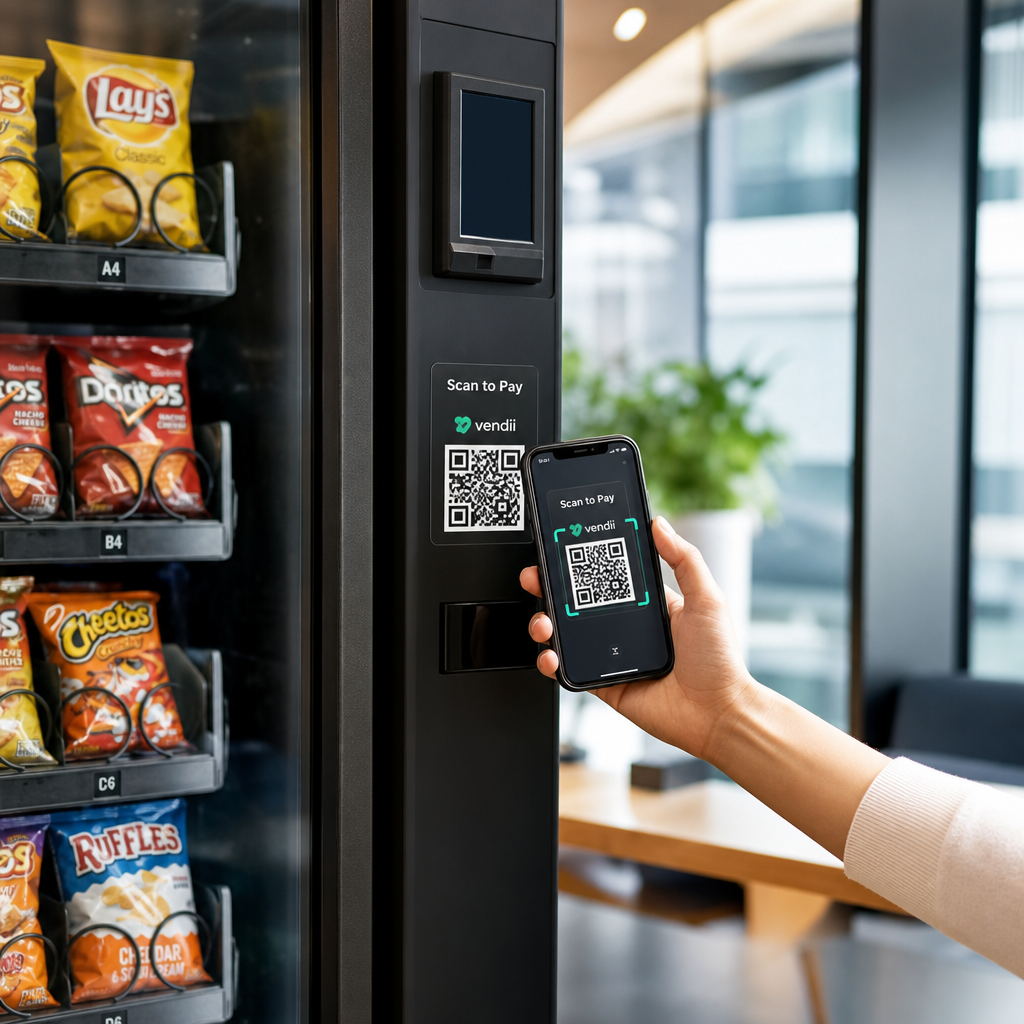
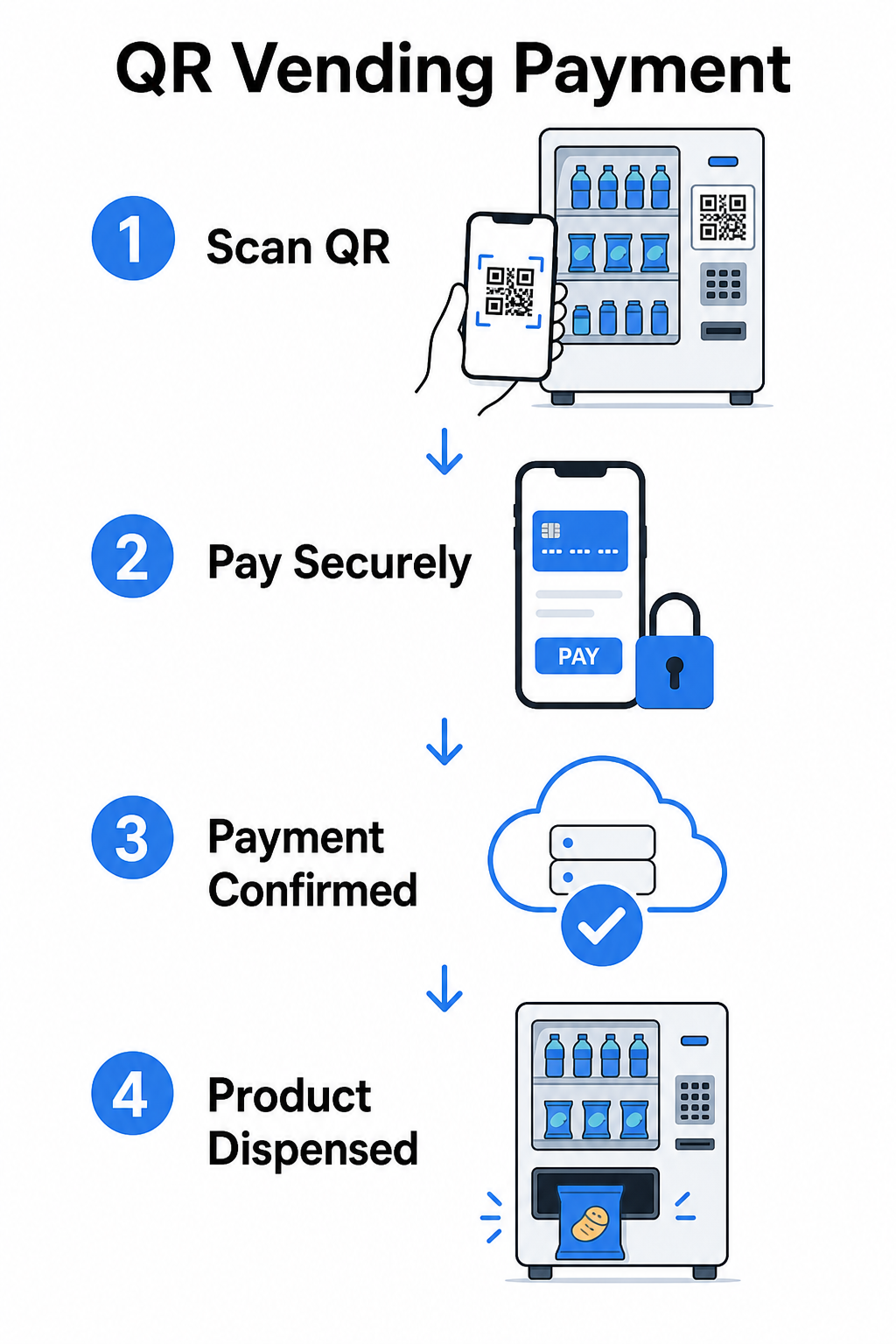
The core concept is straightforward: instead of inserting a card or cash, a customer scans a QR code displayed on the machine, completes payment on their phone, and the machine receives a confirmation signal before dispensing the product.
There are two main approaches to this flow.
Consumer scans machine QR – The machine displays a static or dynamic QR code. The customer opens their camera app, scans the code, and lands on a hosted payment page that supports cards, PayPal, Apple Pay, Google Pay, or other mobile wallets. Once the payment gateway authorizes the transaction, it sends a confirmation back to the machine via an API, triggering the vend.
Machine scans consumer QR – The customer’s app generates a QR code representing stored value or account credits. The machine’s scanner reads it, the system deducts the appropriate amount, and the machine activates. This model is common in closed-loop systems like campus or corporate accounts.
Both architectures rely on backend APIs to confirm transactions, synchronize inventory, and log item-level data. The practical difference is who does the scanning and where the payment credentials live.
Accept Payments Without a Card Reader Need a simple way to turn a URL into a scannable payment touchpoint? The PayPal QR-kód generátor lets you create a branded payment QR in minutes – no hardware required.
Static vs. Dynamic QR Codes for Vending
Not all QR codes behave the same way, and the distinction matters for vending operators.
| Funkció | Statikus QR-kód | Dinamikus QR-kód |
|---|---|---|
| Destination editable after printing | Nem | Igen |
| Szkenneléskövetés és elemzés | Nem | Igen |
| Deactivate if compromised | Nem | Igen |
| Requires reprinting to update | Igen | Nem |
| Suitable for permanent machine decals | Korlátozott | Ajánlott |
A statikus QR-kód encodes a fixed URL directly into the pattern. If your payment provider changes, your checkout URL updates, or you want to redirect to a promotion, you need to print a new code and physically replace it on every machine.
A dinamikus QR-kód points to a short redirect link that you control. You can update the destination at any time without touching the physical code on the machine. For a vending operator managing dozens or hundreds of machines across multiple locations, this flexibility eliminates reprinting costs and reduces maintenance visits.
Dynamic codes also capture scan analytics – total scans, unique scans, scan times, and geographic data – giving you visibility into which machines are generating payment activity and when.
Beyond Payments: Other Ways QR Codes Add Value to Vending
Cashless payment is the most obvious use case, but QR codes open up several other operational and marketing possibilities.
Customer Engagement and Loyalty
A QR code on a vending machine can link to more than a checkout page. You can direct customers to a loyalty program where they scan to earn points, access rewards, and redeem benefits instantly – replacing the friction of physical loyalty cards with a smartphone-based experience. These programs support instant enrollment, real-time rewards, and personalized offers based on purchase behavior.
You can also deliver digital coupons or limited-time discounts to customers who scan, creating an incentive that drives repeat visits to specific machines. Linking a QR code to a payment or digital pass compatible with Apple Wallet or Google Wallet takes this a step further, letting customers save their loyalty credentials directly to their phone.
Remote Machine Management Support
QR codes can serve an operational function that has nothing to do with the customer. Placing a unique QR code on each machine – linked to that machine’s management page or service portal – gives technicians and route drivers instant access to the right machine record when they arrive on-site, with no searching through spreadsheets or calling the office to identify a unit.
When combined with a telemetry system, this approach means the person standing in front of a machine can immediately pull up its transaction history, inventory status, or fault log by scanning the code.
Maintenance and Reporting Shortcuts
A QR code linked to a reporting form lets customers flag a stuck product, a malfunctioning payment reader, or an out-of-stock machine – without requiring a phone number or email address. The submission is tied to the specific machine, giving your operations team actionable information without a site visit to diagnose the problem.
Keep Your QR Codes Flexible If you want one code that can serve multiple purposes over time – payments today, a loyalty program next quarter – use the Dinamikus QR Kód Generátorunkkal to update destinations without reprinting.
What QR Code Analytics Tell You About Your Machines
One underappreciated advantage of dynamic QR codes is the data they generate. Every scan is logged with a timestamp, location, and device type. For vending operators, this creates a lightweight layer of behavioral data that complements your telemetry.
Scan volume at a specific machine can tell you:
- When customers are most active at that location, helping you optimize restocking schedules
- Whether a machine is being ignored, which might indicate a placement problem or a product assortment issue
- How promotional changes perform, since you can compare scan rates before and after updating the linked destination
For a deeper look at how to set up and interpret this data, see the guide to QR-kódok követése.
Security and Compliance Considerations
QR code payments at unattended machines introduce specific security responsibilities that operators need to understand before deployment.
PCI DSS Applies to You
If your vending machines accept credit or debit card payments via a QR code workflow, you are required to comply with PCI DSS – the Payment Card Industry Data Security Standard. This applies regardless of whether the payment is processed by a third-party gateway. The QR code payments PCI DSS compliance guide covers this in detail, but the key requirements include:
- Encrypting cardholder data during transmission using protocols like TLS
- Never storing sensitive authentication data such as CVV codes, PINs, or magnetic stripe data after authorization
- Validating your compliance level through Self-Assessment Questionnaires or third-party audits, depending on your transaction volume
Operators who redirect customers to a hosted payment page managed by a PCI-compliant gateway significantly reduce their compliance scope, since cardholder data never touches their own systems.
Physical Tampering Is a Real Risk
Unattended machines are vulnerable to a specific fraud vector: someone places a fraudulent QR code sticker over your legitimate one. The customer scans what appears to be your payment code but is redirected to a phishing page that captures their payment details. Mitigation steps include:
- Using tamper-evident materials for QR code signage
- Applying branded QR codes that include your logo and colors, making unauthorized replacements visually obvious
- Instructing route drivers to inspect QR codes during regular visits
- Enabling real-time scan analytics so that unusual geographic scan patterns – for example, scans originating far from the machine’s known location – trigger an alert
For a full breakdown of QR payment risks and how to address them, see the guide on QR code risks in payments and how to mitigate them.
Design Guidelines for Vending Machine QR Codes
A QR code that doesn’t scan reliably creates customer frustration at precisely the moment they want a quick transaction. Follow these practical guidelines to get it right.
Size and scanning distance – Use the 10:1 ratio as your baseline: a code scanned from 20 inches away should be at least 2 inches wide. Most vending machine interactions happen at arm’s length, so a code sized between 2 and 3 inches square is appropriate for face-level placement. The QR-kód méretezési útmutatónkban covers this formula in detail for different contexts.
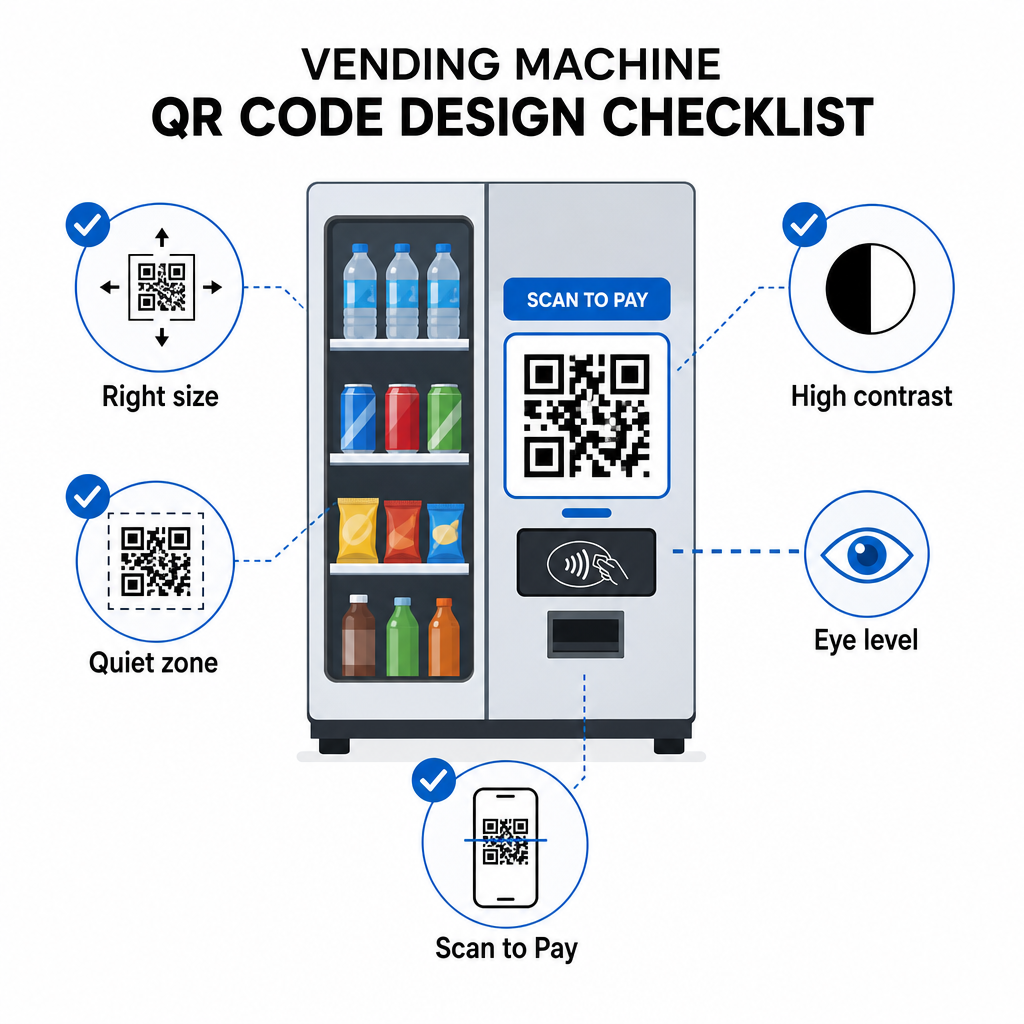
Color and contrast – Dark patterns on a light background scan most reliably. Black on white is the most consistent combination. If you’re using branded colors, aim for at least a 4:1 contrast ratio between the QR module color and the background, with 4.5:1 preferred. The guidelines for QR-kód olvashatóságát explain why contrast directly affects whether a scanner can detect the code pattern under different lighting conditions.
Quiet zone – Maintain a clear blank margin around the QR code. Placing design elements, text, or branding inside this border can prevent scanners from correctly identifying the code boundaries.
Print format – For physical application on machines, export QR codes in vector formats such as SVG, EPS, or PDF to ensure they remain sharp at any size and don’t lose scannability due to pixelation.
Do not distort – QR codes must remain square. Stretching or compressing the code to fit a template will misalign the internal modules and make it unscannable.
Provide a clear call to action – Label the code clearly: “Scan to Pay,” “Scan for Cashless Payment,” or “Scan to Earn Points.” Customers at a vending machine are not browsing – they want to complete a task quickly, and a direct label removes hesitation.
Getting Started: Implementation Steps
If you’re adding QR code payments to existing machines, the typical path looks like this:
- Choose a payment gateway that supports QR-based checkout and is PCI DSS certified. The gateway provides the hosted payment page your QR code will link to.
- Generate a dynamic QR code for each machine, linking to that machine’s unique checkout URL. Using dinamikus QR kódok means you can update payment destinations or add features later without replacing physical signage.
- Brand the code with your logo and color scheme to make it recognizable and harder to tamper with.
- Apply the code to each machine at eye level using tamper-evident materials.
- Test across multiple devices before full deployment – scan the code with both iOS and Android devices under the lighting conditions present at each machine location.
- Monitor scan analytics after launch to identify machines with low engagement, track payment activity, and detect any anomalous scan patterns.
For operators accepting international payment methods like Alipay or WeChat Pay, there are additional integration steps covered in the guide to Alipay and WeChat Pay QR code integration.
QR codes give vending operators a low-barrier path to cashless payments, customer engagement tools, and better operational visibility – all without replacing existing hardware. The most durable implementations use dynamic codes, so the physical sticker on the machine can serve changing purposes over time without a technician visit. Start with a single location, measure performance through scan analytics, and expand based on what the data shows.
Create Your First Vending Machine QR Code Használja a QR Kód Generátor to build a branded, trackable code for your machines – or explore the full range of industry-specific QR solutions to find the right approach for your operation.
Gyakran Ismételt Kérdések
In most implementations, no. When a machine displays a QR code linked to a hosted payment page, customers can scan it using their phone’s native camera app and complete the transaction in their browser using a saved card or mobile wallet. Some closed-loop systems – like campus account apps – do require a specific app, but open payment flows are designed to work without one.
Yes. A static or dynamic QR code linked to a hosted checkout page can be applied as a sticker or printed insert to most existing machines. The payment authorization is handled by the gateway’s backend, which communicates with the machine’s cashless interface to trigger the vend. This makes QR a relatively low-cost upgrade compared to installing a new card reader.
A customer who scans the fraudulent code will be redirected to a different page rather than your checkout. You can reduce this risk by using branded QR codes that include your logo – making tampering visually obvious – and applying tamper-evident materials that show damage when the sticker is removed. Dynamic QR code analytics can also help: if scans suddenly drop to zero or originate from unexpected locations, that’s a signal to investigate the physical code at that machine.