> 블로그 > QR 코드 캠페인을 위한 SMART 목표 설정
QR 캠페인 계획

QR 코드 캠페인을 위한 SMART 목표 설정

Learn how to apply the SMART framework to your QR code marketing. Define specific targets, track scan metrics, and align QR codes with your marketing
Updated on 6월 10, 2026
목차

Are your QR code campaigns producing results, or are you just generating codes and hoping they perform? Without a structured goal-setting approach, most campaigns stay vague, making it impossible to measure progress or justify investment. This guide explains how to apply the SMART framework to QR code marketing so every campaign has a clear direction, trackable metrics, and a defined timeline.

What SMART Goals Mean for QR Code Campaigns

SMART is an acronym for goals that are Specific, Measurable, Achievable, Relevant, and Time-bound. First defined in a 1981 management article by George T. Doran, the framework has since become a standard in marketing planning because it forces abstract intentions into concrete objectives.

Applied to QR code campaigns, SMART goal-setting closes the gap between “we want more engagement” and “we want 500 product page visits from QR codes on retail packaging within 60 days.” The difference matters because the second version tells you what to build, where to place it, and when to evaluate it.

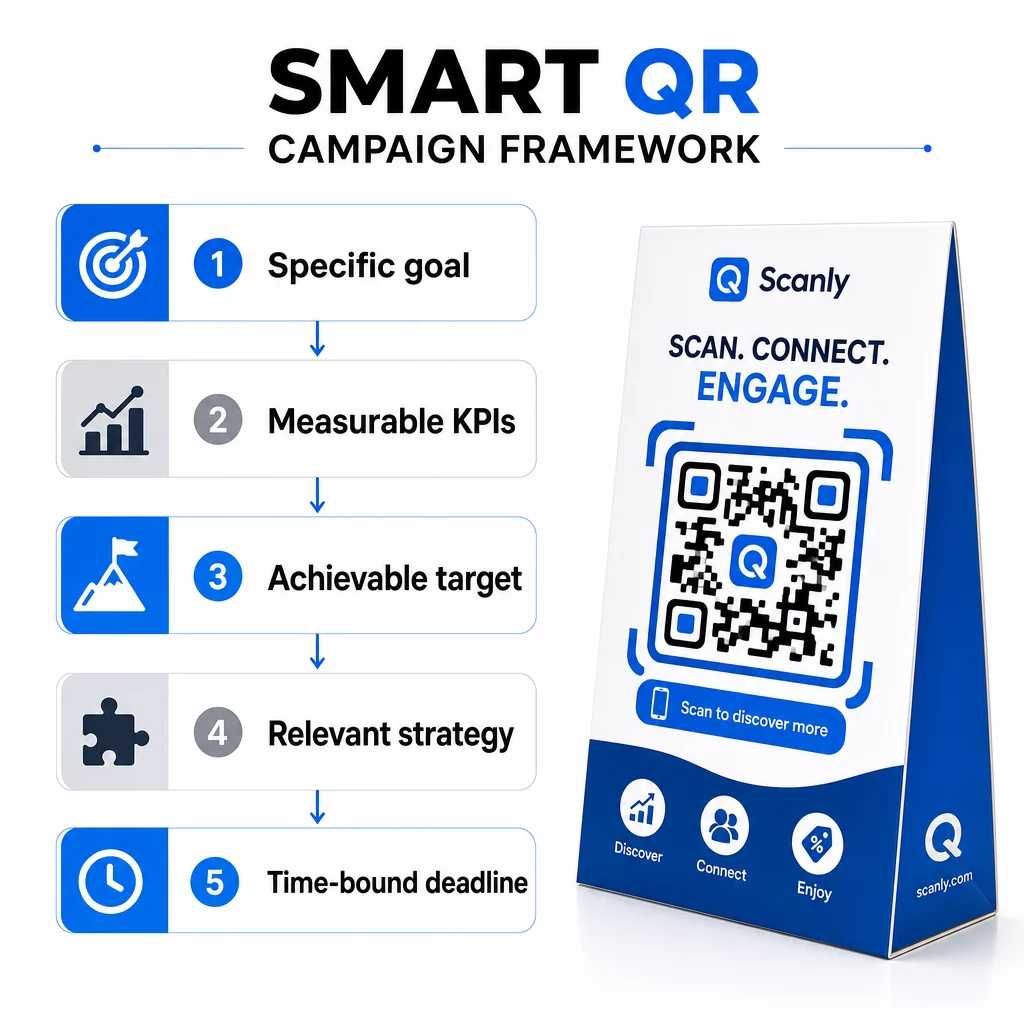
SMART QR framework

Here is what each component contributes to a QR campaign:

  • Specific – Defines the exact outcome, audience, and placement
  • Measurable – Establishes KPIs you can track, such as total scans, unique scans, or conversions
  • Achievable – Aligns targets with your budget, team capacity, and technical resources
  • Relevant – Connects the campaign to a broader business or marketing objective
  • Time-bound – Sets a deadline for evaluation and optimization

The sections below break down each element and show how to apply it in practice.

How to Set Specific Goals for QR Code Campaigns

Specificity answers two questions: what do you want to happen, and why does it matter? Without this clarity, it is difficult to decide where to place your codes, what content they should link to, or which type of QR code to use.

Compare these two objectives:

  • Vague: “Boost customer engagement”
  • Specific: “Increase app downloads by 20% over the next quarter by placing QR codes on product packaging that link directly to our app store listing”

The second version tells you the desired outcome (app downloads), the target (20%), the placement (product packaging), and the destination (app store). Each of those decisions flows naturally from the goal.

Your specific goal also determines the right type of QR code. Choosing the right QR code for your campaign depends on your objective – a URL QR code works well for driving website traffic, while a vCard QR code suits networking scenarios, and a coupon code on a storefront window can attract new customers with a discount offer.

동적 QR 코드 are especially useful when your goal involves ongoing campaigns, because you can update the destination without reprinting your materials. This flexibility keeps your specific objectives achievable even when details change mid-campaign.

How to Create Measurable QR Code Objectives

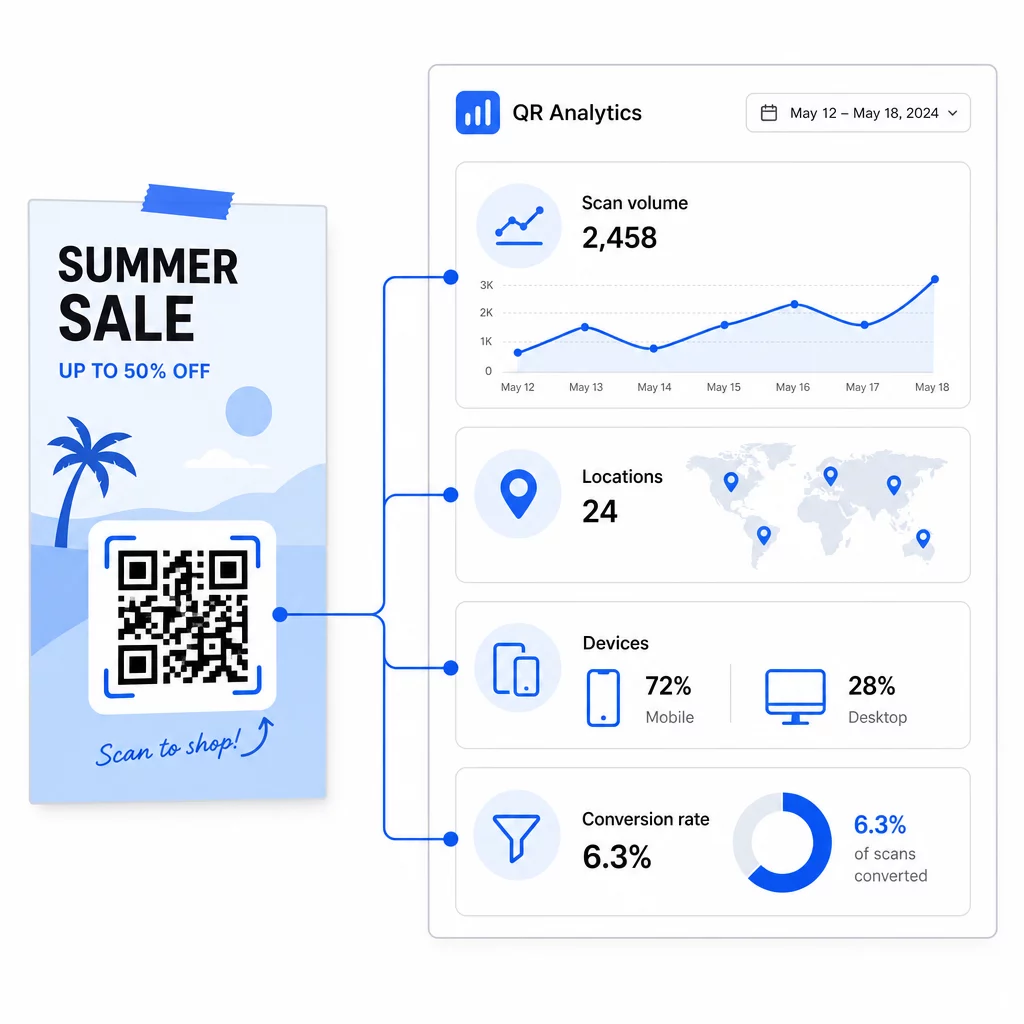
A measurable objective has defined indicators you can check at any point during the campaign. For QR code campaigns, the core metrics include:

  • Total scans – Overall interaction volume with your code
  • Unique scans – How many distinct users engaged, as opposed to repeat scans from the same device
  • Scan location – Geographic data that reveals which placements or regions drive the most engagement
  • Device type – Whether users are on iOS, Android, or desktop, which informs landing page optimization
  • Time and date of scan – Identifies when your audience is most active so you can align campaign timing accordingly
  • Conversion rate – The percentage of scanners who complete the desired action, such as filling out a form, making a purchase, or downloading an app
  • Post-scan behavior – Bounce rate, time on page, and click-through rates that indicate content quality after the scan

Conversion rate is particularly telling. If your QR code receives 400 scans and 120 people complete the desired action, you have a 30% conversion rate. That figure goes beyond reach to show actual campaign impact.

Adding UTM parameters to your QR code destination URLs lets you bring this data into Google Analytics, where you can connect QR-driven traffic to specific campaigns, compare placements, and analyze post-scan behavior in detail.

모든 스캔을 실시간으로 추적 페이지루트의 QR 코드 분석 대시보드 monitors total scans, locations, device types, and engagement trends so you always know how your campaign is performing.

How to Set Achievable Targets

Ambitious goals are useful. Unrealistic ones damage credibility and waste resources. Achievable targets are grounded in what your team, budget, and tools can actually support.

Budget directly affects campaign scope. If resources are limited, concentrate on high-impact placements rather than distributing QR codes across too many surfaces. A single well-placed code on a business card or retail shelf may outperform a dozen poorly positioned ones.

Team capacity shapes how complex your campaign can be. 동적 QR 코드 require ongoing management – updating destinations, monitoring analytics, and adjusting content – while static codes are simpler to maintain once deployed. If your team is new to QR campaigns, starting with one or two dynamic codes and scaling up as confidence grows is a practical approach.

Technical capabilities determine which features you can use effectively. CRM integrations, automated follow-up workflows, and advanced segmentation are powerful tools, but they require setup time and platform compatibility. Build targets around what your stack can actually deliver.

Industry benchmarks can anchor your expectations, but because standardized QR code conversion rates vary widely by industry, placement, and audience, the most reliable benchmark is your own past performance. If you are running your first campaign, a soft launch with limited distribution helps you establish a baseline before scaling.

How to Align QR Code Goals with Your Marketing Strategy

A QR code campaign that operates in isolation tends to underperform. When your campaign goals connect to a broader marketing objective – whether that is lead generation, customer retention, or brand awareness – every scan contributes to something larger.

Branding consistency matters whenever QR codes bridge offline and online experiences. If a luxury retailer places codes on product packaging, the landing page those codes point to should reflect the same premium aesthetic. A disconnect between the physical touchpoint and the digital destination erodes trust and reduces conversions.

Audience alignment shapes where and how you deploy codes. A social media QR code placed on event materials may resonate strongly with a younger audience, while a vCard QR code on a business card suits professional networking contexts. Understanding your audience’s habits helps you match the code type and placement to their expectations.

Content strategy alignment ensures QR codes support your editorial and campaign goals. If your focus for a quarter is thought leadership, QR codes on conference materials that link to whitepapers or research reports reinforce that positioning. If you are running a promotional period, codes linking to exclusive discount offers complement the campaign theme.

Customer journey mapping helps identify the right moment for QR code placement. A QR code in a post-purchase email that links to a satisfaction survey catches customers when the experience is fresh. One on an event badge connects attendees to session resources at exactly the right time. Understanding how QR codes fit into your overall marketing approach is what separates a strategic campaign from a code that just exists on a flyer.

How to Make QR Code Goals Time-Bound

A deadline creates urgency and defines when you will evaluate whether your goals were met. Without one, campaigns drift indefinitely with no clear point to assess performance.

Structured launch phases reduce risk. A soft launch with limited QR code distribution lets you test placement, content, and technical setup before full deployment. This is particularly valuable for dynamic QR codes, where early analytics can inform adjustments before you scale.

Evaluation intervals should match the campaign type. A short promotional campaign might need daily scan monitoring. A brand awareness effort can be reviewed weekly or monthly. Event-based campaigns often require real-time tracking so you can address issues as they arise.

Optimization windows need to be built into your timeline explicitly. If scan rates are lower than expected after two weeks, you need enough time remaining to test alternative placements, update the destination URL, or revise your call-to-action. Dynamic QR codes make these adjustments possible without reprinting, which is a meaningful advantage when time is limited.

Performance milestones help you maintain momentum on longer campaigns. Setting checkpoints at 25%, 50%, and 75% of your timeline creates natural opportunities to compare actual performance against your measurable targets and course-correct before the end date.

Tracking Performance with QR Code Analytics

Analytics are what make SMART goals operational. Without tracking, you cannot confirm whether your specific targets were met, assess whether your benchmarks were achievable, or know when to optimize.

QR 코드 추적 도구 capture scan volume, unique users, geographic location, device type, and time of scan – all of which connect directly to the measurable component of your goals. Time-based data is especially useful for refining campaign timing. If analytics show that scans cluster around lunch hours or specific days of the week, you can align promotional content changes or campaign launches to match those patterns.

QR 분석 대시보드

Post-scan behavior metrics – bounce rate, pages per session, and conversion actions – reveal what happens after the scan. A high scan count with a high bounce rate suggests the landing page is not delivering on what the QR code promised. That is actionable information.

그만큼 ultimate guide to QR code analytics dashboards covers how to set up tracking parameters, configure UTM tags, and read performance data in Google Analytics 4. For campaigns across multiple placements or regions, tracking QR codes by geographic area lets you compare scan volumes and conversion rates by city or region and reallocate budget toward the highest-performing locations.

Pageloot’s analytics dashboard tracks all of this in real time and separates performance data by individual QR code, making it straightforward to compare placements, identify weak points, and calculate ROI by tying scan data to specific business outcomes.

Start Tracking Your QR Campaigns Create trackable dynamic QR codes and access real-time scan data with the Pageloot QR 코드 생성기. Free 14-day trial, no credit card required.

Using Dynamic QR Codes to Stay Aligned with Your Goals

One practical challenge with time-bound campaigns is that circumstances change. A landing page underperforms, a promotional offer expires, or an event is rescheduled. With static QR codes, any of these changes require reprinting.

Dynamic QR codes solve this by pointing to a short redirect URL that you control. You can update the destination, swap out an offer, or redirect to a new page at any point – without touching the printed code. This supports the achievable aspect of SMART goals by removing the friction that typically makes mid-campaign adjustments costly.

Dynamic codes also enable A/B testing, where you test one variable at a time – destination URL, call-to-action, or landing page design – and measure which version drives better conversions. Over time, this iterative process improves campaign performance and builds a clearer picture of what works for your specific audience.

For a structured overview of when to use static versus dynamic codes, the static vs. dynamic QR code comparison covers the key trade-offs in terms of cost, flexibility, and tracking capability.

Calculating ROI for QR Code Campaigns

Connecting analytics to business outcomes is the final step in making your SMART goals pay off. ROI calculation starts with establishing cost baselines – design, printing, platform fees, and staff hours – and then identifying the revenue or value generated from QR code interactions.

When you can tie scans to specific actions, the calculation becomes straightforward. If a QR code on product packaging drives warranty registrations, you can quantify the reduction in customer service calls. If a code at a trade show populates your CRM with qualified leads, you can compare the cost per lead against other acquisition channels.

Attribution windows matter here. Some users scan a code but convert days or weeks later. Tracking periods need to account for this delay to avoid undervaluing the campaign. Monitoring both immediate conversions and longer-term customer lifetime value gives a more complete picture.

Regular ROI reporting keeps stakeholders informed and justifies continued investment. Monthly updates that connect scan volumes, conversion rates, and revenue attribution back to the original SMART objectives demonstrate campaign value clearly and identify opportunities for improvement in the next cycle. Setting SMART goals is what separates a QR code strategy from a QR code experiment. By defining specific outcomes, establishing measurable KPIs, building realistic targets, connecting campaigns to broader marketing objectives, and setting clear deadlines, you give every scan a purpose. Pair that structure with dynamic QR codes and real-time analytics, and you have the tools to act on what your data tells you – not just report on it after the fact. The 소규모 비즈니스를 위한 QR 코드 마케팅 체크리스트 is a practical next step if you want a structured framework for putting these principles into action.

자주 묻는 질문

How do I make sure my QR code campaign goals align with my overall marketing strategy?

Start by identifying the broader marketing objective your campaign should support – whether that is lead generation, brand awareness, or customer retention. Then work backward to define a QR code goal that contributes directly to that objective. For example, if your quarterly priority is acquiring new email subscribers, a SMART QR code goal might be “generate 200 new email opt-ins from QR codes on event materials within 30 days.” Consistency in branding and content between your physical materials and your digital destination also reinforces alignment at every touchpoint.

What metrics should I track to evaluate QR code campaign performance?

The most important metrics depend on your campaign goal, but core KPIs include total scans, unique scans, scan location, device type, and time of scan. Beyond those, post-scan behavior metrics – such as conversion rate, bounce rate, and time on page – reveal whether your landing page is delivering on what the QR code promised. Adding UTM parameters to your destination URLs brings all of this data into Google Analytics, where you can analyze it alongside your other channel performance.

How do dynamic QR codes help with SMART goal campaigns?

Dynamic QR codes allow you to update the destination URL without reprinting your materials, which is critical for time-bound campaigns where conditions change. If a landing page underperforms or a promotion expires mid-campaign, you can redirect to updated content immediately. Dynamic codes also support A/B testing by letting you compare destination variants and measure which drives better conversions. Combined with built-in analytics, they give you the flexibility and data needed to stay on track with measurable, achievable goals throughout the campaign lifecycle.

작성자 정보

시임 코스타비는 페이지루트의 콘텐츠 책임자입니다. 그는 페이지루트의 혁신적인 QR 코드 생성 서비스에 대한 글을 쓰고 있습니다. 5년 이상 QR 코드 분야에서 쌓아온 깊이 있는 전문 지식을 바탕으로, 시임은 이 분야의 전문가로 인정받고 있습니다. 그는 QR 기술을 활용하여 디지털 상호작용을 간소화하고 향상시키는 데 크게 기여하고 있습니다.

범주
에 대해 자세히 알아보기
제품 바코드 라벨 스캔
만드는 방법 바코드
QR 브로셔를 든 마케터
어떻게 QR 코드 편집

온라인으로 QR 코드를 생성해야하는 경우 QR 코드 만들기 무료로 여기!
Pageloot는 #1 Go-To 솔루션 QR 코드를 만들고 스캔합니다.

BL-0114

20,000개 이상의 브랜드로부터 신뢰를 받아 더 많은 매출, 리뷰, 팔로워를 확보했습니다.

클라이언트 로고
최고 브랜드의 신뢰
5 중 4.8 평가

4.86 / 5 별점

휴고 로랑
휴고 로랑
레스토랑 주인
가장 쉽고 안정적인 QR 코드 생성기. PDF 파일을 즉시 업로드할 수 있습니다. 이제 레스토랑 메뉴가 디지털화되었습니다.
루카스 얀센
루카스 얀센
부동산 개발사
이것은 훌륭한 도구이며 QR 코드를 사용하면 원하는 곳으로 이동할 수 있습니다. 우리는 위치 QR 코드만 사용하지만 유용한 기능이 너무 많습니다.
엠마 모레티
엠마 모레티
소매 제품
사용하기 쉽고 빠릅니다. 그것은 훌륭하게 작동하고 완벽한 이미지를 생성하므로 직원들이 내 vCard를 다운로드할 수 있습니다.
휴고 로랑
휴고 로랑
레스토랑 주인
가장 쉽고 안정적인 QR 코드 생성기. PDF 파일을 즉시 업로드할 수 있습니다. 이제 레스토랑 메뉴가 디지털화되었습니다.
루카스 얀센
루카스 얀센
부동산 개발사
이것은 훌륭한 도구이며 QR 코드를 사용하면 원하는 곳으로 이동할 수 있습니다. 우리는 위치 QR 코드만 사용하지만 유용한 기능이 너무 많습니다.
엠마 모레티
엠마 모레티
소매 제품
사용하기 쉽고 빠릅니다. 그것은 훌륭하게 작동하고 완벽한 이미지를 생성하므로 직원들이 내 vCard를 다운로드할 수 있습니다.
더 많은 QR 코드보기
QR 티켓 이벤트 입장
QR 코드 사용 티켓 및 페스티벌 패스
Scanning food package QR
QR 코드 사용 식품 포장
무엇이든 디지털 경험으로 전환하세요 3분 이내에.

14일 무료 체험.

신용카드는 필요 없습니다.

첫 구매 시 30% 할인

코드를 사용하세요:

MP3 파일 공유

PDF QR 코드를 생성하려면 가입하세요

필요한 모든 것을 업로드하고 표시합니다.

  • 오디오 파일
  • 팟캐스트
  • 음악

가입 시 14일 무료 체험.
체험 기간 후 QR 코드 만료.

오디오 mp3 QR 코드를 생성하려면 가입하세요

프레임으로 더 많은 스캔 확보

QR 코드에 더 많은 프레임을 추가하려면 가입하세요

클릭 유도 문안 프레임은 고객이 QR 코드와 쉽게 상호 작용할 수 있도록 도와줍니다. 사용해 보세요!

가입 시 14일 무료 체험.
체험 기간 후 QR 코드 만료.

QR 코드에 더 많은 프레임을 추가하려면 가입하세요

도형으로 더 많은 스타일 추가

더 많은 도형을 만들려면 가입하세요

QR 코드는 정사각형일 필요가 없습니다. 브랜드 이미지에 맞게 전환해 보세요.

가입 시 14일 무료 체험.
체험 기간 후 QR 코드 만료.

더 많은 도형을 만들려면 가입하세요

QR 코드에 로고 추가

QR 코드에 로고를 추가하려면 가입하세요

로고와 브랜드를 추가하여 QR 코드를 돋보이게 만드세요.

가입 시 14일 무료 체험.
체험 기간 후 QR 코드 만료.

QR 코드에 로고를 추가하려면 가입하세요

스마트 앱 스토어 리디렉션

앱 스토어 QR 코드를 생성하려면 가입하세요

스마트 앱 스토어 QR 코드에 앱 링크를 추가하세요. 사용자는 장치에 따라 리디렉션됩니다.

가입 시 14일 무료 체험.
체험 기간 후 QR 코드 만료.

앱 스토어 QR 코드를 생성하려면 가입하세요

QR 코드에 이미지 업로드

이미지 QR 코드를 생성하려면 가입하세요

이미지를 쉽게 공유하세요. 몇 초 안에 동적으로 이미지를 변경하십시오.

가입 시 14일 무료 체험.
체험 기간 후 QR 코드 만료.

이미지 QR 코드를 생성하려면 가입하세요

PDF 파일 공유

PDF QR 코드를 생성하려면 가입하세요

필요한 모든 것을 업로드하고 표시합니다.

  • 메뉴 및 가격표
  • 명령
  • 모든 문서

가입 시 14일 무료 체험.
체험 기간 후 QR 코드 만료.

PDF QR 코드를 생성하려면 가입하세요

인쇄 없이 나중에 편집

다시 인쇄하지 않고 QR 코드를 편집하려면 가입하세요

동적 QR 코드를 사용하면 새 QR 코드를 인쇄하지 않고도 QR 코드의 내용을 변경할 수 있습니다.

가입 시 14일 무료 체험.
체험 기간 후 QR 코드 만료.

다시 인쇄하지 않고 QR 코드를 편집하려면 가입하세요

언제? 어디서? QR 코드 스캔 추적

QR 코드를 추적하려면 가입하세요

어떤 QR 코드가 가장 많이 스캔되고 무엇이 고객을 가장 흥분시키는지 알아보십시오.

가입 시 14일 무료 체험.
체험 기간 후 QR 코드 만료.

QR 코드를 추적하려면 가입하세요

인쇄 준비 파일 제공

PDF 및 SVG와 같은 벡터 QR 코드를 생성하려면 가입하세요.

.EPS, .PDF, .SVG

HD 해상도로 QR 코드를 다운로드하고 싶으신가요? 인쇄할 준비가 된 벡터 또는 픽셀 형식을 가져옵니다.

가입 시 14일 무료 체험.
체험 기간 후 QR 코드 만료.

PDF 및 SVG와 같은 벡터 QR 코드를 생성하려면 가입하세요.

기다리세요. 귀하의 QR 코드는 로드 중... 로드 중...

나만의 것으로 만들기

나중을 위해 QR 코드를 저장하려면 가입하세요.

다양한 색상, 로고 및 클릭 유도문안 프레임으로 멋진 QR 코드를 만들어 더 많은 스캔을 받으세요.

가입 시 14일 무료 체험.
체험 기간 후 QR 코드 만료.

나중을 위해 QR 코드를 저장하려면 가입하세요.