首页 > 博客 > QR Code Payments for Green Businesses
Green QR checkout

QR Code Payments for Green Businesses

Learn how QR code payments help green businesses reduce waste. Eliminate paper receipts, digitize menus, and align your checkout with environmental values.
Updated on 6 月 10, 2026
目录

Are your payment processes quietly working against your sustainability goals? Paper receipts, printed menus, and plastic card infrastructure add up to a significant environmental footprint – one that’s increasingly at odds with what eco-conscious customers expect. This guide explains how QR code payments help green businesses reduce physical waste, lower resource consumption, and align their checkout experience with their environmental values.

The Environmental Cost of Traditional Payment Systems

Before exploring the solution, it helps to understand the scale of the problem. In the United States, paper receipt production alone consumes over three million trees and nearly nine billion gallons of water each year, creates nearly 300 million pounds of solid waste, and generates greenhouse gas emissions equivalent to over 400,000 cars on the road annually.

The problem goes beyond volume. An estimated 93% of paper receipts are coated with Bisphenol-A (BPA) or Bisphenol-S (BPS) – endocrine-disrupting chemicals that also make those receipts non-recyclable. They go straight to landfill.

Physical cash and card infrastructure add further costs. ATMs run continuously, transporting cash generates logistics emissions, and plastic payment cards contribute petroleum-based waste to the waste stream. QR code payments address all of these pressure points in a single shift.

How QR Code Payments Reduce Paper and Material Waste

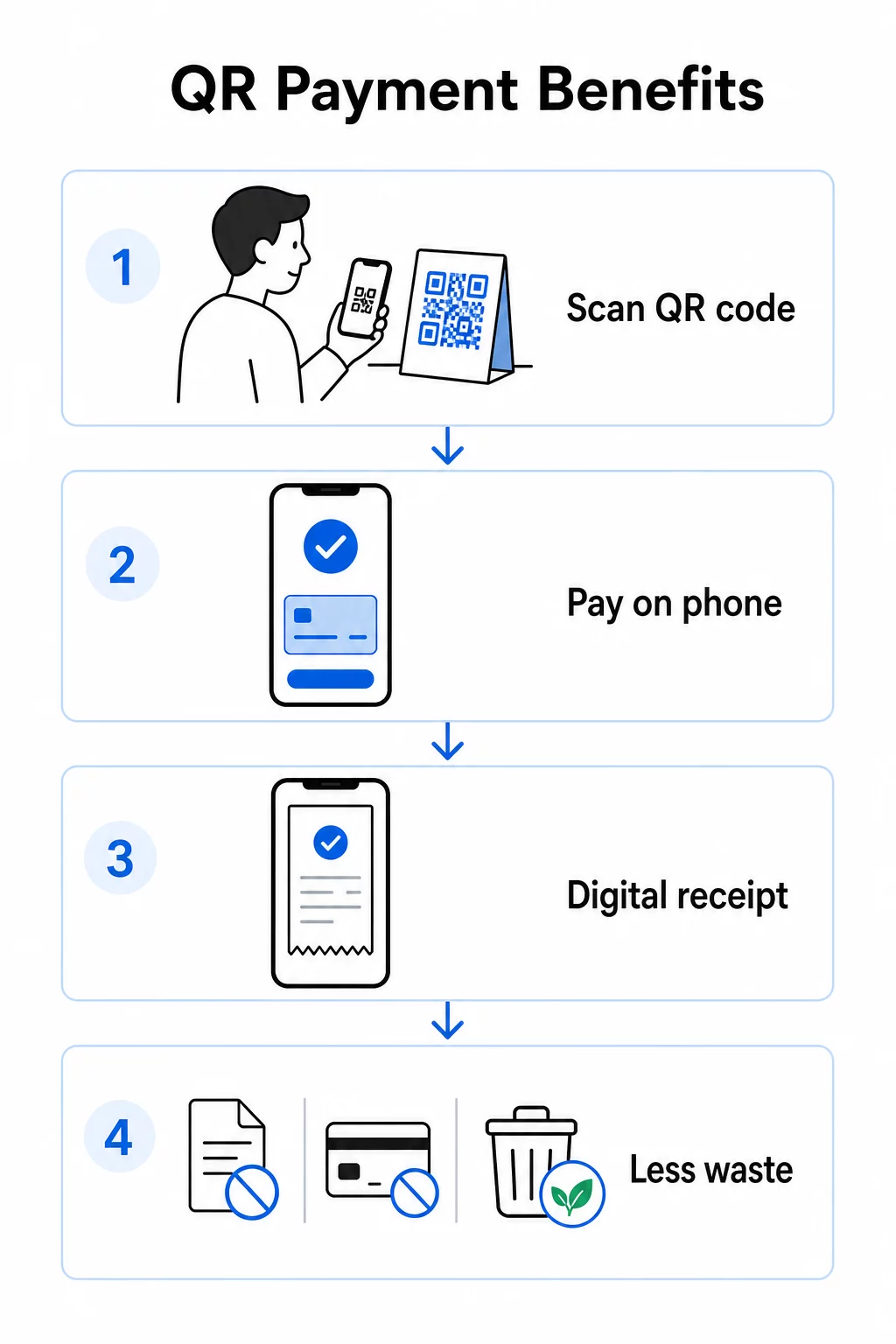
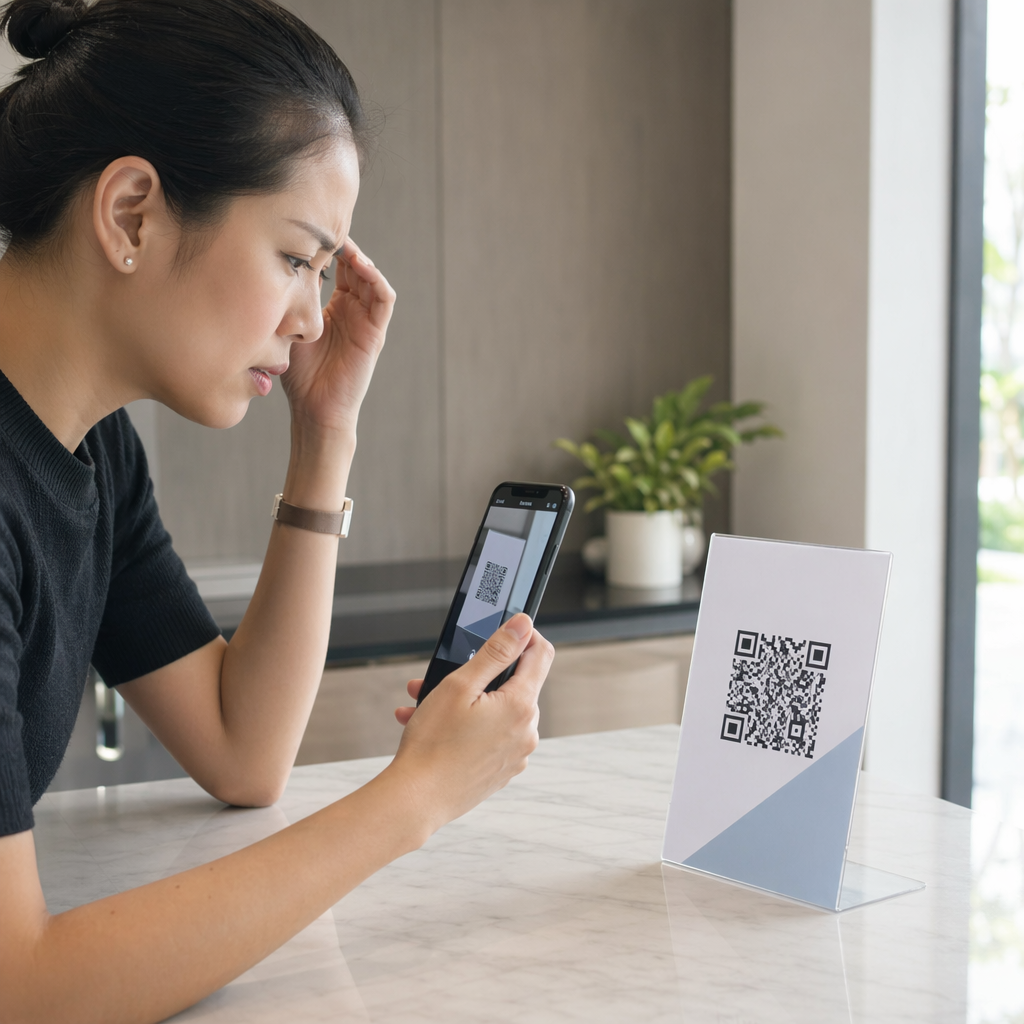
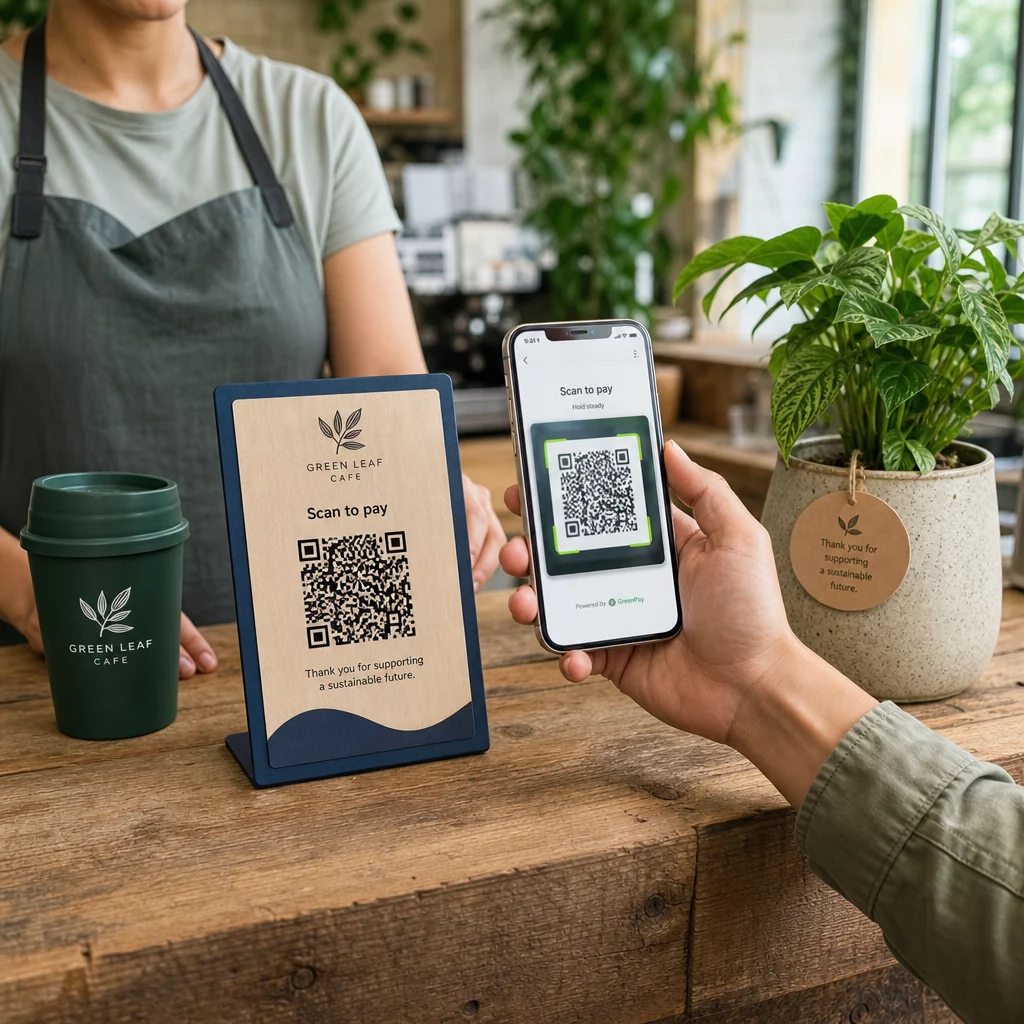
When a customer scans a QR code to pay, the transaction happens entirely on their smartphone. No receipt needs to be printed. No plastic card needs to be swiped. No specialized point-of-sale terminal is required.

QR payment benefits

This matters across multiple touchpoints:

  • 收据 – Digital transaction records replace BPA-coated thermal paper, eliminating both the waste and the associated health exposure for cashiers and customers.
  • 选单 – Restaurants that switch to QR code digital menus can update pricing or seasonal items instantly without reprinting. One restaurant reduced paper use by over 90% through this change alone.
  • 宣传材料 – QR codes on signage or packaging can link to digital offers, tutorials, or product details without requiring new print runs every time content changes.
  • Plastic cards – Smartphone-based QR payments reduce demand for single-use plastic payment cards, which are typically non-recyclable.

The result is a payment system that generates virtually no consumable waste at the point of transaction.

Ready to Accept Payments Without the Paper Trail? Create a branded, trackable payment QR code in minutes using the 贝宝 QR 码生成器 and start replacing paper receipts with digital transactions today.

Static vs. Dynamic QR Codes: Which Is Right for Green Businesses?

Not all QR codes deliver the same environmental benefit. Understanding the difference between static and dynamic codes helps you choose the right tool.

一种 静态二维码 stores its destination URL permanently inside the code itself. If your payment link or menu URL changes, you need to generate and reprint the code. For businesses that are just starting out with QR payments, static codes are a free, low-risk entry point – but every update requires new materials.

一种 动态二维码, by contrast, stores a redirect URL that you control. You can update the linked content or destination at any time, even after the code has been printed and distributed. This is where the real environmental gain lies: one printed code on a table, a window, or a package can serve your business indefinitely, even as promotions change, payment providers shift, or menus evolve.

For green businesses specifically, dynamic codes mean:

  • Fewer reprints when content changes
  • Longer usable life for any printed material that carries a QR code
  • Reduced ink, paper, and design costs over time

Keep One Code, Update Everything With Pageloot’s 动态二维码生成器, you can change where your QR code points without ever reprinting it – reducing waste and keeping your payment flows current.

Using QR Analytics to Cut Waste Further

Dynamic QR codes also come with something static codes cannot offer: tracking data. 二维码分析 tell you where codes are scanned, how often, at what times, and on what devices.

For an eco-focused business, this data is practically useful. If analytics show that a QR code placed on your window display gets almost no scans while the one on your checkout counter gets hundreds, you can eliminate the window signage entirely. You stop printing materials that don’t perform.

This approach applies to promotional campaigns as well. Instead of running large print batches and hoping for results, QR analytics let you measure engagement on a small initial run and scale what works – reducing the waste associated with speculative print marketing.

Eliminating Printed Materials Beyond the Receipt

The sustainability case for QR code payments extends well beyond replacing receipts. Across retail and food service, businesses are using QR codes to eliminate entire categories of printed material.

Digital Menus and Product Information

Restaurants that use QR code menus avoid the ongoing cost and waste of reprinting laminated or paper menus each time prices change or items rotate. A single QR code on a table tent links to a live digital menu that can be updated in real time. The same logic applies to retailers: QR codes on shelving or packaging can surface product details, ingredient sourcing, or care instructions without printing inserts or hanging tags.

Brands like Patagonia and Another Tomorrow have adopted this approach, using QR codes on product labels to share supply chain information, environmental impact data, and recycling instructions – replacing bulky paper booklets with a scan.

Digital Coupons and Promotions

Printed coupons are distributed in bulk, redeemed by a fraction of recipients, and discarded by the rest. QR-linked digital coupons eliminate the physical distribution entirely. They can be updated, tracked, and rotated without new print runs, and they provide redemption data that paper coupons cannot.

忠诚度计划

Paper loyalty cards are easy to lose and costly to produce. Linking QR code payments to a digital loyalty program keeps everything on the customer’s phone, removes another printed item from circulation, and gives businesses better data on purchasing behavior.

Comparing Print-Based and QR-Based Systems

功能 Traditional Print Systems QR-Based Digital Systems
Recurring costs Paper, ink, design, distribution Low subscription cost, minimal reprinting
灵活性 Static; updates require full reprints Dynamic; content updated instantly
Material waste Significant paper and ink waste Near-zero paper waste at transaction
分析工具 Difficult to measure engagement Real-time data on scans, location, device
Receipt materials BPA-coated thermal paper Digital only; no physical material

How to Start Implementing QR Payments in a Green Business

Switching to QR-based payments doesn’t require a full infrastructure overhaul. Here’s a practical path forward:

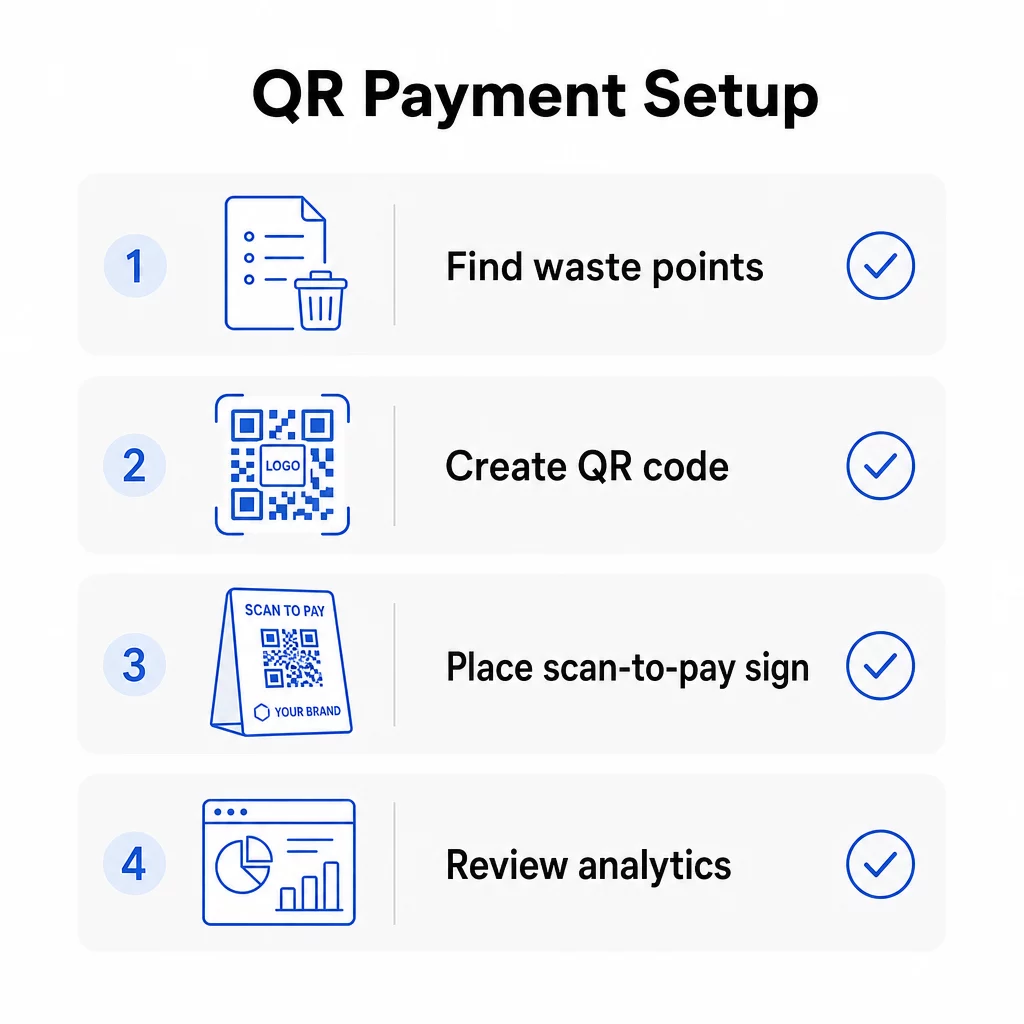
QR setup checklist
  • Identify your highest-waste touchpoints. Receipts, menus, and promotional flyers are typically the biggest sources of print waste. Start there.
  • Begin with a free static QR code for a fixed payment link via a provider like PayPal or Stripe. This lets you test the workflow with customers before committing to a paid plan.
  • Upgrade to dynamic QR codes once you’re ready to add real-time updates and analytics. Tools like Pageloot’s 二维码生成器 support dynamic codes with tracking built in.
  • Customize codes for clarity. Add your logo, brand colors, and a call-to-action frame like “Scan to Pay” or “Scan for Menu.” Branded codes get scanned more often and are harder to counterfeit.
  • Use analytics to optimize placement. Review scan data regularly to understand which physical touchpoints are performing and cut the ones that aren’t.
  • When printing is unavoidable, use dynamic QR codes so the underlying content can change without a reprint, choose recycled materials, and ensure the code is printed at a minimum of 2 × 2 cm in high contrast for reliable scannability.

For businesses in the food and hospitality space, the QR code solutions for small business guide covers practical setup steps across common use cases. You can also explore how QR code payments improve security and transaction speed to understand how these systems protect customer data without requiring expensive hardware.

Aligning Payment Infrastructure with Your Brand Values

For green businesses, the payment experience is a brand touchpoint. Choosing contactless, paper-free QR payments signals your commitment to sustainability at the moment of transaction – not just in marketing copy. Customers who care about environmental responsibility notice these details, and research consistently shows that a growing share of consumers factor sustainability into purchase decisions.

Sustainability in QR code marketing explores this alignment further, covering how eco-focused brands are using dynamic codes to reduce waste across their entire marketing footprint – not just at checkout.

QR payments also support the kind of transparency that sustainability-minded customers value. By linking QR codes to sourcing data, recycling instructions, or environmental impact reports – as Patagonia and other brands do – you turn a payment or product interaction into an opportunity to tell your sustainability story without printing a word of it.

The practical steps are straightforward: identify where your business produces the most paper and plastic waste in its payment and marketing flow, replace those touchpoints with QR-based digital alternatives, use dynamic codes to extend the life of any printed material you do produce, and track performance to cut what isn’t working. That combination reduces your resource footprint, lowers operating costs, and builds the kind of brand credibility that resonates with eco-conscious customers.

常见问题

Do QR code payments actually reduce environmental impact, or is that just marketing?

The reduction is real and measurable. Paper receipts alone consume millions of trees and billions of gallons of water annually in the U.S., and the vast majority are coated with BPA or BPS, making them non-recyclable. Switching to digital receipts via QR code eliminates that waste at the point of transaction. Extending QR codes to menus, promotions, and loyalty programs removes additional printed materials from circulation. The benefit compounds when businesses use dynamic QR codes, which can be updated without reprinting – extending the life of any physical material that carries the code.

What is the difference between a static and dynamic QR code for payments?

A static QR code contains a fixed URL or payment link that cannot be changed once the code is generated. If your payment details or linked content changes, you need to create and reprint a new code. A dynamic QR code stores a redirect that you control through a management platform, so you can update the destination URL at any time without changing or reprinting the physical code. For green businesses, dynamic codes are the better choice because they dramatically reduce how often physical materials need to be replaced.

How do I get started with QR code payments without a large upfront investment?

The simplest starting point is generating a free static QR code linked to a payment page from a provider like PayPal or Stripe. This requires no special hardware – customers scan with their phone camera, are directed to a checkout page, and payment is handled by the provider. Once you’re comfortable with the workflow, upgrading to a dynamic QR code plan adds real-time content editing and analytics, typically for a low monthly subscription. Pageloot’s QR code generator offers both options and supports customization with your logo and brand colors.

关于作者

Siim Kostabi 是 Pageloot 的内容主管,负责撰写关于我们创新型二维码生成器服务的文章。凭借五年多来在二维码领域积累的深厚专业知识,Siim 是该领域的专家。他致力于利用二维码技术简化和增强数字交互,并取得了显著的成果。.

类别
了解更多关于
选择二维码类型
如何使用 动态二维码
QR QR码的#1解决方案

如果您需要在线创建QR码,则可以 制作二维码 就在这里免费!
Pageloot是 #1转到解决方案 创建和扫描QR码。

受到超过 20,000 个品牌的信赖,可获得更多销售、评论和关注者。

客户徽标
受到顶级品牌的信赖
评分为 4.8(共 5)

4.86 / 5 星评级

雨果·劳伦特
雨果·劳伦特
餐馆老板
有史以来最容易和最可靠的QR码生成器。PDF文件可以立即上传。我们的餐厅菜单现在是数字化的。
卢卡斯-詹森
卢卡斯-詹森
房地产开发商
这是一个很好的工具,二维码带你到你想要的地方。我们只使用位置二维码,但有许多有用的功能。
艾玛-莫雷蒂
艾玛-莫雷蒂
零售产品
易于使用和快速。它工作得很好,创造了一个完美的图像,所以员工可以下载我的vCard。
雨果·劳伦特
雨果·劳伦特
餐馆老板
有史以来最容易和最可靠的QR码生成器。PDF文件可以立即上传。我们的餐厅菜单现在是数字化的。
卢卡斯-詹森
卢卡斯-詹森
房地产开发商
这是一个很好的工具,二维码带你到你想要的地方。我们只使用位置二维码,但有许多有用的功能。
艾玛-莫雷蒂
艾玛-莫雷蒂
零售产品
易于使用和快速。它工作得很好,创造了一个完美的图像,所以员工可以下载我的vCard。
查看更多QR码
扫描打印的二维码
二维码 尺寸指南
会员扫描健身房二维码
的QR码 健身与健康
将一切转化为数字体验 不到3分钟。

免费试用 14 天。

无需信用卡。

首次购买可享受 30% 折扣

使用代码:

分享您的 MP3 文件

注册以创建 PDF QR 码

上传和显示你需要的一切。

  • 音频文件
  • 播客
  • 音乐

注册即可享 14 天免费试用。.
试用期结束后,二维码将失效。.

注册以创建音频 mp3 二维码

使用边框获得更多扫描

注册以向您的二维码添加更多框架

呼叫行动框架帮助您的客户与QR码轻松互动。试试吧!

注册即可享 14 天免费试用。.
试用期结束后,二维码将失效。.

注册以向您的二维码添加更多框架

使用形状添加更多样式

注册以创建更多形状

二维码不一定是方形的。试着改变它以适应你的品牌形象。

注册即可享 14 天免费试用。.
试用期结束后,二维码将失效。.

注册以创建更多形状

为您的二维码添加徽标

注册以将您的徽标添加到二维码中

通过在二维码上添加你的标志和品牌,使你的二维码脱颖而出。

注册即可享 14 天免费试用。.
试用期结束后,二维码将失效。.

注册以将您的徽标添加到二维码中

智能应用商店重定向

注册以创建应用商店二维码

将您的应用程序链接添加到我们的智能应用程序商店QR码。用户会根据他们的设备被重新定向。

注册即可享 14 天免费试用。.
试用期结束后,二维码将失效。.

注册以创建应用商店二维码

将图片上传到二维码

注册以创建图像二维码

轻松分享你的图像。在几秒钟内动态地改变任何图像。

注册即可享 14 天免费试用。.
试用期结束后,二维码将失效。.

注册以创建图像二维码

分享您的 PDF 文件

注册以创建 PDF QR 码

上传和显示你需要的一切。

  • 菜单和价格表
  • 使用说明
  • 任何文件

注册即可享 14 天免费试用。.
试用期结束后,二维码将失效。.

注册以创建 PDF QR 码

稍后编辑,无需打印

注册即可编辑您的二维码,无需再次打印

动态QR码让你改变你的QR码的内容,而不需要打印新的QR码。

注册即可享 14 天免费试用。.
试用期结束后,二维码将失效。.

注册即可编辑您的二维码,无需再次打印

何时?何地?追踪您的二维码扫描

注册以追踪您的二维码

发现你的哪些二维码收到了最多的扫描,以及什么最能让你的客户兴奋。

注册即可享 14 天免费试用。.
试用期结束后,二维码将失效。.

注册以追踪您的二维码

提供可打印文件

注册以创建 PDF 和 SVG 等矢量二维码

.EPS, .PDF, .SVG

想下载高清分辨率的QR码吗?获得矢量或像素格式,可随时打印。

注册即可享 14 天免费试用。.
试用期结束后,二维码将失效。.

注册以创建 PDF 和 SVG 等矢量二维码

请等待。您的二维码是 正在加载... 正在加载...

打造专属

注册以保存您的二维码以供日后使用

通过创建具有不同颜色、标识和行动呼吁框架的出色的QR码,获得更多的扫描。

注册即可享 14 天免费试用。.
试用期结束后,二维码将失效。.

注册以保存您的二维码以供日后使用