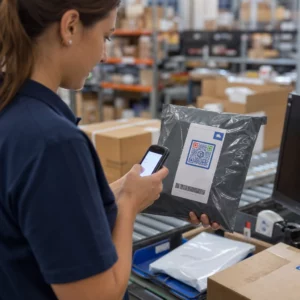
Kullanıcıların izlendiğini hissetmeden QR kodları aracılığıyla müşteri etkileşimini nasıl takip edebilirsiniz? Yanlış hizalanmış veri uygulamaları, ağır yasal cezalara ve tüketici güveninin tamamen kaybına yol açabilir. Bu kılavuz, katı, etik veri standartlarını korurken kişiselleştirme ve analitikten nasıl yararlanılacağını açıklamaktadır.
Why Privacy Matters in Custom QR Marketing
Personalization should never come at the expense of digital security. When you deploy QR codes across physical touchpoints like product packaging, event signage, or print advertisements, you create a direct bridge to your digital ecosystem. If you fail to secure that bridge, you expose your audience to risks like “quishing” – malicious QR phishing – or intrusive data harvesting.
Regulatory frameworks treat scan analytics seriously. Under global regulations detailed in QR kodu gizlilik yasaları, data points such as IP addresses, device identifiers, and precise geographic locations constitute personal data. For instance, the CCPA classifies location tracking within an area smaller than an 1,850-foot radius as sensitive personal information, requiring specific disclosures and opt-out options. Demonstrating transparent, ethical data practices transforms privacy from a legal hurdle into a competitive advantage that builds brand credibility.
Statik ve Dinamik QR Kodları Arasında Seçim Yapmak
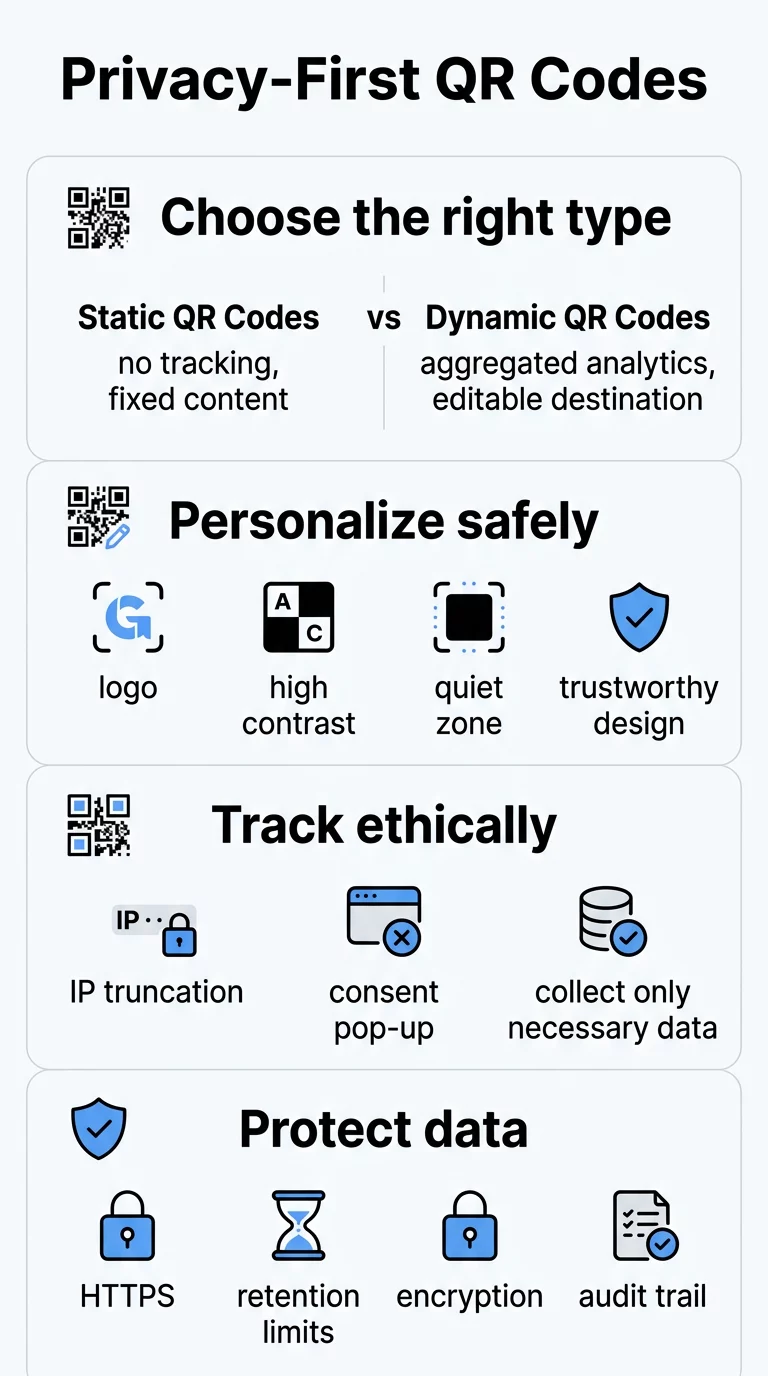
Selecting the appropriate code format determines how much control you maintain over user data and how much information your system records during a scan.
- Static QR codes encode destination information directly into the pattern without passing through an external redirect. Because scanning a static code creates no external scan record on a management server, static codes offer inherent anonymity. You can generate static codes freely using a basic QR kod oluşturucu, but you cannot modify the destination URL or gather performance analytics after printing.
- Dynamic QR codes encode a short redirect link that forwards scanners to your target destination. This architecture powers comprehensive QR kodlarını izleme by logging aggregated scan metrics like device category, timestamp, and country or city data. Dynamic codes allow you to edit destination links, update privacy policies, or disable compromised URLs instantly without replacing physical signage.
For commercial campaigns, privacy-configured dynamic codes represent the standard choice because they let you maintain governance over the link long after distribution.
Build Secure, Trackable Campaigns Looking to update destinations and monitor scans without risking user trust? Use our Dinamik QR Kod Oluşturucu to deploy secure, privacy-compliant codes with centralized management.
Customizing Visual Design Without Sacrificing Trust or Scannability
Visual customization does far more than satisfy corporate styling manuals. Case studies in markalı QR kodları show that custom designs featuring brand marks can boost user engagement and scan rates between 30% and 70% compared to generic black-and-white squares. Recognized visual markers signal legitimacy, helping consumers verify that the physical code belongs to your organization rather than a fraudulent actor.
Integrating brand elements requires careful calibration to prevent decoding failures:
- Embed logos centrally and keep their dimensions within 20% to 25% of the total code area so you do not obscure the corner position detection patterns.
- Apply high error correction to offset the visual interference of embedded images. As explained in our guide on Düzenlenebilir QR Kodlarda Hata Düzeltme Nasıl Çalışır, Level H error correction uses Reed-Solomon redundancy algorithms to reconstruct up to 30% of obscured data.
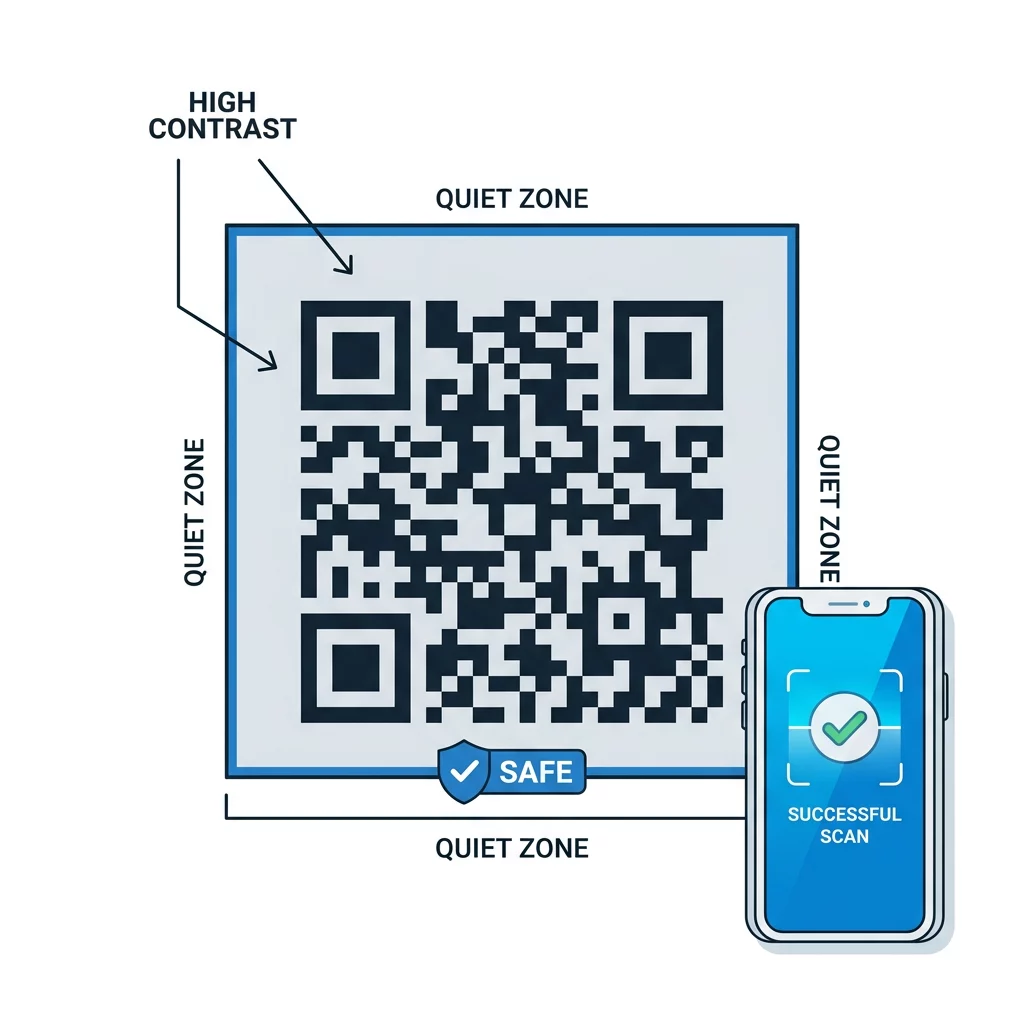
- Maintain adequate visual distinction by adhering to QR kodu renk kontrastı yönergelerini uygulayın, targeting at least a 4.5:1 contrast ratio between dark pattern modules and a light background.
- Preserve an unobstructed quiet zone measuring at least four modules wide around all edges to isolate the code from surrounding graphics or text.
- Size physical codes to at least 0.8 by 0.8 inches (2 by 2 centimeters) for close-range interactions, expanding dimensions according to the 10:1 scanning distance rule for distant signage.
Design Branded Codes with Built-In Integrity Ready to stand out on print media while assuring your audience their scan is authentic? Create custom designs using our Logolu QR Kod Oluşturucu to combine brand assets with robust error correction.
Implementing Data Minimization and Ethical Analytics
Data minimization means collecting only the information reasonably necessary to measure campaign reach. When tracking scan performance, focus on macro-level analytics rather than individual surveillance.
Dynamic platforms support ethical measurement through automated IP truncation, which discards the final digits of an IP address upon scan receipt. This practice determines the broad city or region while stripping away individual device identifiers, supporting compliance with GDPR and CCPA standards.
If a campaign requires deeper interaction, such as distributing promotional incentives or capturing email sign-ups, establish a clear value exchange. Place a concise disclosure directly on the landing page explaining what information you collect and how you use it before asking users to submit forms. Avoid deploying scripts that attempt to access hardware GPS sensors without affirmative consent, relying instead on coarse, network-level location data.
Privacy Features Across QR Code Types
| ÖZELLİK | Statik QR Kodları | Dinamik QR Kodları (Gizlilik Odaklı) |
|---|---|---|
| İzleme Yetenekleri | None (No server logging) | Aggregated (City, Device Type, Time) |
| Post-Print Editability | None (Fixed destination) | Fully editable destination URL |
| Data Minimization | Inherent (Zero data recorded) | Pseudonymized logs & IP truncation |
| Access Controls | Yok | Password protection & link expiration |
| Legal Risk Exposure | Minimal (Destination dependent) | Controlled via consent & audit trails |
Essential Protocols for Secure QR Data Management
- Enforce HTTPS connections across every landing page and redirect to protect transmitted traffic from eavesdropping.
- Establish automated data retention rules to delete detailed scan records once active reporting periods conclude.
- Configure password protection on dynamic redirects when sharing proprietary files, internal training manuals, or confidential media.
- Test physical prints across different mobile operating systems, lighting environments, and scanning distances before volume printing.
- Monitor redirect destinations through centralized dashboards to confirm links point to verified, active web assets.
Respecting privacy does not prevent you from measuring marketing performance. By combining dynamic management, high-contrast visual branding, and strict data minimization, you create a seamless physical-to-digital journey that protects your audience and builds enduring brand loyalty. Implement privacy-by-design standards across your next rollout to deliver personalized digital experiences your audience can trust.
Sıkça sorulan sorular
A QR code itself is simply encoded text or a URL and cannot execute code to extract data directly from your smartphone. However, a malicious code can redirect users to fraudulent phishing websites designed to collect passwords, payment information, or personal credentials.
Tracking scan metrics is legal when businesses adhere to statutory transparency and consent obligations. Operating within these frameworks requires providing clear privacy notices, establishing a legal basis for data processing, and avoiding the collection of precise personal identifiers without explicit consent.
Businesses can use privacy-focused QR management platforms that feature automated IP anonymization. These systems record the high-level device category and broad geographic region during the scan redirect before immediately discarding the user’s full IP address from the database.