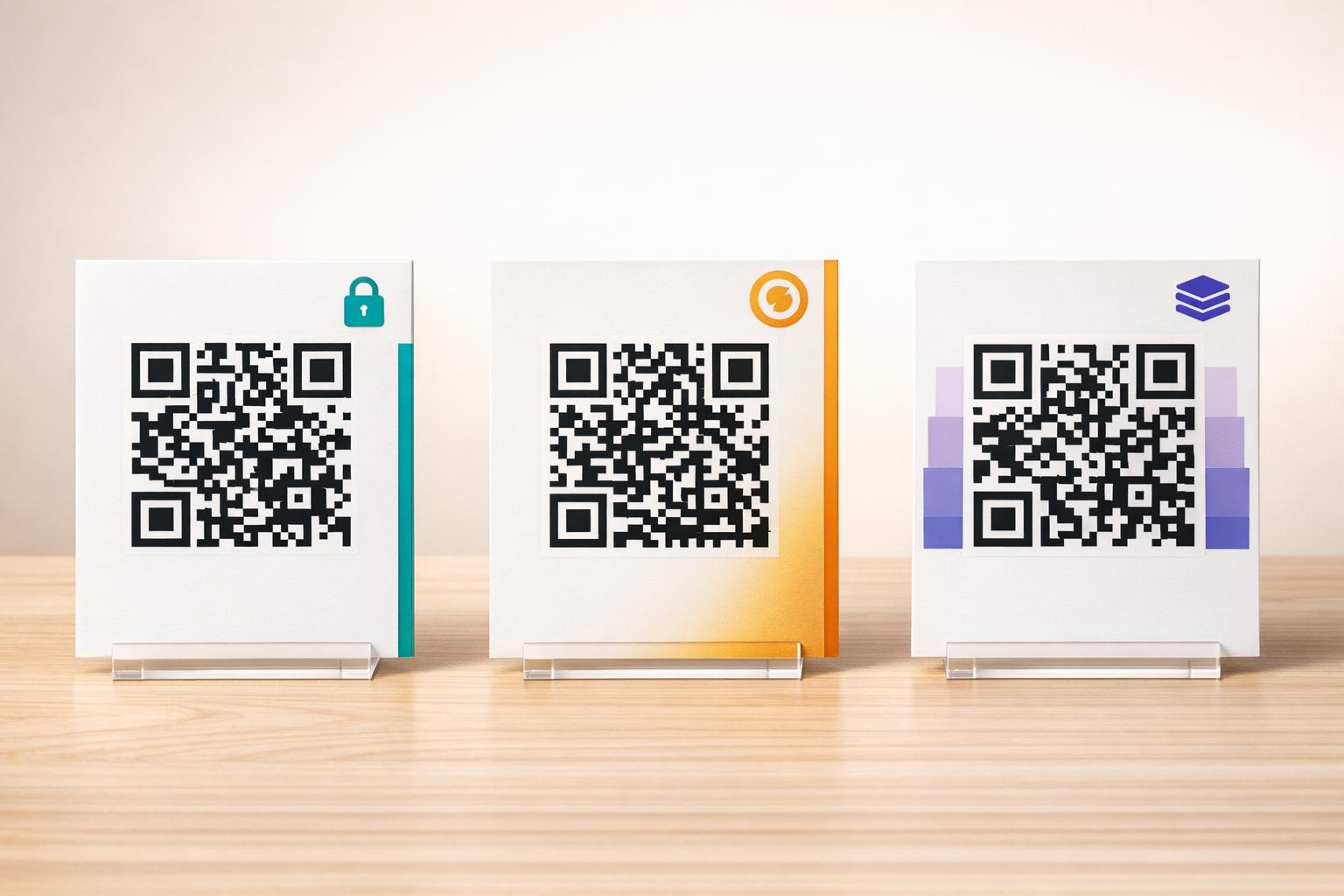
QR codes come in three types: statique, dynamiqueet multi-level. Each serves different purposes:
- Codes QR statiques: Fixed information that can’t be changed. Best for permanent data like Wi-Fi passwords or serial numbers.
- Dynamic QR Codes: Flexible and editable. Ideal for marketing, tracking, or updating content without reprinting.
- Multi-Level QR Codes: Advanced options with conditional redirects based on device, location, or time. Perfect for global campaigns or tailored experiences.
Comparaison rapide
| Fonctionnalité | Codes QR statiques | Dynamic QR Codes | Multi-Level QR Codes |
|---|---|---|---|
| Éditabilité | Permanent, not editable | Editable after printing | Editable with conditional logic |
| Tracking | Aucune | Full analytics (scans, location, etc.) | Advanced tracking by triggers |
| Coût | Gratuit | Subscription ($7–$50/month) | Premium subscription required |
| Best Use Cases | Fixed data, like Wi-Fi or contact info | Marketing campaigns, menus, packaging | Tailored redirects for apps, regions, or languages |
Choose statique for unchanging needs, dynamique for flexibility and tracking, or multi-level for advanced targeting. Each type fits specific goals and budgets.
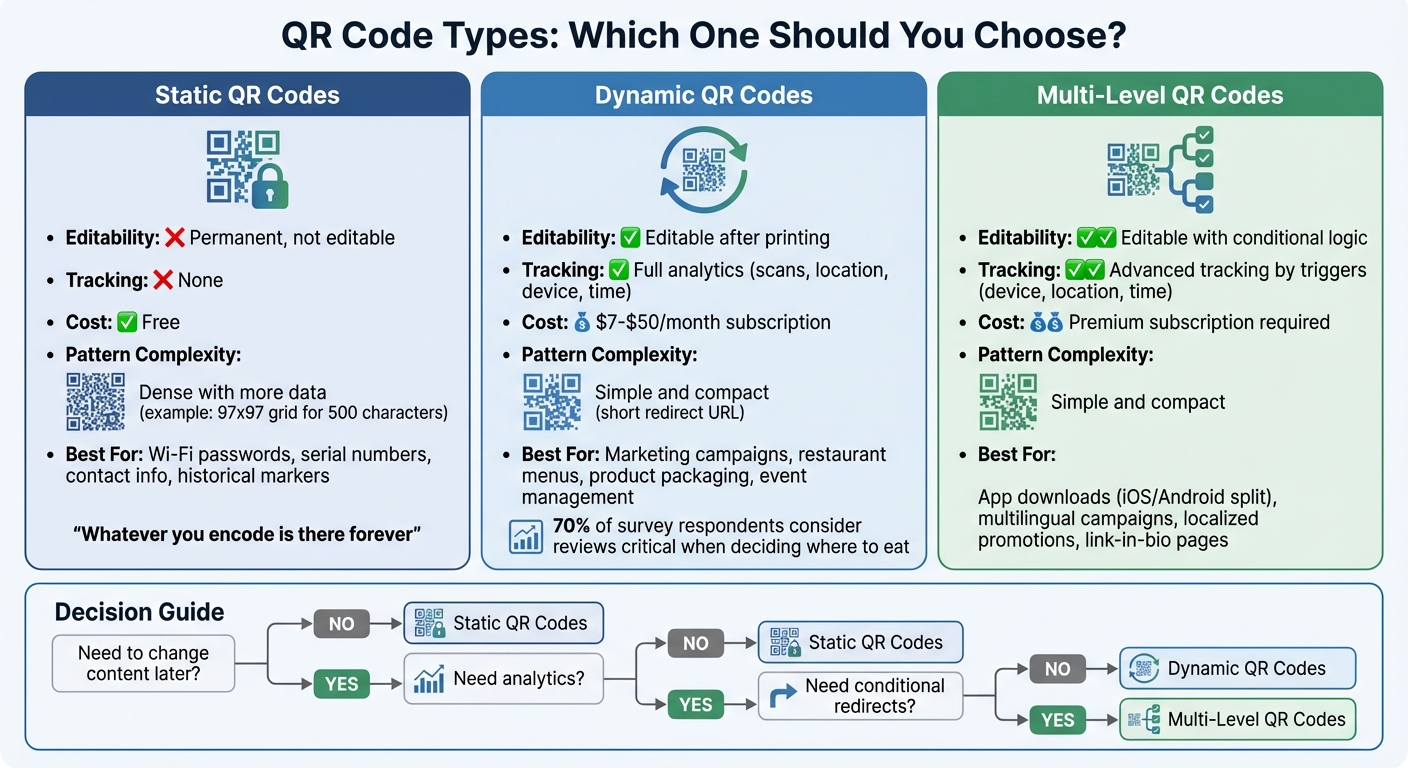
Static vs Dynamic vs Multi-Level QR Codes Comparison Chart
How QR Codes Work: Technology, Types, Uses and Safety
1. Static QR Codes
Static QR codes contain information directly embedded in their black-and-white design. When scanned, the data is read instantly without needing to connect to an external server. This makes the content permanent – once the code is created and printed, the information it holds cannot be changed.
"Whatever you encode is there forever." – QR-Verse Team
The amount of data encoded impacts the complexity of the QR code. For instance, a short URL with 20 characters might produce a simple 25×25 grid, requiring only about 0.8 inches of printed space. On the other hand, a longer URL with 500 characters creates a much denser 97×97 grid, which needs at least 2 inches to scan effectively. In short, the more data you include, the larger the code needs to be for reliable scanning.
Here’s a closer look at key aspects of static QR codes, including their editability, tracking capabilities, cost, and best uses.
Éditabilité
Once created, static QR codes cannot be altered. If you encode a URL and later need to update it – or if there’s an error – you’ll need to generate a new code and reprint all related materials. For example, fixing a typo on a batch of 5,000 printed items could cost anywhere from $500 to $1,500. Because of this, static QR codes are not suitable for campaigns where the destination URL or content might change. Additionally, static codes don’t provide any performance data after deployment.
Suivi et Analyse
Static QR codes do not offer tracking features. You won’t be able to gather insights like scan counts or user demographics. If performance analytics are important for your project, static codes won’t meet your needs.
Coût
Static QR codes are completely free to generate and don’t require any subscription fees. You can create them using tools like an online free QR code generator and use them as long as you need. The only costs involved occur if you need to reprint materials due to outdated or incorrect information.
Best Use Cases
Static QR codes are perfect for situations where the information won’t change. They’re ideal for:
- Displaying Wi-Fi passwords on routers
- Adding permanent contact details to business cards
- Encoding serial numbers on machinery
They’re also useful in offline environments, such as underground facilities or construction sites, where internet access might not be available. However, they’re not well-suited for marketing campaigns or event promotions where updates to the linked content may be necessary. For these scenarios, the inability to make changes and lack of analytics could become major drawbacks. Static codes shine when stable, unchanging information is the priority, especially if reprinting costs are a concern.
2. Dynamic QR Codes
Dynamic QR codes work by encoding a short redirect URL that connects users to a server where the content is stored and tracked. This setup offers much more flexibility compared to static QR codes. When scanned, the code first routes users to a management server that logs the scan before redirecting them to the final destination.
This redirect feature is what makes dynamic QR codes so versatile. You can update the destination URL or switch out the linked content – like replacing a PDF, updating a digital menu, or pointing to a new landing page – without needing to reprint the QR code itself. This eliminates the cost and hassle of reprinting materials. Let’s break down why dynamic QR codes are a game-changer when it comes to editability, tracking, and cost efficiency.
"Dynamic QR codes are every marketer’s dream, due to their flexibility." – Patrick Augstein, Customer Support Team Manager, Bitly
Another advantage? Since dynamic QR codes only store a short URL, their design stays simple and compact, making them easier to scan, even when printed at smaller sizes.
Éditabilité
One of the standout features of dynamic QR codes is their ability to be updated after printing. If a link breaks, a promotion changes, or you want to redirect users to seasonal content, you can easily make these updates through your plateforme de génération de codes QR dashboard. This is especially useful for large print runs, where reprinting costs can add up. Many platforms also offer extra features like password protection, scan limits, expiration dates, and even A/B testing options, giving you full control over how and when users interact with your content.
Suivi et Analyse
Dynamic QR codes take tracking to the next level by providing real-time analytics that static codes simply can’t match. For example, you can track total scans, unique versus repeat visitors, geographic data (down to the city level), device types, time of scans, and even browser details. These insights turn your QR code into a powerful marketing tool, helping you evaluate campaign performance. Some platforms even allow for retargeting through integrations with tools like Pixel Facebook ou Google Analytics, giving you an edge in reaching your audience.
Coût
Unlike static QR codes, dynamic ones usually come with a subscription fee, which can range from $7 to $50 per month. Most platforms offer a free trial so you can test advanced features before committing. However, it’s crucial to check the platform’s expiration policies – some may deactivate your codes if you cancel your subscription, which could be a major issue if those codes are already in circulation.
Best Use Cases
Dynamic QR codes shine in scenarios where content needs to be updated or tracking performance is essential. Common applications include:
- Menus des restaurants that need daily updates for specials or pricing.
- Real estate signs that link to new property listings after a sale.
- Emballage du produit, where support links or user manuals may need updates after the product hits shelves.
- Event management, allowing for live updates to schedules or speaker details.
- Campagnes de marketing, where tracking ROI or testing different landing pages with the same printed code is crucial.
"70% of survey respondents consider reviews critical when deciding where to eat, making dynamic QR codes a vital tool for restaurants aiming to capture and respond to customer feedback."
Dynamic QR codes are also perfect for business cards, flyers, and posters. They allow you to update portfolios, promotions, or contact details without the need to reprint materials, saving both time and money.
sbb-itb-74874c9
3. Multi-level QR Codes
Multi-level QR codes, sometimes referred to as Multi-URL or Smart QR codes, are a dynamic variation designed to deliver different outcomes based on specific conditions. Unlike static QR codes that lead to a single, unchangeable destination or standard dynamic codes that offer one adjustable link, these codes can adapt and redirect users to various destinations depending on factors like device type, location, or even the time of day.
Here’s how they work: these codes use a smart redirect system that evaluates certain conditions before taking action. For instance, imagine scanning a QR code on a promotional poster for an app. If you’re using an iPhone, the code might send you directly to the App Store, while Android users are seamlessly redirected to Google Play. Similarly, these codes are perfect for "link-in-bio" scenarios, where a single scan can lead to a landing page with multiple links – think social profiles, websites, or contact details. This added layer of functionality makes them stand out from their static and standard dynamic counterparts.
Éditabilité
One of the standout features of multi-level QR codes is their ability to be edited even after they’ve been printed. You can update destination links, tweak redirect logic, or add new links to a landing page without needing to create a new code. This flexibility is especially useful for businesses running global campaigns that need localization or for restaurants that want to display different menus at different times of the day.
Suivi et Analyse
Multi-level QR codes also offer detailed tracking capabilities. They can monitor total scans, differentiate between unique and repeat users, and capture geographic data down to the city level. Beyond that, they track the operating systems of scanning devices (like iOS or Android), record when scans occur, and even provide insights into which specific link on a multi-link landing page was clicked. This level of data is invaluable for understanding user behavior and optimizing campaigns.
Coût
The advanced features of multi-level QR codes typically come at a premium. While some platforms offer basic dynamic QR codes for free, the more sophisticated multi-link or multi-URL options usually require a subscription, with prices ranging from $7 to $50 per month. If you’re considering these features, it’s worth checking out the pricing options of your chosen QR code generator. The higher cost is often justified by the added control and detailed insights these codes provide for complex marketing efforts.
Best Use Cases
Multi-level QR codes are particularly effective in:
- App Downloads: Automatically directing users to the right app store based on their device.
- Multilingual Campaigns: Showing content in the user’s preferred language.
- Liens vers les médias sociaux: Acting as a "link-in-bio" tool that consolidates all social and web links into one code.
- Dynamic Menus: Automatically updating restaurant menus for different times of the day, like breakfast, lunch, or dinner. Check out examples of menu design.
- Localized Promotions: Redirecting users to region-specific landing pages based on GPS data.
These QR codes offer a blend of adaptability, functionality, and data-driven insights, making them a powerful tool for tailored marketing campaigns.
Comparison: Advantages and Disadvantages
Static, dynamic, and multi-level QR codes each come with their own set of strengths and weaknesses. The table below highlights the main differences in terms of editability, tracking, cost, and ideal applications.
| Fonctionnalité | Codes QR statiques | Dynamic QR Codes | Multi-level QR Codes |
|---|---|---|---|
| Éditabilité | Fixed; data is permanently encoded into the QR code | Highly flexible; content and destination URLs can be updated as needed | Maximum flexibility; supports conditional logic and multiple redirection paths |
| Suivi et analyse | No tracking or analytics available | Provides detailed metrics like scan count, location, time, and device type | Advanced analytics segmented by triggers such as device type or region |
| Coût | Free; no ongoing costs | Requires a subscription, typically ranging from $7 to $50 per month | Premium or enterprise-level subscription required |
| Pattern Complexity | Becomes denser and harder to scan as more data is added | Maintains a simple and compact design regardless of content length | Also remains simple and compact |
| Best Use Cases | Static data like Wi-Fi passwords, historical markers, or permanent contact details | Marketing campaigns, restaurant menus, or product packaging | App downloads (e.g., iOS vs. Android), multi-language content, or global campaigns |
The table provides a clear snapshot, but let’s break it down further to see how these differences play out in practical scenarios.
Static QR codes are perfect for scenarios where the data is permanent and unlikely to change. They’re free and straightforward but come with a big risk: they can’t be updated. If a URL embedded in a static QR code becomes outdated, it renders the code useless.
"If you print thousands of flyers with a static QR code and the destination URL changes, every single flyer becomes useless. A dynamic code prevents this entirely"
Dynamic QR codes solve this problem by using a redirect URL, which allows you to update the destination without reprinting materials. They also offer valuable analytics, such as scan location, device type, and time, making them ideal for marketing campaigns. However, this flexibility comes with a cost – you’ll need an active subscription to keep the code functional. For businesses that rely on performance tracking or need to make real-time adjustments, the expense is often worth it.
Multi-level QR codes take things a step further with conditional logic. These codes can adjust their behavior based on factors like the user’s device, location, or even the time of day. For example, they can direct iPhone users to the App Store and Android users to Google Play, or display region-specific content. While they offer the most advanced functionality, they also require a premium subscription. If you’re managing a global campaign or need to tailor content for different audiences, this option can provide unmatched versatility.
Weighing these pros and cons will help you choose the QR code type that best aligns with your goals and budget.
Conclusion
Pick a QR code type that aligns with your specific goals.
Codes QR statiques work best for unchanging information, like Wi-Fi passwords, historical plaques, or fixed contact details. These codes are free and permanent, but there’s a catch: once printed, they can’t be updated. If the linked URL stops working or the content changes, you’ll need to reprint the code entirely.
On the other hand, les codes QR dynamiques offer flexibility that businesses often require. With these, you can update the destination URL anytime, track scan data, and avoid reprinting costs. They’re ideal for marketing campaigns, restaurant menus, and product packaging. While dynamic QR codes come with a monthly fee, they can help you monitor ROI and quickly fix broken links.
For more advanced needs, multi-level QR codes provide a tailored experience. These codes excel in scenarios requiring conditional logic, such as adjusting based on device type, location, or language. Though they require a premium subscription, they’re perfect for projects that need to cater to diverse audiences.
Utilisez notre online free QR code generator to explore dynamic tracking and easy updates. For permanent, unchanging content, static QR codes are the way to go. And if your project spans multiple regions or platforms, multi-level QR codes can simplify your processes. Check out our plateforme de génération de codes QR to find tools that fit your needs.
FAQ
Will my dynamic QR code stop working if I cancel my plan?
If you cancel your plan, your dynamic QR code will stop working. These codes rely on an active account to manage features like redirects and tracking. Without an active subscription, the code’s functionality, including these features, will no longer work.
How small can I print a QR code and still have it scan reliably?
When printing a QR code, a size of 1 x 1 pouce (2,5 x 2,5 cm) is generally sufficient for reliable scanning. However, the success of scanning also depends on factors like print quality, contrast, and the type of scanner being used. If you go smaller than 0.8 inches (2 cm), you may start to encounter issues with reliability.
When should I use a multi-level QR code instead of a dynamic one?
Multi-level QR codes are perfect for situations where you want to give users several options or pathways after they scan. For example, they can be used to guide users through language selection, product categoriesou service choices.
Unlike dynamic QR codes, which send users to a single destination, multi-level QR codes create a more interactive and tailored experience. This makes them a great fit for things like interactive menus, product catalogsou websites with multiple language options. They add a layer of engagement that helps users feel more connected to the content.
Articles de blog connexes